Right now, somewhere on Reddit, a stranger is asking the exact question your product answers. In a Facebook group, someone is complaining about the exact problem you solve. Under a competitor’s TikTok, a frustrated customer is spelling out the exact reason they will never reorder.
What’s in This Article
And most Aussie Shopify founders see none of it. They pay for surveys that 5% of customers answer with one-word responses, then guess at ad hooks and product page copy while thousands of unfiltered, unprompted buying conversations happen in public, for free, every single day.
The numbers say your customers are already there. Around 82% of shoppers use social media to discover and research products before buying, and Reddit is now the fifth most visited website in Australia. This article gives you the 5-step social listening system we work through with eCommerce Circle members: where to listen, how to automate it for free, what to capture, and how to turn a spreadsheet of verbatim quotes into ads, product pages, and products that convert because they sound like the customer wrote them.
Why Unprompted Beats Surveyed Every Time
Surveys have a built-in flaw: people answer the question you asked, not the question that matters. The moment someone knows a brand is watching, they tidy up their language, soften their complaints, and tell you what sounds reasonable.
A Reddit thread has no such filter. Nobody posting in r/AusSkincare at 11pm is trying to be polite to your marketing team. They are venting, comparing, recommending, and warning each other off products in the rawest language you will ever read. That rawness is the asset.
Social listening does a different job to the research methods we have covered before. Your Voice of Customer system mines channels you own: your reviews, your support inbox, your post-purchase surveys. Social listening mines the conversations you do not own, where prospects who have never heard of you describe their problem in their own words. One tells you what your customers think of you. The other tells you what the market wants from anyone willing to listen.
Both matter. But if your ads feel stale and your product page copy reads like a spec sheet, the fix is almost never another survey. It is borrowed language from people who do not know you exist yet.
Why This Matters More in 2026 Than It Ever Has
Two shifts have turned social listening from a nice-to-have into a core Prospects discipline.
First, Reddit became a search engine. Reddit’s visibility in Google search results grew over 1,300% between mid-2023 and early 2024, and it has stayed in the top tier of Google’s most visible domains ever since. By late 2025, Reddit reported 80 million people per week searching directly on the platform, up from 60 million a year earlier, and its own AI answers product now fields around 28 million queries a day. Shoppers type “best magnesium supplement reddit” into Google on purpose, because they trust strangers with no commission over a brand’s own landing page.
Second, AI assistants read Reddit too. Reddit’s share of AI citations grew 73% between October 2025 and January 2026, overtaking YouTube as the most cited social source in AI-generated answers. When a prospect asks ChatGPT or Google’s AI Overview what to buy, the answer is increasingly assembled from the same threads you are choosing to ignore.
For Australian founders this is not a fringe channel. Reddit’s advertising reach in Australia grew 179% year on year to an estimated 23 million accounts, and in categories like beauty, around 39% of younger buyers say they research products on Reddit before purchasing. The conversations are happening either way. The only question is whether you are in the room.
Step 1: Map Your Category’s Watering Holes
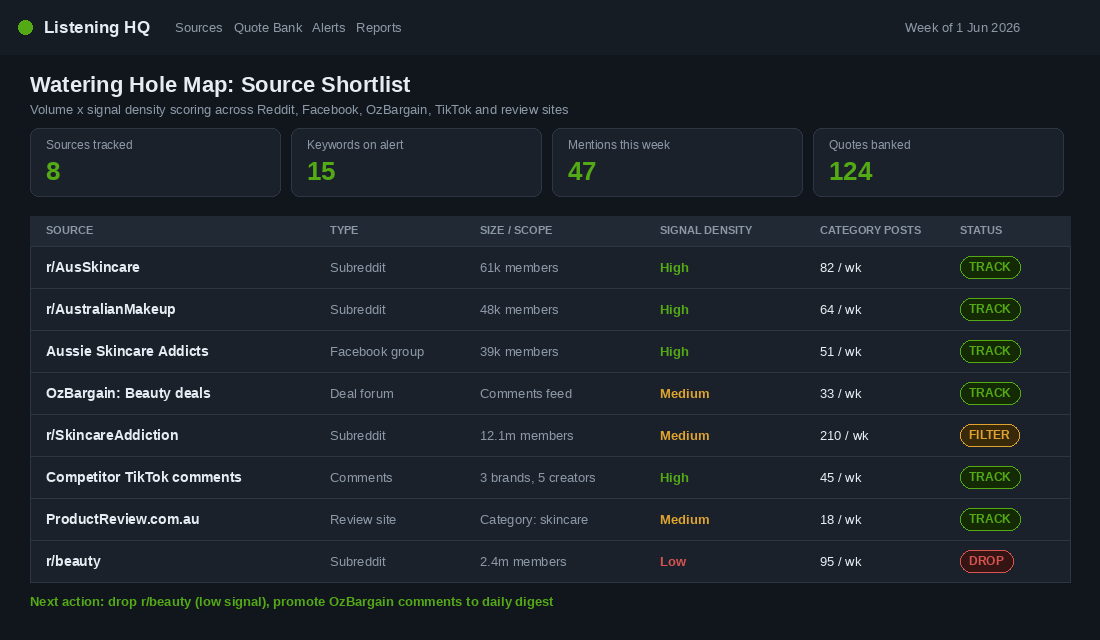
Social listening fails when it is vague. “Keep an eye on social” means nothing. The first step is a one-hour mapping exercise that produces a shortlist of 6 to 10 specific places where your category is discussed every week.
Work through these five source types:
- Subreddits. Start local: r/AusFemaleFashion, r/AustralianMakeup, r/AusSkincare, r/fitness30plus, r/AusFinance, whatever fits your niche. Then add the big global subs for your category and the brilliant cross-category ones like r/BuyItForLife, where durability complaints are a product roadmap in disguise.
- Facebook groups. Search your category plus “Australia” and join the three biggest active groups. A 40,000-member group about home renovation or kids’ nutrition is a permanent live focus group.
- OzBargain. Uniquely Australian and brutally honest. The comment threads under deals in your category tell you exactly how price-sensitive buyers compare you to competitors, and which features they think justify full price.
- TikTok and Instagram comments. Not your own. Pull up your three biggest competitors and the five biggest creators in your niche, and read the 50 newest comments on their recent posts. Questions in comments are purchase objections in the wild.
- Review aggregators. ProductReview.com.au and the review sections of competitors’ bestsellers. One-star and three-star reviews of competing products are a list of promises you can make and keep.
Score each candidate source on two things: volume (posts per week mentioning your category) and signal density (how often a thread contains language about problems, comparisons, or buying decisions rather than memes). Keep the 6 to 10 that score highest. Write them down. This list is your listening territory, and it is reviewed quarterly, not rebuilt weekly.
Step 2: Build a Listening Engine That Runs While You Sleep
You do not have time to scroll Reddit all day, and you should not. The engine does the watching. Your job is 30 minutes a week of reading what it catches.
A quick housekeeping note first: GummySearch, the Reddit research tool many founders used for this, shut down at the end of November 2025 after Reddit’s data API changes. Over 140,000 marketers relied on it, and plenty of “best social listening tool” articles still recommend it. Skip them. Here is the stack that works now.
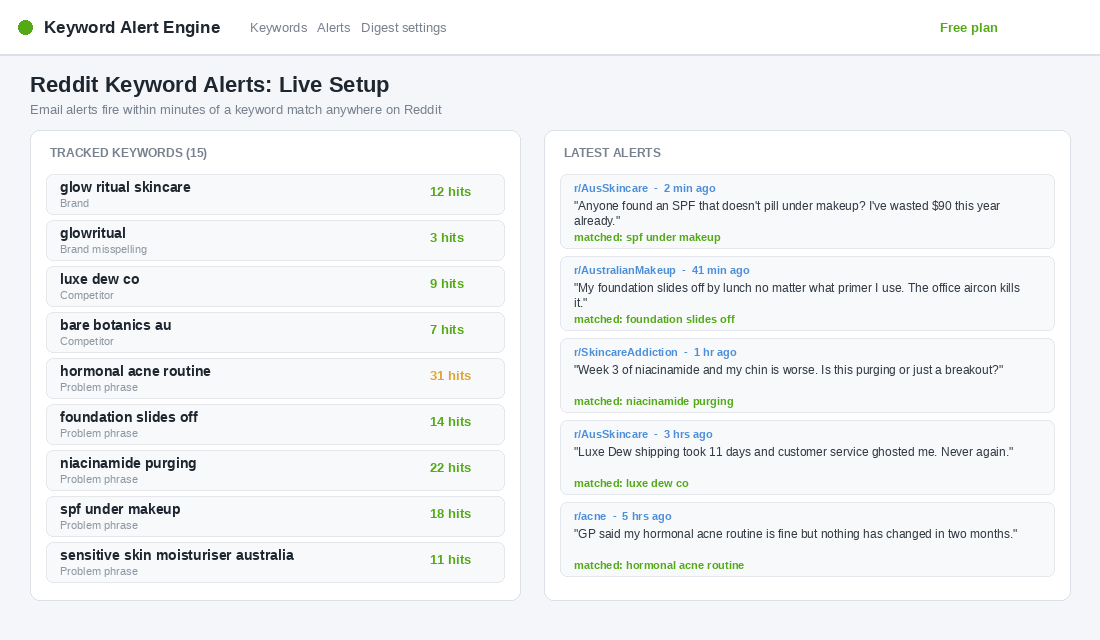
Your core tool: F5Bot. It is free. F5Bot emails you within minutes whenever your chosen keywords appear anywhere on Reddit, Hacker News, or Lobsters. Setup takes five minutes:
- Create a free account at f5bot.com with the email you actually check.
- Add your brand name and common misspellings as keywords.
- Add your top three competitors’ brand names.
- Add 5 to 8 problem phrases your customers use, like “hormonal acne”, “dog pulls on lead”, or “work bag fits laptop”. Phrases beat single words; “protein” will flood you, “protein powder bloating” will feed you.
- Set alerts to a daily digest if the volume gets noisy, and prune keywords monthly.
Around F5Bot, add three free layers: Google Alerts on your brand and category terms for blogs and forums, joined-and-followed status in your shortlisted Facebook groups so the algorithm surfaces them daily, and saved keyword alerts on OzBargain so you see every deal and comment thread in your category. If you outgrow free and want filtering, sentiment, and history, paid Reddit-focused tools like Syften (around USD$40 a month) or Subreddit Signals (around USD$20 a month) are the current options, but do not start there. Start free, prove the habit, then upgrade if volume demands it.
Step 3: Mine the Four Signal Types Into a Quote Bank
Reading threads feels productive. It is not, unless you capture what you read. The difference between lurking and listening is a quote bank: one spreadsheet where every useful comment gets logged verbatim.
Set up six columns: date, source, link, verbatim quote, signal type, and theme tag. Then train yourself to spot the four signal types that matter:
- Pain language. How people describe the problem when no brand is listening. “My foundation slides off by lunch” is a headline. “Inadequate wear time” is what a committee writes after reading it.
- Buying triggers. The moment that pushed someone from researching to purchasing. Wedding coming up, GP comment, third failed cheap version. Triggers become campaign timing and ad angles.
- Objections. Every “I wanted to buy X but…” comment. Shipping cost, sizing confusion, ingredient worries, doubt it works on Aussie conditions. These feed your FAQ, your PDP, and your retargeting.
- Competitor gaps. Complaints about the brands you compete with. Slow shipping from the US, formulas that changed, sizes that run small. Each one is a positioning line you have earned the right to use.
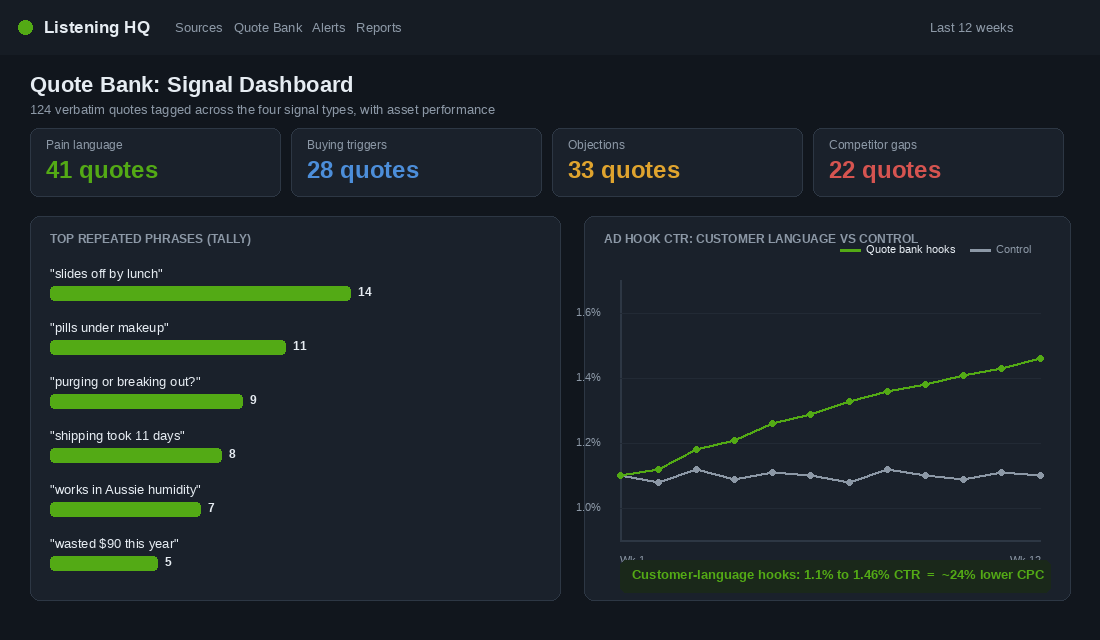
Two rules. Capture quotes word for word, never paraphrased, because the rough edges are where the conversion power lives. And tally repeats: when the same phrase shows up a fifth time, that is not an anecdote anymore, it is a pattern. Aim for 20 quotes a week. Within a month you will have 80-plus lines of raw customer language, sorted by theme, that no competitor can see because they never did the work.
Step 4: Turn Verbatim Quotes Into Revenue Assets
A quote bank that sits in Google Sheets is trivia. The fourth step is a deliberate pipeline from quote to asset. Every month, your best quotes should ship into five destinations:
- Product page copy. Take the most repeated pain phrase and make it your PDP headline or opening line. If 14 people described the problem the same way, the 15th will stop scrolling when she reads her own thoughts on your page.
- Ad hooks. Your next five Meta and TikTok ad openers should be lightly edited customer sentences, not brainstormed slogans. Test customer language against your current best hook and watch the click-through rate.
- Email subject lines. Objection-based subjects (“Will it survive an Aussie summer?”) consistently outperform offer-based ones for mid-funnel sends.
- FAQ and objection handling. Every objection logged three or more times earns an answer on the product page itself, not buried in a help centre.
- Product roadmap. Repeated complaints about competitor products are pre-validated demand. Feed them into what you build, bundle, or fix next quarter.
This pipeline also sharpens your other research. The patterns you spot in public threads tell you exactly what to dig into when you run a founder-led customer interview, and which competitor weaknesses to probe in your switcher research. Listening finds the thread. Interviews pull it.
What It Looks Like When Brands Get It Right
Glossier built a bestseller from a comments section. In January 2015, founder Emily Weiss published a post asking readers one question: what is your dream face wash? Nearly 400 comments came back. Her team handed the lot to a chemist, who worked through around 40 formulations to match what readers actually asked for, including a pH-balanced formula the internal team had not thought to prioritise. The result, Milky Jelly Cleanser, launched a year later and became one of the brand’s all-time bestsellers. The product brief was written by the audience.
TBH Skincare turned hostile comments into a 933% sales spike. When the Sydney acne-care brand’s team video went viral for the wrong reasons in 2024, attracting a wave of abusive comments, co-founder Rachael Wilde’s team did not delete and hide. They read every comment, then filmed a response using the worst of them as the script, chanted back deadpan by the team. The follow-up ignited a 933% month-on-month sales increase and around 5,000 new customers at roughly $8 acquisition cost, in a category where $40-plus CAC is normal. That is social listening at match speed: the comments were the creative.
You do not need a viral moment to apply either lesson. Glossier shows what the quote bank does for product. TBH shows what reading the room does for creative. Both started with someone choosing to treat comments as data.
Step 5: Lock In the Weekly Cadence and Measure Like a Channel
Social listening dies as a project and lives as a routine. The sustainable version costs you 30 minutes a week, same day, same time, in the calendar like a supplier call.
- Weekly, 30 minutes. Clear the F5Bot digest, skim your shortlisted sources, log new quotes, tally repeats. Flag anything urgent, like a thread mentioning your brand that deserves a same-day reply. Speed matters here: 73% of consumers say they will switch to a competitor if a brand does not respond on social.
- Monthly, 60 minutes. Synthesis. Rank themes by frequency, pick the top pain phrase, top objection, and top competitor gap, and ship one asset from each: a PDP edit, an ad hook, an FAQ entry.
- Quarterly. Re-run the watering hole map. Communities move. A subreddit that was gold in February can be a ghost town by August.
Measure it like a channel, with four numbers on your monthly scorecard: quotes banked, assets shipped from quotes, click-through rate of customer-language ad hooks versus your previous hooks, and conversion rate of any PDP rewritten with quote bank copy. If the customer-language assets are not beating your old ones within two test cycles, your quotes are too generic. Go a level rawer.
The Four Mistakes That Kill Social Listening
- Lurking without capturing. Reading threads on the couch feels like research. Without a quote bank, it evaporates by morning. If it is not logged, it did not happen.
- Astroturfing. Posting fake recommendations of your own product, or having your VA do it, is the fastest way to get hunted down by moderators and publicly shredded. Reddit communities are forensic. Listen first, and when you do participate, do it under your real brand identity with disclosure.
- Paraphrasing the life out of quotes. The moment “it broke me out so bad I cried before work” becomes “customers experienced dissatisfaction”, you have destroyed the asset. Verbatim in the bank, lightly edited in the ad, never laundered into marketing-speak.
- Treating it as a one-off audit. A single afternoon of Reddit research gives you a snapshot that decays in weeks. The compounding value is in the cadence: 20 quotes a week becomes a thousand-line language asset within a year.
The Compound Effect: What 30 Minutes a Week Is Actually Worth
Run the maths on a $2 million Aussie Shopify brand converting at 2.1% with a $95 AOV.
Rewrite your two bestseller PDPs with quote bank language: headline from the top pain phrase, objection answers on-page. A lift from 2.1% to 2.3% on the traffic those pages see is conservative, and worth roughly $130,000 to $190,000 in annualised revenue depending on how much of your traffic they carry.
Now the ad side. If customer-language hooks lift click-through from 1.1% to 1.4%, your cost per click and cost per acquisition fall by 20-plus percent on the same budget. On $25,000 a month of ad spend at a $55 blended CAC, that is roughly $60,000 a year in acquisition cost you did not spend, or the same budget buying a fifth more customers.
Call it $150,000 to $250,000 of combined annual impact, from a free tool, a spreadsheet, and 30 disciplined minutes a week. That is a better return than any paid research panel will ever give you, and it compounds, because the quote bank gets more valuable every single week.
Your 30-Day Social Listening Rollout
Print this, tape it next to your monitor, and tick it off:
- Week 1: Map. Run the one-hour watering hole exercise. Shortlist 6 to 10 sources. Set up F5Bot with brand, competitor, and problem-phrase keywords. Add Google Alerts and OzBargain keyword alerts. Join the Facebook groups.
- Week 2: Mine. Build the six-column quote bank. Log your first 20 verbatim quotes across the four signal types. Start the repeat tally.
- Week 3: Deploy. Rewrite one bestseller PDP headline and FAQ from the bank. Brief two ad hooks using lightly edited customer sentences. Launch them against your current control.
- Week 4: Measure and lock. Compare CTR and conversion against the old versions. Book the weekly 30-minute listening block and the monthly synthesis hour as recurring calendar events. From here it is a system, not a sprint.
Your customers are already telling the internet exactly what they want, what annoys them, and what would make them switch. The brands that win the next few years of Australian DTC are not the ones with the biggest survey budgets. They are the ones who showed up where the conversation was already happening, wrote it down, and shipped it.
Inside eCommerce Circle, knowing your prospects this deeply is one of the core pillars we work on with every member. If you want a second opinion on your research system, let’s talk.