Most Aussie Shopify brands are spending 70% of their marketing budget chasing new customers when their existing customers are sitting right there, ready to buy again. They send one post-purchase email, slap a generic 10% off coupon in the footer, and call it a retention strategy.
What’s in This Article
Then they wonder why their CAC keeps creeping up while their margin keeps shrinking.
Here is the maths that should change how you think about your store. Around 65% of revenue in mature ecommerce brands comes from repeat customers. Loyalty members make 67% more purchases than non-members and generate 115% more revenue per customer. And the famous Bain & Company finding still holds true today: a 5% increase in retention can lift profits by 25 to 95%.
A well-designed loyalty program is not a “nice to have” you bolt on once you hit seven figures. It is the asset that compounds every other dollar you spend on Meta, Google, and TikTok. Done right, it can deliver 30% or more of your monthly revenue from repeat customers on autopilot.
This guide walks you through exactly how to build one. The mechanics, the maths, the tier structure, the apps, and the brands doing it best in Australia. Skim the sections you already know. Implement the ones you do not.
Why Most Loyalty Programs Fail (And the One Job Yours Has to Do)
Walk through 50 random Shopify stores and you will see the same broken pattern. A “Rewards” link buried in the footer. A points popup that nobody reads. An earn rate so confusing customers cannot work out what 1,000 points is actually worth.
The problem is not the app. It is the strategy. Most brands install Smile.io or LoyaltyLion, set the default earn rate, and assume the program will magically drive retention. It will not.
Your loyalty program has exactly one job: shrink the time between purchase one and purchase two, then keep shrinking it. Every other metric (points balance, tier distribution, redemption rate) is a leading indicator of that single outcome.
The average ecommerce store retains only 31% of customers. If you can lift that to 40% — even 35% — through a well-built program, the compound effect on contribution margin is bigger than any ads optimisation you can run this quarter. The only number that matters in the first 90 days of your program is repeat purchase rate. If that does not move, your program is decoration.
Three reasons most programs fail:
- The earn rate is too stingy. Customers need to spend $200+ before they can redeem anything meaningful. They lose interest before they ever earn a reward.
- The rewards are boring. A 10% off coupon every 1,000 points is the same thing they get from a generic newsletter signup. There is no reason to choose your program over that.
- Nobody knows it exists. The program lives in a footer link and a popup widget. It is never mentioned in product pages, post-purchase emails, or SMS flows where intent is highest.
Fix those three things and you will outperform 90% of stores running loyalty apps.
The Three Mechanics That Drive Repeat Purchases
Every successful loyalty program is built from three core mechanics. You do not need exotic gamification. You need these three working together.
1. Points for purchases. The base layer. Customers earn points on every order, redeemable for a discount, free product, or free shipping. The earn rate is your single most important variable here. Get it wrong and the rest of the program collapses.
2. Earn-and-burn behaviours beyond purchases. Account creation, birthday rewards, leaving a review, referring a friend, following on social. These are the behaviours that lift program adoption above the 25-35% baseline most stores see. Birthday points alone can lift annual purchase frequency by 12-18% because they create a guaranteed re-engagement moment.
3. VIP tiers that escalate spend. This is the lever most brands ignore and the one with the highest ROI. Tiered programs deliver 1.8x higher ROI than flat point-based programs, and upper-tier members spend 2.5 to 4x more annually than base-tier members. Tiers create a status game your best customers want to win.
If your current program is just “earn 1 point per dollar, redeem at 1,000 points,” you are leaving the two mechanics that do the most work off the table.
How to Set Your Earn Rate (The Math Most Brands Get Wrong)
This is where 80% of programs go sideways. The earn rate is the answer to two questions: how many points does a customer earn per dollar, and what is each point worth in dollars?
The most effective structure for Aussie Shopify brands looks like this:
- Earn rate: 1 point per $1 spent (clear, easy to remember)
- Redemption value: 100 points = $5 reward (effective 5% return on spend)
- First reward threshold: 100 points minimum, so a $100 order gets a meaningful reward
- Bonus moments: 200 points for sign-up, 100 points for a review, 250 points for a birthday
Notice the framing. Customers see $5 reward, not 100 points. That matters. Behavioural research consistently shows that dollar framing outperforms points framing because customers respond to concrete value over abstract currency. Configure your widget and emails to lead with the dollar amount and treat points as the mechanism.
Now the maths. A 5% effective return on spend sounds expensive until you compare it to your blended Meta CPA. If your average order value is $80 and your customer acquisition cost is $32, that is a 40% effective acquisition cost on order one. A 5% loyalty cost on order two is 8x cheaper. And the redemption rate on most programs is only 40-60%, so your real cost is closer to 2-3%.
If you are running a high-margin category (skincare, supplements, jewellery) you can push to 7-10% effective return without breaking your unit economics. If your margins are tighter (apparel, accessories) stick to 3-5% and lean harder on tier benefits and exclusive access instead of straight discounts.
Building Tiers That Make Customers Spend More
Tiers are where the program shifts from a discount mechanism to a status engine. Done properly, they trigger a behaviour called “tier-chasing” — customers stretch their basket size to qualify for or maintain a higher level. This is what lifts AOV by 12-20% on tiered programs.
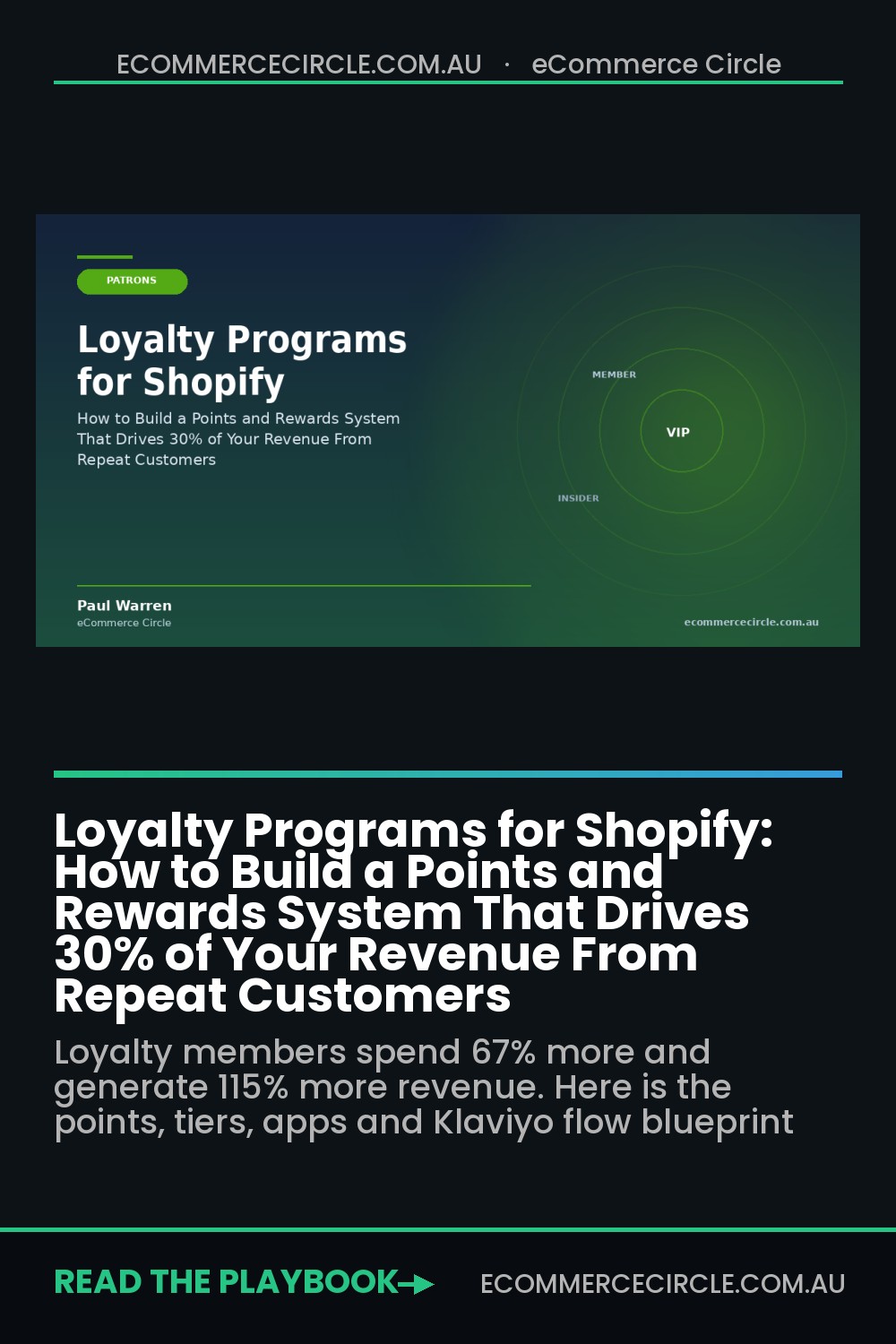
The standard structure that works for most Aussie Shopify brands has three or four tiers. The first tier threshold should qualify roughly 20-25% of your customer base. Gold should qualify 8-12%. Platinum or VIP should be 3-5% — your top spenders.
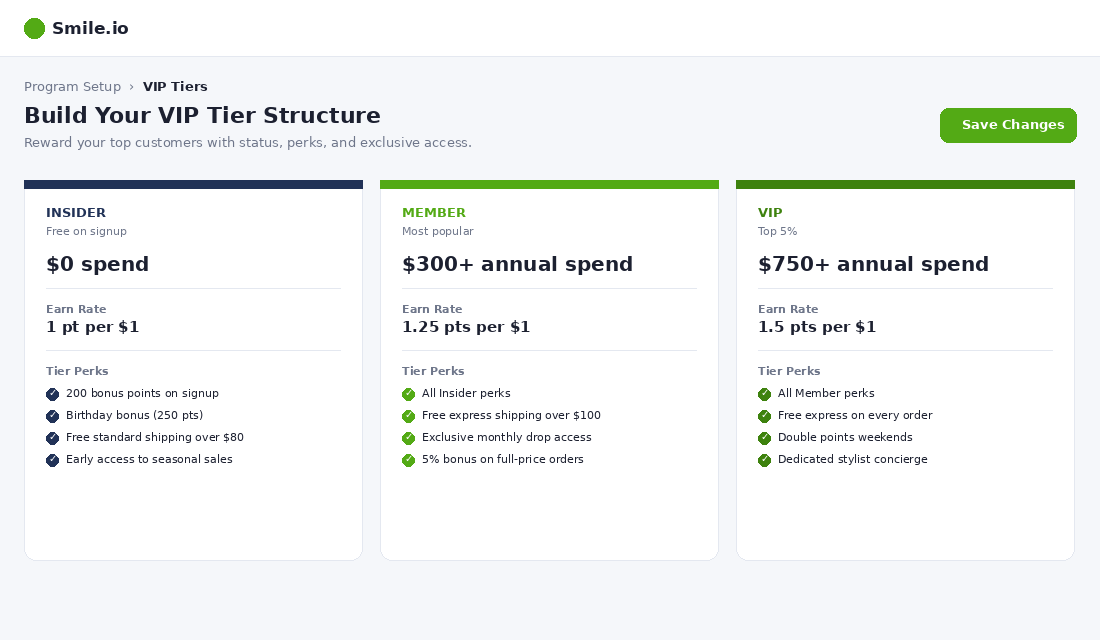
A practical structure for an apparel brand with $90 AOV:
- Tier 1 — Insider (free, on signup): 1 point per $1, birthday bonus, free standard shipping over $80, early access to sales
- Tier 2 — Member ($300+ annual spend): 1.25 points per $1, free express shipping over $100, exclusive monthly drop access, 5% bonus points on full-price purchases
- Tier 3 — VIP ($750+ annual spend): 1.5 points per $1, free express on every order, double points weekends, dedicated stylist or concierge contact, exclusive product access
The mistake most brands make is setting tier thresholds based on what feels nice instead of what reflects their actual customer data. Pull a cohort report from Shopify, find the 75th, 90th, and 95th percentile of annual customer spend, and use those as your tier breakpoints. The tier structure should reward who is already loyal, not aspirationally over-reward who you wish was loyal.
One more thing. Tier benefits should escalate experientially, not just numerically. A 1.5x earn rate is fine, but the upgrade to free express shipping on every order or “early access to drops” is what makes someone push to spend $750 instead of $500. Status and convenience win over points every time at the top tier.
The Best Shopify Loyalty Apps in 2026 (And When to Choose Each)
Shopify does not ship with a built-in loyalty program. You will need a dedicated app. The three that dominate the market for Aussie Shopify brands are Smile.io, LoyaltyLion, and Rivo, with Yotpo and Stamped.io rounding out the list.
Smile.io is the easiest to launch and powers over 100,000 stores. The free plan gives you a working points and referral program in under an hour. Paid plans start around $49 USD per month and add VIP tiers, more reward types, and stronger branding control. Best for stores doing under $50K AUD per month who want a clean, no-code program live this week.
LoyaltyLion is the platform of choice for stores doing $100K+ AUD per month who care about segmentation, advanced analytics, and full design control. Pricing starts higher (typically $399 USD per month for the Classic plan) but you get up to four VIP tiers, a fully customisable on-site loyalty page, deep Klaviyo integration, and an open API. Best for Shopify Plus brands that want loyalty as a core retention asset, not a footer widget.
Rivo sits between the two on price and offers strong out-of-the-box performance, particularly on referral mechanics. It also publishes some of the best benchmarking data in the category, which makes it useful even if you choose a different app.
The decision tree is simple:
- Under $50K/month and need a program live in 7 days: Smile.io free or Starter plan
- $50K-$150K/month and want tiers plus better branding: Smile.io Plus or Rivo
- $150K+/month or on Shopify Plus: LoyaltyLion (the segmentation alone pays for itself)
One non-negotiable regardless of which app you pick: your loyalty app must integrate with your email and SMS platform. If Klaviyo cannot see who is in which tier, who has unredeemed points, and who is about to expire, your program is invisible. We will get to that in a moment.
Lessons From Aussie Brands Doing It Best
You do not need to invent the wheel. The best Aussie loyalty programs are right in front of you. Two are worth studying closely.
Mecca’s Beauty Loop is arguably the most successful loyalty program in Australian retail. Five tiers, gated by annual spend ($300, $600, $1,200, $3,500+). The genius is that the rewards are not just discounts — they are quarterly Beauty Loop Boxes filled with samples of Mecca’s most popular products. Members at Level 1 and above receive four boxes per year. The tier upgrade is not about a higher discount, it is about getting more curated experiences. That is what creates fanaticism, not a 10% off code.
Adore Beauty’s Adore Society launched in 2023 and was rebuilt in 2025 to match its omnichannel shift. The standout feature in the new program is four complimentary full-size products per year for top-tier members. They could have given a points multiplier or a deeper discount. They did not. They gave away free product, which is a higher-perceived-value reward at lower true cost (because the product is at COGS, not retail). That is a smart margin play disguised as a generous experience.
Three takeaways from these programs:
- Lead with experiences and product, not discounts. A free hero product gift at the top tier is more valuable to the customer and cheaper to you than a $50 discount.
- Make the tier structure visible. Both Mecca and Adore make it crystal clear what you get at each level and how close you are to the next one. The path is the motivation.
- Use the program to create proprietary moments. The Beauty Loop Box is a Mecca-only thing. It cannot be replicated by competitors. Build a recurring branded ritual into your top tier.
The Email and SMS Layer That Actually Activates Your Program
Here is what kills more loyalty programs than anything else: the customer enrols, earns points on order one, then never thinks about your program again until you accidentally remind them six months later when they want to unsubscribe.
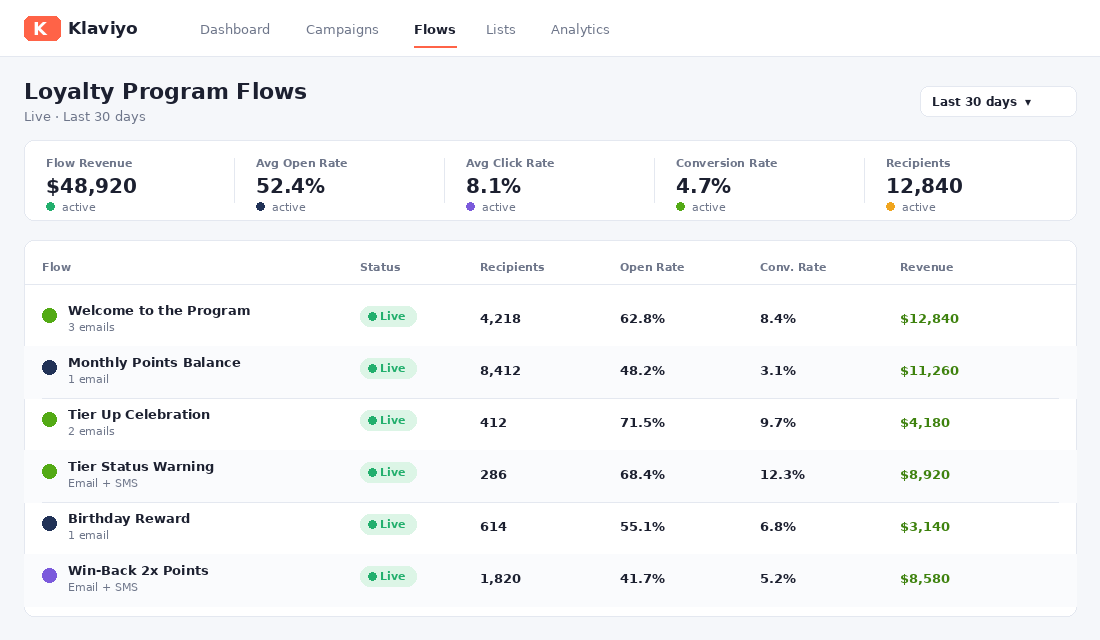
Your loyalty program needs an activation engine, and that engine lives in Klaviyo (or Omnisend) plus SMS. At minimum, you need these flows running:
- Welcome to the program (3 emails over 7 days): Confirm enrolment, explain how points work in plain English with dollar framing, show their current balance, and trigger a first-redemption offer
- Points balance update (monthly): “You have $X waiting to spend” — dollar value, not points balance. This single email lifts redemption rates by 25-40%
- Tier-up celebration: Triggered the moment a customer crosses a threshold. Include the new benefits and a bonus reward to anchor the win
- Tier-status warning (60 days before expiry): “You are $X away from keeping VIP status.” This is the single highest-converting flow most stores never build
- Birthday flow: Bonus points and a reminder of what they can redeem with their balance
- Win-back with bonus points (90 and 180 days lapsed): Trigger 2x or 3x points for next purchase, exclusive to lapsed members
SMS amplifies all of these. A “$15 reward expiring in 48 hours” text gets opened in 90 seconds. The same message in email might wait three days for the open. For tier warnings and points expiry, SMS is the channel of choice.
Most stores running loyalty programs have only two of these flows live. Build the missing four and you will lift program revenue by 40-70% without touching the program structure itself.
How to Measure Whether Your Loyalty Program Is Actually Working
Most loyalty dashboards show vanity metrics. Total members. Points issued. Points redeemed. None of these tell you whether the program is making you money.
The metrics that actually matter:
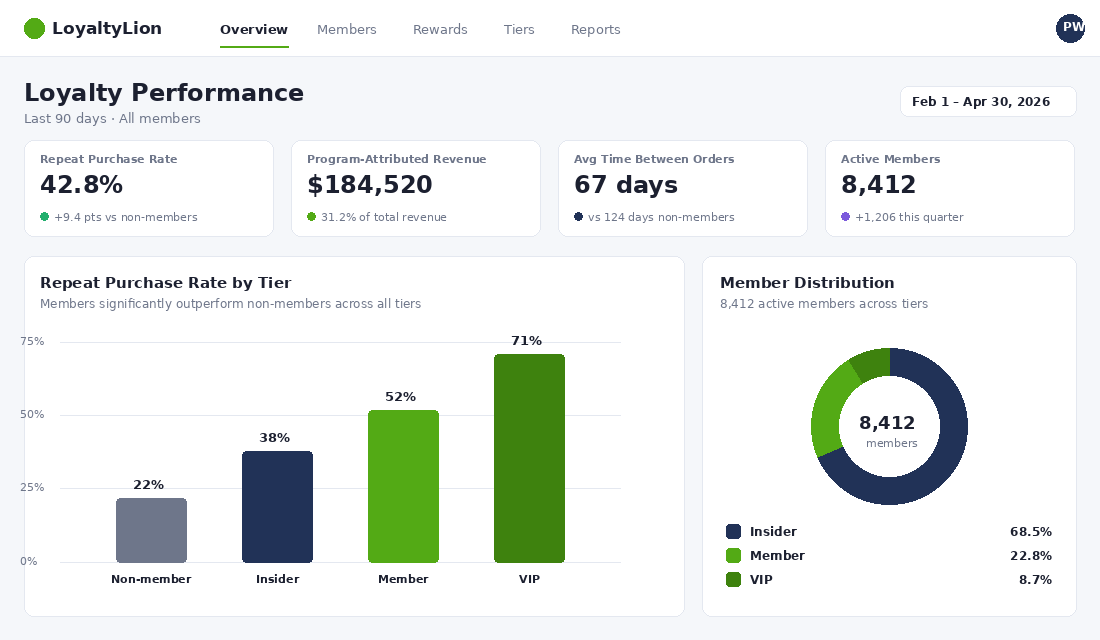
- Repeat purchase rate (members vs non-members). Members should be at least 1.5x non-members within 90 days of launch. If they are not, your earn rate or activation flows are broken.
- Time between orders (members vs non-members). Members should buy every 60-90 days versus 120+ for non-members. Watch this trend monthly.
- AOV by tier. Each tier should have a higher AOV than the one below it. If your VIP tier is not at least 1.5x your base tier, your tier benefits are not creating enough lift.
- Points liability. The total dollar value of unredeemed points sitting on the books. Most programs see 40-60% redemption rate, so liability is naturally a fraction of issued points. If liability is climbing without redemptions, your program is hoarding instead of activating.
- Program-attributed revenue. The revenue from orders where a reward was redeemed or where the customer was tagged as a member. Aim to push this above 30% of total revenue within 12 months.
Build a simple weekly dashboard with these five numbers. If you cannot see them at a glance, you cannot manage the program. Most loyalty apps will surface the first four. Program-attributed revenue is usually a custom Klaviyo or Triple Whale view, but it is the one that justifies the program to the rest of the business.
The Compound Effect: How Loyalty Pays for Every Other Channel
Here is the part most brand owners do not see until 12 months in. A working loyalty program does not just lift retention. It changes the maths of every channel you run.
When 30% of your revenue comes from members making their second, third, and fourth purchase, your blended CAC drops because you are not paying ad costs to get those orders. Which means you can afford to bid higher on Meta and Google for net-new customers. Which means you outbid competitors who are still relying purely on first-purchase economics.
The brands that scale past $5M in Australia almost always have one thing in common: they have built a retention asset that funds growth. The loyalty program is the visible part of that asset. The invisible part is the tier-segmented email flows, the bonus points campaigns timed to slow weeks, the VIP early access drops that fund the next inventory order before it even hits the homepage.
This is why we tell every eCommerce Circle member that loyalty is not a Q4 project. It is a Q1, Q2, Q3, and Q4 project. Build it once, refine it forever.
The Loyalty Program P&L: What Points Actually Cost You
Almost nobody models this before launch, and it is the reason loyalty programs get quietly switched off eighteen months in. Points are not a marketing expense. They are a liability you issue today and pay for later, and they need to sit in your P&L like one.
Here is the maths, worked properly. Say you run a 1-point-per-dollar earn rate with 100 points redeemable for $5 off. That is a 5% discount rate on every dollar spent. On a $95 average order with a 62% gross margin, you are handing back $4.75 against $58.90 of gross profit — about 8% of your margin on that order, before you have paid the app fee.
But you never pay the full 5%, because not every point gets redeemed. That gap is called breakage, and across ecommerce loyalty programs it typically runs 60 to 75% for points-based schemes. So your real cost lands closer to 1.3 to 2% of revenue, not 5%.
That is the number to budget. And it is the number to compare against your paid acquisition cost, because the whole point of the program is to shift spend from the top of the funnel to the bottom. If loyalty costs you 1.8% of revenue and your blended CAC is running at 22% of revenue, that trade is not close.
Three Numbers to Put in Your Model Before You Launch
Your expected breakage rate. Start conservative at 55% for the first year. New programs see higher redemption because early joiners are your most engaged customers, and they will clear their balance fast. Breakage climbs as the member base broadens.
Your points expiry policy. A 12-month rolling expiry on inactivity is the industry norm and it does two jobs — it caps your liability and it gives you a legitimate reason to send a re-engagement email. Just be careful here: under Australian Consumer Law your terms need to be clear and prominently disclosed at sign-up, and retrospectively shortening an expiry window on existing balances is the fastest way to turn a loyalty program into a complaint thread. Set the policy once, disclose it properly, and leave it alone.
Your outstanding liability. Multiply unredeemed points by your redemption value, then discount by expected breakage. Review it quarterly. If liability is growing faster than revenue, your earn rate is too generous or your rewards are not compelling enough to trigger redemption — and a program nobody redeems from is not a loyalty program, it is a spreadsheet.
The Segments That Decide Whether the Program Pays
Blended loyalty reporting lies to you. Members always look better than non-members, because your best customers join first. That is self-selection, not causation, and it is why so many founders can show a beautiful “members spend 67% more” slide while the program is not moving the business at all.
The honest read requires three segments, built in Klaviyo or straight out of your loyalty app’s export:
- Enrolled and redeemed at least once. These are your active members. Track their repeat rate and 12-month value.
- Enrolled but never redeemed. Usually 40 to 60% of the base. If this group’s repeat rate matches non-members, your program is decorative for most of the people in it.
- Not enrolled, matched on first-order value and acquisition channel. This is your control group and the only fair comparison you have.
The number that matters is the gap in second-order rate between enrolled-and-redeemed and the matched control. A healthy program shows an 8 to 15 percentage point lift. Under 5 points and you are paying to discount purchases that were going to happen anyway.
Run this the same way you would run any cohort retention analysis — by join month, not blended. A program that looked great in month three often flattens by month nine, and only cohorts will show you that.
The First Redemption Is the Whole Game
If you take one operational thing from this section, take this. The single strongest predictor of whether a member becomes a repeat customer is whether they redeem once. Not whether they enrol. Not how many points they hold. Whether they have felt the reward land.
Which means your program’s most important job in the first 60 days is engineering that first redemption. Set your entry reward low enough that a single average order gets a customer most of the way there. If your AOV is $95 and 100 points unlocks a reward, a 1-point-per-dollar earn rate leaves them 5% short — close enough to feel achievable, far enough to prompt a second visit.
Then build a three-message flow around it: a balance notification at 48 hours post-delivery, a “you are $X away” nudge at day 21, and a redemption reminder at day 45 with the specific reward named and a one-click apply link. Brands that run this sequence properly typically see first-redemption rates of 30 to 40% within 90 days, against 12 to 18% for programs that rely on customers remembering on their own.
None of this works if the customer’s first purchase was a bad fit for your brand. Loyalty amplifies a good entry product; it cannot rescue a poor one.
Your 30-Day Loyalty Program Implementation Plan
If you are starting from zero, here is the order of operations that will get you live and producing in 30 days.
- Days 1-3: Pull your last 12 months of customer data. Find the 75th, 90th, and 95th percentile of annual spend. Those are your tier thresholds. Calculate your average order value and current repeat purchase rate as your baseline.
- Days 4-7: Choose your app. Install. Configure earn rate (1 point per $1, 100 points = $5), set the three tier thresholds, build the welcome email and points balance flows.
- Days 8-14: Add the program to your product pages, cart drawer, and post-purchase page. Update your email signup popup to mention the program. Add a banner to your homepage. The program must be visible in five places before launch.
- Days 15-21: Build the four core flows: welcome series, monthly balance update, tier-up celebration, tier-status warning. Set up SMS replicas for the time-sensitive ones.
- Days 22-30: Launch a campaign to your existing customer list inviting them in with a sign-up bonus (200 points). Track repeat purchase rate, time between orders, and program-attributed revenue weekly from this point on. Iterate quarterly based on what the data shows.
You will not have the perfect program in 30 days. You will have a program that already outperforms what most stores have running, and you will have the data to refine it from there. Iteration beats perfection in retention every time.
If you want help mapping this to your specific category, margin profile, and customer data — including the tier maths and the Klaviyo flows — that is exactly what we work on inside eCommerce Circle. Loyalty and retention is one of the core pillars of our coaching, and most members see repeat purchase rate move within 60 days of implementation.