Most Shopify owners can tell you their revenue this month within $500. Ask them what their customers are worth over the next two years, and you get a shrug.
What’s in This Article
That single blind spot is the reason most Australian brands stall around $1M to $3M and never break through. Not the ad account. Not the theme. Not the offer. The blind spot is Customer Lifetime Value – and the brands you’re competing with on Meta, Google, and TikTok have done the maths. They know exactly how much a new customer is worth across 90 days, 12 months, and 36 months. That’s why they can outbid you for the same click and still make money.
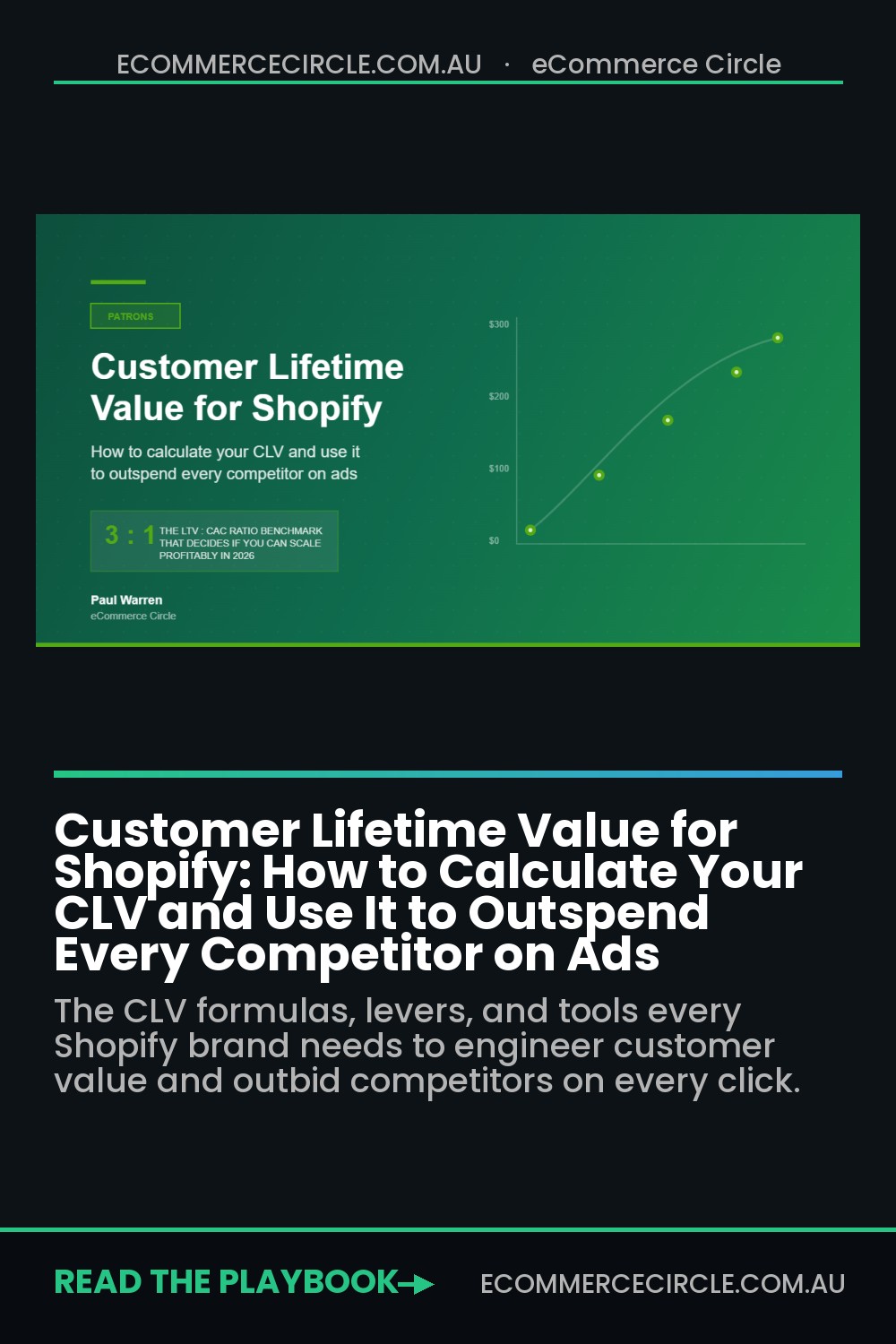
According to 2026 industry benchmarks, the average Shopify CLV sits at around $168 over three years. Top performers hit $250 to $450+. Subscription brands clear $350 to $800. The brands at the top of those benchmarks aren’t lucky – they’ve built a CLV engine. And that engine is what we’re going to break down in this article, with the exact formulas, levers, and tools to engineer your own.
Why CLV Is the Hidden Ceiling on Your Growth
Here’s the uncomfortable truth: your CLV decides your maximum CAC. And your maximum CAC decides whether you can scale at all.
If your average customer spends $90 with you across their entire lifetime, you cannot pay $80 to acquire them and survive. You’ll grow revenue and lose money on every order. We’ve seen it happen to dozens of Aussie Shopify brands – they hit $2M, scale ad spend hard, and 18 months later the founder is selling the car to make payroll.
The brands that scale past $5M, $10M, and beyond have all done one thing first: they’ve engineered their CLV up to a point where they can confidently spend more than the competition on every single click. CAC has risen 40% since 2023, with average ecommerce CAC now sitting between $68 and $84. If your CLV hasn’t risen by the same amount, your business has quietly become unprofitable while your revenue dashboard says otherwise.
This is why we put CLV at the centre of the Patrons P inside the More Orders Operating System. Without it, every other lever – your ad strategy, your pricing, your retention work – is being pulled in the dark.
The Three CLV Formulas (And Which One You Should Actually Use)
There are three ways to calculate CLV. Most blogs throw all three at you and walk off. Here’s how to know which one your store actually needs right now.
Formula 1: The Quick Snapshot (Use this if you’re under $500K)
The classic CLV formula is simple:
CLV = Average Order Value × Purchase Frequency × Customer Lifespan
If your AOV is $80, customers buy 2.5 times per year on average, and your average lifespan is 2 years, your CLV is $400. Pull these numbers from Shopify Analytics → Customers → Loyal customers, or from your reports tab. This formula gives you a directional answer in 10 minutes. Use it when you have less than 18 months of order history and you just need a starting number.
Formula 2: Profit-Based CLV (Use this once you’re past $1M)
Revenue-based CLV is dangerous when you scale. A $400 CLV at 12% margin only gives you $48 to spend acquiring that customer. The profit version corrects this:
Profit CLV = (AOV × Gross Margin %) × Purchase Frequency × Lifespan
Same example, but with a 50% gross margin: ($80 × 0.5) × 2.5 × 2 = $200 in customer profit. That’s the real number you can spend on acquisition. If you’ve never read our piece on contribution margin, do that before you scale ad spend – it’s the metric that turns CLV into spend authority.
Formula 3: Cohort CLV (Use this once you have 24+ months of data)
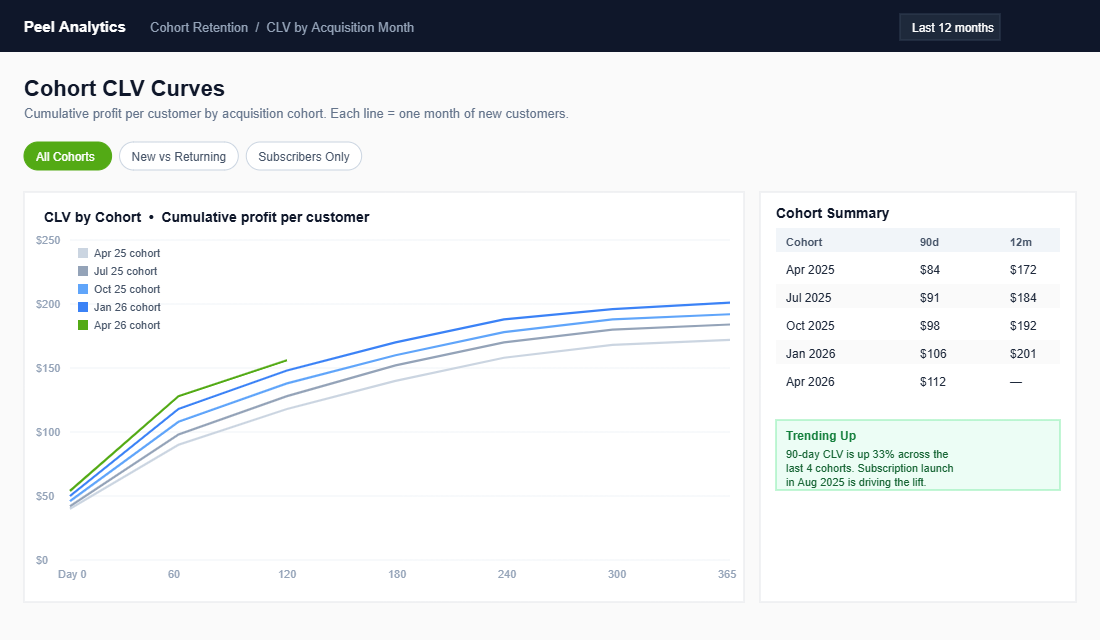
The most accurate approach is cohort-based. You group every customer by the month they first purchased, then track their cumulative spend over time. This gives you an LTV curve per cohort that shows exactly when revenue accumulates – and how that’s changing as your brand matures.
This is where most brands discover something painful: their newer cohorts are spending less than their 2022 cohorts did at the same age. That’s the iOS-tracking-changes era impact and the rising cost of sponsored discovery. If your cohorts are flat or declining, your CLV strategy needs intervention before you spend another dollar on ads.
The LTV:CAC Ratio – The Only Growth Math That Matters
Once you’ve calculated CLV, the next number you need is your LTV to CAC ratio. This is the single most important number in ecommerce, and most brand owners couldn’t tell you theirs.
The benchmark is simple:
- Below 1:1 – You’re losing money on every customer. Stop scaling immediately.
- 1:1 to 2:1 – Surviving but not growing. This is the danger zone where a bad month puts you out of business.
- 3:1 – The healthy DTC standard. You’re profitable and have room to invest in growth.
- 3:1 to 4:1 – The sustainable scaling zone. Most successful Shopify brands sit here.
- Above 5:1 – Surprisingly, this is a problem. It usually means you’re under-investing in acquisition and leaving market share on the table for a competitor to take.
Run the maths now. If your gross-margin CLV is $200 and your CAC is $90, you’re at 2.2:1. That’s not enough room to ride out a slow month or a Meta algorithm change. The fix isn’t always to cut CAC – sometimes the smartest play is to lift your CLV by $80 so you can comfortably push CAC up to $100 and outbid every competitor in your category.
Pair this with your CAC payback period. For DTC in 2026, a healthy payback is 90 to 120 days. If it’s taking you 8 months to recover the cost of a customer, your cash flow can’t support aggressive scaling, regardless of what your LTV:CAC ratio says.
The 6 Levers That Move CLV (Pull Them in This Order)
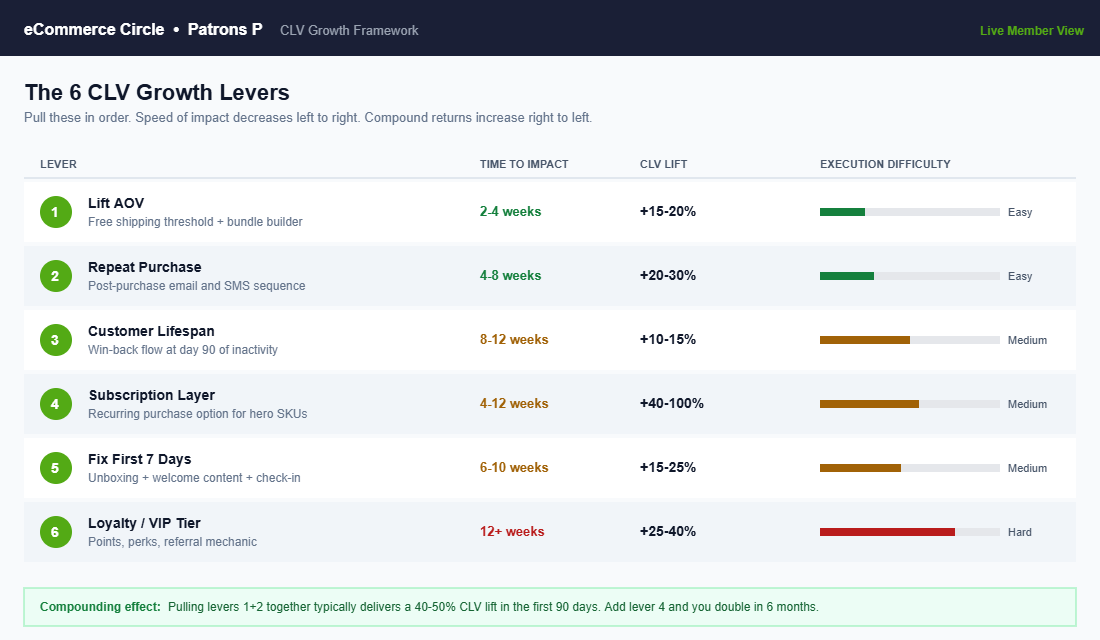
You don’t grow CLV by hoping. You grow it by pulling specific levers in a deliberate sequence. Here’s the order we work through with members inside the eCommerce Circle.
Lever 1: Lift Your AOV (Fastest Win)
This is the lowest-effort, highest-impact lever for most brands. A $10 AOV lift on a customer who buys 5 times in their lifetime is a $50 CLV lift – without acquiring a single new customer.
The three tactics that move AOV most reliably: a free shipping threshold set 25-35% above your current AOV, a single high-converting upsell on the cart page (not the checkout), and a “build your bundle” mechanic for product categories with natural pairings. Aussie skincare and supplement brands have been crushing it with bundle builders – the average brand sees a 15-20% AOV lift in the first 60 days.
Lever 2: Lift Your Repeat Purchase Rate
The average Shopify store has a repeat purchase rate of 28.2%. The brands hitting 40%+ have one thing in common – a deliberate post-purchase sequence that engineers the second sale within 60-90 days.
Why 60-90 days? Because the probability of a customer returning drops off a cliff after that window. If they haven’t bought again by day 90, your odds drop from roughly 35% to under 10%. The post-purchase email and SMS flow exists to ensure that second purchase happens inside the high-probability window.
Lever 3: Extend Customer Lifespan
If your customers churn at month 6, you’re capped on CLV no matter how good your AOV is. Lifespan is extended through three things: relevance (you keep showing up with products they actually want), reliability (their experience is consistent), and reactivation (you have a plan for the customer who’s gone quiet).
The reactivation piece is the most overlooked. Most brands don’t even know they’ve lost a customer until 12 months pass. Build a “lapsed customer” segment that triggers at day 90 of no activity – and run a structured win-back flow with a low-friction offer (free shipping, a small bonus, a hand-written feel from the founder). A 5% improvement in retention can lift profits by 25% to 95% according to Bain & Company’s classic research.
Lever 4: Add a Subscription Layer
Subscription brands hit $350 to $800+ CLV – sometimes 4x what one-off-purchase brands achieve. If any portion of your catalogue is consumable, replenishable, or routinely re-purchased, you’re leaving CLV on the table by not offering a subscription option. We covered the full playbook in our piece on Shopify subscription commerce – start there if subscription is even partially viable for your category.
Lever 5: Fix the First 7 Days
The first week after a customer’s first purchase decides their long-term value. Brands that nail the unboxing, send a thoughtful “thanks for the order” message, and follow up with a useful piece of content (not another offer) have repeat rates 2x higher than brands that go silent.
This is where Aussie brands like Who Gives A Crap have engineered a quiet advantage. Their post-purchase experience – from the playful packaging to the personalised messaging – is a deliberate CLV play. Their key internal metric is “Percent of Customers Reordering” by cohort, which feeds directly into both inventory forecasting and the next acquisition decision.
Lever 6: Build a Loyalty or VIP Layer
Your top 20% of customers usually account for 60-80% of your revenue. Treating them like everyone else is a CLV crime. A well-designed loyalty program does three things: it gives heavy buyers a reason to consolidate spend with you (instead of splitting with competitors), it raises perceived switching cost, and it creates a tier of brand advocates who refer for free.
Bondi Sands’ “Bondi Babe Rewards” program is a strong Aussie example – their loyalty ROI grew 348% after launching it. The program isn’t complicated. It’s points for purchases, points for referrals, points for reviews, and a small tier of perks that make their best customers feel known. Simple beats clever every time in loyalty.
The Tools You Actually Need to Track CLV on Shopify
You can’t move what you can’t see. Here’s the lean tool stack we recommend for tracking and acting on CLV.
Lifetimely (or Triple Whale) – Your CLV Source of Truth
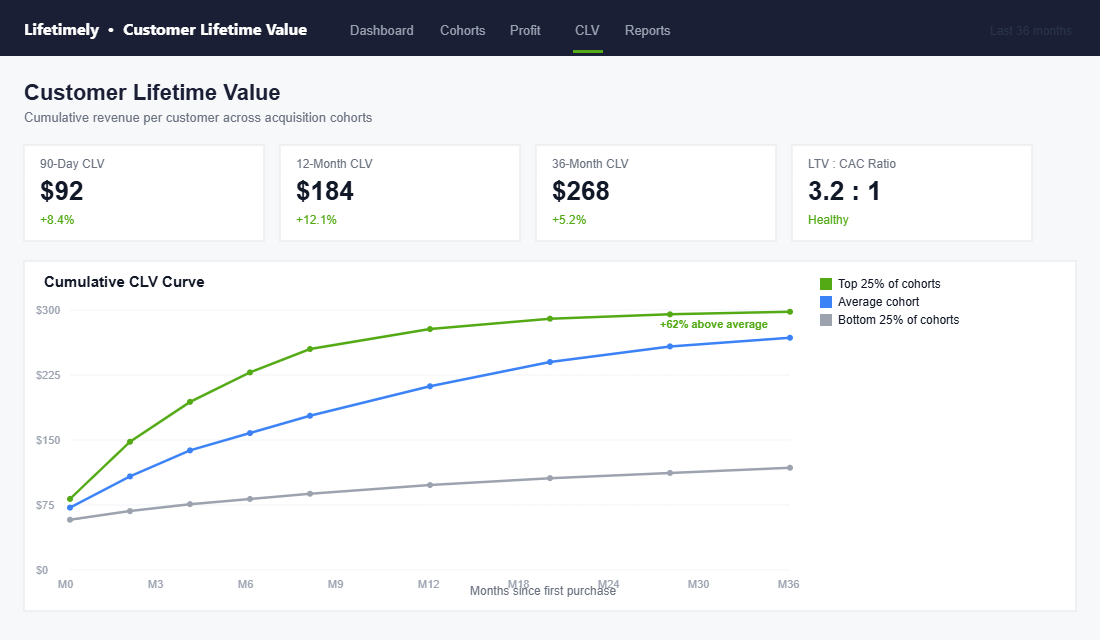
Lifetimely is the dedicated Shopify app for profit and CLV analytics. It pulls your order history, calculates CLV by cohort automatically, and shows you 60-day, 90-day, and lifetime profit per customer. Brands using it report an average 12% CLV lift within their first six months – purely from being able to see what was previously invisible.
Setup steps:
- Install Lifetimely from the Shopify App Store and connect your store.
- Enter your COGS for each product (or use a category-based blended margin if you have hundreds of SKUs).
- Connect your ad accounts (Meta, Google, TikTok) so the tool can calculate true blended CAC.
- Open the CLV by Cohort report. This is the only dashboard that matters for the first 90 days.
- Set a weekly review – every Monday, look at last week’s new cohort and compare against the trailing 12-week average.
Klaviyo – Your CLV Activation Layer
Lifetimely tells you who your high-CLV customers are. Klaviyo lets you treat them differently. Build segments for Top 10% Spenders, At-Risk (no purchase in 60-90 days), and Repeat Customer (2+ orders) and tailor your flows accordingly.
The data is striking: email subscribers have approximately 3x the CLV of non-subscribers – $285 vs $95 over three years. If you’re not capturing emails aggressively, you’re capping your own CLV before the first sale even happens.
Shopify’s Native Customer Reports – Free, Underrated
If you’re not ready to pay for Lifetimely yet, Shopify’s built-in customer reports give you the basics: first-time vs returning customers, customer cohort analysis, and predicted spend by customer. It won’t replace a dedicated CLV tool at $5M+ scale, but it’s enough to start having intelligent conversations about retention before then.
The Compound Effect: Why a CLV Lift Changes Everything
Let’s run the maths on a real scenario. You’re an Aussie supplements brand doing $1.2M a year. Your current numbers:
- AOV: $85
- Repeat purchase rate: 28%
- Average orders per customer: 1.8
- Customer lifespan: 14 months
- Gross margin: 55%
- Profit CLV: $84
- Current CAC: $42
- LTV:CAC ratio: 2:1
Now you pull three CLV levers over the next 6 months: a bundle builder lifts AOV by $12 to $97. A post-purchase email flow lifts repeat purchase rate from 28% to 36%. A subscription option for your hero product takes 18% of new customers into a recurring purchase pattern that lifts average orders to 2.6.
New profit CLV: $138. That’s a $54 lift, or 64% growth in CLV with no additional ad spend.
Now you can confidently push your CAC ceiling from $42 to $55 – a 30% increase in your bidding power. While your competitors are pulling back because Meta CPMs are up, you’re scaling. Apply that to a $1.2M business and you’re staring at a path to $2M+ over the next 12 months without any heroics.
This is what a CLV strategy actually opens up. It’s not a vanity metric or a quarterly report line. It’s the lever that decides whether you can afford to play in your category at all.
Your CLV Action Plan for the Next 30 Days
Don’t try to do all six levers at once. Use this 30-day sequence to install a CLV discipline that compounds.
- Week 1 – Calculate your baseline. Pull your AOV, purchase frequency, and customer lifespan from Shopify. Run the profit CLV formula. Calculate your blended CAC across all paid channels. Document your LTV:CAC ratio. This is your starting point.
- Week 2 – Install your tracking layer. Get Lifetimely or your tool of choice connected with COGS loaded. Build the three Klaviyo segments (Top 10%, At-Risk, Repeat). Set up your Monday review.
- Week 3 – Pull the AOV lever. Move your free shipping threshold, install a bundle builder or single cart upsell. Don’t touch retention yet – get the AOV win first.
- Week 4 – Pull the repeat purchase lever. Build (or rebuild) your post-purchase email and SMS flow. Time it to your category’s natural repurchase window. Add a low-friction reactivation offer at day 90.
Run this for 90 days, then measure the lift. If you’ve executed it properly, you’ll see your CLV climb 15-30% – enough to fundamentally change what’s possible on the acquisition side of the business.
The 90-Day CLV Lift Plan (What to Do Monday Morning)
Knowing your CLV is step one. Moving it is where the money is. Here is the 90-day sequence we walk members through, and it works whether you are doing $40k a month or $400k.
- Days 1 to 14: get your baseline. Pull 24 months of order data and calculate CLV by cohort, not just the blended average. Lifetimely or Peel will do this automatically for under $50 AUD a month, or you can export from Shopify Analytics and build it in a spreadsheet. You are looking for two numbers: 60-day repeat rate and 12-month CLV by first product purchased.
- Days 15 to 45: fix the post-purchase window. Most Aussie stores send a shipping confirmation and then go silent. Build a three-email post-purchase flow in Klaviyo: a how-to-use email at day 3, a check-in at day 10, and a replenishment or cross-sell nudge timed to your median second-purchase gap. A solid post-purchase flow typically lifts repeat purchase rate by 3 to 5 percentage points on its own.
- Days 46 to 75: add a compounding channel. This is where a referral program or a WhatsApp flow earns its keep, because both channels reach customers who already trust you. Our referral program playbook and WhatsApp marketing playbook cover the exact setups.
- Days 76 to 90: reset your ad ceiling. Re-run the CLV calculation, then set your customer acquisition cost ceiling at roughly one third of 12-month CLV. That ratio keeps you profitable while still letting you outbid competitors who are pricing ads off first-order value.
The compounding here is real. Bain’s research puts a 5% lift in retention at anywhere from 25% to 95% more profit, and repeat customers spend around 67% more per order than first-timers. Imagine you run a $120k a month supplement brand in Brisbane: shifting repeat rate from 28% to 33% adds roughly $70k of revenue over the next year without a single extra ad dollar.
CLV Is the Number Behind Every Other Number
Most Shopify owners are running their business on the wrong scoreboard. They’re watching daily revenue and ROAS and missing the metric that actually decides whether the business compounds or collapses.
CLV is the single number that ties together every part of the business. It tells you what your offer is worth, what your retention is doing, what you can spend on acquisition, and how much runway you actually have. The brands that win in the next 24 months will be the ones that put CLV at the centre of every decision – not the ones with the cleverest creative or the cheapest ad cost.
Inside the eCommerce Circle, engineering CLV is one of the foundational pieces of work we do with every member. We start with the baseline calculation, work through the levers in the right sequence, and build the dashboard so you can see the impact week by week. If you want help installing this discipline in your own brand, let’s talk.