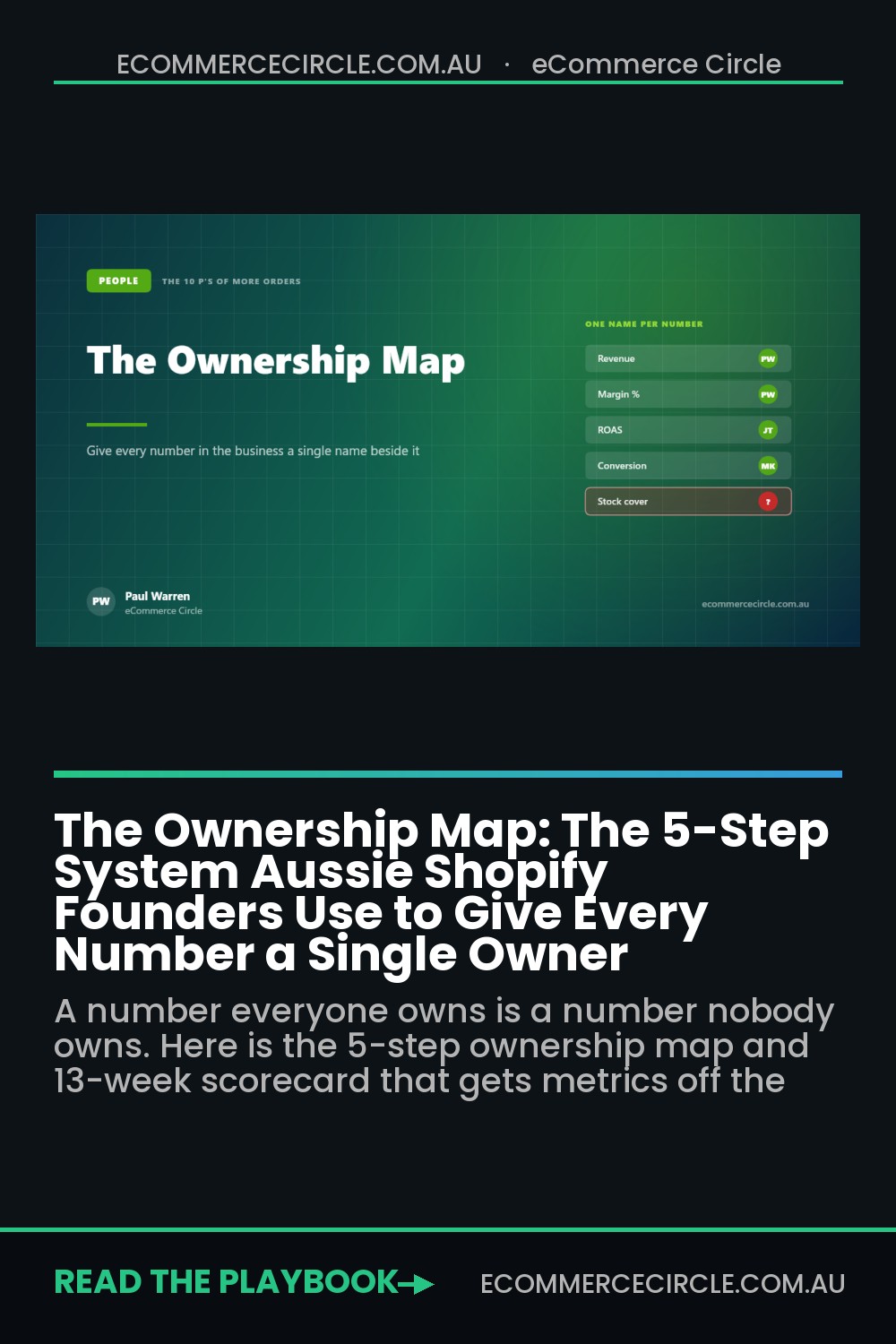
Try this at your next team meeting. Ask one question: “Who owns our conversion rate?”
What’s in This Article
Watch what happens. Your marketing person will look at your developer. Your developer will say it depends on traffic quality. Someone will say “we all do, really.” And then the conversation moves on, and conversion rate keeps sliding for another eleven weeks, because a number everyone owns is a number nobody owns.
This is the bottleneck that shows up in every business that gets past about four people. The founder has delegated tasks — running ads, packing orders, answering tickets — but hasn’t delegated a single outcome. So every number still routes back through them, and they wonder why growing the team didn’t reduce the load. The fix isn’t another hire or another dashboard. It’s a one-page document that puts a single name beside every number that matters.
Delegating Tasks Isn’t Delegating Outcomes
Most founders think they’ve solved this already. They’ve hired a media buyer, brought on a VA, signed with a 3PL. The work left the building. But look closely at what was actually handed over: activities, not results.
Your media buyer owns “running Meta campaigns.” Nobody owns blended ROAS. Your 3PL owns “picking and packing.” Nobody owns dispatch reliability. Your VA owns “replying to tickets.” Nobody owns first response time. Every one of those numbers has someone working near it and nobody answering for it.
The tell is simple. When a number goes bad, is there one person whose week changes? If the answer is “we’d have a chat about it,” the number is unowned — and unowned numbers drift for months before anyone notices, because noticing is also nobody’s job.
There are two failure modes here and they look identical from the outside. The first is a number with no name against it at all. The second is more dangerous: a number with three names against it, which feels like coverage and behaves like abandonment.
Step 1: List the Numbers That Actually Run the Business
Open a blank page and write down every number that, if it moved 20% in the wrong direction, would change your year. Not every metric you can pull — the ones that actually steer.
For a store between $500k and $5m, that list is usually 15 to 20 numbers, and it clusters into five areas:
- Trading. Weekly revenue, contribution margin percentage, average order value, cash on hand.
- Marketing. Blended ROAS, customer acquisition cost, email revenue share, new customer count.
- Store. Conversion rate, add-to-cart rate, site speed, checkout completion.
- Supply. Weeks of stock cover, dispatch within 24 hours, stockout count, inventory write-offs.
- Service. First response time, return rate, review response rate, repeat purchase rate.
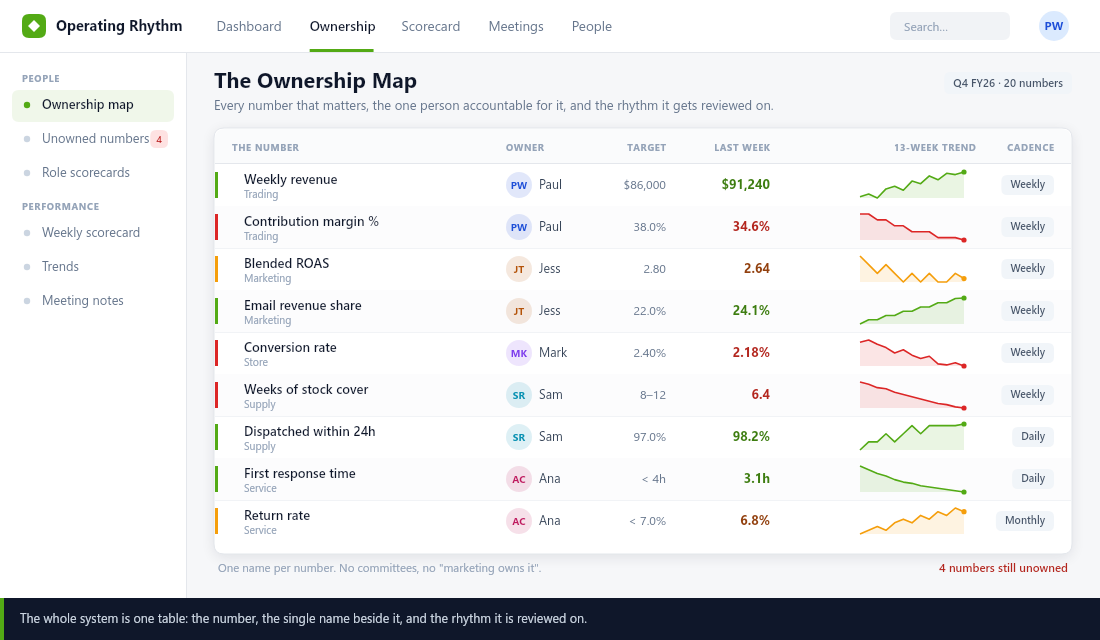
Resist the urge to make this list longer. Twenty numbers with real owners beats sixty numbers on a dashboard nobody opens. If you can’t say in one sentence why a number would change a decision, it’s reporting, not steering — leave it off.
Beside each number, write a target and a cadence. Targets have to be specific enough to be missed: “38% contribution margin,” not “improve margins.” Cadence is daily for operational numbers, weekly for the majority, monthly for anything with too much noise week to week.
Step 2: Put Exactly One Name Beside Each Number
Now the hard part, and the part people negotiate their way out of. One number, one name. Not a team. Not a department. Not “Jess and Ana.” A person.
Two objections come up every time, and both have the same answer.
“But conversion rate depends on traffic quality, which Jess controls.” Correct. Owning a number doesn’t mean controlling every input. It means being the person who watches it, explains it when it moves, and brings a plan when it’s off. Mark owning conversion rate means Mark is the one walking into Monday’s meeting saying “it’s down 0.22 points, here’s why, here’s what I’m doing.” He’ll need Jess’s help. He’s still the owner.
“But I’m the only one senior enough to own margin.” Sometimes true, at first. Just be honest about how many numbers you’ve claimed. If seven of the twenty have your initials on them, you haven’t built a team — you’ve built an org chart with a bottleneck at the top, and every one of those numbers will get the attention that’s left over after a busy week.
A practical rule: nobody carries more than four numbers well. Past that, the ones at the bottom of their list get looked at once a quarter, which is the same as not owned. If you’re over four, that’s your hiring brief — not a vague “we need more help,” but “we need someone who can own these three numbers.”
Step 3: Run the Coverage Audit
Before you roll this out, audit what you’ve just built. Three columns: numbers with exactly one owner, numbers split between two or more people, numbers with nobody at all.
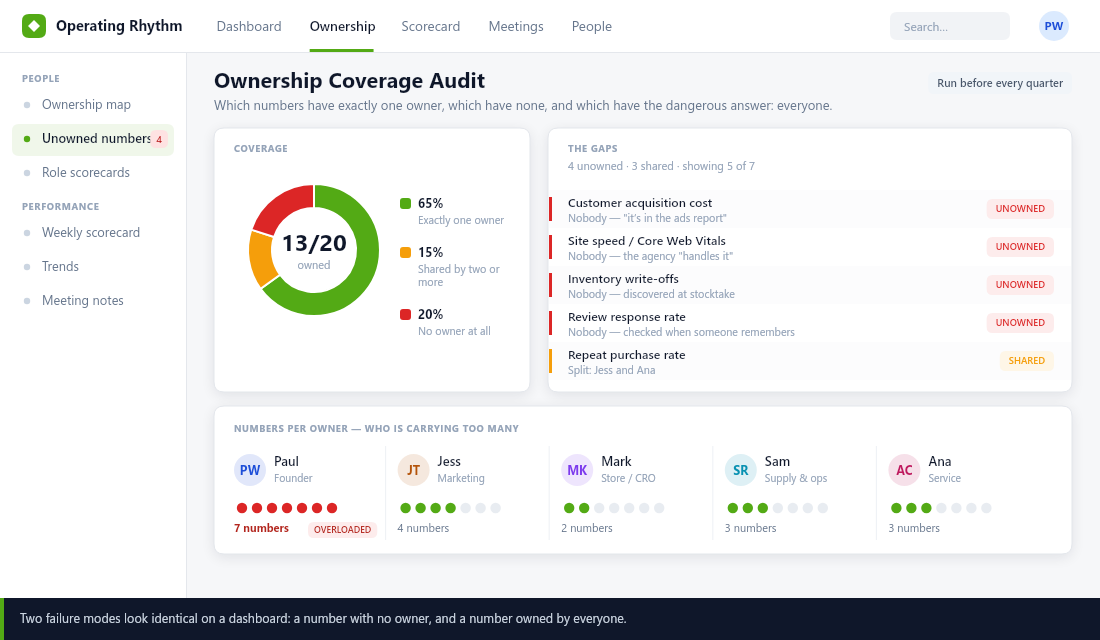
The unowned column is usually the interesting one, because it’s rarely random. The same four numbers turn up in almost every audit we run:
- Customer acquisition cost. Everyone assumes it’s in the ads report. It isn’t — the ads report shows platform-reported cost per purchase, which is not your CAC once you include the orders that came from email and organic.
- Site speed. The agency “handles it,” which means it gets looked at when someone complains.
- Inventory write-offs. Discovered at stocktake, twelve months after the buying decision that caused them.
- Review response rate. Everyone agrees it matters. It gets done when someone remembers.
Those four have something in common: they’re all numbers that degrade slowly and never trigger an alarm. That’s precisely why they end up unowned, and precisely why they quietly cost you money for years.
Step 4: Build the 13-Week Scorecard
An ownership map on its own is a good intention. The scorecard is what turns it into a system. One row per number, one column per week, thirteen weeks visible at once. Green if the target was hit, red if it wasn’t. No commentary in the grid.
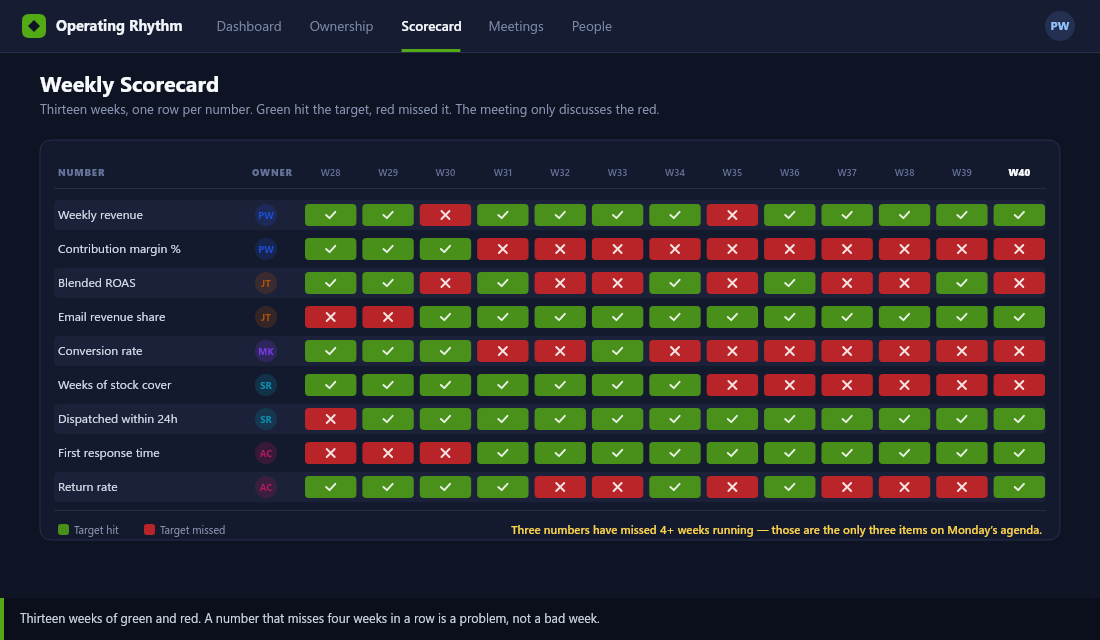
Thirteen weeks is the right length for a reason. One bad week tells you nothing — stock arrived late, a campaign was off, someone was on holiday. A run of four tells you something structural has changed. The grid makes that pattern visible without anyone having to argue for it.
Build it in a Google Sheet. Not a BI tool, not a new app. The scorecard needs to be somewhere every owner can update their own row in under two minutes, and the second it requires a login someone doesn’t have, it dies. Each owner fills in their own cells before the weekly meeting. That small act of self-reporting is doing more work than it looks like it is.
Step 5: Install the Meeting That Makes It Real
Ownership without a review rhythm decays inside a month. You need one recurring meeting, same time every week, 45 minutes, with a fixed structure:
- Scorecard read (10 minutes). Each owner reads their number and says hit or miss. No explanation yet. Just the number.
- Red only (25 minutes). Discuss only the numbers that missed, and only the ones that have missed more than once. Green numbers get no airtime at all. This is the discipline that keeps the meeting to 45 minutes.
- Owner actions (10 minutes). Each red number leaves with one action, one name and one date. Written down where everyone can see it.
Then layer the longer rhythms on top. Monthly, ask whether the right numbers are on the map and whether the targets are still correct. Quarterly, reassign ownership properly — as people grow, numbers should move off your list and onto theirs.
One warning. The first month feels brutal, because the scorecard shows a lot of red and people read that as a judgement on them. Say out loud in week one that red is information, not blame — the map exists so problems surface in week two instead of month five. Founders who skip that conversation get a team that quietly sets soft targets, and a scorecard that’s green and useless.
How Ownership Compounds
What changes first is your calendar. Numbers stop routing through you for interpretation, because someone else is already watching them and already has a view. The ad-hoc “can I grab you for a sec” traffic drops noticeably inside a month.
What changes next is speed. A slow decline in conversion rate used to surface when quarterly revenue came in soft. Now it surfaces on the fourth red week, from the person who owns it, with a plan attached. Problems get caught while they’re still cheap.
What changes last, and matters most, is your hiring. The ownership map tells you exactly which numbers have no home and exactly who is carrying too many. That turns “we probably need someone in marketing” into a role you can write a scorecard for, interview against and measure in ninety days.
And there’s the test that tells you it’s worked: take two weeks off. If the business runs without you, it’s because every number that matters had a name beside it that wasn’t yours.
Inside eCommerce Circle, People and Performance are two of the ten engines we work through with every member — because most founders don’t have a capacity problem, they have an ownership problem. If you want to see where your business is being capped, take the free More Orders Scorecard. It takes two minutes and shows you which of the 10 P’s to fix first.