Most Shopify founders write their job ad in twenty minutes. They open SEEK, copy the structure of the last ad they saw, paste in a list of “responsibilities” that reads like a photocopied position description, leave the salary blank, and hit publish. Then they wonder why 90 applications land in the inbox and maybe four of them are worth a phone call.
What’s in This Article
Here is the uncomfortable truth. The job ad is the first piece of marketing your future team member ever sees from you. You would never launch a product page with no price, a generic headline and a wall of bullet points. Yet that is exactly what most brands do when they hire, and it costs them the one thing money cannot easily buy back: a great operator who chose the other store instead.
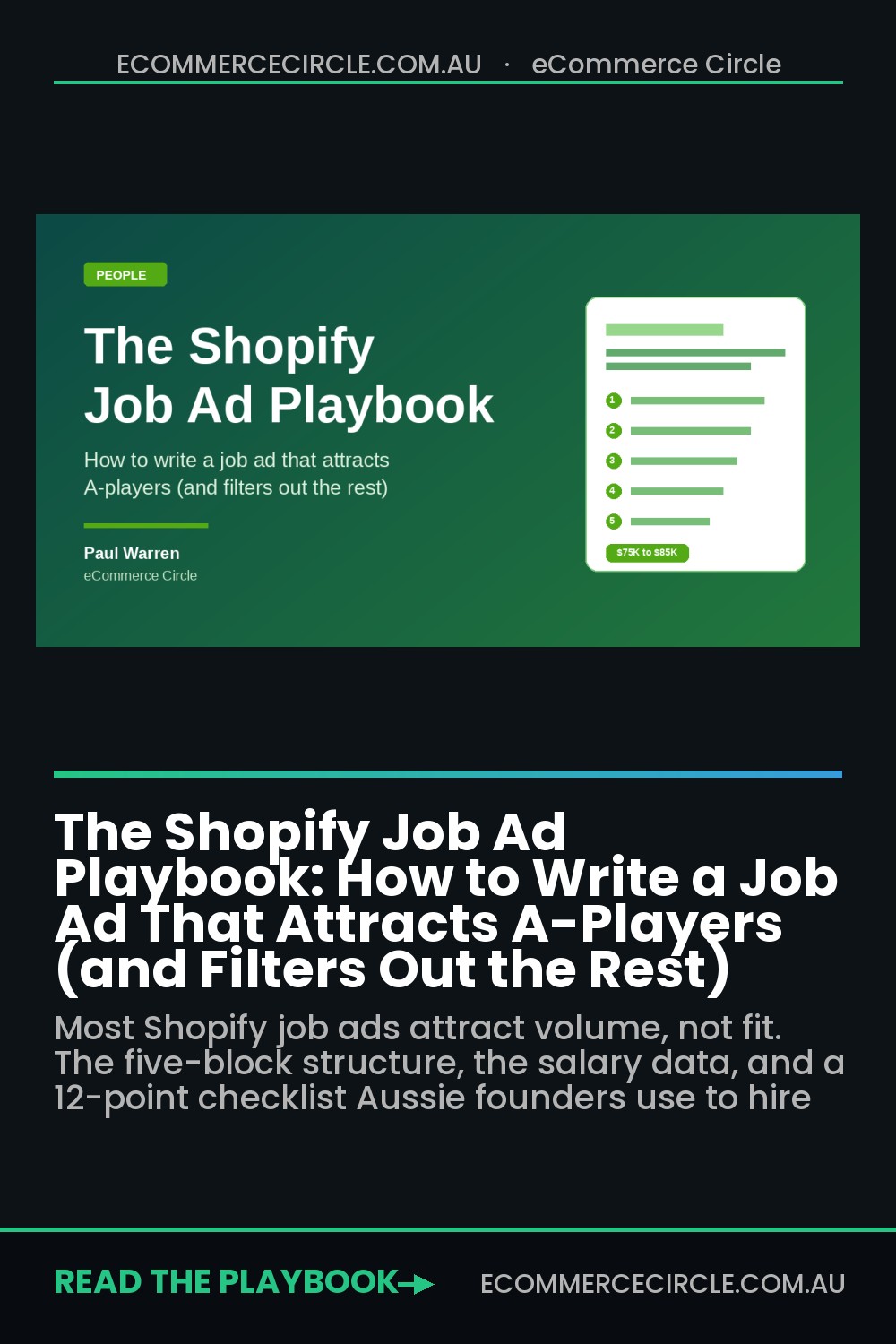
The brands that hire well treat the ad like a landing page. A sharp headline, a clear promise, a visible price, and a filter that quietly turns away the wrong people. Do it properly and the shift is measurable: SEEK’s own research found that simply showing the salary lifts applications by an average of 47%, and the calls you take are with people who already know the role fits. This playbook walks you through the exact structure, the numbers behind each decision, and a template you can paste into SEEK this afternoon.
Why Your Job Ad Is a Sales Page, Not a Form
Hiring in Australia right now is a strange mix. Jobs and Skills Australia’s Recruitment Experiences and Outlook Survey for the June quarter 2026 found that 48% of employers recruited during the quarter, and 44% of those recruiting reported difficulty filling vacancies. At the same time, SEEK reported through 2025 that applications per job ad were sitting at the highest level in its history, up more than 16% year on year in April 2025.
Read those two facts together and the picture is obvious. Founders are drowning in applications and still cannot find the right person. Volume is not your problem. Fit is. And fit is decided long before the interview, by the words you put in the ad.
A strong candidate is usually employed, scanning SEEK on their phone at 9pm, giving each ad the same few seconds they give a product on Instagram. Hiring experts consistently recommend a job ad of 300 to 600 words because that is all a good candidate will read before deciding whether to tap “Apply” or keep scrolling. If your ad opens with three paragraphs of “About Us” corporate history, you have already lost them.
So borrow the discipline you already use on your product pages. Every job ad needs a hook that names the outcome, a body that sells the day-to-day truthfully, social proof that you are a real and decent business, a price (the salary), and a clear call to action. The rest of this article builds each of those pieces in order.
Step 1: Write the Outcome Before You Write the Role
The single biggest mistake in Shopify job ads is describing tasks instead of outcomes. “Manage email marketing campaigns” tells a candidate nothing. “Take our Klaviyo flows from 18% to 30% of revenue within six months” tells them exactly what winning looks like, what tools they will use, and whether they are capable of it.
Before you open SEEK, write down three outcomes the hire must deliver in their first 90 days. Be specific enough that you could measure them on a dashboard. Some examples we see inside eCommerce Circle:
- Customer service lead. First response time under two hours on weekdays, review rating held above 4.7, and a macro library covering the top 25 ticket types built by day 60.
- Warehouse and dispatch. 99% of orders placed before 1pm shipped same day, pick error rate under 0.5%, and a weekly stock count SOP running without you.
- Ecommerce coordinator. Every new product live on the site within 48 hours of photography, collection pages merchandised weekly, and the promo calendar loaded four weeks ahead.
These outcomes do double duty. They become the opening block of your ad, and they become the interview scorecard later. If you have not built one yet, the Shopify Hiring Scorecard shows you how to turn the same three outcomes into a six-stage interview so you stop hiring on gut feel.
One more test. Would a strong operator be excited by these three outcomes, or bored? If bored, the role needs rethinking, not the ad. No copywriting fixes a job that is three unrelated chores stapled together.
Step 2: Win the First Eight Seconds With a Plain Title
Job boards are search engines. Candidates type “ecommerce coordinator Brisbane” or “customer service Shopify” and scan the results list. Your title has to match what they type, which means the best titles are the plainest ones.
Kill the creative labels. “Customer Happiness Ninja”, “Growth Wizard” and “Brand Storyteller” feel fun in the founder’s head, but nobody searches for them, and experienced people quietly read them as a sign the business does not know what it wants. Use the title the market already uses and put the hook in the first line of the body instead.
- Weak: “Ecommerce Superstar Wanted!”
- Strong: “Ecommerce Coordinator (Shopify) – Full Time – Melbourne, hybrid – $70K to $80K plus super”
- Weak: “Customer Experience Guru”
- Strong: “Customer Service Team Lead – Shopify DTC brand – Gold Coast – $75K to $85K plus super”
Notice the pattern. Role, platform, work type, location and pay range, all in the title. That is five filters a candidate applies before they even click, and you have answered all of them. The people who click through are already a fit on the basics. The people who bounce were never going to take the job anyway, and you just saved yourself the time of reading their CV.
Step 3: Put the Pay In (The Data Is Not Close)
This is where most Aussie founders flinch, so let’s deal with it head on. The fear is that a visible salary either scares off great people (too low) or creates awkward conversations with the existing team (too high). The evidence says the cost of hiding it is far larger than either of those risks.
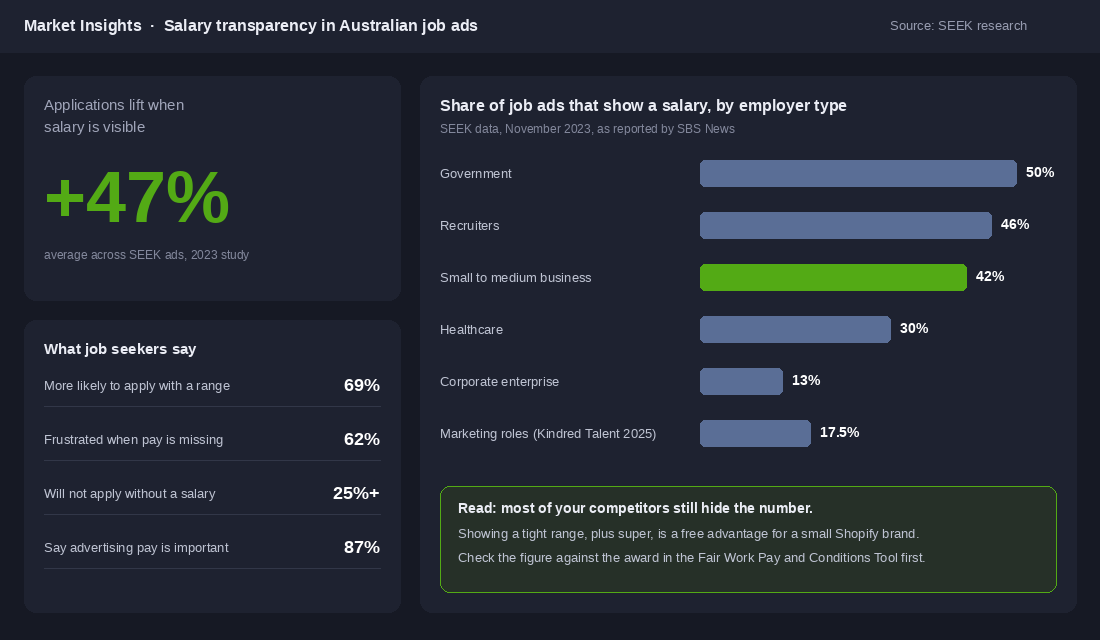
- 47% more applications. SEEK’s research found that ads with a visible salary receive on average 47% more applications than ads without one.
- More than 25% will not apply at all without a visible salary, and 69% of job seekers say they are more likely to apply when a range is listed, according to independent research commissioned by SEEK across 4,800 Australians.
- Your competitors are still hiding it. SEEK data reported by SBS News showed two-thirds of ads posted in November 2023 had no salary range, and small to medium businesses listed pay in only 42% of ads. A 2025 audit by Kindred Talent of 3,392 Australian marketing roles found just 17.5% showed the pay.
- Half of underperforming ads are priced below market. SEEK’s user experience team found that 50% of ads receiving fewer applications than comparable roles were advertised with a salary range below the market average. The problem was the number, not the transparency.
Put those together and salary transparency is one of the few real unfair advantages left in small-business hiring. Most of your competitors will not do it. The candidates want it. And the Fair Work Act now sits on the side of transparency: pay secrecy clauses have been banned in new contracts since December 2022, and any pay rate you do put in an ad must not be below the relevant award or agreement minimum. Check the number first using the Fair Work Ombudsman’s Pay and Conditions Tool at calculate.fairwork.gov.au, because “we thought it was above award” is not a defence.
How to set the range without blowing up your wage bill:
- Search SEEK for the same title in your city and note the ranges on the ads that do show pay. That is your market, not a global survey.
- Keep the range tight. A ten to fifteen thousand dollar spread reads as honest. “$60K to $110K” reads as “we have no idea what this job is.”
- Quote it the way Australians read it. “$75,000 to $85,000 plus super” is clearer than a total-package figure, and it avoids the candidate doing mental maths on the superannuation guarantee.
- Anchor to your pay structure, not to one candidate. If you want a system for this, the Shopify Compensation Playbook lays out the five-layer pay architecture we use with members so every role has a band before it is advertised.
Step 4: The Five-Block Job Ad Structure
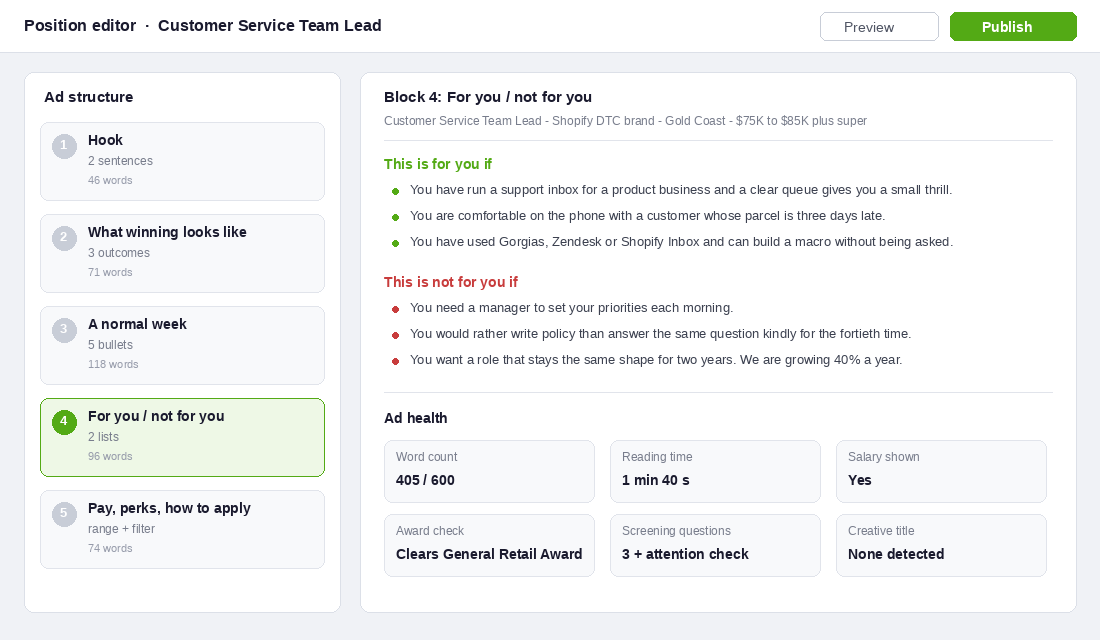
Here is the structure we hand members when they hire. It lands between 400 and 550 words, which is inside the range candidates will actually read, and every block has one job.
Block 1: The hook (two sentences). Who you are in plain language, what the role owns, and the one number that makes it real. “We are a Perth-based supplements brand doing around 600 orders a week on Shopify. You will run customer service end to end so our founder never touches the inbox again.”
Block 2: What winning looks like (three bullets). The three 90-day outcomes from Step 1. This block does more filtering than any other. Weak candidates skim past it. Strong candidates read it twice and start planning how they would do it.
Block 3: A normal week (four to six bullets). Honest, specific, tool-named. “Monday morning you will pull the weekend Gorgias queue and clear it by 11am. Tuesday you will sit in the 30-minute stock meeting with the founder and the warehouse lead.” Name Shopify, Klaviyo, Gorgias, Xero, whatever you actually use. Candidates who know those tools lean in. Candidates who do not will self-select out or tell you they are willing to learn, which is useful information either way.
Block 4: Who this is for, and who it is not for (two short lists). This is the block almost nobody writes and it is the one that saves you the most time. “This is for you if you have run a support inbox for a product business and you get a small thrill from a clear queue. This is not for you if you need a manager to set your daily priorities, or if you dislike talking to customers on the phone.” Being candid about the downsides is not negative. It is respect, and good people notice it.
Block 5: Pay, perks, and how to apply (short and exact). The range plus super. The real perks (hybrid days, product allowance, the 4pm Friday finish). Then the application instruction with a filter built in, which we cover next.
Two things to leave out. First, the ten-paragraph company history. A single sentence about what you sell and how long you have been going is plenty; the rest lives on your About page, and they will read it if they are interested. Second, the “must have five years’ experience and a bachelor’s degree” list. In ecommerce that list screens out exactly the scrappy, self-taught operators who tend to be your best hires. Ask for outcomes they have achieved, not years they have served.
Step 5: Build Filters Into the Application Itself
A good ad attracts more of the right people. A good application process removes the wrong ones before you spend a minute on them. With applications per ad at record highs, this step is what protects your calendar.
- Ask two or three real screening questions. Not “why do you want to work here?” but “Tell us about a support queue or a store you have run. What was the volume, what tools did you use, and what did you improve?” A candidate who cannot answer that in five lines has not done the job.
- Use an attention check. Ask applicants to start their cover note with a specific word, or to name their favourite product on your site. It sounds trivial. It removes the 30 to 40% of applicants who fire off the same CV to sixty ads without reading any of them.
- Set a small, relevant task at the second stage. Before a formal interview, send shortlisted candidates a 30-minute task that mirrors the role: rewrite three support replies, merchandise a collection from a spreadsheet, or draft a week of email subject lines. Pay them for anything longer than an hour. The Paid Trial Test walks through how to run this properly so it is fair to them and decisive for you.
- Reply to everyone, quickly. An automated “we have received your application and will be in touch by Friday” costs nothing and protects your brand. Remember that in a DTC business your applicants are often also your customers.
One benchmark to hold yourself to: a well-built ad and filter should give you a shortlist of five to eight qualified people from the first 40 to 60 applications, and you should be able to get there in under two hours of reading. If you are spending a full day sorting applications, the ad is doing too little of the work.
Where to Post, and What Two Aussie Brands Get Right
Post the ad on SEEK first. For Australian ecommerce roles it is still where most serious candidates look, and its salary and location filters reward the plain-title approach from Step 2. Add LinkedIn for marketing and management roles, and Indeed for warehouse or retail staff. Then do the thing most founders forget: post it to your own audience. Your email list, your Instagram stories, and your customer base are full of people who already love the product. A short “we’re hiring” email to your subscribers regularly outperforms a paid job board for culture fit, because the applicants arrive already knowing what you sell and why.
Two Australian brands are worth studying because their careers pages do the hard part before the ad even appears.
Who Gives A Crap (Melbourne-founded, now a distributed team) runs a careers page headed “Come join the fold” that leads with its 50% profit donation to sanitation projects, its B Corp certification, and five named values: Give a crap, Deliver & delight, Kembot, Progress over perfection, and Go big. By the time a candidate reaches the actual ad on its Greenhouse job board, they already know whether the mission and the humour suit them. That is Block 4 of our structure, done at the brand level.
LSKD (Loganholme, Queensland) opens its careers page with a single question, “Are you hungry, humble and smart?”, then splits roles into three clear tracks: in-store and community, distribution centre, and HQ. The “1% better every day” line that runs through its marketing runs through its hiring too. It is not fancy. It is consistent, and consistency is what makes a candidate trust that the ad and the workplace are the same thing.
You do not need a careers site to copy either of them. One honest paragraph about what you stand for, in every ad, puts you ahead of most of SEEK.
The Tool Stack: Set Up a Lightweight Hiring Pipeline in an Afternoon
You do not need enterprise recruitment software. You need somewhere for applications to land that is not your personal inbox, a way to reply automatically, and a simple pipeline so nobody falls through the cracks. Breezy HR is the tool we point most members to because its free plan covers one open role, which is exactly what a small brand usually has. Here is the setup.
- 1. Create your account and company profile. Add your logo, a two-sentence description of the brand, and a link to your store. This becomes the header on your hosted careers page.
- 2. Create the position. Paste in the five-block ad from Step 4. Set the location, work type and salary range fields, because Breezy pushes those to the free job boards it syndicates to and the boards use them as filters.
- 3. Add your screening questions to the application form. Two or three short-answer questions plus the attention check. Mark the attention-check question as required.
- 4. Set the pipeline stages. Keep it simple: Applied, Screened, Task sent, Interview, Reference check, Offer. Drag candidates across as they move so you and anyone helping you can see the whole picture.
- 5. Write the automatic acknowledgement email. Thank them, tell them the date they will hear back, and sign it with a real name.
- 6. Post the SEEK ad separately and point its “apply” link to the Breezy application page so every applicant lands in one pipeline regardless of where they found you.
Before you publish, run the pay figure through the Fair Work Pay and Conditions Tool to confirm it clears the award, and save the screenshot. It takes three minutes and it means the number in your ad is one you can defend.
How It All Compounds
None of these steps is dramatic on its own. Together they change the economics of every hire you make. The outcome-first block means the right candidates recognise the job. The plain title and visible pay mean more of them find it and apply. The honest week-in-the-life and the “not for you” list mean the wrong ones opt out before they cost you an hour. The screening questions and task mean your shortlist arrives pre-qualified. And the pipeline tool means the whole process runs the same way next time, whether you are hiring or a team lead is.
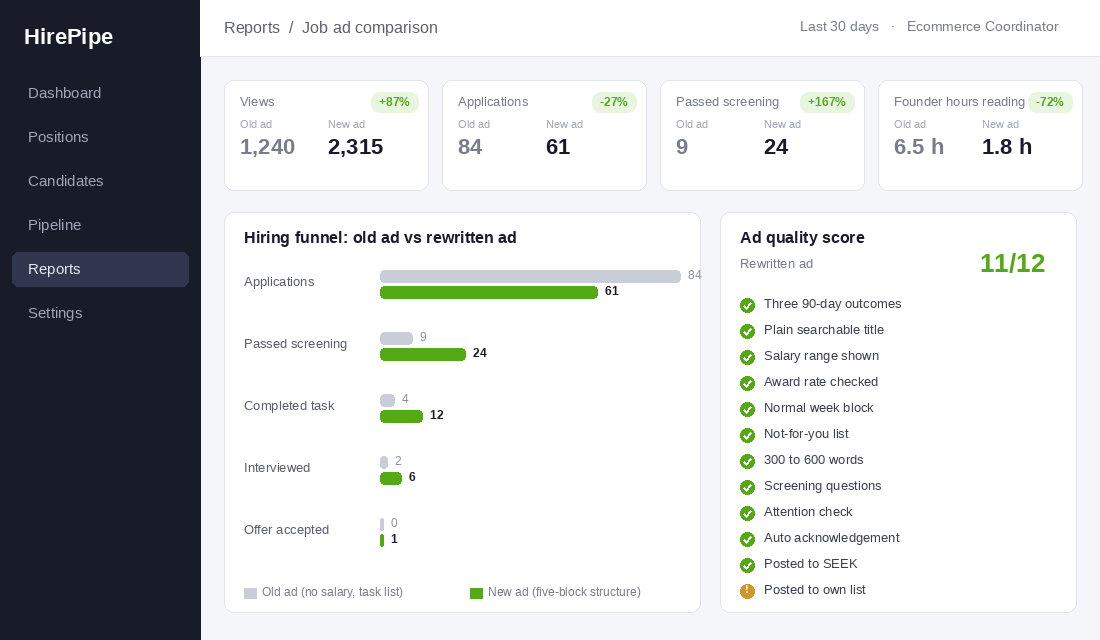
Here is what that looks like in practice for a brand we coached through a customer service hire earlier this year. The first ad, written the old way, pulled 84 applications and produced two interviews, neither of whom accepted. The rewrite using this structure pulled 61 applications, 11 of which passed the screening questions, six did the task, three were interviewed, and one started three weeks later. Less volume, far less founder time, and a hire who is still there. That is the pattern we see over and over: the ad does the filtering, so the founder does the choosing.
Then the work shifts to keeping them. A great ad sets expectations that the first month has to meet, which is why the 30-Day Onboarding Playbook is the natural next read once the offer is signed.
The 12-Point Job Ad Checklist
Run every ad through this before it goes live. If you cannot tick all twelve, it is not ready.
- 1. Three measurable 90-day outcomes written before the ad.
- 2. Plain, searchable title with role, platform, work type, location and pay.
- 3. Opening sentence says what the role owns and includes one real number about the business.
- 4. Salary range shown, plus super, spread of no more than fifteen thousand dollars.
- 5. Pay checked against the award in the Fair Work Pay and Conditions Tool.
- 6. A “normal week” block that names the actual tools and rhythms.
- 7. A “this is not for you if” list with at least two honest items.
- 8. No creative titles, no years-of-experience gate, no degree requirement unless legally required.
- 9. Total length between 300 and 600 words.
- 10. Two or three screening questions and one attention check in the application form.
- 11. Automatic acknowledgement email with a reply-by date.
- 12. Posted to SEEK and to your own customer list on the same day.
Inside eCommerce Circle, People is one of the 10 P’s we work on with every member, and the job ad is where most hiring problems quietly begin. If you want to see exactly where your store is being capped, take the free More Orders Scorecard. It takes two minutes and shows you which of the 10 P’s to fix first.