Open up the product page on a typical $1m Aussie Shopify store. Scroll past the gallery. What do you see?
What’s in This Article
A 60-word paragraph that opens with “Introducing our newest…” or “Our premium range of…” Three bullet points listing the material, the dimensions, and the wash instructions. A “View Full Description” toggle that nobody clicks. Reviews stuck somewhere below the fold.
That product page is leaking sales every single day. Not because the photography is bad. Not because the price is wrong. Because the copy reads like a spec sheet wrote it, not like a human wrote it for another human.
Baymard found that 10% of ecommerce sites have product descriptions so thin they can’t give shoppers the confidence to add to cart. That number sounds small until you realise it represents roughly one in ten product views. For a $1m brand sending 200,000 sessions a quarter to product pages, you’re losing buyers on tens of thousands of those visits. The fix isn’t more copy. It’s better-structured copy. Brands that move from generic descriptions to a deliberately structured PDP system regularly see conversion lifts of 25 to 40%, with headline changes alone moving add-to-cart rates 20 to 30%. The maths is brutal once you do it.
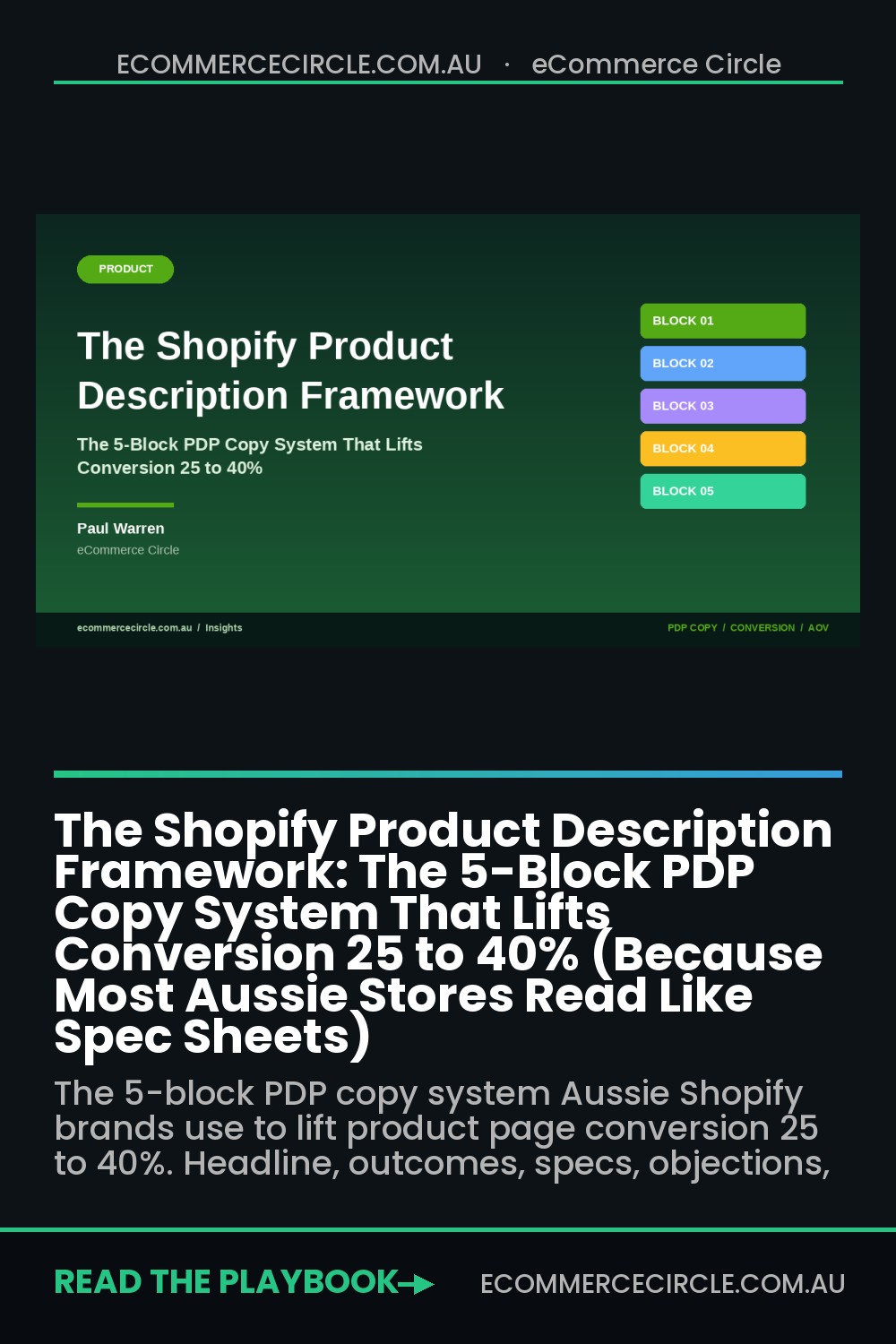
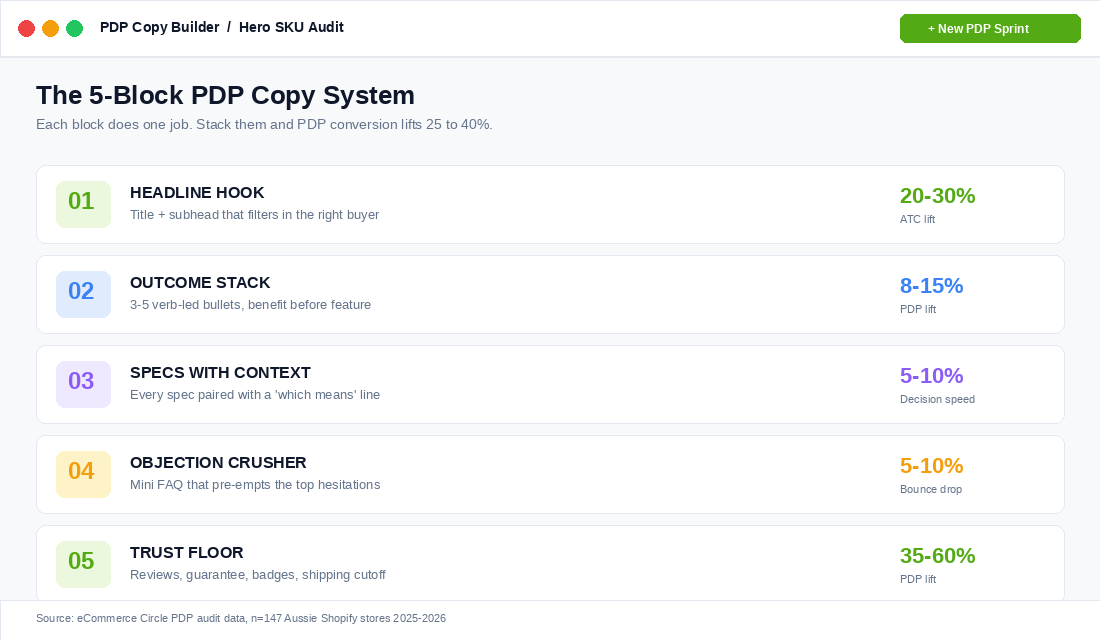
The good news: there’s a repeatable framework. Five copy blocks, in a fixed order, each doing one job. Plug it in and your PDP stops reading like a packing slip and starts reading like a salesperson who actually knows the product. Here’s the system.
Why Most Shopify Product Descriptions Fail
Before we get to the system, you need to know why your current descriptions are underperforming. Most Aussie founders write PDP copy in one of three broken ways.
The first is the manufacturer mode. You copy whatever the supplier gave you in the wholesale catalogue. The result is generic, feature-led copy that any of your competitors selling the same SKU could publish word-for-word. Google penalises duplicate content, and customers can’t tell why your listing matters more than the next.
The second is the founder voice mode. You wrote it yourself in 15 minutes after a long day in Notion, and it reads like an Instagram caption. Charming, but it doesn’t answer the questions a buyer needs answered before they tap Add to Cart. Personality is great. Personality without information is just noise.
The third is the everything-and-the-kitchen-sink mode. You hired a copywriter who wrote 800 words of beautiful prose about heritage and craftsmanship. The buyer scrolls, gets overwhelmed, and bounces. According to Baymard’s mobile usability research, 70% of Shopify traffic is mobile, and mobile shoppers scan, they do not read. Walls of text die on mobile.
The 5-Block system fixes all three. It gives you structure (so you know what each block is for), specificity (so each block is doing one job well), and scanability (so the mobile shopper can extract what they need in 8 seconds without giving up).
The 5-Block PDP Copy System: Overview
Every product page on every Shopify store should have these five blocks, in this order, doing these jobs:
- Block 1: The Headline Hook. A title and subhead that makes the right buyer recognise themselves and stops the wrong buyer from clicking Add to Cart. The headline is doing 80% of the work.
- Block 2: The Outcome Stack. Three to five benefit-first bullets that paint the picture of life with the product, not the technical spec of the product itself.
- Block 3: The Specs With Context. The features. Materials, dimensions, ingredients. But each spec is paired with a ‘which means’ line that turns it into a benefit.
- Block 4: The Objection Crusher. A short FAQ block that pre-empts the three to five things that stop buyers from clicking Buy. Sizing, shipping, returns, comparison.
- Block 5: The Trust Floor. Reviews summary, guarantees, badges, and social proof, anchored at the bottom of the description block (above the fold for the gallery, but below the buy box on mobile).
Each block is short. Each block is scanable. Each block has a single job. When you stop trying to make one paragraph do all five jobs at once, every block gets sharper. Conversion follows.
Let’s go through them one at a time.
Block 1: The Headline Hook (the Sentence That Decides Everything)
The product title is the most undervalued field on a Shopify product page. Most Aussie brands set it once during product upload and never touch it again. That’s a mistake worth thousands of dollars a month.
Your title plus the one-line subhead under it are doing three jobs at once. They confirm to the buyer that this is the product they searched for. They communicate the single sharpest reason this product matters. And they filter out shoppers who would have bounced or returned the product, which protects your conversion rate and your margins.
The framework is simple. Title: what the product is, plus the one descriptor that matters most to the buyer. Subhead: the outcome the buyer gets, in their language. Not yours.
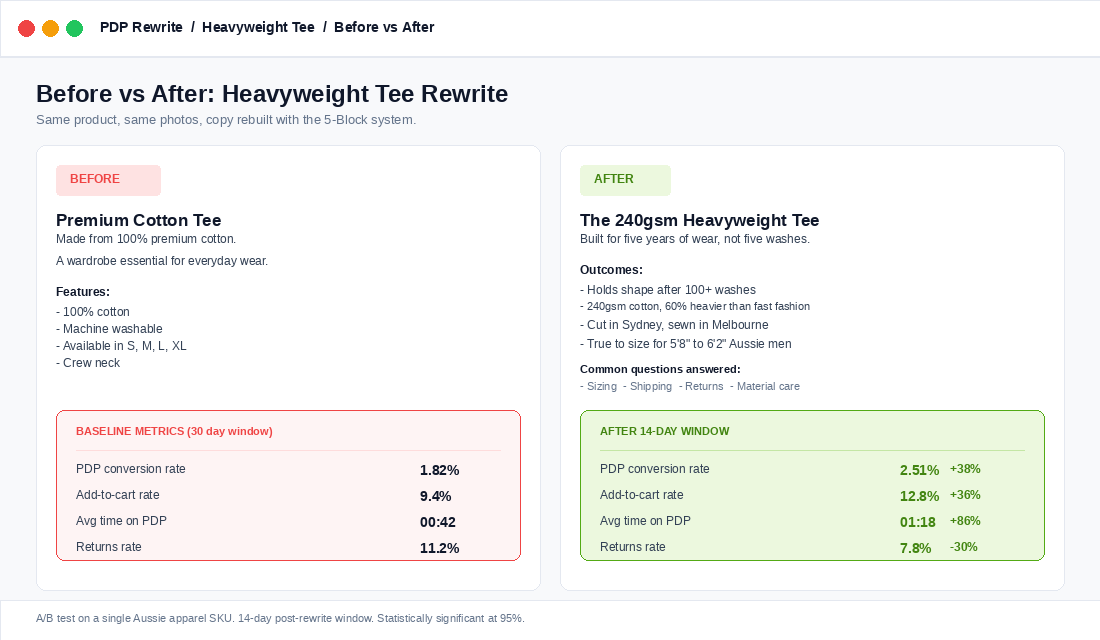
Bad headline: “Premium Cotton Tee.”
Better headline: “The Heavyweight 240gsm Tee. Built for Five Years of Wear, Not Five Washes.”
The first version says nothing. The second tells you the weight (a buying signal cotton shoppers care about), positions it against fast-fashion competitors, and sets the durability expectation upfront. A buyer who wants a $15 tee bounces. A buyer who wants a tee they can wear for years adds to cart. Your refunds drop. Your reviews get better. Your conversion rate goes up.
Frank Body, the Aussie scrub brand, do this brilliantly. Their PDP titles read like a friend describing the product over coffee. “The Original Coffee Scrub. The OG that started the whole thing.” That’s voice plus positioning plus origin story in 12 words.
Here’s the test. Cover the photo on your product page and read just the title and subhead. If a stranger couldn’t tell you what the product does, who it’s for, and why it’s better than the next one Google shows them, your headline isn’t working hard enough. Rewrite it.
Block 2: The Outcome Stack (Show the Life, Not the Spec)
Here’s where most product descriptions die. They tell you what the product is made of when the buyer wants to know what the product will do for them.
The Outcome Stack is three to five short, punchy bullets that describe what the buyer’s life looks like once they own the product. Not the materials. Not the features. The outcome.
The structure for each bullet is a verb-led benefit, followed by the proof point that backs it up.
For example, instead of “Made with German-engineered ceramic burrs”:
“Pulls a barista-grade espresso shot in 28 seconds. The German ceramic burrs grind 40% finer than steel, which is why your shot tastes like the cafe instead of the office.”
That bullet is doing five things. It promises an outcome (cafe-grade espresso). It quantifies the outcome (28 seconds). It introduces the spec (German ceramic burrs). It explains why the spec matters (40% finer grind). And it lands the emotional payoff (your shot tastes like the cafe).
Most Shopify brands write a bullet that says “Made with German ceramic burrs” and stop. They’ve delivered the feature and not the outcome. The buyer reads it and thinks “OK, but what does that mean for me?” The buyer who has to translate features into benefits in their head is the buyer who closes the tab.
Three to five bullets is the sweet spot. Less than three and the description feels light. More than five and you’ve crossed into wall-of-text territory. Each bullet should be 15 to 30 words. Each should lead with the outcome and back it with one specific proof point. No more.
Block 3: The Specs With Context (Where the Buyer Validates Their Decision)
Once the headline has hooked them and the outcome stack has them imagining the win, the buyer’s brain switches to validation mode. They want to know the technical details. The fabric weight. The wattage. The dimensions in centimetres. The ingredients. The country of origin.
Most Aussie brands handle this stage by dumping a bulleted spec list. That’s fine. The mistake is leaving the specs naked. A spec without context is a number the buyer has to interpret on their own. A spec with context is a buying argument.
The pattern is the Spec, Comma, Which Means structure. Every spec gets paired with a one-line benefit that explains why the buyer should care.
- Cotton GSM 240, which means it’ll outlast the $15 fast-fashion tees you keep replacing every six months.
- 4,000mAh battery, which means a full day of mobile work without hunting for an outlet.
- Cold-pressed Australian olive oil base, which means no synthetic fragrances and a shelf life of 18 months.
This block is also where you should publish the comparison data your buyer is going to Google anyway. If you sell a coffee machine and your closest competitor is the Breville Barista Express, address it. Don’t pretend the comparison doesn’t exist. State your machine’s pressure, grind range, and milk-frothing time alongside the equivalent specs from the Breville. Buyers respect brands that don’t make them open a second tab.
Aussie brand Hismile uses this beautifully on their teeth-whitening kits. They list the active ingredient (PAP+), the percentage, and then add “the same active used in dental clinics, but at home-use strength so it doesn’t dehydrate enamel.” The buyer doesn’t need to Google PAP+ to make a decision.
Block 4: The Objection Crusher (Stop the “Yeah But…” Before It Starts)
Every product has a list of objections that stop people from buying. You can hear them in your customer service inbox, in your live chat transcripts, and in the comments under your Meta ads. The brands that handle objections in the PDP itself convert way better than the ones that make the buyer go searching.
The Objection Crusher is a short FAQ block, three to five questions deep, that pre-empts the most common reasons buyers hesitate. It sits inside the product description, not on a separate FAQ page nobody finds.
The framework: open your customer service inbox, search for the SKU you’re rewriting, and pull out every question that came in about that product in the last 90 days. The questions that show up three or more times are your FAQ. Write the answer in the buyer’s words, not yours.
Categories to cover:
- Sizing or fit. “I’m 5’8″ and a size 10. Which size fits me?” The answer should reference real customer body types, not a chart with abstract measurements.
- Shipping and delivery. “How long will this take to get to Perth?” Answer with a specific number of business days, not “fast shipping Australia-wide.”
- Returns. “What if it doesn’t fit?” Answer with the exact policy in plain English, not legalese.
- Comparison. “How is this different from [competitor product]?” Answer honestly with the specific differentiator that matters to your buyer.
- Use case edge. “Can I use this for [unusual use case]?” Answer based on actual customer feedback.
Aussie brands like Bondi Sands, Modibodi, and Who Gives A Crap put their FAQ block right inside the description, often as a collapsible accordion. Buyers tap the question they care about. They get a one-paragraph answer. They make the decision faster. Conversion rate climbs.
The compound effect of an Objection Crusher is also that you’ll see your support ticket volume drop. The questions stop hitting your inbox because the answers are now on the page. Your team gets more time back. Your buyer gets answered without waiting. Win-win.
Block 5: The Trust Floor (the Final Push)
The buyer has now scanned the headline, read the outcomes, validated the specs, and resolved their objections. They are seconds away from the Add to Cart click. The Trust Floor is what tips them over.
Five elements belong here:
- Star rating with review count. Not just the star rating. The number of reviews. Five stars from 12 reviews is suspicious. Five stars from 847 reviews is irresistible.
- One social-proof quote pulled from a verified review. Pick a review that hits the strongest objection. If your biggest sales objection is durability, pick the review that says “still wearing it three years later.”
- Guarantee or warranty statement. “30-day money-back guarantee, no questions asked” reduces the perceived risk to zero. Quantify the guarantee.
- Trust badges. Afterpay, Shop Pay, secure checkout, Australian-owned. Visual trust signals that take half a second to absorb.
- Live shipping confirmation. “Order in the next 4 hours and 23 minutes for next-business-day delivery to Sydney.” Urgency without being slimy. Real, not invented.
The reviews integration alone, when done well, has been shown in published case studies to lift PDP conversion by 35 to 60%. Pulling reviews into the page in a structured, visible way is one of the highest-impact changes you can make. If you haven’t already, this is the time to revisit how your store actually collects and displays reviews. Our Shopify Reviews Engine guide walks through the 5-stage system that fills your PDP with verified social proof on autopilot.
Where the Words Actually Come From: The Voice of Customer Method
A big mistake Aussie founders make when rewriting PDPs is sitting down with a blank Google Doc and trying to invent the copy from scratch. Don’t.
The best PDP copy is not invented, it is mined. The exact words your customers use to describe the product, in reviews, in customer service emails, in Instagram DMs, in chat transcripts: those words are gold. Your job as the founder is to pull them out, organise them, and put them on the product page.
The five sources to mine:
- Reviews on your own store. Especially the long-form reviews and the one-star reviews. The five-star reviews tell you what to highlight. The one-star reviews tell you what objections to address.
- Reviews on Amazon and competitor sites. Your category competitors have already done the customer research for you. Read their five-star and one-star reviews and extract the patterns.
- Customer service transcripts. The questions people ask before they buy are the FAQ block writing itself.
- Meta and TikTok ad comments. The phrases that show up in comments are the phrases that resonate with your audience. Steal them shamelessly.
- Returns reasons. Every return is a customer telling you what the product description failed to communicate. Fix the description, the return rate drops.
Run a 30-minute mining session for each SKU you’re rewriting. Open a Google Doc, paste in the raw text from each source, and highlight every phrase that uses your buyer’s specific language. Those phrases become your headline, your outcome stack, your FAQ. The PDP basically writes itself.
This is the same Voice of Customer methodology we run with brands inside the workshop. For the longer playbook on systematising this across your business, see our Voice of Customer Research guide which walks through the 5-channel mining system.
The Compound Effect: When the 5 Blocks Work as One System
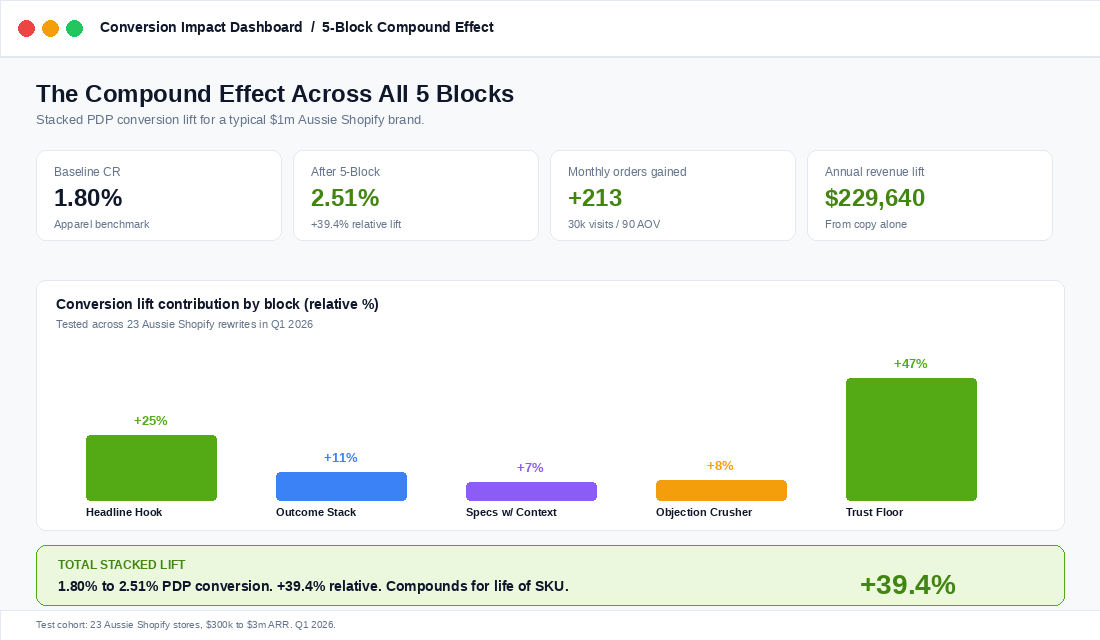
The reason the 5-Block system outperforms ad-hoc copy is the compound effect. Each block alone gives you a small lift. All five working together gives you something closer to a 25 to 40% PDP conversion improvement, depending on your starting point.
Here’s the maths.
A baseline PDP might convert 1.8% (the Shopify average for fashion and apparel). Add a sharper headline that lifts add-to-cart by 20%. Add a benefits-first outcome stack that lifts by another 8%. Add objection-crushing copy that recovers 5 to 10% of buyers who would have bounced. Add a properly integrated review block that adds 15 to 25%. Stacked together, your PDP could be converting 2.4 to 2.7%. That’s a 30 to 50% relative lift, achieved with copy alone, no new ad spend, no design overhaul.
If you’re a $1m Aussie Shopify brand running 30,000 PDP visits a month, a lift from 1.8% to 2.5% is roughly 210 extra orders per month at a $90 AOV. That’s $18,900 a month, or $226,800 a year, in pure incremental revenue. From rewriting the words on your product pages.
That’s why the PDP copy rewrite sits in the top three highest-impact projects we recommend brands tackle inside the workshop. Most founders treat copy as a soft, opinion-based exercise. The data says it’s one of the hardest, most measurable levers you have.
For the broader product page picture, including how copy interacts with photography, pricing, and structural elements like badges and recommendations, our Shopify Product Page Optimisation 7-Layer Anatomy is the companion piece to this article.
The 90-Minute PDP Rewrite Sprint (Your Action Plan)
Reading a framework is not the same as shipping the rewrite. Here’s the exact 90-minute sprint to take one of your hero SKUs and run it through the 5-Block system this week.
Minutes 0 to 15: Voice of customer mining. Open the chosen SKU. Pull the last 30 reviews, the last 20 customer service emails, and the last 50 Meta ad comments. Highlight every recurring phrase.
Minutes 15 to 30: Headline rewrite. Draft three headline variants using the formula. Pick the one that filters in the right buyer and filters out the wrong one. Write the matching subhead.
Minutes 30 to 45: Outcome stack. Write three to five outcome bullets using the verb-led benefit plus proof point structure. Trim ruthlessly.
Minutes 45 to 60: Specs with context. List the technical specs. For each one, add the “which means” line. Cut anything that doesn’t matter to the buyer.
Minutes 60 to 75: Objection crusher. Use your support inbox. Pull the five questions that came up most in the last 90 days. Write the one-paragraph answer for each.
Minutes 75 to 90: Trust floor. Confirm the review widget is showing star rating plus count. Pull one quote that hits the biggest objection. Add the guarantee line. Confirm the trust badges. Confirm the shipping cutoff is dynamic.
Once you’ve shipped the rewrite, set a calendar reminder for 14 days later to check the data. Compare add-to-cart rate, PDP conversion rate, and revenue per visitor against the prior 14 days. The lift will be obvious. If it isn’t, look at which block needs more work and iterate.
Do this for your top five SKUs by traffic and you’ll have rewritten the pages that drive 60% to 80% of your revenue. That’s a half-day project for an Aussie founder with the operating upside of a six-month uplift in conversion rate.
A Note on AI Copy Tools
Every Aussie founder is asking the same question right now: can I just paste this framework into ChatGPT and have it write all my PDPs?
The honest answer is yes, with a caveat. AI tools like Shopify Magic, Stormy, and ChatGPT will produce a competent first draft if you feed them the framework, your product specs, and the voice-of-customer phrases you mined. They will not, on their own, write a PDP that beats your competitors.
The reason is that AI defaults to averages. It pulls from the millions of generic product descriptions on the internet and produces something that is mathematically average. Your job is to take the AI draft and inject the three to five specific phrases, voice-of-customer mining, and Australian context that the AI doesn’t have.
Use AI as the typist. You are still the editor. The AI handles the 70% of the work that’s structural. You handle the 30% that’s the difference between a description that sounds like every other store and one that sounds like yours.
Getting It Live
Inside eCommerce Circle, the PDP copy rewrite is one of the first projects we run with new members because the lift is fast and the maths is undeniable. If you want a second opinion on your top five SKUs and the framework applied to your specific category, let’s talk.
Stop letting your product pages read like spec sheets. Five blocks. One sprint per SKU. The conversion lift compounds for the life of the product.
Related Reading
- Shopify Homepage Design: The Conversion Framework Top Stores Use to Turn Browsers Into Buyers
- Shopify Theme Customisation: How to Make Your Store Look Premium Without Hiring a Developer
- 7 Shopify Conversion Killers Costing You Sales Right Now (And How to Fix Each One)