BFCM 2025 is done. The brands that crushed it didn’t start planning in November. They started in September. And right now, while your competitors are still coasting on their Q1 plans, the smartest Shopify brands are already mapping out their BFCM 2026 strategy.
What’s in This Article
Here’s the reality: BFCM typically generates 20-30% of an ecommerce brand’s annual revenue in just four days. For a store doing $80K/month normally, a well-executed BFCM can deliver $60K-$100K in a single weekend. But that kind of result doesn’t happen by slapping a 20% off code on your site on Black Friday morning. It happens through 90 days of deliberate preparation.
This playbook gives you the exact execution plan — week by week, task by task — from September 1 through Cyber Monday. Follow it, and you’ll have your biggest BFCM ever.
Phase 1: Build (September 1 – September 30)
September is strategy month. No campaigns launch. No emails go out. This is when you lay the foundation that everything else builds on.
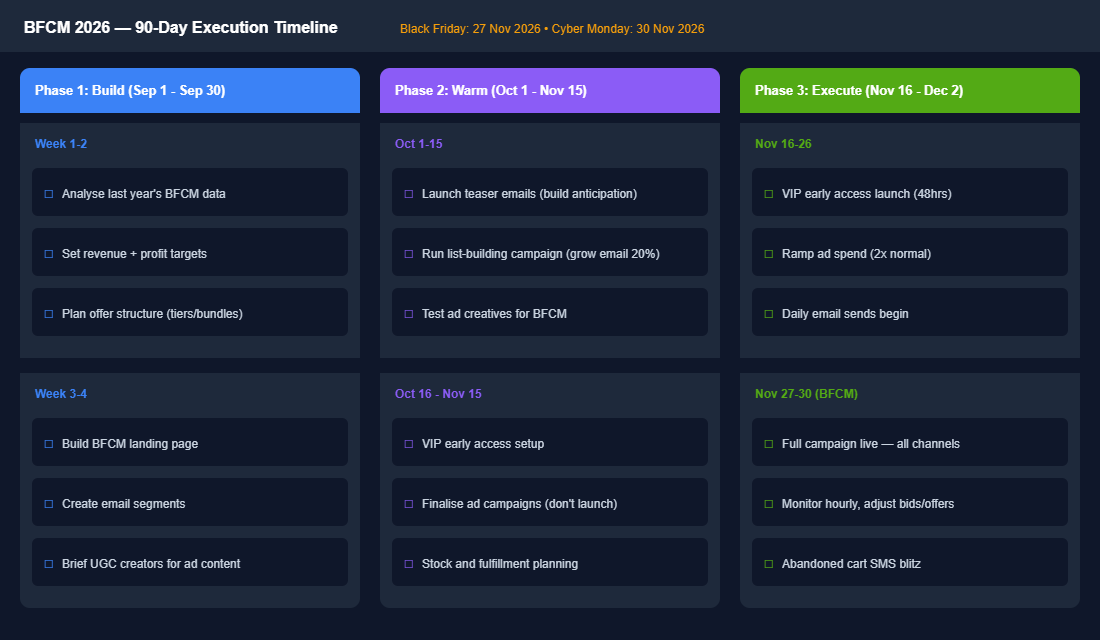
Week 1-2: Analyse and Plan. Pull your BFCM 2025 data: total revenue, top-selling products, email performance, ad ROAS, conversion rate, average discount given. What worked? What flopped? Set specific targets for 2026 — not just “more revenue” but exact numbers: “$85K BFCM revenue at 22% net margin.” Then plan your offer structure (more on this below).
Week 3-4: Build Assets. Create your BFCM landing page (it doesn’t go live yet — just built and ready). Segment your email list into VIPs (top 20% by LTV), engaged subscribers (opened in last 90 days), and the rest. Brief your UGC creators or content team on BFCM ad creative — you need assets ready by mid-October, not mid-November.
Your Offer Structure: Don’t Just Discount
The biggest mistake brands make on BFCM? Running a flat sitewide discount and calling it a strategy. A tiered offer structure generates more revenue, protects margin, and creates multiple reasons for customers to buy.
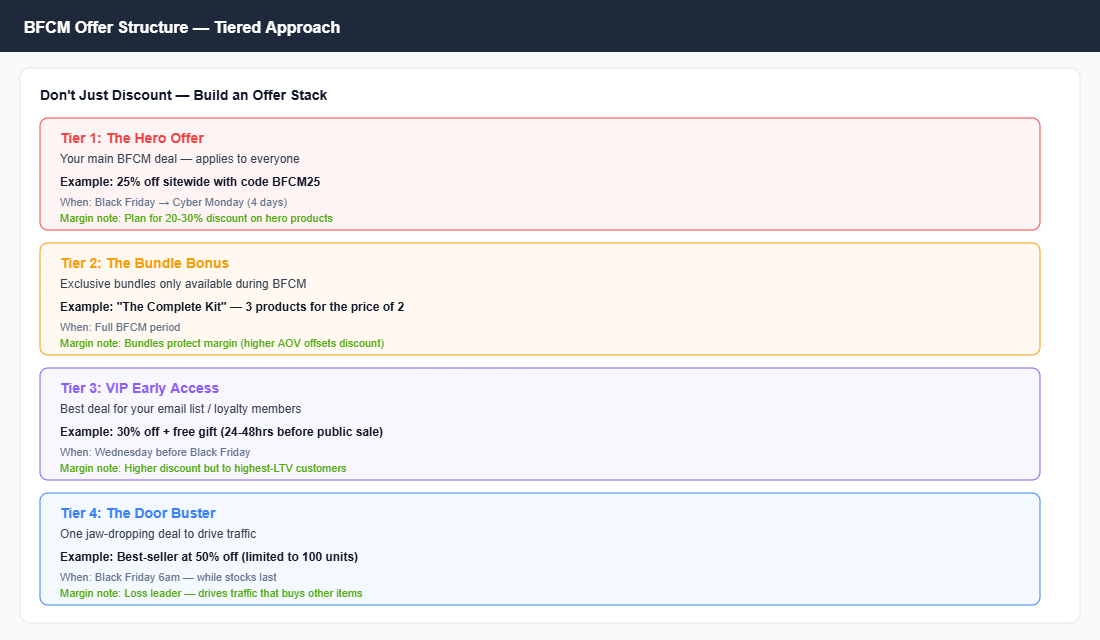
Tier 1: The Hero Offer — Your main deal that applies to everyone. Keep it simple: “25% off sitewide” or “Up to 30% off.” This is your traffic driver. Tier 2: The Bundle Bonus — BFCM-exclusive bundles that aren’t available any other time. “The Complete Skincare Kit — 3 products for the price of 2.” Bundles increase AOV and protect margin because customers perceive the discount without you giving away as much. Tier 3: VIP Early Access — Your email list and loyalty members get in 24-48 hours before the public sale, with a slightly better deal (30% off + a free gift). This rewards your best customers and generates early revenue. Tier 4: The Door Buster — One jaw-dropping offer on a hero product (50% off, limited to 100 units). This drives traffic and media attention. Most door buster buyers add other items to their cart at regular BFCM pricing.
Phase 2: Warm (October 1 – November 15)
This phase is about building anticipation and growing your audience before the sale starts. The brands that win BFCM have the biggest, most engaged audience going into the weekend.
October 1-15: List Building Blitz. Run a dedicated email list growth campaign. Use a lead magnet (“Get early access to our BFCM sale — sign up now”), Instagram giveaways, and pop-ups with BFCM-specific messaging. Target: grow your email list by 20% in 6 weeks. Every new subscriber is a potential BFCM customer.
October 15 – November 1: Creative Testing. Launch your BFCM ad creatives in “test mode” — small budget ($20-30/day per creative) to find winners before you need to scale. Test at least 8-10 different creatives: UGC unboxings, product demos, testimonial compilations, and offer-focused static ads. By November 1, you should know your top 3-4 performers.
November 1-15: Final Preparation. Confirm inventory levels for your top 20 products (the ones that’ll drive 80% of BFCM revenue). Set up your email sequences in Klaviyo — all 10-12 emails drafted, designed, and scheduled. Prepare your ad campaigns in Meta Ads Manager but don’t launch yet. Test your site speed under load. Brief your customer service team (or VA) on expected volume and BFCM policies.
Phase 3: Execute (November 16 – December 2)
This is when everything you’ve built comes to life. The execution phase has two sub-phases: the warm-up week and BFCM weekend itself.
November 16-25: The Warm-Up. Start sending teaser emails — “Something big is coming” — to build anticipation. Launch your VIP early access sign-up. Begin ramping ad spend (increase by 20% per day, not all at once). Create urgency without revealing the full offer yet.
November 25 (Wednesday): VIP Early Access. Your email list and loyalty members get first access. This typically generates 30-40% of total BFCM revenue because these are your warmest customers. Send email + SMS simultaneously for maximum impact.
November 27 (Black Friday): Full Launch. All campaigns go live. All channels firing. This is your highest-spend, highest-return day of the year. Monitor performance hourly — adjust ad bids, send additional email pushes if engagement is high, and activate your abandoned cart SMS sequence with a tighter window (2 hours instead of 24).
The BFCM Email Calendar: 12 Emails That Drive Revenue
Email is your highest-ROI channel during BFCM. You should be emailing daily (sometimes twice) during the sale period. Yes, that feels like a lot. No, people don’t unsubscribe in meaningful numbers during BFCM — they expect frequent emails because they’re shopping.
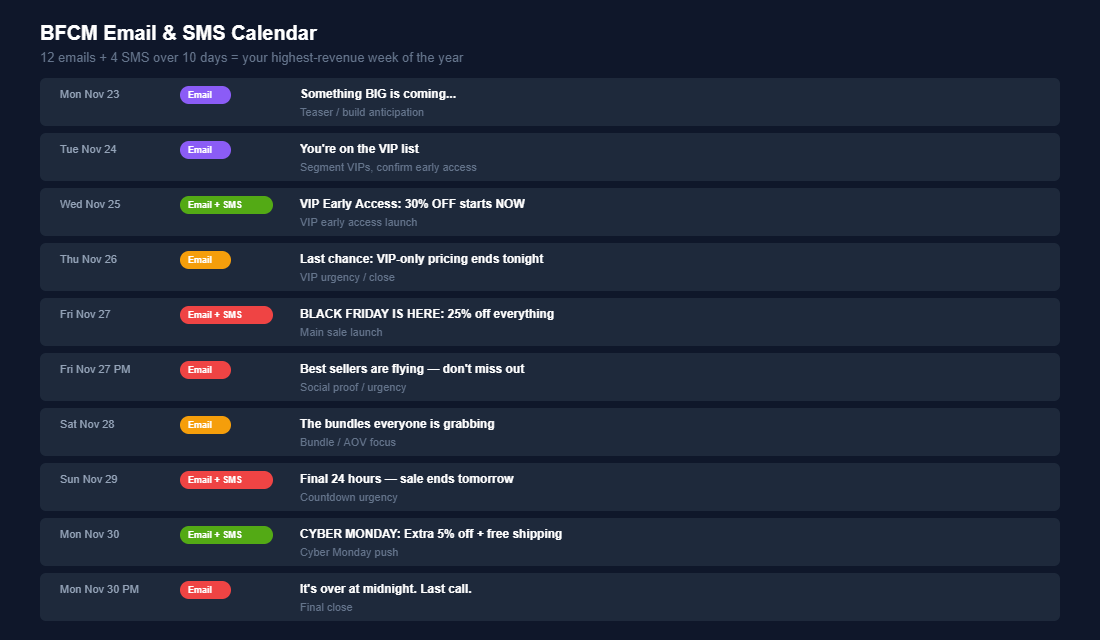
The key principles: build anticipation before the sale (teaser emails starting Monday), launch to VIPs first (Wednesday), hit hard on Black Friday (two emails on the day), vary the angle each day (social proof, bundles, urgency, final call), and close aggressively on Cyber Monday with a clear deadline. Every email should have a single CTA and a clear reason to buy now rather than later.
Ad Strategy: How to Scale Spend Without Wasting Money
BFCM is the most competitive (and expensive) time on Meta and Google. CPMs spike 30-50% because every brand is competing for attention. The brands that profit follow three rules:
Rule 1: Front-load retargeting. Your warmest audiences (cart abandoners, site visitors, past customers) are cheapest to convert. Allocate 40-50% of BFCM ad budget to retargeting instead of the usual 30%. Rule 2: Use proven creatives only. BFCM is not the time to test new creative. Run the winners you identified in October. Rule 3: Ramp gradually. Start increasing spend 7-10 days before Black Friday. Don’t double your budget overnight — increase 15-20% per day to let the algorithms adjust.
The Compound Effect: Why BFCM Is a Growth Flywheel
A great BFCM isn’t just about the weekend’s revenue. It’s about what happens after. Done right, BFCM floods your business with new customers who enter your post-purchase flow, join your loyalty program, and become repeat buyers throughout Q1 and Q2. The brands that treat BFCM as a customer acquisition event (not just a revenue event) see compounding returns for 6-12 months afterward.
Set up your post-BFCM strategy in advance: a welcome sequence for new BFCM customers (different from your regular welcome flow), a January replenishment campaign, and a “new year, new favourites” cross-sell push in February. The sale ends on Cyber Monday. The relationship-building continues indefinitely.
Your Next Step
It’s March 2026. BFCM is 8 months away. That might feel like plenty of time, but September will arrive faster than you think. Block out a 2-hour strategy session this month to review your BFCM 2025 performance and set targets for 2026. Then add the 90-day timeline to your calendar starting September 1.
Inside the eCommerce Circle, BFCM planning is one of the most intensive projects we run with members every year — because getting it right can deliver 20-30% of your annual revenue in four days. If you want hands-on help building your BFCM 2026 playbook, let’s talk.