Every year, the same thing happens. June rolls around, and thousands of Shopify store owners scramble to throw together a last-minute EOFY sale. They slap 20% off everything, blast one email to their list, and hope for the best.
What’s in This Article
The result? Thin margins, lukewarm engagement, and the sinking feeling that they left serious money on the table. Meanwhile, the brands that planned their EOFY campaign 8-10 weeks in advance? They’re clearing dead stock at healthy margins, acquiring new customers through smart ad spend, and setting up their second half of the year with clean inventory and a fat customer list.
Here’s what most store owners don’t realise: EOFY is Australia’s second-biggest retail event. Australians spent an estimated $10.5 billion during the 2025 EOFY sales period, and 71% of shoppers actively planned to buy — up from just 38% the year before. With cost-of-living pressures pushing 76% of consumers to hunt for deals during sale events, EOFY isn’t optional anymore. It’s a revenue engine you need to build properly.
This is your complete playbook. Whether you’re a solo founder doing $20K a month or a growing brand pushing past $100K, this guide walks you through every phase of EOFY planning — from the inventory audit you should be doing right now, to the final-hours email that squeezes out every last dollar on June 30.
Phase 1: The Audit (8-10 Weeks Before June 30)
The biggest mistake brands make with EOFY is treating it like a discount event. It’s not. It’s a strategic stock clearance, customer acquisition, and revenue acceleration moment — but only if you know exactly what you’re working with before you start.
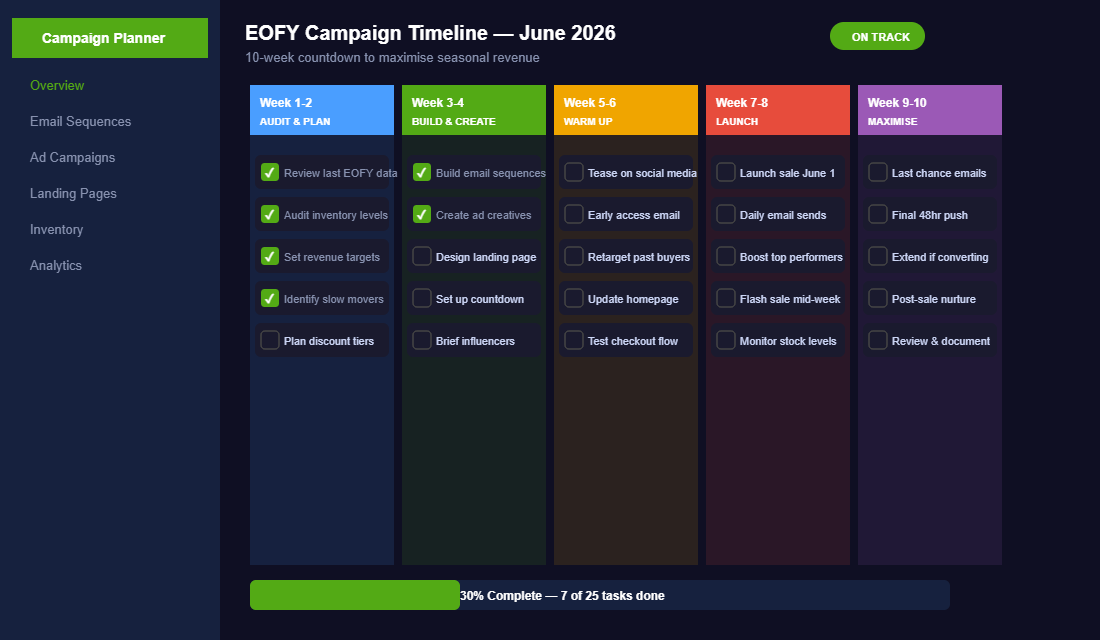
Start with your inventory. Pull up your Shopify product reports and sort by units sold over the last 90 and 180 days. You’re looking for three buckets:
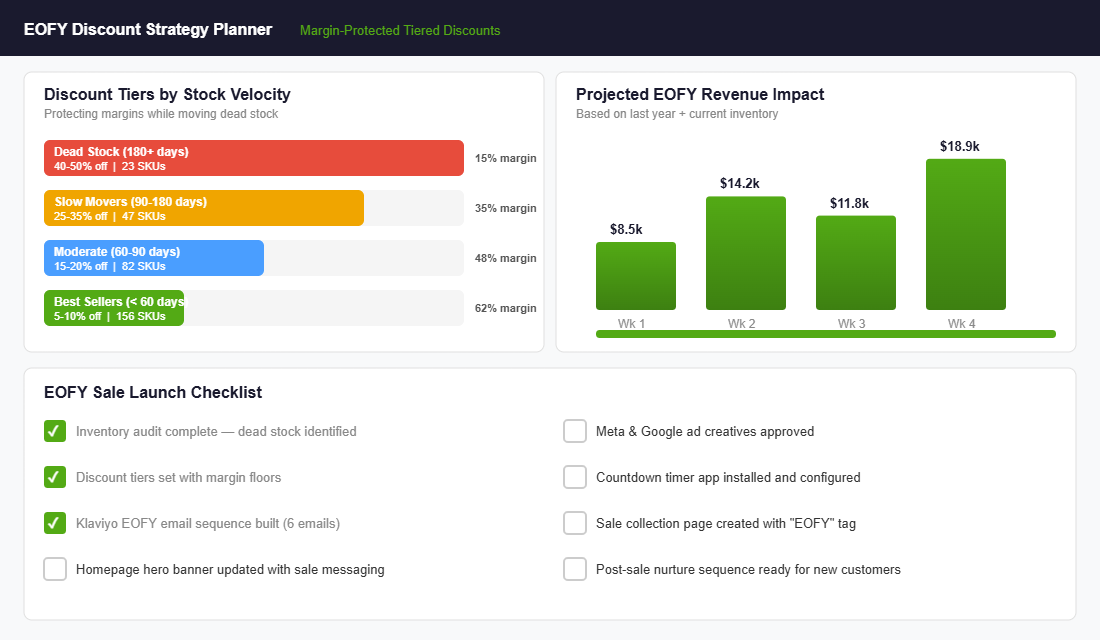
- Dead stock (180+ days sitting). These are the SKUs collecting dust in your warehouse. They’re costing you money in storage and tying up cash you could be reinvesting. These get the deepest discounts — 40-50% off — because recovering any margin is better than holding them into the new financial year.
- Slow movers (90-180 days). Not dead, but not earning their keep. A 25-35% discount is usually enough to accelerate these without torching your margins. Bundle them with popular items for even better results.
- Moderate sellers (60-90 days). These need a nudge, not a fire sale. A 15-20% discount or a “buy 2, get 10% off” offer keeps the perceived value high while moving units.
- Best sellers (under 60 days). Here’s where most brands go wrong — they discount their winners. Your best sellers don’t need 30% off. A modest 5-10% discount (or none at all) maintains your margin where it matters most. If anything, use your best sellers as a draw to get people into your store, then cross-sell the slower stock.
Set your revenue target. Look at last year’s June performance (or your best sale month if this is your first EOFY push). Set a realistic stretch target — typically 30-50% above your average month. Then work backwards: if you need $60K in revenue and your average order value is $120, you need 500 orders. That tells you exactly how much traffic and how many email sends you need to generate.
Phase 2: Build Your Discount Architecture (6-8 Weeks Out)
Flat discounts are lazy. “20% off everything” trains your customers to wait for sales and erodes your brand over time. Smart EOFY discounting is tiered, strategic, and protects your most important margins.
The Tiered Discount Model is your best friend here. Instead of one blanket offer, create multiple discount levels tied to your inventory velocity (the buckets you identified in Phase 1). This means your homepage might say “Up to 50% off for EOFY” — which is technically true for your dead stock — but your best sellers stay at full price or modest markdowns.
Here’s a practical setup in Shopify:
- Create an “EOFY Sale” collection using automated rules. Tag products based on their discount tier (e.g., “eofy-50”, “eofy-30”, “eofy-15”). Use Shopify’s automatic collections to pull these in dynamically.
- Use Shopify’s compare-at pricing. Set the original price as the “compare at” price and the sale price as the actual price. This shows the crossed-out original price on product pages and collection pages — a proven conversion driver.
- Consider spend-based incentives alongside product discounts. “Spend $150, get $20 off” or “Free express shipping over $100” encourages larger carts without discounting individual products further. These work brilliantly for your best-seller range where you don’t want to cut prices.
Set your margin floors. Before you publish any discount, calculate your break-even on every tier. If your landed cost on a product is $40 and you normally sell it for $100, a 50% discount puts you at $50 — still $10 margin per unit. But if you’re paying $60 landed cost, 50% off means you’re losing money. Run the numbers on every tier before you commit. Your accountant will thank you.
One move that works particularly well for Australian brands: bundle slow movers with complementary best sellers. If you sell skincare, pair your slow-moving body lotion with your best-selling face serum in an “EOFY Bundle” at 20% off the combined price. The customer feels like they’re getting a deal, you move the slow stock, and your effective discount on the serum is minimal.
Phase 3: Build Your Email Sequence (4-6 Weeks Out)
Email is where EOFY campaigns are won or lost. The data is clear: stores that send 4 or more emails during a seasonal sale generate 2-3x more revenue than those sending a single blast. And yet, most Shopify stores send one “EOFY SALE IS HERE” email and wonder why their open rate was 18% and nobody bought anything.
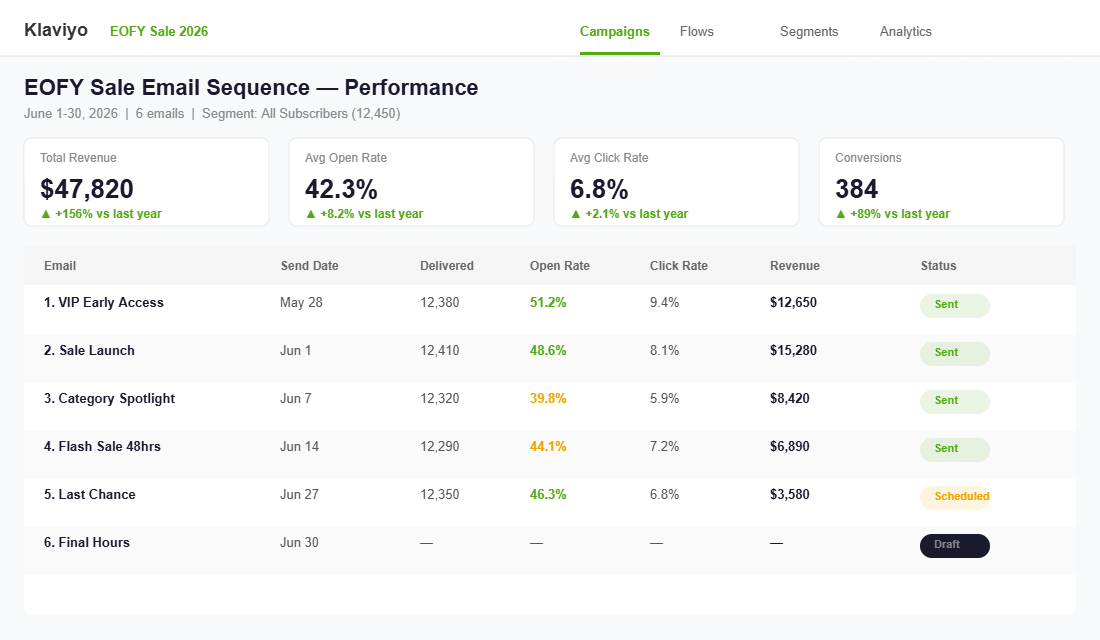
Here’s the 6-email EOFY sequence that consistently outperforms for ecommerce brands:
Email 1: VIP Early Access (3-5 days before launch). Send this to your most engaged segment — repeat buyers, high-AOV customers, and anyone who’s opened 3+ emails in the last 90 days. Give them first access to the sale before the general public. Subject line example: “You’re in early — EOFY deals before everyone else.” This email alone can drive 25-30% of your total sale revenue because these people already trust you and are primed to buy.
Email 2: Sale Launch (Day 1 — June 1). Your main event. Send to your full list. Lead with your biggest discount (the dead stock at 50% off), but make sure the email also features your best-selling categories. Use urgency — “EOFY Sale is live. Ends June 30.” Include your top 3-4 deal categories with direct links to each collection page.
Email 3: Category Spotlight (Day 7). Pick your best-performing category from Week 1 and go deeper. If fashion performed well, showcase the top 6 items. If health and beauty moved, build a “stock up and save” angle. This email re-engages people who opened Email 2 but didn’t buy — which is typically 70-80% of openers.
Email 4: Flash Sale / Mid-Sale Bump (Day 14). By week two, momentum slows. Inject fresh urgency with a 48-hour flash sale within the sale. “This weekend only: extra 10% off everything already on sale.” This stacks on top of existing discounts and creates a new reason to buy. Countdown timers in emails increase click-through rates by 9-30% — use them here.
Email 5: Last Chance (3 days before end). Send to everyone who hasn’t purchased yet during the sale. Lead with social proof — “Over 800 orders placed this EOFY” — and highlight items that are almost sold out. Fear of missing out is real, and it works.
Email 6: Final Hours (June 30 morning + evening resend). This is your closer. Send it in the morning with a subject line like “Ends tonight: EOFY sale closes at midnight.” Then resend to non-openers 4-6 hours before midnight with a different subject line. This final push typically generates 15-20% of total sale revenue. Emails sent within 24 hours of a sale ending see a 35% lift in transaction rates.
If you’re using Klaviyo, set all six emails up as campaigns (not flows) so you have full control over timing and audience. Use Klaviyo’s Smart Sending feature to avoid over-mailing subscribers who’ve already purchased. If you’re on Omnisend, the campaign builder works similarly — just make sure you’re excluding recent buyers from your later sends.
Phase 4: Prepare Your Store and Ads (3-4 Weeks Out)
Your store needs to look like a sale is happening the second someone lands on it. Too many brands run EOFY campaigns that drive traffic to a homepage that looks exactly the same as any other day. That’s a conversion killer.
Homepage updates:
- Hero banner. Replace your standard hero with an EOFY-specific banner. “EOFY Sale — Up to 50% Off” with a clear CTA button linking to your sale collection. Make sure it’s mobile-optimised — over 65% of Australian ecommerce traffic comes from mobile devices.
- Announcement bar. Add a sticky announcement bar at the top of every page: “EOFY Sale — Ends June 30. Free shipping over $100.” This stays visible as people browse and reinforces urgency on every page.
- Countdown timer. Install a countdown timer app (Essential Countdown Timer Bar or Hextom are solid Shopify options). Place it on your homepage, collection pages, and cart page. Countdown timers consistently lift conversion rates because they create genuine scarcity — the sale really does end at midnight on June 30.
Sale collection page. Create a dedicated “EOFY Sale” collection with all discounted products. Sub-divide it with tags so customers can filter by category. This becomes the primary landing page for your ads and emails. Make sure it loads fast — a slow checkout kills conversions, but a slow collection page kills them even earlier.
Paid advertising. EOFY is worth dedicated ad spend. Here’s how to approach it:
- Meta Ads: Create a dedicated EOFY campaign with two ad sets — one retargeting your website visitors and email subscribers (warm audience), one targeting lookalike audiences based on your best customers (cold). Your warm audience will convert at 3-5x the rate of cold, so allocate 60% of your budget there. Use carousel ads featuring your deepest discounts to stop the scroll. If you need help structuring this, check out our guide on Meta Ads account structure.
- Google Ads: Increase your branded search bids — when people search “[your brand] EOFY sale,” you need to own that top spot. Add EOFY-specific sitelinks and callout extensions. If you run Shopping ads, make sure your product feed reflects the sale prices.
- Budget: Plan to spend 40-60% more on ads during June than a normal month. The CPMs are higher because everyone’s advertising, but the conversion intent is also higher. A well-targeted EOFY campaign should deliver 4-6x ROAS for warm audiences.
Phase 5: The Warm-Up (1-2 Weeks Before Launch)
The two weeks before your sale launches are critical for building anticipation. You want your audience primed and ready to buy the moment the sale goes live.
Social media teasing. Start dropping hints on Instagram and Facebook 10-14 days before launch. “Something big is coming for EOFY” with a blurred product image. “The biggest sale we’ve ever run drops next week.” These posts don’t need to convert — they need to create mental bookmarks so your audience remembers to check back.
SMS opt-in push. If you have an SMS list (or you want to build one), this is the perfect time. Run a pop-up on your site: “Get exclusive early access to our EOFY sale — sign up for SMS alerts.” SMS open rates sit around 98% compared to email’s 20-25%, making it a powerful channel for time-sensitive sale announcements.
Retarget past EOFY buyers. If you ran an EOFY sale last year, create a custom audience of everyone who purchased during that period. These people have already demonstrated seasonal buying behaviour — they’re your highest-probability converters. Hit them with a Meta ad: “Last year you saved $X during EOFY. This year’s deals are even bigger.”
Test your checkout flow. Place a test order through your entire checkout process. Make sure discount codes apply correctly, shipping rates are right, and your payment gateway is processing cleanly. Nothing kills EOFY momentum faster than a broken checkout on launch day. Our checkout optimisation guide walks through exactly what to test.
Phase 6: Launch and Maximise (June 1-30)
Sale is live. Now the real work begins. The brands that crush EOFY don’t just launch and forget — they actively manage the campaign every single day.
Daily monitoring checklist:
- Revenue vs target. Are you tracking towards your goal? If you’re behind after Week 1, it’s time to increase ad spend or send an unplanned email to re-engage.
- Stock levels. Check your top-selling discounted products daily. If something’s about to sell out, either restock fast or pull it from the sale and replace it with another slow mover. Running out of your hero product mid-sale is a conversion disaster.
- Ad performance. Review your ROAS daily. Kill underperforming ad sets quickly and reallocate budget to winners. During a sale, you can’t afford to let poor performers drain budget for a week before you notice.
- Email engagement. After each email send, check open rates and click rates within 4 hours. If Email 2 underperformed, adjust your subject line strategy for Email 3. A/B test subject lines on every send if your list size supports it.
Mid-sale flash sale. Around June 14-15, inject a 48-hour flash sale. Pick 10-15 products and add an extra 10-15% off. Promote it with a dedicated email (Email 4 in your sequence) and bump up your social posting frequency. This mid-month push typically generates a second spike in revenue that fills the gap between launch excitement and end-of-sale urgency.
The final 72 hours. This is where the magic happens. Consumer psychology around deadlines is powerful — people who’ve been “thinking about it” all month finally pull the trigger. Send your Last Chance email (Email 5) three days out, then your Final Hours email (Email 6) on June 30 morning with a resend to non-openers at 6pm. Update your announcement bar to show a live countdown. If you’re on social media, go hard with Stories and Reels — “24 hours left,” “12 hours left,” “Last chance.”
Phase 7: Post-Sale — Set Up Your Next 6 Months
The sale ends at midnight on June 30, but your work isn’t done. The first week of July is when smart brands convert their EOFY momentum into long-term growth.
New customer nurture sequence. Every first-time buyer from your EOFY sale should enter a post-purchase email flow. Welcome them, tell your brand story, and make a second purchase offer within 14 days. Customers acquired during sales have a lower average retention rate — roughly 25-30% compared to 40-50% for full-price buyers — but a strong nurture sequence closes that gap significantly.
Review and document everything. Within the first week of July, while the data is fresh, document your results:
- Total revenue vs target
- Revenue by email (which of the 6 emails drove the most?)
- Ad spend and ROAS by campaign and audience
- Best-selling products and categories
- Inventory cleared vs remaining
- New customers acquired and their average order value
- What worked and what you’d change next year
This becomes your playbook for BFCM in November and next year’s EOFY. The brands that improve year over year are the ones that actually review their results instead of just celebrating the revenue number and moving on.
Clean up your store. Remove all EOFY banners, countdown timers, and sale collection pages by July 2. Revert your compare-at pricing. Update your homepage hero. Your store should feel fresh for the new financial year — lingering sale assets make your brand look stale and train customers to wait for discounts.
The EOFY Planning Checklist You Can Steal
Here’s a condensed checklist you can copy and use right now. Print it, stick it on your wall, or drop it into your project management tool:
8-10 Weeks Out (Now — Late April)
- Audit inventory — identify dead stock, slow movers, moderate sellers, best sellers
- Set your EOFY revenue target based on last year’s data
- Calculate margin floors for each discount tier
- Review last year’s EOFY performance (if applicable)
6-8 Weeks Out (Early May)
- Build your tiered discount structure in Shopify
- Create your EOFY sale collection with product tags
- Set compare-at pricing on all sale products
- Plan your 6-email sequence and write the copy
4-6 Weeks Out (Mid May)
- Build and schedule all 6 emails in Klaviyo or Omnisend
- Create ad creatives for Meta and Google
- Design homepage hero banner and announcement bar
- Install and configure countdown timer app
1-2 Weeks Out (Late May)
- Start social media teasing
- Send VIP early access email
- Launch retargeting ads to past EOFY and recent buyers
- Test your entire checkout flow with a test order
June 1-30 (Live)
- Launch sale and monitor daily
- Send email sequence on schedule
- Run mid-month flash sale
- Execute final 72-hour push
- Monitor stock levels and ad performance daily
July 1-7 (Post-Sale)
- Activate new customer nurture sequence
- Document full results and learnings
- Remove all sale assets from your store
- Brief your team on what worked for BFCM planning
The EOFY Cash Flow Trap That Catches Founders Every Single Year
Here is the part nobody warns you about. A great EOFY sale can put your business in a worse cash position than a bad one.
The maths is simple and brutal. You sell $180,000 in June at an average 30% discount. Shopify Payments holds your funds for 2 to 3 business days. Afterpay and Zip settle on their own cycles, usually next business day but sometimes longer over end of financial year. Your Meta and Google invoices for the June scale-up hit on 1 July. Your supplier deposit for the spring range is due mid-July. And the stock you just sold at 30% off needs replacing at full landed cost.
So you had your best month ever and you are tighter in July than you were in May.
Run this check before you set your discount depth, not after. Build a simple 13 week cash forecast in a Google Sheet covering the four weeks before your sale, the sale month, and the eight weeks after. Model three columns: cash in from sales net of processing fees, cash out for ad spend and operating costs, and cash out for replenishment stock. Most founders find the July replenishment number is the one that breaks the model.
Three ways to protect the position without cutting the campaign:
- Weight the offer toward aged stock, not hero stock. Discounting a bestseller you will reorder at full cost in three weeks is a margin donation. Discounting stock that has sat past 120 days is a cash release. Sort your inventory by days-on-hand before you build the offer, not by what feels easiest to sell.
- Negotiate supplier terms in May, not July. If you are placing a spring order off the back of an EOFY cash spike, ask for 30 or 60 day terms while you still look strong on paper. Suppliers say yes far more often in a month where your order volume is up.
- Hold a hard floor on your discount ladder. Set the maximum stacked discount before the campaign starts, including any code that gets shared publicly. Codes leak. Every EOFY, a handful of Aussie brands find their “VIP 40” code posted on OzBargain by day three and blow their margin plan in 48 hours. Read the discount code leak defence playbook before you build your codes, not after.
If your cash position is already tight going into planning, work the cash flow management framework first. A smaller, sharper EOFY campaign run from a stable cash base beats a big one that leaves you unable to reorder in July.
What to Do If You Are Reading This With Three Weeks to Go
The seven phase plan above assumes you started 10 weeks out. Most founders do not. If June is close and you have nothing built, do not try to compress all seven phases. Cut to the four things that carry almost all the result.
Week 1: One offer, one list segment, one landing page. Pick a single offer you can defend on margin. Build one collection page for it. Do not try to run tiered bundles, a gift with purchase and a sitewide code in the same three weeks. Complexity is what kills rushed campaigns.
Week 2: Warm the list, do not just blast it. Send two pre-sale emails to your engaged 90 day segment before anything goes public. Klaviyo users should see 35 to 45% open rates on a warmed segment against 20 to 25% on a full-list blast, and the revenue per recipient on a pre-sale email typically runs 2 to 3x the public launch email. That gap is free money and it takes an hour to set up.
Week 3: Fix the two conversion leaks that cost the most. Not a full site audit. Just two things: make sure your delivery cut-off date for pre-June 30 arrival is stated on the product page and in the cart, and make sure your checkout is not asking for anything it does not need. Average cart abandonment sits near 70% across ecommerce, and unexpected cost plus a slow checkout account for the bulk of it.
Through June: Send more than feels comfortable. The single most common regret from founders after EOFY is under-sending. Four to six emails across a two week sale window is normal for a warmed list. Your unsubscribe rate will tick up. Your revenue will more than cover it.
A three week EOFY campaign done properly will not match a ten week one. It will comfortably beat doing nothing, and it gives you a real baseline to plan against next year. Log what you ran, what it made and what broke while it is fresh, then start Phase 1 in April next year with actual numbers instead of guesses.
The Compound Effect: Why EOFY Is About More Than June Revenue
The real value of a well-run EOFY campaign isn’t the revenue number — though that’s nice. It’s the compound effect across your business.
You clear dead stock, which frees up cash and warehouse space for fresh product going into the second half of the year. You acquire hundreds of new customers who, if nurtured properly, become repeat buyers over the next 6-12 months. You build your email and SMS lists with high-intent shoppers who’ve demonstrated willingness to spend. You generate data — what products moved, what channels performed, what messaging resonated — that makes your BFCM campaign in November dramatically more effective.
And perhaps most importantly for Australian store owners: you start the new financial year on July 1 with clean books, fresh inventory, and a clear picture of what’s working. That’s a powerful position to be in. Tracking which channels actually drove your EOFY results is critical here — if you’re not set up for proper attribution, read our guide on ecommerce marketing attribution before June hits.
EOFY sales have grown 75% since 2019, and Australian online spend hit $82.6 billion in 2025 — up 14% year on year. The opportunity is massive and it’s only getting bigger. But the window is closing fast. If you’re reading this and you haven’t started planning, you’re already behind the brands that have. The good news? You still have time. Start with the audit this week. Build your email sequence next week. And by the time June 1 rolls around, you’ll have a campaign that actually delivers.
The 6 EOFY Mistakes That Will Quietly Cost You in 2026
Even with a solid plan, most Aussie Shopify brands leave money on the table during EOFY. Here are the six errors we see every year — and the fix for each.
- Discount too deep, too early. A 30% storewide sale on June 1 trains your list to wait for steeper offers next year. Use tiered offers: 15% sitewide, 20-25% on bundles, 30% only on slow-movers and last-chance SKUs. Protects margin, drives AOV.
- Forgetting the contribution-margin floor. Run every discount through your contribution calculation before approving it. A 25% discount on a 40% margin product still leaves you 15% — but a 25% discount on a 30% margin product is now a 5% margin trap. Read our contribution margin guide if you have not done this exercise yet.
- Single-channel reliance. Brands that lean on Meta ads alone for EOFY blow their CAC out by 30-50%. Diversify: email gets you 30-40% of EOFY revenue, SMS another 10-15%, organic social another 10-20%, paid for the rest. Our SMS marketing playbook is worth the time investment for the SMS leg of the stool.
- Stock-outs on hero SKUs. Run your weekly velocity numbers x 1.8 for EOFY weeks. If you cannot get reorders in time, raise the price of the constrained SKU by 10-15% in the last week — high demand absorbs it and you protect margin.
- No abandoned-cart push. EOFY drives a wave of new cart adds, but cart abandonment goes UP during sale periods (often 75-80%). Make sure your Klaviyo abandoned-cart flow is tested, the discount references EOFY, and you have at least 3 messages in the sequence.
- No post-sale plan. July 1 hits and the energy dies. The brands that win EOFY have a “welcome to the brand” sequence locked and loaded for the thousands of new customers they just acquired — typically 5-7 emails over the next 30 days that convert one-time buyers into repeat shoppers.
Tracking EOFY: The Numbers That Tell You If It Worked
You cannot improve next year if you do not measure this year cleanly. Track these five numbers in a simple Google Sheet from June 1 to June 30 — and again post-sale.
- Total EOFY revenue vs. same period last year. Year-on-year growth is the headline. Healthy Aussie brands target 25-50% YoY growth in EOFY revenue.
- Blended contribution margin during sale period. If your normal blended CM is 35% and EOFY drops it below 22%, your discount architecture is broken. Diagnose and adjust before next year.
- New customers acquired. EOFY is a customer acquisition event as much as a revenue event. Aim for 30-50% of total customers acquired during the campaign window being net-new.
- Email and SMS-attributed revenue %. Owned channels should drive 40-55% of EOFY revenue. If paid is doing 70%+, you have a list-and-loyalty problem to fix before next June.
- Post-EOFY 60-day repeat rate. Of customers who bought during EOFY, what % buy again in the next 60 days? Aim for 18-25%. Below 10% means your post-purchase nurture is missing.
Drop these numbers into a Notion or Airtable EOFY retrospective right after July 1 while the campaign is still fresh. The brands that get compounding EOFY gains year on year are the ones with documented learnings — not the ones with the loudest opening campaign.
Inside the eCommerce Circle, EOFY planning is one of the core seasonal playbooks we work through with every member. We help you set your targets, build your discount architecture, and execute a campaign that protects your margins while maximising revenue. If you want a second set of eyes on your EOFY plan — or you want someone to build it with you — let’s talk.