You have found a product you are excited about. Maybe you saw it trending on TikTok, or a supplier sent you samples that felt premium. You can already picture the brand, the packaging, the Instagram ads. So you order 500 units, build a Shopify store, and wait for the sales to roll in.
What’s in This Article
Three months later, you are sitting on $8,000 worth of inventory in your garage, wondering where it all went wrong. Sound familiar? It should, because this is the story of roughly 80% of first-time ecommerce brands in Australia.
The brands that actually make it do not start with excitement. They start with validation. They treat product selection like an investment decision, not a gut feeling. And the difference between a $0 flop and a $40K/month winner often comes down to what you do before you spend a single dollar on inventory.
Why Most Product Decisions Are Backwards
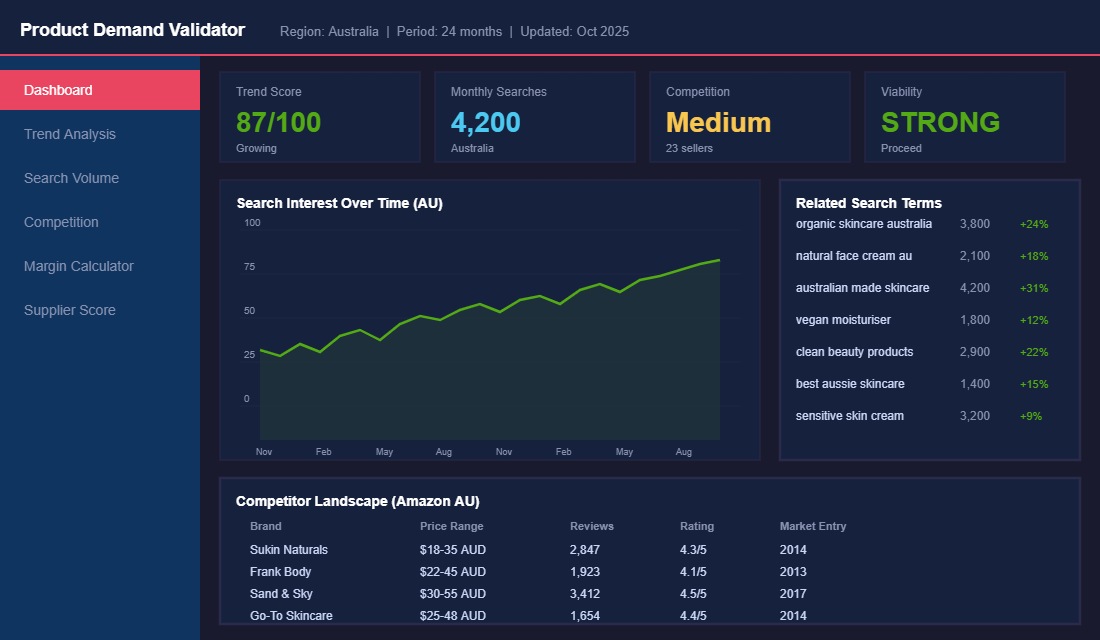
Here is the mistake most aspiring Shopify store owners make: they fall in love with a product first, then try to find a market for it. That is backwards. The successful approach is to find a market with proven demand, identify a gap or underserved segment, and then source a product that fills it.
Think of it this way, you would not open a restaurant without checking whether people in your area actually want that cuisine. But ecommerce founders do the equivalent every single day. They pick products based on what they personally like, not what the market is actively searching for and buying.
The data backs this up. According to Australian ecommerce benchmarks, stores that validate demand before sourcing have a 3x higher survival rate past the 12-month mark compared to those that source first and hope for the best.
Step 1: Confirm Real Demand (Not Just Hype)
Before you even think about contacting a supplier, you need to answer one question: are people actively looking for this product right now, and will they still be looking in six months?
Start with Google Trends. Search your product category and filter to Australia. You are looking for stable or growing interest over the past 2-3 years, not a spike that is already declining. A product that peaked six months ago is a product you will be discounting by Christmas.
Next, check search volume using tools like Ubersuggest, Ahrefs, or even Google Keyword Planner. You want to see at least 1,000-2,000 monthly searches in Australia for your core product keyword. Below that, you are looking at a niche so small that even a 5% conversion rate will not pay the rent.
- Google Trends. Filter to AU, check 2-3 year trend line. Stable or growing = green light. Declining = walk away.
- Keyword volume. At least 1,000-2,000 monthly AU searches for the core product term.
- Amazon AU bestsellers. Check if competitors are selling and getting reviews. Competitors are a good sign, it means the market exists.
- Social proof. Search the product on TikTok, Instagram, and Reddit. Are real people talking about it organically, or is it only promoted by dropshippers?
Step 2: Stress Test Your Margins (The Real Ones)
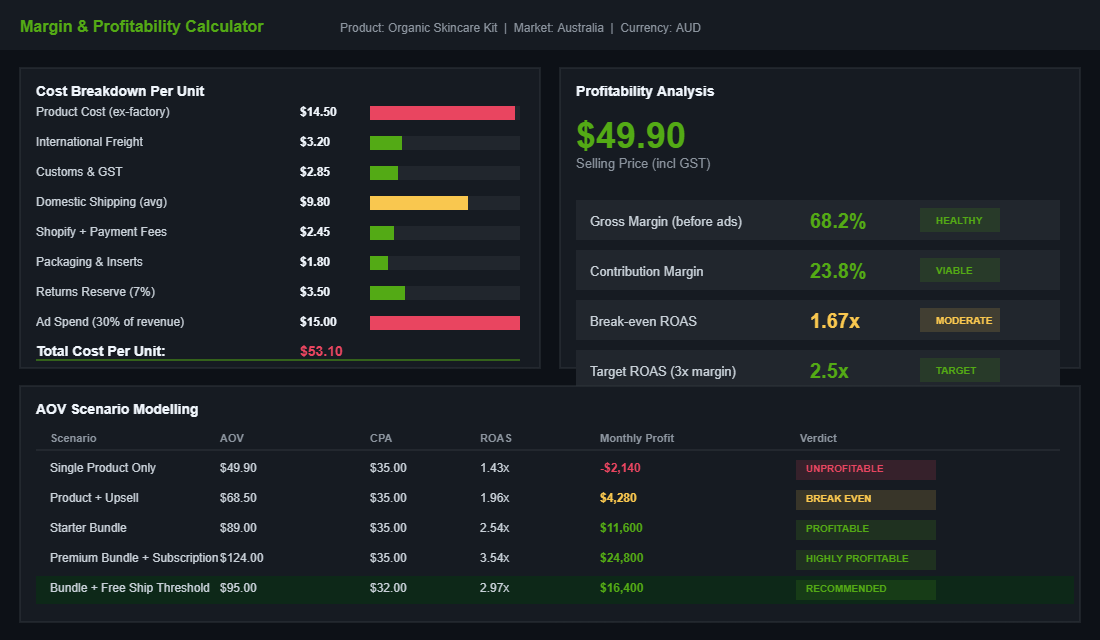
Most new brand owners calculate margins like this: “I buy it for $15, sell it for $50, that is a $35 margin.” And then they are confused when they are losing money at $30K/month in revenue.
Here is what real margin analysis looks like for an Australian Shopify store. You need to account for every cost that sits between your supplier invoice and the cash that actually hits your bank account:
- Landed cost. Product cost + international shipping + customs duty + GST on import. For most products from China, add 25-40% on top of the unit cost.
- Domestic shipping. Australia Post or Sendle rates for your product weight and dimensions. Average $8-12 for a standard parcel in metro areas.
- Platform fees. Shopify plan ($39-399/month AUD) + payment processing (1.75-2.9% + 30c per transaction).
- Ad spend. Budget at least 25-35% of revenue for paid acquisition in the first 6 months. If your margins cannot absorb this, the product will not scale.
- Returns. Budget 5-8% of orders for returns and exchanges. Higher for fashion and apparel (up to 15-20%).
Run those numbers honestly. For a deeper look at how margin mistakes play out in practice, see our guide on the pricing mistakes killing your margins. If your contribution margin (what is left after ALL variable costs including ad spend) is below 15-20%, you are going to struggle. The sweet spot for a scalable Shopify brand is a 65-75% gross margin before ad spend, which gives you enough room to acquire customers profitably while still covering your fixed costs.
Step 3: Vet Your Supplier Before You Commit Capital
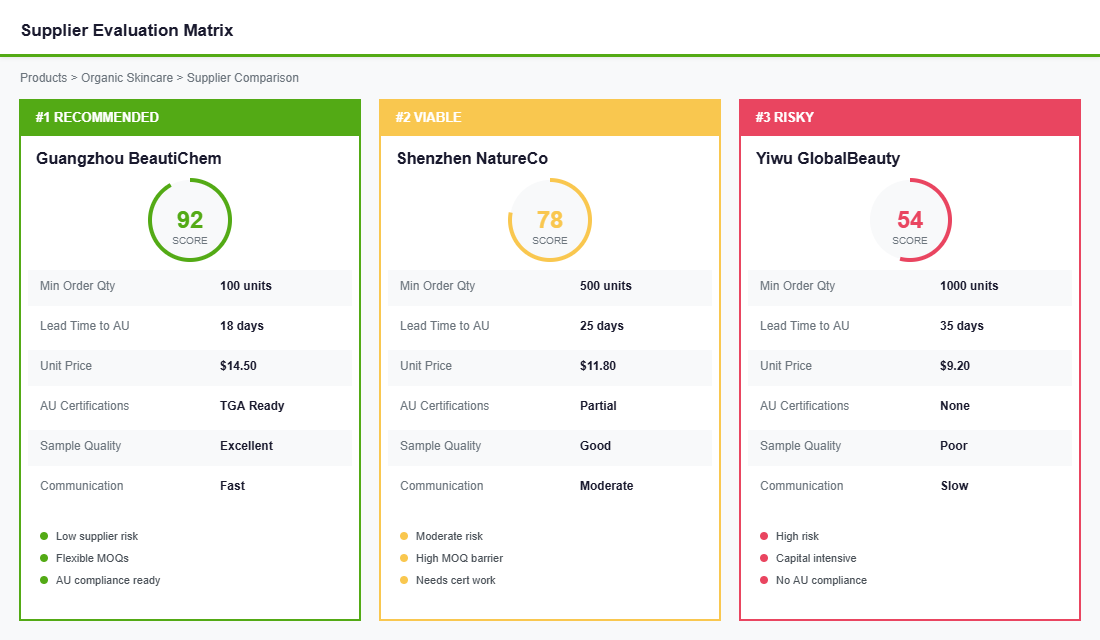
Your supplier relationship will make or break your brand. Yet most founders pick their supplier based on whoever responds fastest on Alibaba. That is like hiring your first employee based on who walks in the door first.
Before you place a bulk order, run every potential supplier through this checklist:
- Order samples from at least 3 suppliers. Compare quality, packaging, and consistency. The cheapest option is rarely the best option.
- Check MOQs (Minimum Order Quantities). Can you start with 100-200 units, or do they require 1,000+? A good supplier will negotiate MOQs for a new relationship.
- Test lead times. Place a small test order and track exactly how long from payment to delivery at your door in Australia. Add 2 weeks to whatever they quote you, that is your realistic lead time.
- Verify certifications. Does the product need TGA approval, Australian safety standards compliance, or specific labelling? Getting this wrong can mean your entire shipment gets held at customs.
- Ask for references. A legitimate supplier will happily connect you with other brands they work with. If they will not, that is a red flag.
The goal here is to de-risk your first order. Start with a small test batch (50-200 units), sell through it, gather customer feedback, and then scale. The brands that blow $10K on their first order without testing are the ones writing “lessons learned” posts on Reddit six months later.
Step 4: Build Your AOV Strategy Before You Launch
Average Order Value (AOV) is the silent killer of Shopify stores. If your AOV is $45 and your customer acquisition cost is $35, you are basically running a charity. The time to solve this is before you launch, not after you have already set up your store with single-product listings and no upsell strategy.
Here is what high-performing Aussie Shopify stores do differently:
- Bundle from day one. Create a “starter kit” or “essentials bundle” that combines your hero product with complementary items. Bundles typically increase AOV by 25-40%.
- Design collections around buying logic. Do not just group products by type, group them by use case. “Everything you need for [outcome]” sells better than “Category: Accessories.”
- Plan your upsell before your product page. Know exactly what you will offer as a post-add-to-cart upsell. Apps like ReConvert or Zipify OCU make this dead simple on Shopify.
- Set a free shipping threshold. Place it 20-30% above your current AOV. Australian shoppers are conditioned to expect free shipping, use it as an AOV lever, not just a cost centre.
Aim for an AOV that is at least 2.5-3x your customer acquisition cost. If you cannot get there with your current product line, you either need to add complementary products or rethink your pricing.
Step 5: The Pre-Launch Validation Test
Before you invest in 500 units and a full brand build, there is a smart way to validate demand with minimal risk. Set up a simple pre-launch landing page using Shopify password page or a tool like Carrd, and drive a small amount of traffic to it.
Here is the playbook:
- Create a landing page with your product photos (even sample photos work), a compelling headline, and an email capture form. “Be the first to know when we launch” works perfectly.
- Run $200-300 in Meta Ads targeting your ideal customer in Australia. Broad targeting, simple creative, just your product shot with a benefit-driven headline.
- Measure the response. If you can capture emails for under $2-3 each, you have got a product worth pursuing. If it is costing $8-10 per email, the market is telling you something.
- Survey your list. Ask those email subscribers what they would pay, what features matter most, and what would stop them from buying. This is gold-standard product research.
This entire test costs $200-400 and a weekend of work. Compare that to the $5,000-15,000 most people spend on inventory before they have validated a single assumption. It is not even close.
Step 6: Read the Competitive Landscape Before You Commit
Validation is not just about your product, it is about what you are walking into. If you launch into a market dominated by established brands with massive ad budgets and thousands of reviews, your $5K launch budget will get swallowed whole. Conversely, finding a niche with demand but weak competition is like finding a gap in traffic on the M1, you can accelerate while everyone else is stuck.
Here is how to assess the competitive landscape for an Australian ecommerce market:
- Search Google Shopping for your product. Count how many advertisers are running Google Shopping ads for your core keyword. Fewer than 10 active advertisers in Australia usually means low competition and cheaper CPCs. More than 30 means you are entering a dogfight, make sure your margins and differentiation can handle it.
- Audit the top 5 competitors on Shopify. Use tools like Store Leads or the Wappalyzer browser extension to identify which competitors are on Shopify. Check their review counts (a proxy for sales volume), their pricing, their brand positioning, and their product photography quality. If the top 5 have slick branding and 500+ reviews, you need a clear angle to stand out. If their photos are poor and reviews are thin, that is your opening.
- Check their ad activity on Meta Ad Library. Search for your competitors on the Facebook Ad Library. Are they running ads? How many variants? How long have their ads been active? Ads running for 60+ days are almost certainly profitable, that tells you the market supports paid acquisition. Brands with no active ads might mean they cannot make the maths work on paid, which is a warning sign.
- Look for differentiation gaps. Scroll through competitor reviews on their sites and on Amazon AU. What are customers complaining about? Common complaints are goldmines, they tell you exactly where the market is underserved. If every dog bed brand gets complaints about covers that are not machine-washable, and you can source one that is, you have just found your angle.
- Estimate market size. Multiply your core keyword search volume by an assumed 3% click-through rate and a 2% conversion rate. For a keyword with 5,000 monthly searches in Australia, that is roughly 3 sales per day across the entire market. If there are already 20 competitors splitting those sales, your share on day one will be tiny. Look for markets where the search volume can support your revenue goals even with conservative market share assumptions.
The brands that skip competitive analysis are the ones who discover, after spending $10K on inventory, that they are competing against a brand with 10,000 reviews, a $50K monthly ad budget, and a three-year head start. Do this homework upfront and you will either find the right angle to compete or save yourself from a market that was never going to work. For more on how to research competitors systematically, see our guide on competitive analysis for Shopify.
Step 7: The Minimum Viable Launch: Test Before You Scale
You have validated demand, stress-tested margins, vetted suppliers, built your AOV strategy, tested with a landing page, and mapped the competition. Now comes the discipline most founders lack: launching small.
Order 50-200 units maximum for your first batch. Not 500. Not 1,000. Enough to fulfil your pre-launch email list and run a 2-week paid traffic test. Your goal for the first 30 days is not revenue, it is data. You want to know your real conversion rate (not an estimate), your real CAC (not a projection), and your real return rate (not an assumption).
Here is the minimum viable launch checklist for an Australian Shopify brand:
- 50-200 units of your hero product. Enough to test, not enough to bankrupt you if it flops.
- $500-1,000 AUD in Meta Ads over 14 days. Broad targeting, 3-5 creative variations, optimised for purchases. If your CPA is above $60 AUD after 14 days with clean creative, pause and reassess.
- Klaviyo set up with at least 3 flows. Welcome series, abandoned cart, and post-purchase. These three flows will recover 15-25% of revenue you would otherwise lose. They cost nothing to run once built.
- Google Analytics 4 and Meta Pixel installed. You need attribution data from day one. Without it, you are guessing which traffic sources work.
- A post-purchase survey. Use Fairing or a simple Shopify form asking “How did you hear about us?” and “What almost stopped you from buying?” This data is more valuable than any analytics dashboard in your first month.
If the first batch sells through profitably, meaning your contribution margin is above 20% after all variable costs including ads, then and only then do you place a bigger order. If it does not sell through, you have lost $2,000-4,000 instead of $10,000-15,000. That is the difference between a setback and a business-ending mistake. For more on understanding your real costs, read our breakdown of the margin mistake killing most Shopify stores.
The Validation Scorecard: How to Make the Go/No-Go Call
After running the seven steps, you need a way to turn the evidence into a decision. Gut feel creeps back in at exactly this moment, so force the call through a scorecard instead.
Score each of these out of 10, and be honest:
- Demand signal (x2 weighting): search volume trend in Google Keyword Planner, pre-launch waitlist size, and paid test click-through rate. A waitlist under 100 emails after two weeks of promotion is a warning, not a detail.
- Margin headroom: you want a landed gross margin of 65%+ for a paid-ads-led brand, or 50%+ if you will grow through organic and retention. Below that, every acquisition channel has to overperform just to break even.
- Supplier reliability: sample consistency across two separate orders, response time under 24 hours, and a second supplier identified as backup.
- Competitive gap: can you name, in one sentence, why someone would switch from the category leader to you? If the sentence starts with “cheaper”, score it a 3.
- AOV pathway: at least two credible attach products or a bundle that lifts first-order value 20%+.
A weighted total of 42 out of 60 or better is a green light for a minimum viable order. Anything between 32 and 41 means fix the weakest line before committing capital. Below 32, walk away: the $3K you “lose” by not ordering is the cheapest tuition you will ever pay. Once you clear the scorecard, your next read should be our Shopify product launch playbook, which picks up exactly where validation ends.
The Compound Effect: How Validation Builds Momentum
Here is what happens when you validate properly: every decision downstream gets easier and more profitable. Your ad creative performs better because you know exactly who you are talking to. Your product pages convert higher because you have already tested the messaging. Your margins are healthy because you stress-tested them before committing capital.
The brands inside eCommerce Circle that follow this validation framework consistently hit their first $10K month within 60-90 days of launching. The ones who skip it? They are still tweaking their store at month six, wondering why their ROAS is below 1.
Product validation is not the sexy part of ecommerce. It is not designing a logo or choosing brand colours. But it is the foundation that everything else is built on. Get this wrong, and nothing else matters. Get this right, and you have just eliminated 80% of the reasons new brands fail.
Ready to Build on Solid Ground?
Inside the eCommerce Circle, product validation is the very first pillar of our More Orders Operating System, because nothing else works until your product-market fit is locked in. If you are in the early stages of building your Shopify brand and want to make sure you are not building on sand, let’s talk.