Most Shopify store owners are obsessed with acquisition. More traffic. More ads. More new customers. And they completely ignore the most profitable growth lever they have: getting existing customers to buy again.
What’s in This Article
Here is the maths that changes everything: acquiring a new customer costs 5-7x more than retaining an existing one. A repeat customer spends 67% more per order than a first-time buyer. And increasing your repeat purchase rate by just 5% can increase total revenue by 25-95%.
If you are spending $30-50K/month on ads to acquire new customers but your repeat purchase rate is below 25%, you are running on a treadmill. The brands that build real, sustainable revenue are the ones that turn first-time buyers into lifetime customers. This guide shows you exactly how to build that retention engine, from the first post-purchase email to a fully automated loyalty system.
Why Most Brands Lose Customers After the First Purchase
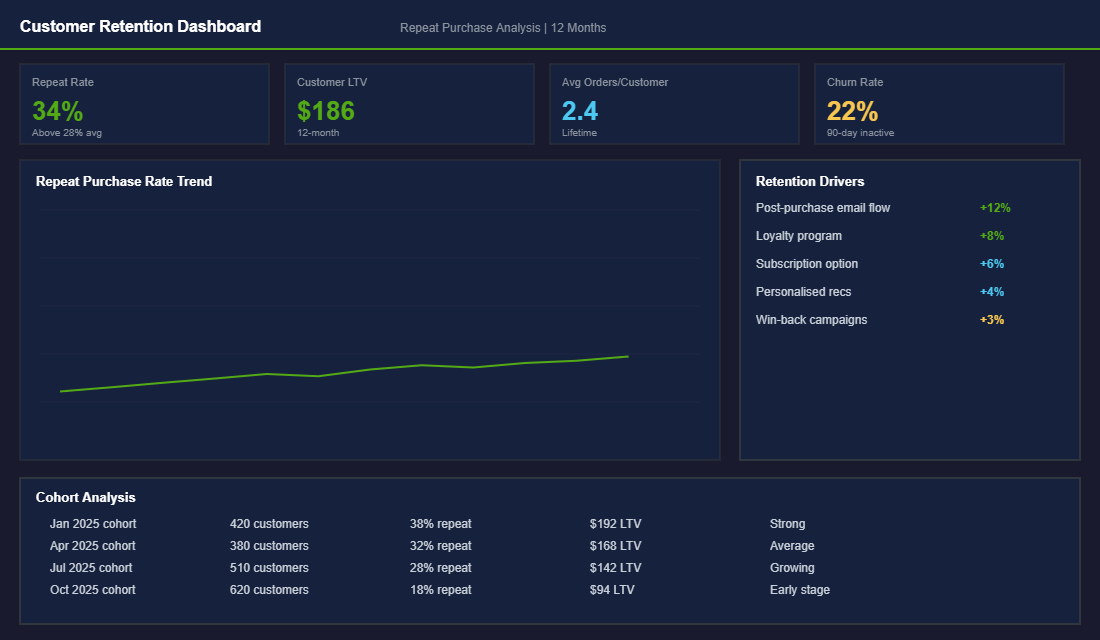
The number one reason customers do not come back is simple: you did not give them a reason to. After the purchase confirmation email, most brands go silent until they blast out a sale announcement three months later. By then, the customer has moved on, they have been retargeted by five other brands, forgotten your name, and the emotional connection from their purchase has completely faded.
Think about the customer journey from their perspective. They took a risk buying from a brand they did not know. The product arrived, they tried it, and… nothing. No follow-up, no personalised recommendations, no reward for their loyalty. Why would they come back when a dozen other brands are actively competing for their attention?
The data tells the story clearly: the probability of selling to an existing customer is 60-70%, compared to just 5-20% for a new prospect. Yet the average ecommerce brand spends 80% of its marketing budget on acquisition and less than 20% on retention. That is a massive misallocation of resources, and fixing it is one of the fastest ways to improve your bottom line.
The fix is not complicated. It is about building intentional touchpoints that keep your brand top-of-mind and make repeat purchasing easy and rewarding.
Build a Post-Purchase Experience Worth Coming Back For
The 30 days after a first purchase are the most critical window for earning a second sale. Research shows that if a customer makes a second purchase within 30 days, their likelihood of buying a third time jumps to over 50%. Miss that window and your chances drop dramatically. Here is what high-retention Shopify brands do during this period:
- Send a branded order confirmation that makes customers feel great about their purchase. Include a personal note from the founder, not just a transaction receipt. This email gets the highest open rate of any email you will ever send (averaging 60-70%), use that attention wisely.
- Follow up 3-5 days after delivery with usage tips. Help them get the best results from the product. This reduces returns and increases satisfaction. For a skincare brand, this might be a “how to get the most from your new serum” guide. For apparel, it could be styling ideas.
- Ask for a review at 7-10 days. Timing matters, too early and they have not formed an opinion, too late and the excitement has faded. Include a direct link to leave a review (tools like Judge.me or Loox make this a two-tap job on Shopify) and consider offering loyalty points as an incentive. Stores that actively collect reviews see conversion rates 3.5x higher than those that do not.
- Send a personalised recommendation at 21 days. “Based on your purchase, you might love these…” with 2-3 complementary products. This is where Klaviyo’s product recommendation engine earns its keep, it analyses purchase history and browsing behaviour to suggest products each customer is most likely to buy next.
- Create an unboxing experience that surprises and delights. A handwritten thank you note, a sample of another product, or a small branded gift costs $1-3 but creates the kind of emotional connection that drives word of mouth and repeat purchases. Australian brand Who Gives A Crap nails this, their quirky packaging and paper wrappers have become a social media phenomenon that generates thousands of shares.
For the complete email flow architecture, including the exact timing and content for each touchpoint, see our guide on the post-purchase sequence that turns one-time buyers into repeat customers.
Launch a Simple Loyalty Program (It Does Not Need to Be Complicated)
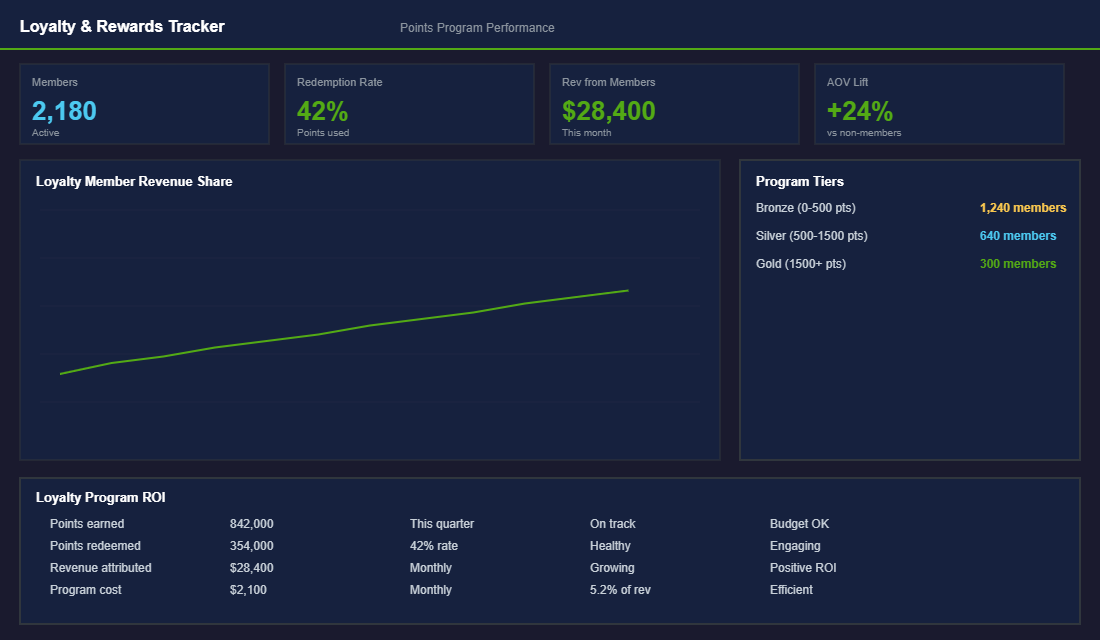
Loyalty programs work because they create a psychological investment. Once a customer has points or a status level, they are more likely to buy from you again to either redeem those points or maintain their status. The data backs this up, loyalty program members spend 12-18% more per order and purchase 33% more frequently than non-members. On average, loyalty program members have a 40% higher customer lifetime value.
You do not need a complicated tier system to start. Apps like Smile.io (free up to 200 monthly orders, paid from $49/month), LoyaltyLion ($199/month), or Yotpo Loyalty make it easy to set up a basic points program on Shopify in under an hour. Here is a simple structure that works:
- Earn points for purchases. 1 point per $1 spent is simple and easy to understand. Set the earning rate so that customers accumulate a meaningful reward after 2-3 purchases, this creates the right incentive for repeat buying.
- Earn bonus points for reviews (50 points), social shares (25 points), and referrals (200 points). This turns your loyalty program into a growth engine that drives both retention and acquisition simultaneously.
- Redeem points for discounts. 100 points = $5 off, 250 points = $15 off, 500 points = $35 off. The value increases with higher thresholds to encourage accumulation rather than immediate redemption.
- Set a free shipping threshold for members. Give loyalty members free shipping at a lower threshold than non-members. This is a simple perk that drives repeat purchases without costing you much, and it creates a tangible, immediate benefit of joining the program.
The key mistake brands make with loyalty programs is launching them and then ignoring them. Send monthly points balance emails (“You have 180 points, just 70 more for a $15 reward!”). Feature loyalty-exclusive products or early access to new drops. Make the program a living part of your brand, not a widget buried in your footer. For a deeper look at structuring your program, see our full guide on loyalty programs for Shopify.
Use Replenishment and Subscription to Automate Repeat Revenue
If your product is consumable or has a natural replenishment cycle, you are sitting on a goldmine of predictable revenue. Think skincare (60-90 day cycles), supplements (30-day cycles), pet food (monthly), and cleaning products (quarterly). Subscription revenue is the holy grail of ecommerce, it is predictable, high-margin (no acquisition cost on repeat orders), and dramatically increases customer lifetime value.
- Send replenishment reminders timed to your product usage cycle. If your face cream lasts 45 days, send a “time to restock” email at day 38 with a one-click reorder link. Klaviyo’s predictive analytics can estimate when individual customers are likely to run out based on their purchase history, use this for even more precise timing.
- Offer a subscribe-and-save option. A 10-15% discount for subscription orders is a small margin hit that creates predictable, recurring revenue. Apps like Recharge ($99/month) or Loop Subscriptions ($99/month) make this a two-tap job on Shopify. Subscription customers have an average LTV 2-3x higher than one-time buyers.
- Bundle subscriptions with exclusive perks. Subscribers get early access to new products, exclusive colours or scents, or a free sample with every delivery. This makes the subscription feel premium, not just cheaper. Frank Body, the Aussie skincare brand, offers subscribers exclusive seasonal bundles and limited-edition products that are not available to non-subscribers, it is a retention strategy that also drives FOMO and social sharing.
Identify and Save At-Risk Customers Before They Churn
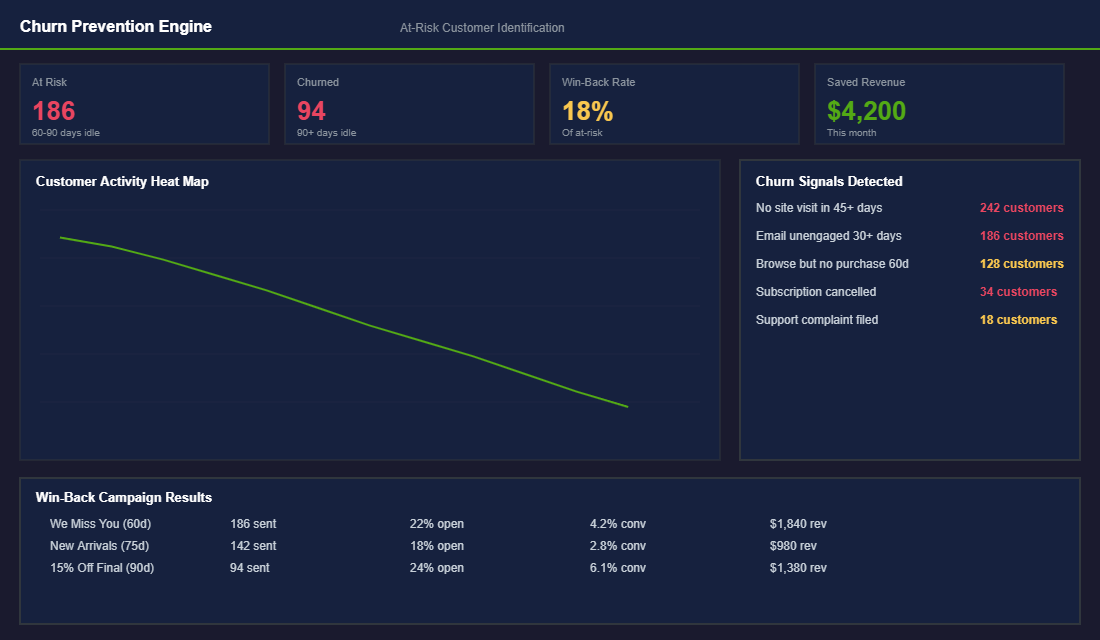
By the time a customer has been inactive for 90 days, your chance of winning them back drops below 10%. The key is to identify at-risk customers early, at the 45-60 day mark, and intervene before they mentally move on. Prevention is always cheaper than recovery.
Set up automated triggers in Klaviyo that flag customers based on engagement signals:
- No site visit in 45+ days, send a “we miss you” email featuring new arrivals, bestsellers, or content that adds value (styling tips, how-to guides). Avoid leading with a discount, try re-engagement first.
- No email engagement in 30+ days, try a re-engagement campaign with a compelling subject line and different send time. If they still do not engage after 2-3 attempts, move them to a sunset flow to protect your deliverability. For more on keeping your emails out of spam, see our guide on email deliverability for Shopify.
- Last purchase 60+ days ago, send a personalised win-back offer with a modest incentive (our full win-back campaigns guide covers the complete playbook) (10-15% off or free shipping). Make it feel exclusive: “We saved this just for you” performs better than generic sale language.
- Subscription cancelled, immediate follow-up asking why, with a retention offer (pause instead of cancel, or a one-time discount to continue). Brands that offer a “pause” option instead of just cancel/confirm retain 15-25% more subscribers.
The key metric to track here is your “customer reactivation rate”, the percentage of lapsed customers who return within 90 days of receiving a win-back campaign. Good ecommerce brands achieve 5-8%, and excellent ones hit 10-15%. If yours is below 5%, your win-back messaging needs work, test different offers, subject lines, and timing until you find what resonates with your audience.
Personalisation at Scale: Making Every Customer Feel Like Your Only Customer
Generic marketing kills retention. When a customer who just bought a protein powder gets an email promoting vegan skincare, you have told them you do not actually know who they are. Personalisation is the difference between a brand that feels like a trusted advisor and one that feels like spam.
The good news is that Shopify and Klaviyo give you the data to personalise at scale without a data science team. Here is what high-retention brands do differently:
- Segment by purchase behaviour, not just demographics. Someone who bought your premium range has different needs than someone who grabbed a sale item. Create segments in Klaviyo based on AOV tier, product category, purchase frequency, and recency. Then tailor your email content, product recommendations, and offers to each segment. A customer who consistently buys full-price items does not need a 20% off coupon, they want early access to new drops.
- Use predictive analytics for next-best-product recommendations. Klaviyo’s predictive engine analyses purchase patterns across your entire customer base to suggest what each individual is most likely to buy next. Personalised product recommendation emails achieve click rates 2-3x higher than generic “bestseller” emails. Set up a monthly “picked for you” email that uses these predictions, it is one of the highest-ROI retention emails you can send.
- Personalise by lifecycle stage. A customer on their first purchase needs education and trust-building. A customer on their fifth purchase needs VIP recognition and exclusive perks. Map your email content to where each customer sits in their journey. First-time buyers get product tips and review requests. Repeat buyers get loyalty rewards and referral invitations. VIP customers (top 10% by LTV) get personal notes, early access, and exclusive bundles.
- Build a community, not just a customer list. Australian brand Oodie built a Facebook group with over 200,000 members where customers share photos, styling ideas, and product requests. That community drives repeat purchases organically because customers feel like they belong to something bigger than a transaction. You do not need 200K members, even a small, engaged community of 500 customers on Facebook, Discord, or a private SMS list creates a retention flywheel that no amount of email marketing can replicate.
- Surprise and delight your best customers. Identify your top 50 customers by LTV each quarter and do something unexpected. A handwritten note, a free product, a personal video from the founder. This costs almost nothing at scale but creates the kind of loyalty that is immune to competitor discounts. One eCommerce Circle member sends a $10 coffee voucher to customers on their birthday, and their birthday email has a 78% open rate and a 22% conversion rate back to their store.
Personalisation is not about being creepy, it is about being relevant. When a customer feels like your brand genuinely understands what they need, switching to a competitor feels like starting over. That switching cost is the ultimate retention moat. For more on segmentation strategies that power personalisation, see our guide on customer segmentation for Shopify.
Measure What Matters: The Retention Metrics Dashboard
You cannot improve what you do not measure. Here are the five retention metrics every Shopify store owner should track monthly:
Repeat purchase rate. The percentage of customers who buy more than once. Check this in Shopify Analytics under Customer Cohorts. Healthy ecommerce brands sit between 25-40%. Below 20% and you have a retention problem. Above 40% and your retention engine is strong, focus on increasing average order value next.
Customer lifetime value (CLV). The total revenue a customer generates over their entire relationship with your brand. Calculate this as: average order value × purchase frequency × average customer lifespan. Knowing your CLV tells you exactly how much you can afford to spend on acquisition and still be profitable. For a detailed breakdown of calculating and increasing CLV, see our guide on customer lifetime value for Shopify.
Time between purchases. How long customers typically wait between orders. This tells you when to send replenishment reminders, win-back campaigns, and loyalty nudges. If your average time between purchases is 45 days but you are sending win-back emails at 90 days, you are intervening too late.
Customer churn rate. The percentage of customers who stop buying within a given period. Track this monthly, if churn is increasing, something in your product, service, or communication has changed and needs investigation.
Net promoter score (NPS). A simple one-question survey (“How likely are you to recommend us to a friend?”) that predicts future retention. Send this 14 days after delivery via Klaviyo. Scores above 50 indicate strong loyalty. Below 30 means you have work to do on the customer experience.
The Retention Economics Calculator: Know Your Numbers Before You Build
Before you invest time and money into retention tactics, you need to know exactly what a repeat customer is worth to your business. This is the calculation that tells you how aggressively to invest in retention, and it is the one most store owners skip.
Step 1: Calculate your current repeat purchase rate. Go to Shopify Analytics, then Customers, then Returning customer rate. If this number is below 20%, your retention engine is broken. Between 20-30% is average for Shopify stores. Between 30-40% is good. Above 40% means your retention is strong and you should focus on increasing AOV and frequency among existing repeat buyers.
Step 2: Calculate the value gap between one-time and repeat customers. Export your customer data and segment by purchase count. For most Shopify brands, a customer who buys twice spends 2.5-3x what a one-time buyer spends over 12 months. A customer who buys three times? That number jumps to 5-7x. This tells you exactly how much a second purchase is worth, and it is almost certainly more than you think. If your average first order is $85 and your average second order is $95 (repeat customers typically spend 10-15% more per order), then every customer you convert from one-time to repeat is worth an additional $180-$250 over the next year.
Step 3: Set your retention marketing budget. A good rule of thumb is that your retention marketing budget should equal 20-30% of the value of your repeat customer revenue. If repeat customers generate $40,000 per month, you should be investing $8,000-$12,000 monthly in retention activities, including your Klaviyo subscription, loyalty program costs, review platform fees, and any team time dedicated to retention campaigns. Most stores under-invest here dramatically, spending less than 5% of their marketing budget on retention while pouring 95% into acquisition. The maths simply does not support that split.
Step 4: Model the impact of a 5-point improvement. Take your current repeat rate and add 5 percentage points. If you are at 22% and move to 27%, calculate what that means in additional monthly revenue. For a store doing $80,000/month with 1,000 new customers per month, going from 22% to 27% repeat rate means 50 additional repeat orders per month at $95 average, that is $4,750/month in extra revenue with near-zero acquisition cost. That is $57,000 per year dropping straight to your bottom line. This is the number that should determine how seriously you take the tactics in this article. For more on understanding your contribution margin per customer, our guide breaks down how to calculate what actually makes it to your bank account after all costs.
The Compound Effect: Retention Makes Everything Else Work Better
When your retention rate climbs, every other metric in your business improves. Your customer acquisition cost effectively drops because each customer is worth more over their lifetime. Your ROAS improves because repeat purchases are attributed back to the original acquisition channel. Your cash flow stabilises because predictable repeat revenue smooths out the peaks and troughs of ad-driven sales.
We see this transformation constantly inside eCommerce Circle. A brand will join spending $40K/month on ads with a 2.5x ROAS. After building out their retention engine, post-purchase flows, loyalty program, win-back campaigns, subscription option, the same ad spend delivers a 4x+ blended ROAS because repeat customers are driving an additional $15-20K/month in revenue with almost zero acquisition cost.
The maths is simple but powerful. If you acquire 1,000 new customers per month at $30 CPA ($30,000 spend) and your average order value is $85, that is $85,000 in first-purchase revenue. If your repeat purchase rate is 20%, you get 200 repeat orders per month, $17,000 in additional revenue at near-zero acquisition cost. Push that repeat rate to 35% and those 350 repeat orders generate $29,750/month, an extra $12,750 that drops almost entirely to your bottom line. That is $153,000 per year in additional profit from the same ad spend.
Match Your Retention Play to Your Product Category (Or Waste the Budget)
Here is the mistake that quietly kills most retention projects: copying a strategy built for a completely different product category. A supplements brand and a furniture brand should not run the same playbook. Their repeat windows are months apart.
Consumables (supplements, coffee, skincare, pet food). Your customer runs out on a predictable clock, usually every 30 to 60 days. Retention here is a timing game. Build your replenishment flows around actual usage cycles, not guesswork. A well-timed reorder email at day 25 of a 30-day product converts 2 to 3x better than a generic monthly newsletter. If your repeat rate on a consumable is under 35% at six months, your problem is timing, not product.
Considered purchases (furniture, appliances, premium bags). The same customer might not need another sofa for five years. Chasing a fast second sale here burns goodwill. Instead, retention means category expansion: care products, accessories, complementary items. An Aussie furniture brand doing $150k a month might see only an 8 to 12% twelve-month repeat rate, and that can still be healthy if average order value on the second purchase holds above 40% of the first.
Seasonal and gifting (candles, hampers, occasion wear). Your repeat window is the calendar, not the product. Mother’s Day buyers are your strongest Father’s Day prospects. Tag every gifting purchase in Klaviyo at the point of sale, then market to the occasion, not the month. Brands that build occasion-based segments typically see 20 to 30% higher click rates on seasonal sends than brands blasting their full list.
Before you build a single flow, write down your category’s natural repeat window and your current repeat rate against it. That one number decides whether your budget goes into replenishment automation, cross-category merchandising, or occasion marketing. It also feeds directly into your LTV model, because a “poor” repeat rate is sometimes just the wrong benchmark for your category.
Ready to Build Your Retention Engine?
Inside the eCommerce Circle, Patrons (customer retention) is the sixth pillar of the More Orders Operating System. It is where we see some of the fastest revenue improvements because retention compounds on everything else you are already doing.
The Retention Benchmark Numbers Aussie Shopify Brands Should Be Hitting
“Retention is important” is not a strategy. You need real numbers to know whether you are winning or just busy. Here is what the top quartile of Aussie Shopify brands hit in 2026 across the categories we coach:
- Repeat purchase rate (90 days): 22-32% for consumables (beauty, supplements, food), 12-18% for apparel, 8-14% for considered-purchase categories like homewares.
- Customer lifetime value at 12 months: 1.6-2.4x AOV is healthy, 2.5x+ is exceptional. Below 1.4x and your acquisition model is one bad month away from collapse.
- Email-driven revenue share: 25-35% of total revenue for stores with a retention-led strategy. Under 18% means your Klaviyo segmentation is leaving money on the table.
- Top 10% customer revenue share: 40-55% of annual revenue should come from your top decile. If it is below 35%, you have a VIP identification problem, not a marketing problem.
- Subscription / replenishment penetration: 12-22% of revenue for consumables. If you sell something people reorder and you have no subscription option, you are leaving 15-20% of LTV on the table.
- Churn rate at 6 months: 65-72% lapsed is normal across DTC. Top brands push that down to 55-62% with disciplined post-purchase + replenishment flows.
Pull these numbers monthly. If you cannot pull them from your stack today, that is your real retention problem, you cannot fix what you do not measure.
The Top 10% Customer Move Most Aussie Founders Skip
Every Shopify store has a top 10% cohort, the customers driving 40-55% of revenue. Most founders cannot name 5 of them. The ones who can are running 3-5x higher repeat rates on that cohort, which compounds into the kind of LTV that makes paid acquisition look profitable again.
Your 90-Day Retention Sprint: A Quarter Plan That Actually Moves Repeat Rate
Everything above is useless if it stays theoretical. Here is how to turn it into one focused quarter of work, built for a founder who is already flat out running the store.
- Weeks 1 to 2: instrument before you optimise. Pull your 12-month repeat purchase rate and your 60-day second-order rate out of Shopify Analytics. Healthy DTC brands sit at 25% to 30% repeat over 12 months. Write your numbers down. You cannot improve a number you have never seen.
- Weeks 3 to 6: rebuild the post-purchase window. The 30 days after the first order decide whether a customer becomes a patron. Ship a three-email post-purchase flow in Klaviyo, fix your order tracking experience (our order tracking page playbook shows how to turn WISMO anxiety into repeat revenue), and time your replenishment nudge to your actual reorder window, not a guess.
- Weeks 7 to 10: pilot one retention lever, not five. Pick the single lever that matches your category: loyalty points for high-frequency products, subscriptions for replenishables, or a gift with purchase on second orders for considered purchases. One lever, properly executed, beats three half-built ones every time.
- Weeks 11 to 13: switch on the winback engine. Build a lapsed-customer flow for anyone past 1.5x their expected reorder gap. A well-built winback sequence typically recovers 5% to 10% of lapsed customers, and they cost you cents against the $30 to $80 it takes to buy a cold customer through Meta in most Aussie categories.
At the end of the quarter, re-pull the same two numbers from week one. Even a 3-point lift in repeat rate compounds quietly: on a store doing $100k a month, that is roughly $36k of extra annual revenue you did not have to buy with ads.
The Four Retention Numbers Most Aussie Founders Never Track
You cannot fix what you do not measure. Most Shopify dashboards are built to celebrate acquisition, so the numbers that actually predict your second sale stay hidden. Here are the four to watch, and the benchmarks that tell you whether your retention engine is healthy or quietly leaking cash.
- Repeat purchase rate. The share of customers who buy more than once. A healthy Aussie DTC store sits between 25 and 35%. Under 20% and you are running a leaky bucket, paying Meta to refill it every month.
- Time between orders. The median gap from first to second purchase. Track it in Klaviyo or Lifetimely, then time your win-back flow to fire just before that window closes. For consumables it is often 30 to 45 days; for apparel, 90 to 120.
- 90-day repeat rate. The percentage of new customers who order again within 90 days. This is your best early-warning signal. Brands that lift this number 5 points usually see a 15 to 20% jump in 12-month LTV.
- Cohort LTV curve. Group customers by the month they first bought, then watch how their cumulative spend grows. If your March cohort outspends your January cohort at the same age, your retention work is compounding.
Pull these monthly, not annually. Shopify’s built-in reports give you repeat purchase rate for free, Lifetimely and Klaviyo handle the cohort and LTV maths, and a simple spreadsheet beats no tracking at all. Once you can see the numbers, the work in this article stops being theory and becomes a scoreboard. Our playbook on predicting churn with a 5-signal health score shows you how to catch lapsing customers 30 to 60 days before they go quiet.
The play is simple: tag your top 10% in Klaviyo on the first of every month, send them ONE founder-voice email per quarter (no offer, just a thank-you and a glimpse behind the curtain), and route their support tickets to a priority lane. Brands we coach add 8-14% to LTV inside 90 days doing exactly this, no new tools, no new ad spend. Full breakdown in The Top 10% Customer Strategy.
If your repeat purchase rate is below 30% and you want to change that, let’s talk.