Most Aussie Shopify founders spend 80% of their week chasing the next new customer. They tune Meta campaigns, redesign collection pages, hunt fresh creative angles for TikTok. Meanwhile the customers who already bought, the people who liked the product enough to come back twice, three times, six times, are quietly slipping out the back door.
What’s in This Article
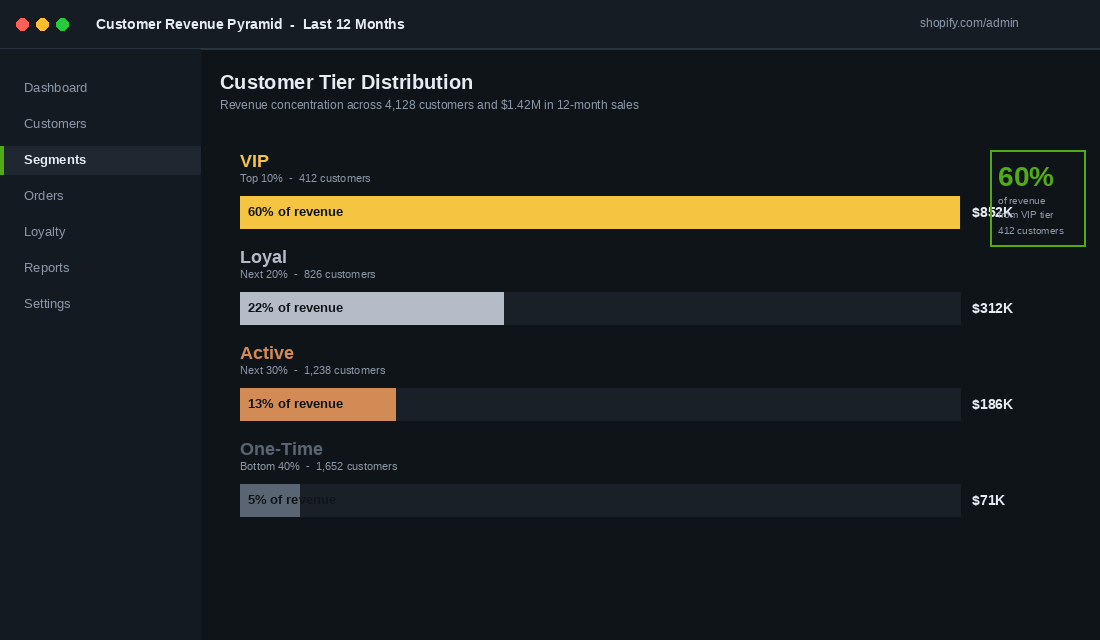
Here is the uncomfortable maths. In almost every store we audit through eCommerce Circle, roughly 10% of customers drive 50 to 65% of annual revenue. The bottom 40% drive less than 6%.
Yet most founders treat every customer the same: same emails, same offers, same shipping, same service. The store with $2k blended customer acquisition cost is happy to lose a $1,200 lifetime customer over a $14 refund argument.
If you want a high-return move that pays back faster than any new ad account, build a real strategy for your top 10%. This is the playbook hundreds of Aussie Shopify founders inside the eCommerce Circle workshop run to identify their VIPs, give them a different experience to the rest of the database, and catch them before they churn.
It is not a loyalty points program. It is a concierge system that compounds.
The Maths That Most Founders Miss
The Pareto principle is not theory in ecommerce. It is the shape of almost every Shopify customer file once you sort by lifetime value.
Adobe’s Digital Index found the top 10% of online shoppers spend three times more per order and account for between 30 and 70% of total revenue depending on the category. RJMetrics put repeat purchase economics simpler: a top decile customer is worth 5 to 7 times an average buyer over 12 months.
Bain & Company has been quoting the same study for nearly two decades. A 5% increase in customer retention can lift profit by 25 to 95% depending on the category. The reason is straightforward.
The cost of acquiring a new buyer in 2026 sits anywhere from 5 to 7 times the cost of keeping one. Meta and Google CPMs are not going backwards. Yet the typical Shopify store still pours 80% of its marketing budget into acquisition.
Pull your own Shopify report right now. Customers, sort by total spent, descending. Highlight the top 10%.
Add their revenue. Compare to total. We have never seen a store under $5m a year where that ratio is below 45%.
Most sit between 55 and 70%. Yet on the customer page in Shopify admin, every one of those buyers gets the same automated thank-you email as the one-time buyer who used a 20% discount code two years ago and never came back. That is the gap this playbook closes.
Stage 1: Identify Your Top 10% With a 6-Signal Scorecard
RFM (Recency, Frequency, Monetary) is the starting point. We covered that model in detail inside our RFM segmentation playbook. But for a VIP cohort, RFM alone misses three signals that predict real lifetime value: how engaged the customer is with your brand, whether they advocate for you, and whether they have given you their voice through reviews or UGC.
The eCommerce Circle VIP scorecard scores every customer out of 100 across six weighted signals. The threshold of 70 enters the VIP cohort.
Lower the bar and you dilute the experience. Raise it too high and you under-invest in a buyer who is just one nudge away from doubling their spend.
- Recency (out of 30). Last order within 90 days scores 30, within 180 days scores 20, within 365 days scores 10. A VIP who has not bought in over a year is no longer a VIP, they are a churn risk.
- Frequency (out of 30). Four or more lifetime orders is the cut. Two orders is a repeat customer. Four orders signals real habit.
- Monetary (out of 30). Lifetime value above the top-decile threshold in your category. For most Aussie skincare or fashion stores in our cohort that sits around $480 AUD. For consumables it drops to $260. For premium homewares it lifts to $1,400.
- Engagement (out of 20). 30-day email open rate above 35% or SMS click rate above 12%. They want to hear from you.
- Referral (out of 20). At least one referred customer through your program, a tracked Klaviyo share link, or a unique influencer code in the wild.
- Voice (out of 15). Has submitted a review with a photo or video, or has been tagged in UGC. The customers who give you their voice almost never churn quietly.
Build this in Klaviyo as a segment. Recency and order count come from Shopify natively. Engagement is a Klaviyo metric.
Referral and Voice need tags pulled from your referral app (Friendbuy, Goaffpro, Mention Me) and your review platform (Stamped, Yotpo, Junip). Once a customer crosses 70 they get tagged “VIP” in Shopify and “vip-cohort” in Klaviyo. Every concierge sequence in stages two through five fires off those tags.

Stage 2: Build the 4-Tier Customer Architecture
Once the VIP cohort is identified, the rest of the customer file still needs a structure. A flat database where every buyer gets the same treatment wastes money on the bottom and starves the top. The architecture we run inside the workshop has four tiers.
- VIP (top 10%). Concierge service. Personalised outreach from a real human. Early access. Free upgrades. No questions on returns. Founder cc on hot tickets. Annual gift.
- Loyal (next 20%). Tiered loyalty program rewards. Birthday gift. Quarterly thank-you note. Priority shipping included.
- Active (next 30%). Standard flows. Reorder reminders. Cross-sell sequences. Replenishment timing pulled from your replenishment flow.
- One-Time (bottom 40%). Aggressive winback. Different creative, different offer, different sender. If they do not respond within 90 days, suppress from acquisition retargeting and move on.
The tier is not a static label. Customers move up and down monthly. The Klaviyo segment recalculates every 24 hours.
A VIP who has not bought in 100 days drops to Loyal and triggers a re-engagement sequence. A first-time buyer who hits four orders inside six months climbs into VIP.
That movement is the whole point. The system rewards behaviour, not history.
One Sydney skincare brand we coached lifted their VIP cohort from 4.2% to 11.8% of total customers over nine months by making the tier visible. They added a small badge to the customer account page. They sent an email when a buyer levelled up.
They did not gamify it heavily, no points or progress bars. Just visibility.
VIP revenue share rose from 38% to 58% over the same window. Same product, same ad spend.
Stage 3: The 7 Concierge Touchpoints That Build Real Loyalty
Loyalty points are a transactional shortcut. They get used by the segment of your audience that already loves you and would have come back anyway. The customers you actually need to invest in are the 8 to 12% who could become VIPs if you put one extra hand on the wheel.
Seven concierge moments do most of the heavy lifting. None of them require a custom app. All of them require attention.
- 1. The level-up email. Triggered the day a customer crosses the VIP threshold. Plain text, sent from the founder’s address, single sentence body: “Saw you just placed your fourth order, wanted to say a real thank-you. Here is my direct email if you ever need anything.” Reply rate inside our cohort sits around 14%.
- 2. The handwritten note. Once a quarter, the VIP cohort gets a real card. We use Postable or a local Aussie printer with a CSV pull from Shopify. Cost per card is roughly $4 including postage. ROI is usually 6 to 9 times revenue lift inside 60 days of receipt.
- 3. The early access window. 48 hours before any product launch, the VIP cohort gets a private link. They are buying at full price and they love it. They feel important. New launch sell-through from VIPs alone is typically 15 to 22% of the launch total.
- 4. The replenishment nudge. Concierge replenishment is different to the standard sequence. A VIP who runs out of the hero SKU gets a single SMS from the founder. Not a Klaviyo template. Their reorder rate jumps 18 to 30% compared to email-only reminders.
- 5. The annual gift. One sample, one branded item, one curated bundle. Not a discount. A gift. Twelve months after their first purchase the VIP receives it with a note: “You have been a customer for a year, this is on us.” Reorders inside 30 days of receipt average 41% in the audits we have run.
- 6. The founder Q&A. Every quarter the founder records a 90-second Loom answering questions submitted by VIPs. New product roadmap, restocks, behind the scenes. Sent only to the VIP segment. View rates run 60% plus.
- 7. The no-questions return. VIPs get a one-tap return process. No reason field. No back and forth. Cost recovery on a return is offset many times over by the reorder lift from frictionless service. One client measured a 32% lift in 90-day reorder rate after enabling no-questions returns for VIPs only.
None of this needs a six-figure tech stack. A founder email, a card printer, a Loom account, a Klaviyo segment, and a Shopify tag are enough. The reason most brands do not do this is not budget.
It is attention. The founder is too busy chasing new traffic to look after the buyers funding the business.
Stage 4: The 4 Anti-Churn Signals That Catch Drift Before It Costs You
Most VIPs do not churn loudly. They drift. The order gap stretches.
The open rate falls. They stop tagging you on Instagram.
By the time you notice, they are 180 days lapsed and back in cold winback territory. The signals are visible weeks earlier if you set the right alerts.
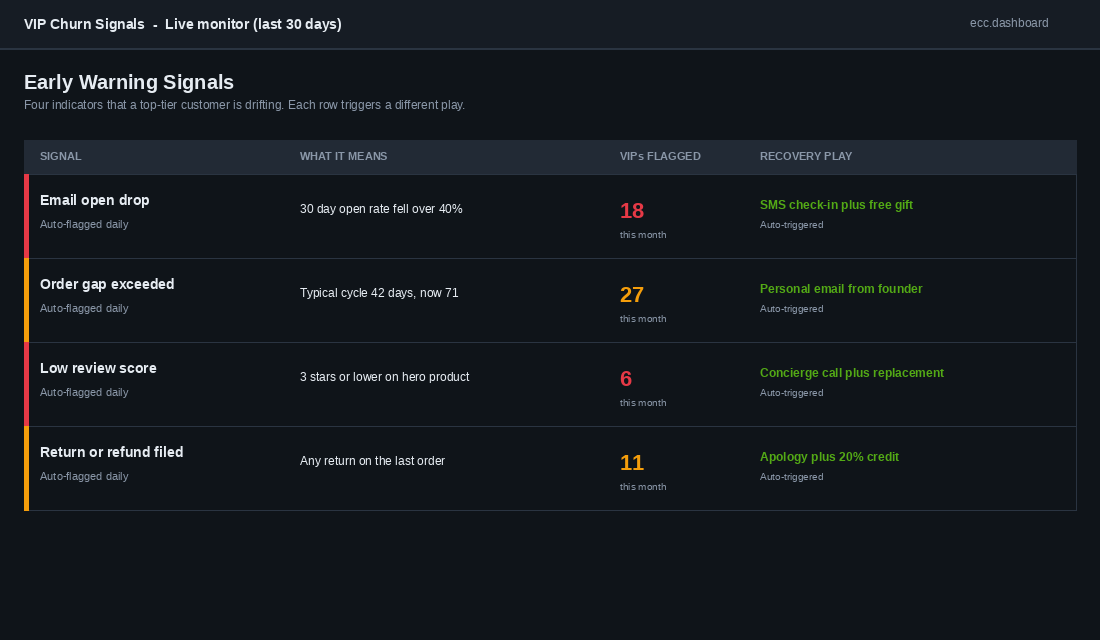
- Signal 1: Email open rate has dropped over 40% in 30 days. The customer who opened 80% of your emails for six months is suddenly at 35%. Something shifted. Either their inbox is buried, or they are losing interest. Trigger: a single SMS from the founder. “Haven’t seen you in the inbox lately, hope all is well. Anything you need from us?”
- Signal 2: The order gap has exceeded their typical cycle by 60%. Their average gap is 42 days, today they are at day 71. They are drifting. Trigger: a personal email from the founder with a curated product pick based on what they have bought before. No discount.
- Signal 3: A recent review or NPS scored 3 or lower. A VIP rarely leaves a bad review unless something genuinely went wrong. Trigger: a phone call from the founder or head of customer experience. Within 24 hours. Replacement on the house if the product is the issue.
- Signal 4: A return or refund on their last order. A return from a VIP is the biggest churn signal in the file. Trigger: an apology email plus a 20% credit toward their next order. Not a discount on the next purchase. A credit that sits in their account ready to use.
Each signal feeds the same audit dashboard. Inside the eCommerce Circle workshop members run a five-minute review every Monday morning of who has been flagged.
The play is not always automated. The highest-value response is almost always a human one.
Stage 5: VIP-Only Perks That Actually Move the Needle
The temptation when designing VIP perks is to copy what the airline industry does. Status. Tiers.
Stars. Most Shopify brands do not have the volume or the brand gravity to make that work. Five perks deliver outsized return for the cost of running them.
- Free express shipping forever. The single biggest perk our audits surface. Cost to the business is usually $4 to $9 per order. The lift on VIP reorder frequency averages 22%. The break-even point is one extra order per VIP per year.
- Early access to new launches. Already covered as a touchpoint. The framing matters: “VIP early window opens Friday 10am, public launch Sunday 10am.” Scarcity plus status.
- Personal product picks. One Brisbane fashion brand we work with sends a quarterly Loom from the buyer with 3 to 5 picks “I think you will love” for each VIP. Conversion on the picks runs 28 to 40%. The buyer makes 12 videos per quarter, batched in a single afternoon.
- Bring-a-friend credit. Not a referral program. A targeted email to VIPs only: “Bring a friend, both of you get $40 credit.” Conversion is 11 to 18% of VIPs in the first 30 days, compared to 2 to 4% on a public referral page.
- Founder dinners or pop-ups. Five to fifteen VIPs in a city. Restaurant night, factory tour, sample night. Cost is usually $80 to $150 per head. The video and UGC alone pays for itself. The retention lift compounds for years.
Notice what is not on the list. A separate VIP discount tier. We have audited dozens of stores where the VIP perk is “10% off everything, all the time.” It is the worst possible perk.
The customer who already loves you and would pay full price is now permanently anchored to a 10% reduction. The margin damage compounds. The status feel disappears.
Treat your VIPs differently with experience, access, and service. Not price.
The Compound Effect: Why This Beats Any New Acquisition Channel
The reason this strategy outperforms a new Meta campaign over a 12-month window is simple. Acquisition is linear. You spend $1, you get one new buyer with a probability of repeat.
Concierge VIP work is exponential. You spend the same $1 on a top-decile buyer and you get four reorders, two referrals, six pieces of UGC, and a customer who tells the next three Aussie founders in their network about you. The compounding is the moat.
Picture a store with 4,128 customers. 412 VIPs at $2,068 lifetime value each. Lift VIP retention by 5 percentage points using the playbook above. That is 21 additional VIPs retained.
At their lifetime value, that is $43,428 in revenue that would otherwise have churned. To replace it through acquisition at a $48 CAC and a $186 average order value, you would need to find 234 new first-time buyers. The maths is not close.
That maths is exactly why customer lifetime value needs to sit on the founder’s dashboard alongside CAC and ROAS. Stores that look at acquisition cost without LTV always over-spend on bad customers and under-spend on good ones. The top 10% strategy fixes the bottom of that funnel.
Worked Example: Finding Your Top 10% in One Shopify Export
You do not need a new app to find your VIPs this week. You need one Shopify export and 20 minutes in Google Sheets.
- Export your customers. In Shopify admin go to Customers, filter to customers with at least one order, and export all to CSV. You get total spent and total orders for every customer.
- Sort by total spent, descending. Count the rows and highlight the top 10%. With 4,000 customers, that is your top 400.
- Add up their spend. Divide it by the total spend of the whole file. That is your VIP revenue share.
- Flag the drifters. Add a column for days since last order. Any top-10% customer past 1.5 times your average reorder gap goes straight onto the anti-churn list from Stage 4.
Here is what this looks like for a typical store. A Perth homewares brand with 4,000 customers and $1.1 million in lifetime revenue finds its top 400 customers spent $610,000. That is a 55% revenue share, right in the range this article describes.
Of those 400, 70 have not ordered in more than 150 days against a normal gap of 90. At an average of $1,525 lifetime spend, those 70 customers represent about $107,000 of past revenue sitting on the edge of lapse. Winning back even a third of them is worth more than most new ad campaigns will earn this quarter.
Once you have the list, move the scoring into Klaviyo so it updates daily. Our Klaviyo segmentation guide shows how to build the segments without code.
Protect Your VIPs From Discount Season
October to December is where most stores accidentally train their best customers to wait for a sale. Your VIPs will happily pay full price in November if you give them something better than a discount.
- Give access, not a bigger code. A 24 to 48 hour early window on your BFCM range, with the same public offer, protects margin and still feels exclusive.
- Exclude VIPs from deep-discount retargeting. Someone who has bought six times does not need a 30% off Meta ad to come back. Upload the VIP segment as an exclusion audience.
- Lock in stock for them. Hold a small allocation of your hero SKUs for VIP early access so they never see “sold out” on launch morning.
- Say thank you in January. A handwritten note or a small gift in the first week of January lands when every other brand has gone quiet.
Stores that run peak season this way usually see VIP margin hold within a point or two of the rest of the year, while first-time buyers carry the discount. For the full post-sale plan, read our post-peak retention playbook and the loyalty program maths guide before you add points to the mix.
Your 30-Day Implementation Checklist
Reading is not the goal. Shipping is. Here is the exact 30-day rollout we use with new workshop members.
- Week 1. Pull the customer file, sort by lifetime value, confirm your top 10% revenue share. Set up the VIP segment in Klaviyo using the six-signal scorecard. Tag the cohort in Shopify.
- Week 2. Build the level-up email. Write the founder thank-you template. Set up the four anti-churn alerts. Decide on the annual gift and source supply.
- Week 3. Launch early-access on your next product drop. Run the bring-a-friend credit campaign. Record the first founder Q&A Loom. Order quarterly handwritten cards.
- Week 4. Review the dashboard. How many VIPs flagged? How many recovered? Adjust the threshold if the cohort feels too small or too large. Lock in the Monday review rhythm.
Inside 90 days you will be able to measure the lift. VIP revenue share, VIP retention rate at 90 and 180 days, average orders per VIP per year. Track these three and the next 12 months take care of themselves.
Treat Your Best Customers Like the Asset They Are
The brands that scale past $5m in Australia are not the ones with the cleverest ads. They are the ones with the deepest moat of repeat buyers.
Your top 10% is sitting in your Shopify admin right now. The question is whether they get the founder’s attention or the same automated thank-you email as everyone else.
Inside eCommerce Circle, the top 10% customer strategy is one of the core pillars we work on with every member. If you want a second opinion on yours, let’s talk.