Most Shopify brands are sitting on an email list that should be printing money — and instead it’s printing crickets. Open rates are mid, revenue per send is dropping, and every campaign feels like shouting into a stadium where 90% of the seats are empty.
What’s in This Article
Here’s the part nobody wants to admit. The problem isn’t your subject lines, your design, or even how often you’re sending. The problem is you’re sending the same email to your superfans, your one-time buyers, and your never-opened-anything-since-2024 ghosts. That’s not email marketing. That’s hope.
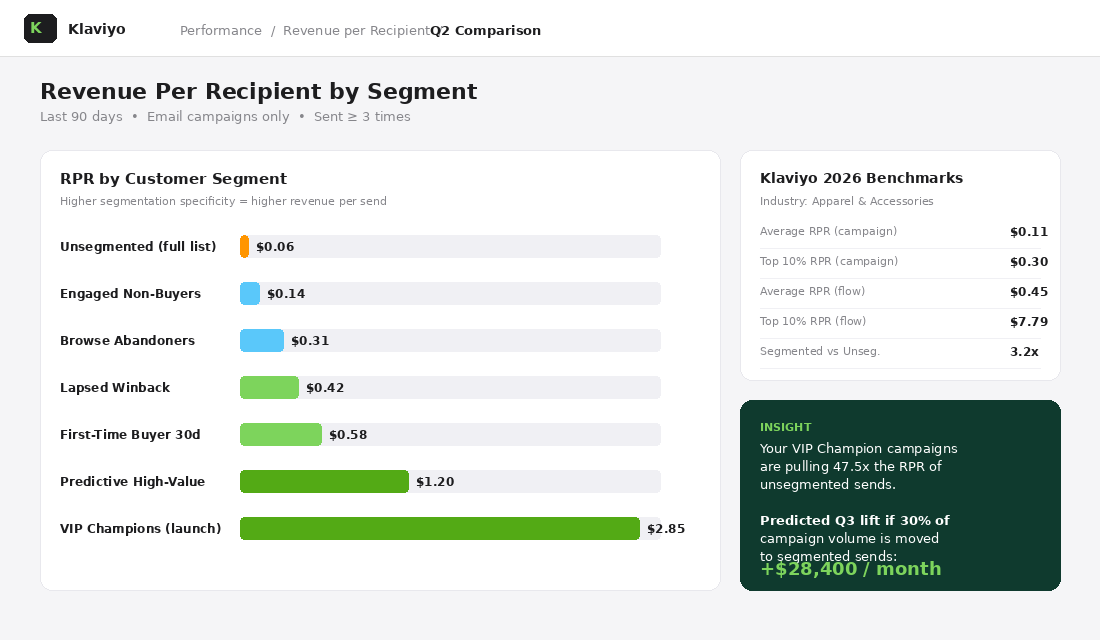
The brands that are actually winning email in 2026 are doing one thing differently — they’ve ditched the “send to all subscribers” button and built proper segmentation. The numbers are not subtle. Highly segmented lists return more than 3x the revenue per recipient of unsegmented lists ($0.19 vs $0.06), and segmented campaigns convert at 7.8% vs 3.4% for the spray-and-pray approach. Taylor Stitch lifted revenue per recipient by 60% and dropped unsubscribes by 60% just by changing who got which email.
This isn’t a “Klaviyo 101” piece. If you’ve already got the basics dialled in (welcome flow, abandoned cart, post-purchase) and you’re wondering why your campaigns still feel flat — segmentation is the lever you haven’t pulled yet. Here are the seven customer segments every Shopify brand should be building inside Klaviyo right now, why they matter, and exactly how to set each one up.
Why Segmentation Is the Highest-ROI Lever in Email Right Now
Before we get into the actual segments, let’s get aligned on why this matters more than anything else you can do in Klaviyo this quarter.
According to Klaviyo’s 2026 benchmarks, the average revenue per recipient for an email send is $0.11. The top 10% of flows hit $7.79 RPR. That’s not a 70x gap by accident — it’s the difference between sending the right message to the right person at the right time, and blasting your whole list with whatever feels good on a Tuesday.
And here’s what most brands miss: flows generate around 41% of total email revenue from just 5.3% of sends. The revenue per recipient on flows is roughly 18x higher than campaigns. So when you build proper segments and trigger flows off them, you’re not just lifting one number — you’re shifting the whole revenue mix toward the highest-margin work your email program can do.
If you’ve ever read our breakdown of the email marketing funnel every Shopify brand needs, segmentation is what makes that funnel actually work. Without it, you’ve got a funnel that everyone goes through the same way — which defeats the entire purpose.
The brands we coach inside the eCommerce Circle who fix segmentation typically see email’s share of revenue jump from sub-15% to 25-35% within 90 days. No new traffic. No new products. Just better targeting on the list they already own.
The Foundation: Set Up RFM Inside Klaviyo Before Anything Else
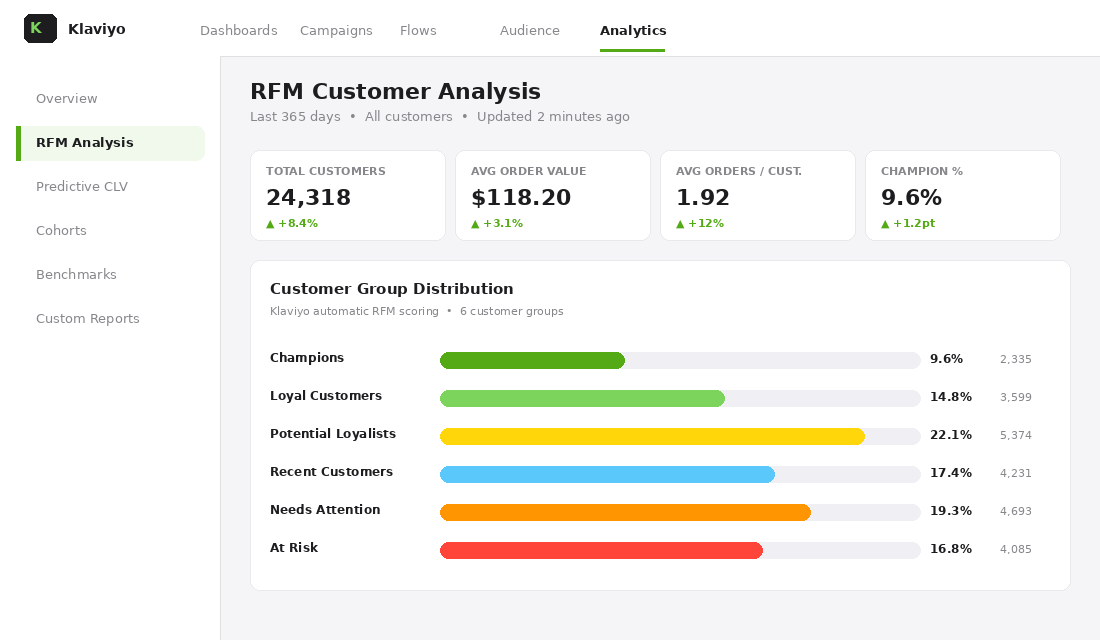
You can’t segment well without knowing where each customer sits across three dimensions: Recency (how long since their last order), Frequency (how often they buy), and Monetary value (how much they’ve spent). This is the RFM model, and Klaviyo has it built in natively now under Analytics > Reports > RFM.
Klaviyo automatically buckets every profile into one of six groups: Champions, Loyal, Potential Loyalists, Recent Customers, Needs Attention, and At Risk. Each group is scored 1-3 across recency, frequency, and monetary, with 3 being the best. A Champion is someone who scores high on all three. An At Risk customer used to score high on monetary but has dropped on recency.
Before you build a single segment from this article, do this: open Klaviyo, go to the RFM report, and look at your distribution. For most stores under $5M, the picture looks something like 8% Champions, 15% Loyal, 22% Potential Loyalists, 18% Recent Customers, 20% Needs Attention, and 17% At Risk. If your Champions are below 5% or your At Risk is above 30%, your retention engine is leaking — and these segments are the patches.
Now let’s get into the seven segments that will do the heavy lifting.
Segment 1: Engaged Non-Buyers (Your Warmest Free Money)
This is the segment most brands ignore because nobody in it has bought anything yet. Which is exactly why it’s a goldmine. These are profiles who have opened or clicked at least one email in the last 30 days, are subscribed, and have placed zero orders.
They’ve already raised their hand. They’re paying attention. They just haven’t pulled the trigger yet. The job of this segment is to figure out what’s stopping them — and remove it.
How to build it in Klaviyo:
- Has been in segment “Email Subscribers” at any point.
- What someone has done (or not done): Opened Email at least once in the last 30 days OR Clicked Email at least once in the last 30 days.
- What someone has done (or not done): Placed Order zero times over all time.
- Properties about someone: Email Marketing Consent equals subscribed.
What to send them: Founder story. Hero product education. Honest reviews from real customers. A first-purchase incentive that’s small enough to protect margin (10% off, free shipping, free sample with order) but high-enough perceived value to tip them over.
What benchmark to expect: A well-targeted Engaged Non-Buyer campaign should hit 35-45% open rates and convert at 1-3% on a single send. That’s massive compared to a list-wide campaign converting at 0.3-0.6%.
Segment 2: First-Time Buyers (The Make-or-Break Window)
Here’s a stat that will reframe how you think about retention: a first-time buyer who comes back for a second purchase is roughly 3x more likely to become a third-time buyer. The gap between “ordered once” and “ordered twice” is the single biggest cliff in your customer base.
And the window to convert it is narrow — typically 30 to 90 days, depending on your product category. After that, attention drops, the post-purchase glow wears off, and you’re competing with dozens of other brands fighting for the same wallet share.
How to build it in Klaviyo:
- What someone has done (or not done): Placed Order exactly once over all time.
- Properties about someone: First Active in the last 90 days (or set this to your category’s repurchase window).
- Email Marketing Consent equals subscribed.
What to send them: The post-purchase flow already gets the basics done (thank you, shipping confirmation, how to use the product). This segment is for everything after that. Cross-sell campaigns to the obvious next product. Education content that deepens the relationship with the brand. A second-order incentive timed to your category’s typical reorder window.
The Aussie context: If you’re in skincare, expect a 45-60 day reorder window. If you’re in fashion, 60-90. Pet food and supplements: 30-45. Coffee: 21-30. Time your second-purchase nudge to land 7-10 days before the average reorder, not after.
Inside the eCommerce Circle, when we work with members on calculating customer lifetime value properly, this is always one of the first segments we lift — because it’s where the LTV math actually compounds.
Segment 3: VIP Champions (Your Top 10% Funding the Whole Business)
The 80/20 rule on most Shopify stores is closer to 90/10 — your top 10% of customers fund the bottom 50% of marketing spend. These people don’t need discounts. They need to be made to feel like they’re inside the velvet rope.
This is also the single most-discounted segment most brands have. Every Black Friday email goes out to your $5,000 lifetime customer the same way it goes out to your one-time $40 buyer. That’s a margin disaster wrapped in a relationship-killer.
How to build it in Klaviyo:
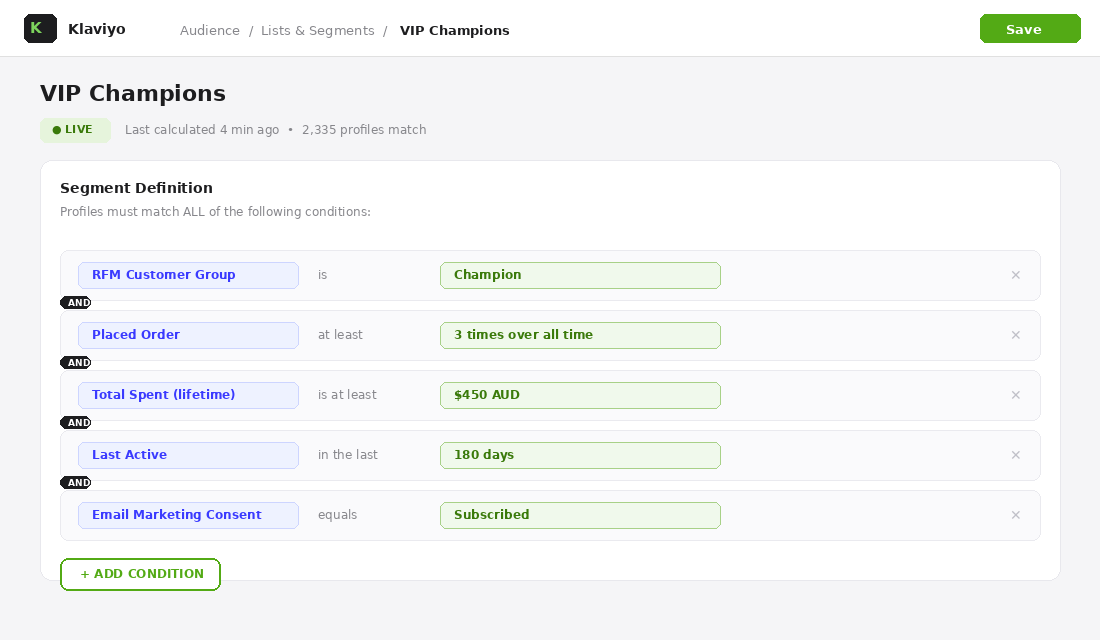
- Use Klaviyo’s RFM property: RFM Customer Group equals Champion.
- Or build manually: Placed Order at least 3 times over all time AND Total Spent is at least $X (set X to your top decile by lifetime spend — pull this from Shopify reports if needed).
- Last order placed in the last 180 days (so they’re still active).
What to send them: Early access to launches (24-48 hours before public). Members-only colours, sizes, or bundles. A handwritten note from the founder once a year. Surprise gift with their next order. Exit any blanket discount campaigns from this segment — they buy anyway, and discounting them just trains them to wait.
The benchmark: A Champion-only launch campaign should convert at 8-15% within 24 hours. If you’re seeing single digits, your VIPs aren’t being treated like VIPs — they’re being treated like list members.
Segment 4: Lapsed Customers (The Winback Goldmine)
Every Shopify store has a graveyard of customers who used to buy and now don’t. They’re not unsubscribed. They’re not dead. They’ve just drifted. And winning even a small fraction of them back is the cheapest acquisition you’ll ever do, because they already know your brand, your shipping, and your product.
Klaviyo has a built-in property called Expected Date of Next Order that uses your store’s purchase data to predict when each customer should be ready to buy again. The trick is to define “lapsed” as 30-60 days past that expected date — not some arbitrary “no order in 180 days” rule that ignores their actual buying rhythm.
How to build it in Klaviyo:
- Placed Order at least once over all time.
- Expected Date of Next Order is before 35 days ago (this catches them just past their expected reorder).
- Has not placed an order in the last 60 days.
- Email Marketing Consent equals subscribed.
What to send them: A three-email winback flow is the standard. Email 1: “We miss you” with a soft reason to come back (new launch, restock of their favourite). Email 2: A genuine incentive — 15-20% off, only valid for 7 days. Email 3: A “this is the last one” final ask, with the offer expiring in 48 hours.
What benchmark to expect: Winback flows typically pull 29% open rates, 4% click rates, and 0.9-1.4% conversion rates per send. Even at the low end, a 1% conversion on 5,000 lapsed customers at a $90 AOV is $4,500 in recovered revenue. Per send.
Segment 5: Browse Abandoners (The Highest-Intent People You’re Probably Ignoring)
Most brands have a cart abandonment flow. Almost no one has a properly built browse abandonment segment. The difference matters — cart abandonment catches roughly 0.7% of your site visitors. Browse abandonment catches the 5-10% of visitors who looked at a product but didn’t add to cart.
That’s a 10x larger pool of high-intent humans you’re letting walk away in silence. And unlike retargeting ads, email costs you essentially nothing to send.
How to build it in Klaviyo:
- Klaviyo’s Viewed Product event needs to be firing — confirm in Analytics > Metrics first.
- Build a flow with the trigger: Viewed Product.
- Filter: has not Placed Order since starting this flow.
- Filter: has not Started Checkout since starting this flow (so cart abandoners get the cart flow, not this one).
- Wait 1 hour, then send. Wait 24 hours, send a second email. Wait 48 hours, send a third.
What to send them: Show the exact product they viewed. Include 2-3 customer reviews of that product (these do the heavy lifting). Add a “questions about this product?” link to a real human. The browse abandonment flow is not the place for hard discounts — most browsers aren’t price-sensitive yet, they just need a reason to come back.
Segment 6: Discount Seekers (The Margin-Killer You Need to Manage)
This is the segment most brands accidentally build by being lazy. If your only growth lever is “email a discount code every Tuesday,” you’ve trained your list to wait for the next sale. They won’t buy without one. Ever.
The fix isn’t to ignore them — it’s to identify them and run a different playbook. You build a segment of customers whose orders have predominantly used a discount code, and you carve them out of full-price launches and into sale-focused campaigns. This protects your margin on full-price work and stops you accidentally giving 25% off to a customer who would have paid full price.
How to build it in Klaviyo:
- Placed Order at least 2 times over all time.
- Placed Order where Discount Code is set at least 75% of the time (Klaviyo’s “in at least X of last Y” filters can approximate this).
- Use this as an exclusion on your full-price campaigns and a target for clearance, EOFY, and BFCM.
The Aussie context: Australian shoppers are particularly trained around the Click Frenzy / EOFY / BFCM calendar. If your store does even 5-10% of revenue at full margin, identifying and protecting that buyer behaviour is worth more than another 5% lift in ad ROAS. Discount seekers should fund your sale season — not your everyday campaigns.
Segment 7: Predictive High-Value (Klaviyo’s CLV Crystal Ball)
This is the segment almost nobody is using and it’s quietly one of the most powerful tools in Klaviyo. The platform calculates a Predicted CLV for every customer based on their early purchase behaviour. It’s not perfect, but for stores with 3+ months of order data and at least a few hundred orders, it’s directionally accurate.
You can identify customers who have only placed one or two orders but whose predicted CLV is in the top 20% of your base — meaning Klaviyo’s model thinks they’re going to be a Champion eventually. And then you can treat them like one before they get there.
How to build it in Klaviyo:
- Placed Order at least 1 time over all time.
- Predicted CLV is at least $X (set this to your top quintile — Klaviyo shows you the distribution in Analytics).
- Last order placed in the last 90 days.
What to send them: A “thank you for being one of our top customers” message even if they’ve only ordered once. Early access invites. A surprise sample with their next order. Treat them as if they’re already a Champion, because the data says they’re on track to be one.
The compound effect: Brands using predictive segmentation typically see their average order count per customer move from 1.6 to 2.1+ within six months — because they’re nudging the right customers up the value ladder before they drift away. That’s how Bloom & Root grew email revenue from $384,000 to $537,600 — a 40% lift — within five months by implementing automated behavioural segmentation.
How These Seven Segments Work as a System
Here’s the part where it clicks. Each of these segments solves a specific job, but the real power is when you stack them.
An Engaged Non-Buyer becomes a First-Time Buyer through your nurture and incentive layer. A First-Time Buyer becomes a Predictive High-Value through targeted second-purchase nudges. A Predictive High-Value becomes a Champion through early access and VIP treatment. A Champion stays a Champion because you stop discounting them. A drift becomes a Lapsed Customer flagged by Expected Date of Next Order, then re-engaged through a winback flow before you lose them entirely.
Browse Abandoners and Discount Seekers run in parallel — they’re cross-cutting segments that improve every campaign you send by either capturing missed intent or protecting margin.
This is the system that turns email from a “30% of revenue if we’re lucky” channel into a 35-40% reliably-driving-orders engine. Not because of a single magic email — because of compound, segmented, behavioural targeting at every stage of the customer journey.
The 90-Day Klaviyo Segmentation Implementation Plan
If you’ve got the basic Klaviyo flows in place (and if you don’t, start with the five Klaviyo flows every Shopify store needs before this), here’s the rollout sequence we use with members:
Days 1-14: Set up the foundation. Run the RFM report, document your distribution, build segments 1 (Engaged Non-Buyers) and 4 (Lapsed). These two unlock revenue from people you already have on the list. Send your first segmented campaign to each within the fortnight.
Days 15-30: Build segments 2 (First-Time Buyers) and 3 (VIP Champions). Audit every existing campaign and make sure VIPs are excluded from blanket discount sends. Build a launch flow that fires to Champions 24 hours before everyone else.
Days 31-60: Build segment 5 (Browse Abandonment flow) and segment 6 (Discount Seekers). The browse flow alone often adds 3-5% to email revenue within the first month. The discount seeker segment changes how you plan EOFY and BFCM.
Days 61-90: Layer in segment 7 (Predictive High-Value). Run an A/B test on one of your best-performing campaigns — same creative, half the list segmented properly, half batch-and-blast. Document the lift. This is the data you’ll use to keep the segmentation rhythm going.
Day 91: Audit your work. Pull the same Klaviyo metrics — RPR, conversion, unsubscribe rate — and compare. Most brands see RPR move from $0.06-$0.10 range up to $0.15-$0.22 within the first 90 days. That’s not a small win. On a 30,000-subscriber list sending one campaign a week, the difference between $0.08 and $0.18 RPR is roughly $156,000 in extra annual revenue.
The Segment Audit Checklist (Save This)
Before you call your segmentation done, run through this every quarter:
- RFM distribution snapshot. Has Champions grown vs last quarter? Has At Risk shrunk?
- Segment 1 (Engaged Non-Buyers) conversion rate. Should be 1-3%. If it’s flatlining, your incentive offer or your hero product education isn’t compelling enough.
- Segment 2 (First-Time Buyers) repurchase rate within 90 days. Should be 25%+. If it’s below 20%, your second-order nudge isn’t landing — or your category window is wrong.
- Segment 3 (VIPs) discount exposure. How many sale emails have they received this quarter? Aim for zero or near-zero.
- Segme