You know your cost of goods. You track your ad spend. But when someone asks “What is your actual profit margin?” most Shopify store owners go quiet. They can tell you their revenue, but the real number – what lands in the bank after every cost is accounted for – is a mystery.
What’s in This Article
Profit margin is the number that determines whether your business is building wealth or burning through cash on a treadmill. A $100K per month store with 8% net profit margin makes $8,000. A $50K per month store with 22% net margin makes $11,000. The smaller store is more profitable. Revenue is a vanity metric. Margin is what pays your bills.
The Three Margins Every Shopify Owner Must Know
There are three margin numbers you need to track, and most Shopify owners only know one of them (if that):
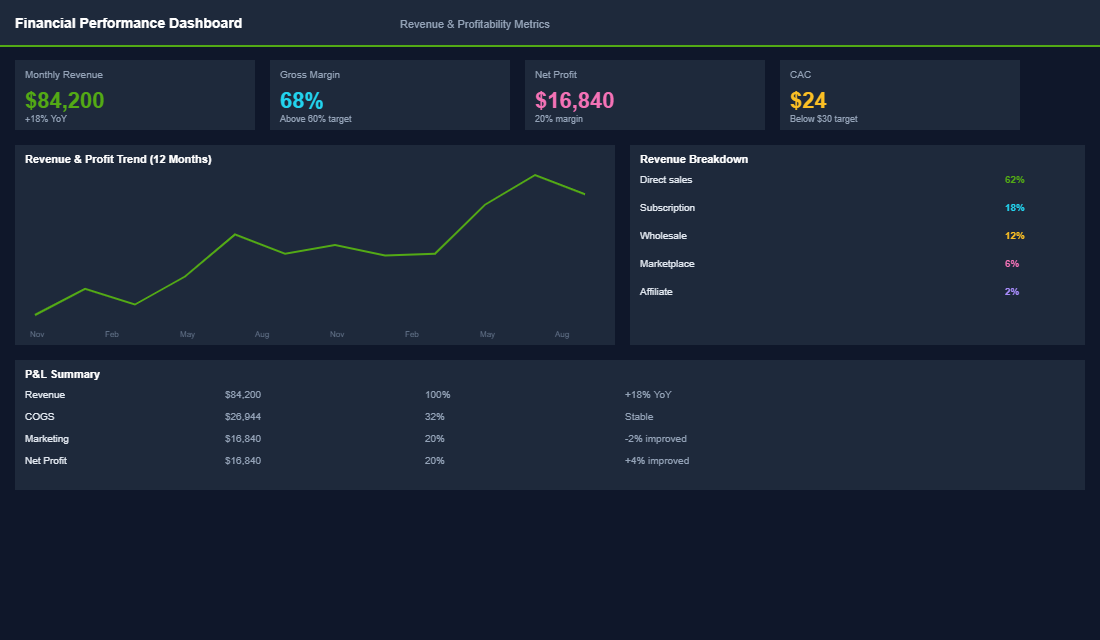
Gross Margin. Revenue minus Cost of Goods Sold (COGS), divided by revenue. Your COGS includes the product cost, inbound shipping, duties, and packaging. If a product sells for $100 and your COGS is $35, your gross margin is 65%. Benchmark for healthy Shopify stores: 55-70%. Below 50% and you have very little room for marketing and operations.
Contribution Margin. Gross profit minus all variable costs associated with the sale: outbound shipping, payment processing fees (2.9% + 30c on Shopify Payments), marketplace fees, and pick-and-pack costs. This tells you how much each sale actually contributes to covering your fixed costs. Benchmark: 35-50%.
Net Profit Margin. Contribution margin minus all fixed costs: rent, software subscriptions, salaries, insurance, accounting, and marketing overhead. This is the real number – what you actually keep. Benchmark: 10-20% for a well-run Shopify store. Below 10% is survivable but not sustainable for growth. Below 5% means one bad month could put you in the red.
The Hidden Costs That Destroy Margins
Most margin problems are not caused by obvious expenses. They are caused by dozens of small costs that individually seem insignificant but collectively eat 10-15% of your revenue:
- Shopify app subscriptions. The average Shopify store has 12-15 installed apps, each costing $10-100/month. An app audit typically reveals 3-5 apps that are unused or redundant. That is $200-500 per month in wasted spend – $2,400-6,000 per year straight off your bottom line.
- Payment processing fees. Shopify Payments charges 2.9% + 30c per transaction (on the basic plan). On $50K monthly revenue, that is $1,480 in processing fees alone. Moving to a higher Shopify plan reduces the rate and can save $200-400/month at higher volumes.
- Returns and exchanges. If your return rate is 10% (common in fashion and apparel), you are losing 10% of revenue plus the return shipping cost, restocking labour, and potential damage to returned goods. Returns can silently consume 12-18% of gross revenue in some categories.
- Discounting and promotions. If your average discount rate is 15% across all orders, you are giving away 15% of potential revenue. Track your discount rate and question whether every promotion is actually driving incremental sales or just training customers to wait for deals.
- Shipping cost absorption. Free shipping over $100 sounds great for conversion, but if your average shipping cost is $12 and 60% of orders qualify for free shipping, you are absorbing $7,200/month on a store doing 1,000 orders. Factor this into your pricing strategy.
Building a Profit-First Pricing Strategy
Most Shopify brands price based on competitor prices or a simple markup multiplier. Both approaches leave money on the table. Here is a profit-first pricing framework:
Step 1: Calculate your true landed cost. Product cost + inbound freight + duties + packaging + any quality control costs. This is your absolute floor – you cannot sell below this without losing money on every unit.
Step 2: Add your variable costs. Payment processing (3%), outbound shipping (either absorbed or charged), pick-and-pack labour, and expected return cost (return rate x return handling cost per item). Now you know the true cost of putting one unit in a customer’s hands.
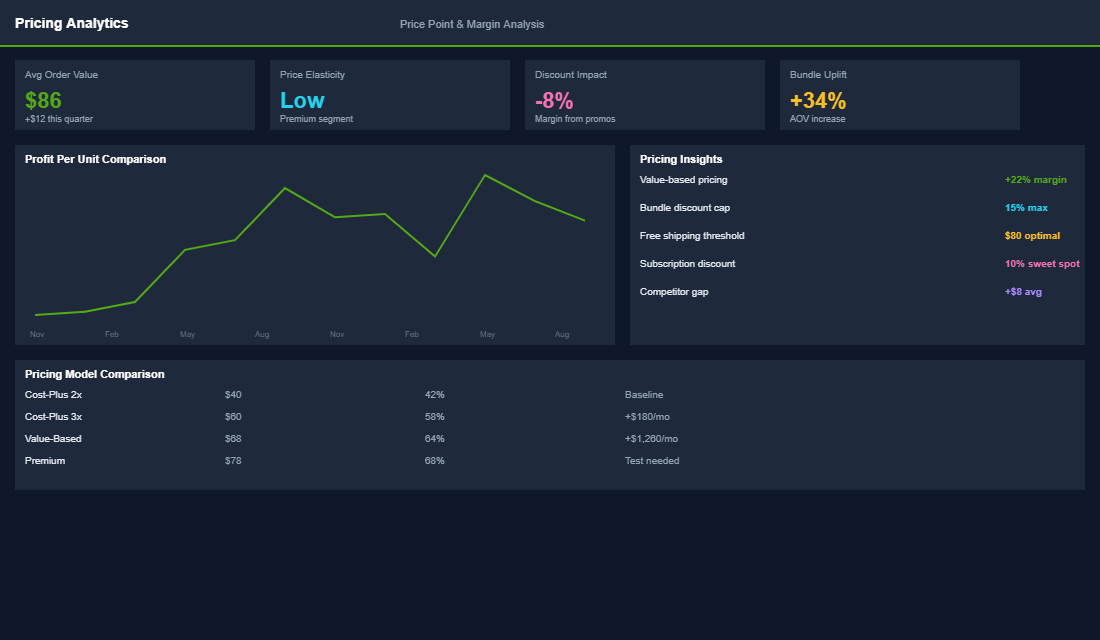
Step 3: Set your target contribution margin. You need at least 35% contribution margin to cover fixed costs and generate profit. Work backwards from your total cost: if total variable cost per unit is $38, you need to charge at least $58 to achieve 35% contribution margin. That is your minimum viable price.
Step 4: Price to value, not to cost. Your minimum viable price is the floor, not the ceiling. Price based on the value your customer perceives. If competitors sell similar products for $80-100 and your brand positioning supports premium pricing, charge $89-99 – even if your minimum viable price is $58. The extra $31-41 per unit is pure margin improvement.
Seven Quick Wins to Improve Margins This Month
You do not need a complete business overhaul to improve margins. These seven tactics can each add 1-3% to your net margin:
- Audit and cancel unused Shopify apps. Go through your apps list today. If you have not actively used an app in the last 30 days, uninstall it. Immediate savings.
- Renegotiate shipping rates. If you are shipping 100+ parcels per month, you have leverage to negotiate better rates with Australia Post or switch to a service like Sendle that offers volume discounts. A $1.50 saving per parcel x 500 parcels = $750/month.
- Increase prices by 5-8%. Most brands are underpriced. A 5% price increase on a $100 product adds $5 to your margin – which goes straight to the bottom line. Test it on your top 10 products and monitor conversion rate. Most stores see zero change in conversion rate with modest price increases.
- Reduce your discount frequency. If you run sales every month, customers learn to wait. Reduce to quarterly promotions and watch full-price sales increase. Your overall revenue might dip slightly but your margin will improve significantly.
- Optimise your free shipping threshold. If your threshold is $80 and your AOV is $85, most customers already qualify – meaning you are subsidising shipping without influencing behaviour. Raise the threshold to $110-120 to actually drive basket increases.
- Switch to lighter packaging. Packaging weight directly affects shipping costs. Switching from a 400g box to a 200g satchel for smaller orders can save $2-3 per shipment. Multiply by monthly volume for the impact.
- Add high-margin digital products. Guides, templates, recipe books, styling lookbooks – digital products have near-zero COGS and can be bundled with physical products to increase AOV and margin simultaneously.
Building a Profit Dashboard
You cannot improve what you do not measure. Set up a simple profit dashboard that you review weekly – a Google Sheet is fine. Track these numbers:
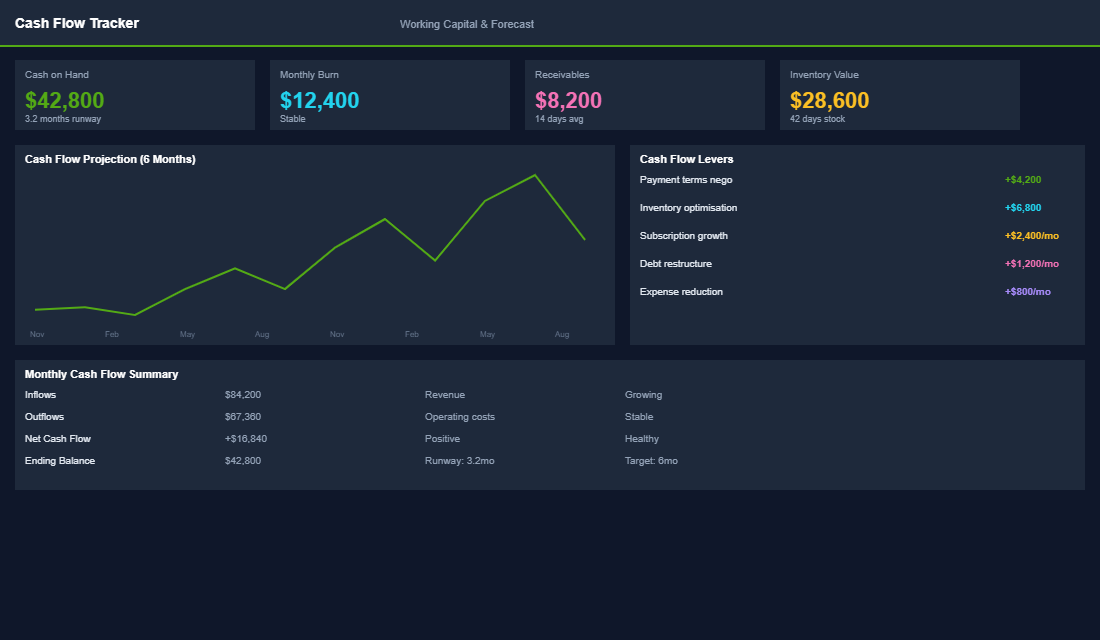
- Weekly: Revenue, COGS, gross margin %, ad spend, blended ROAS, and cash in bank. These six numbers take 10 minutes to update and give you a real-time pulse on business health.
- Monthly: Full P&L including all fixed costs. Calculate net profit margin. Compare to previous months and identify trends. If margin is declining while revenue is growing, you have a scaling problem that needs attention.
- Quarterly: Unit economics review. Recalculate your true landed cost, contribution margin per product, and LTV:CAC ratio. Costs change – supplier prices move, shipping rates adjust, software costs creep up. Quarterly reviews catch drift before it becomes a crisis.
The Compound Effect of Margin Improvement
Margin improvements compound differently than revenue improvements. A 5% improvement in net margin is not a 5% increase in profit – it can be a 50%+ increase if your starting margin was 10%. Moving from 10% to 15% net margin on $50K monthly revenue means your monthly profit goes from $5,000 to $7,500 – a 50% increase in the money you actually keep.
One eCommerce Circle member ran through the seven quick wins above and improved their net margin from 11% to 18% within two months. On their $65K monthly revenue, that translated to an extra $4,550 per month in profit – $54,600 per year – without growing revenue by a single dollar.
Revenue is exciting. Profit is what builds wealth. The most successful Shopify brands obsess over both.
Know Your Numbers This Week
This week, calculate your three margins: gross, contribution, and net. If you do not have the data readily available, that is your first problem to solve. Set up a simple spreadsheet, pull your Shopify reports, and do the maths. The clarity that comes from knowing your real profitability will change how you make every business decision.
Inside the eCommerce Circle, profit optimisation is the core of our Profit framework. We help members audit their cost structure, implement margin improvements, and build the financial dashboards that ensure every dollar of revenue translates to maximum profit – because a business that grows revenue without growing profit is just a more expensive hobby.
Revenue is vanity. Profit is sanity. Know the difference, and manage accordingly.
The Margin Benchmarks That Tell You If You Have a Problem
Numbers on their own mean nothing. A 42% gross margin sounds healthy until you find out your category typically runs at 65%. Here is what good looks like for Australian Shopify stores, so you can judge your own numbers honestly instead of hoping.
- Gross margin. Apparel and accessories should sit at 55-70%. Beauty and skincare 65-80%. Food and beverage 35-50%. Consumer electronics and anything you resell 20-35%. Homewares 45-60%. If you are more than 10 points below your band, the problem is pricing or supplier cost, not marketing.
- Contribution margin after ads. Take gross profit, subtract shipping, payment fees and paid acquisition. Healthy stores land at 25-40%. Under 15% and you are running a business that only works when ad costs behave.
- Net margin. For a store between $40k and $500k a month, 10-20% is solid. Sub-5% is survival mode. Above 25% usually means either premium positioning or a very lean cost base.
- Blended MER. Total revenue divided by total ad spend. Most Aussie DTC stores need 3.0x or better to clear a healthy net margin. Below 2.5x and your ads are eating the business.
- Shipping cost as a share of revenue. Aim for under 8%. Australian stores regularly hit 12-15% because of interstate freight, and it silently erases a third of gross profit.
Write your five numbers next to those bands right now. The gap you find is your first ninety days of work. If your gross margin is the number that is off, your pricing is the lever, and our guide to setting prices that maximise profit without killing conversions covers exactly how to move it.
Where Your Margin Actually Leaks: A Line-by-Line Teardown
Imagine you run a homewares store doing $120,000 a month with a 58% gross margin. On paper you are making $69,600 in gross profit. Here is where it goes.
- Paid acquisition: $24,000. A 5.0x blended MER. Feels efficient until you notice 40% of that spend is retargeting people who would have bought anyway.
- Shipping and fulfilment: $13,200 (11% of revenue). You offer free shipping over $99 and your average order is $104, so almost every order ships at your cost.
- Payment processing: $2,280 (1.9%). Shopify Payments plus Afterpay at roughly 6% on the buy-now-pay-later share of orders.
- App stack: $1,450. Nineteen apps. You use eleven.
- Returns and replacements: $4,800 (4%). Mostly breakage in transit, which is a packaging problem wearing a returns costume.
- Team, rent, software, accounting: $18,000.
That leaves $5,870, a net margin of 4.9%. You have a $120k business paying you like a $30k one. Now look at what moves it. Lifting the free-shipping threshold from $99 to $135 pushes average order value up and cuts the number of orders you subsidise. Cutting eight unused apps returns $600 a month. Fixing the packaging that causes breakage claws back half the returns cost. None of those are growth projects. All three together take net margin from 4.9% to roughly 8.5% without selling a single extra unit.
This is why margin work beats growth work when your foundation is leaking. Every dollar you rescue from the cost base is a dollar of pure profit, whereas every dollar of new revenue only delivers whatever your net margin allows. Track these lines monthly alongside the rest of your core financial metrics and the leaks show up before they compound.
Renegotiating Your Cost Base Without Switching Suppliers
Most founders assume cost reduction means finding a cheaper supplier and starting over. It rarely does. The fastest margin wins come from renegotiating what you already have, because your existing suppliers have switching costs too.
- Consolidate your order volume. If you split orders across three suppliers to spread risk, you are also splitting your bargaining position three ways. Moving 70% of volume to one partner in exchange for a 5-8% unit price reduction is a common trade, and 5% off COGS on a 58% margin store lifts gross margin by roughly 2 points.
- Buy payment terms, not just price. Moving from prepayment to 30-day terms does not change your unit cost, but it changes how much stock you can hold without a cash crunch. That matters more than most founders realise, and it is the difference between funding growth from trading and funding it from a facility.
- Audit your freight annually. Rates you negotiated at 200 parcels a month are not the rates you should be paying at 900. Australia Post, Sendle, Aramex and Couriers Please will all requote on volume, and a 12% freight reduction on a store shipping $13,000 a month returns $1,560 straight to net profit.
- Kill the app tax. Open your Shopify billing, list every subscription, and mark each one used or unused in the last 30 days. Most stores find $300-900 a month of unused apps. That is free margin, available today.
- Renegotiate payment rates at scale. Once you are past roughly $200k a month in processing volume, Shopify Payments rates are negotiable. Ask.
Work through these in order of speed, not size. The app audit takes an hour and pays this month. The supplier renegotiation takes six weeks and pays for years. For the detail on how to run that supplier conversation without damaging the relationship, read our supplier negotiation playbook, and pair it with a proper cash flow management system so the better terms actually translate into breathing room.
Margin work is unglamorous and it compounds faster than anything else on your list. If you want a second set of eyes on where your profit is leaking, let’s talk.