Most Aussie founders chase a bigger business the hard way. They pour another few thousand dollars into Meta, watch their cost to acquire a customer climb, and wonder why the bank balance never seems to move. The cheapest growth in your store is not a brand new customer. It is a bigger order from the customer you have already paid to win.
What’s in This Article
Here is the maths that should change how you think. The average Australian online order sat at roughly AU$95 in 2025, the lowest in a decade, while households still spent a record $69 billion across the year. Acquisition keeps getting dearer. The basket keeps getting smaller. That gap is exactly where your margin goes to die.
Average order value, or AOV, is the one growth lever you fully control. You do not need Meta’s approval, a fatter budget, or a viral moment. You need five specific mechanisms working together on your store. Done properly they lift AOV 15 to 30%, and almost every dollar of that lift drops straight to contribution margin. This is the playbook we run with members inside eCommerce Circle, lever by lever.
Why AOV Is the Cheapest Growth Lever You Own
AOV is simple to calculate: total revenue divided by number of orders over a period. The reason it matters more in 2026 than it did three years ago is that the cost side of your store has moved against you. Ad costs are up, shipping is up, and your marketing efficiency ratio only improves in two ways: spend less to acquire, or earn more per order. The second one is in your hands today.
For context, global AOV settled around US$154 in late 2025, up about 3% year on year. The Asia-Pacific region tends to run lower, closer to US$125. Do not chase those headline numbers. Your category sets your ceiling: luxury and jewellery clear US$300 an order, while pet care sits near US$66. The benchmark that matters is your own store last quarter.
The leverage is in the margin. Add $10 to a $95 order at a 60% gross margin and you keep roughly $6 of near-pure contribution, because you already paid the ad cost, the pick and pack, and the base merchant fee on that order. You are not buying that extra revenue. You are engineering it.
Here is the trap most founders fall into. They try to lift AOV with a blunt sitewide discount, which trains customers to wait for the next sale and quietly bleeds margin on every order. The five levers below do the opposite. They add value to the basket so the customer chooses to spend more, instead of you paying them to.
Lever 1: The Free Shipping Threshold (Your Fastest Win)
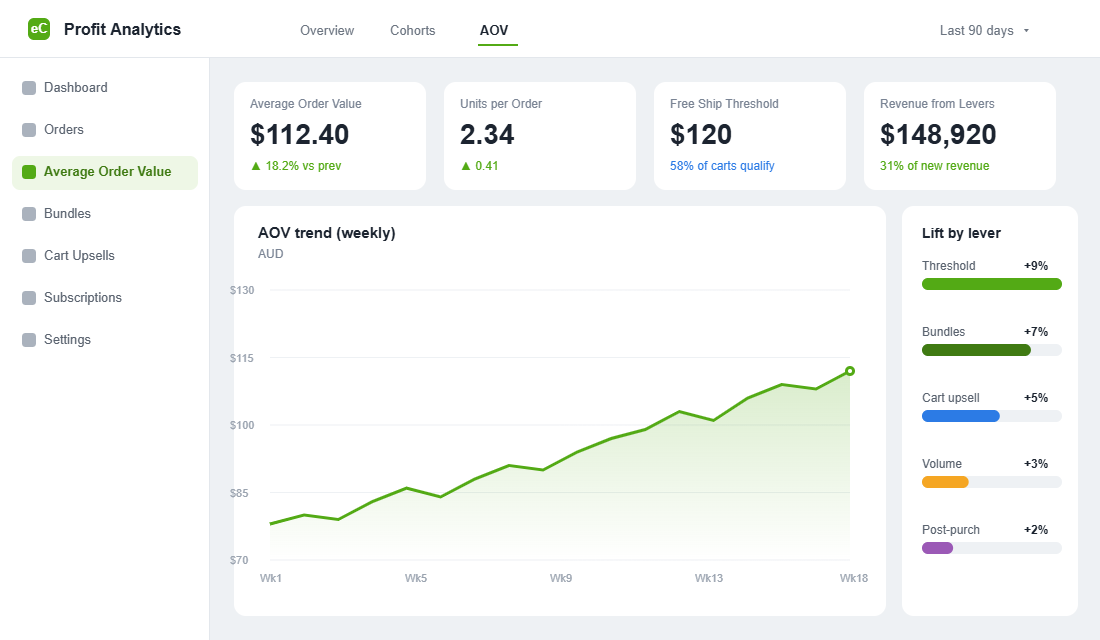
Free shipping is the single most powerful basket-builder you have, and it costs you nothing to switch on properly. Around 93% of consumers actively shop to qualify for it, and 58% will add items specifically to reach a threshold, lifting their order value by roughly 30% when they do. This is not a fringe behaviour. It is how most people shop.
Australians feel it even more strongly. Free shipping ranks as the top delivery preference for 56% of local shoppers. One in four will happily spend up to $10 more to unlock it, and one in five will spend up to $20 more. That extra spend is yours to capture or leave on the table.
Set the number with intent. The threshold should sit 15 to 25% above your current AOV. On a $95 AOV that means a threshold around $115 to $120. Set it too high and you push carts into abandonment. Set it too low and you hand back margin on orders that would have cleared the bar anyway.
The threshold only works if the customer can see it. A dynamic progress nudge in the cart (“You are $8.10 away from free shipping”) converts a vague intention into a deliberate extra add. Without the bar, the threshold is invisible and you get a fraction of the lift.
Protect the economics underneath it. Australia Post added surcharges above 20% on remote routes through 2025, so a single national threshold can quietly turn unprofitable on regional orders. Zone your shipping rates so metro and remote deliveries are not forced to share one number.
- Calculate your live AOV first. Pull the last 90 days, not last year, so seasonality does not skew it.
- Set the threshold 15 to 25% above that figure. Test one number for two weeks before you move it.
- Add a progress bar to the cart and slide cart. The visible “you are nearly there” prompt is where the lift actually happens.
- Zone your rates. Keep remote and metro shipping on separate logic so the threshold stays profitable everywhere.
Lever 2: Bundles and Kits (The Biggest Single Lever)
If you only build one thing this quarter, build bundles. On average, bundles lift AOV 20 to 35%, and best-in-class implementations push past 55%. They work because they remove a decision for the customer. Instead of asking them to assemble the right combination, you hand them the finished answer.
The proof is everywhere, including close to home. Gold Coast brand HiSmile leaned into curated packs and watched more than 80% of orders become bundled, with cart size lifting roughly fourfold. Wellness brand Your Super used bundles and cross-selling to help drive towards $70 million in sales. Pet food brand Maev saw a 15% AOV lift and a 20% jump in units per transaction once bundles went live.
Use the four bundle types that actually move the needle. A “complete the set” starter pack does the heavy lifting for new customers. Build-your-own bundles suit ranges with strong variety. Tiered value packs (“3-pack, 6-pack, 12-pack”) work for consumables. Gift sets carry you through Q4 and Mother’s Day without a single new product.
Price the bundle so the saving is visible but modest, usually 10 to 15% off the sum of the parts. The customer is buying convenience and a complete result, not a fire sale. Shopify’s native bundle tools handle most cases, and a dedicated bundle app covers the more advanced logic if you need build-your-own or mix-and-match rules.
- Start with one hero bundle. Pick your two or three best-attached products and package them as the obvious first purchase.
- Give the bundle its own product page and collection. Do not bury it as a variant; merchandise it like a flagship.
- Keep the discount small and the value story big. Lead with the result the customer gets, not the percentage off.
Lever 3: Turn the Cart Into a Revenue Surface
Your cart is the highest-intent real estate in your entire store, and most brands leave it completely empty. By the time a customer opens the cart, they have already decided to buy. That is the perfect moment to offer one more relevant item, not a hard sell, just a sensible add.
Two mechanics do the work here. In-cart upsells suggest a complementary item (“add the wool socks to your knit”). Frequently-bought-together cross-sells surface what other buyers paired with the same product. Keep the suggested item cheap relative to the basket, ideally in the $5 to $25 psychological add-on zone, where a yes feels easy.
The slide cart is where Lever 1 and Lever 3 meet. The same drawer that shows the free shipping progress bar should also show one or two smart add-ons, so the customer can close the gap to free delivery with a product they actually want. That is two levers pulling in the same direction inside one component.
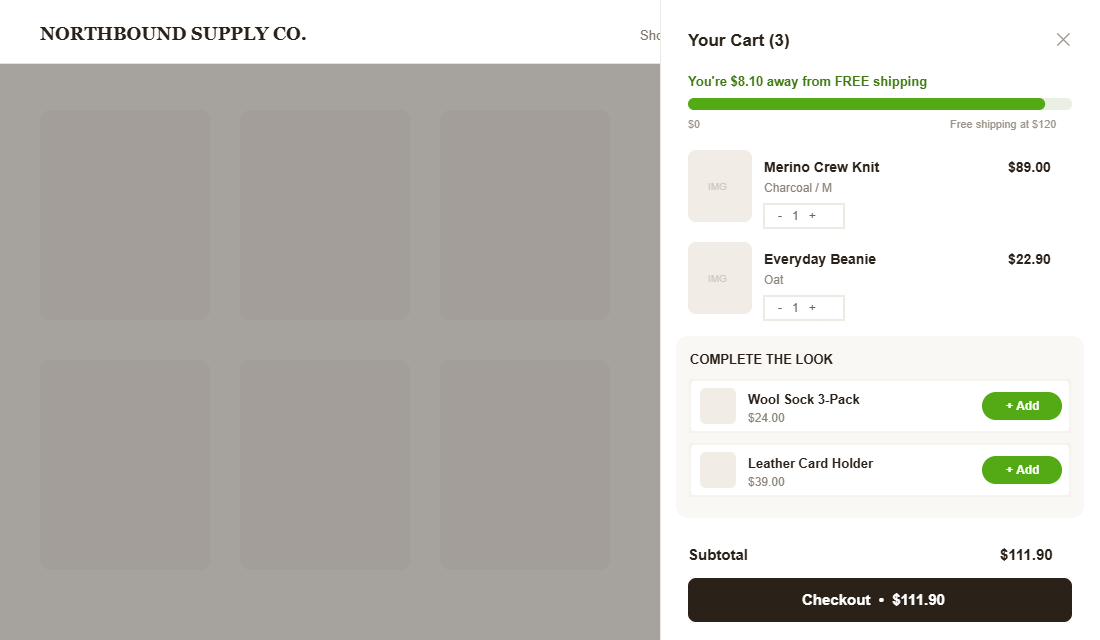
For tooling, Upcart turns a standard cart drawer into a revenue surface with upsells, cross-sells and a reward bar in one app. Rebuy goes further with AI-driven recommendations across the product page, cart, checkout and post-purchase, and it integrates cleanly with Klaviyo and Recharge if you run subscriptions. Start with one, measure the lift, then expand.
- Cap upsells at two per cart. More than that reads as clutter and drags conversion.
- Make every suggestion relevant. A random bestseller converts far worse than a logical companion to what is already in the basket.
- Combine the reward bar and the add-on. Let the shopper reach free shipping by adding something they want, not by spending blindly.
Lever 4: Volume Breaks and Subscribe and Save
For anything consumable, quantity breaks are a quiet workhorse. “Buy 2 save 10%, buy 3 save 15%” gives the customer a reason to stock up now rather than reorder in six weeks. You trade a small per-unit discount for a larger order today and fewer acquisition cycles to earn the same revenue.
Subscribe and save is the same idea with a retention engine attached. It lifts the first order and then compounds lifetime value every cycle after. The economics are strongest on replenishable categories: coffee, supplements, skincare, pet food, anything a customer finishes and rebuys on a predictable rhythm.
Where this lever earns its keep is the back end. A subscriber who would have churned but stays one extra cycle is worth more than three new visitors. That is why your subscription save flow matters as much as the offer itself. Win the order, then engineer the renewal.
- Add quantity breaks to your top consumable SKUs. Keep the tiers simple: two, three, and a stock-up option.
- Offer subscribe and save on anything repeatable. A 10 to 15% subscriber discount is cheaper than the ad spend to re-acquire them.
- Default to the smart choice. Pre-select the most popular tier so the customer opts down rather than up.
Lever 5: Post-Purchase One-Click Upsells (The Free Money Lever)
The thank-you page is the most under-used screen in ecommerce. The customer has already paid, their details are on file, and accepting one more offer takes a single click with no re-entry of card details. That combination of zero friction and peak buying momentum is why it converts so well.
Benchmarks land between 8 and 15% acceptance on a well-targeted post-purchase offer, and the revenue is purely incremental because the original sale is already banked. Even a conservative 4% take rate is free margin you were not collecting yesterday. Critically, it does not touch your store conversion rate, because the checkout is already complete.
Make the offer obvious and time-bound. The best post-purchase upsell is a complementary add-on or a one-size-up upgrade to what they just bought, not a random product. A short countdown (“add this to your order in the next 10 minutes”) gives the customer a clean reason to decide now. Zipify OneClickUpsell, AfterSell and ReConvert all run this flow natively on Shopify.
- Offer one upsell, not a stack. A single relevant add converts better than a wall of options.
- Match the offer to the purchase. An upgrade or companion product beats anything generic.
- Add gentle urgency. A short window to add to the existing order turns “maybe later” into a yes.
The Compound Effect: Where the 30% Actually Comes From
No single lever delivers 30% on its own. The number comes from stacking them so they reinforce each other. Walk the maths on a $95 baseline order. A free shipping threshold lifts it to around $104. Bundles raise the value on the slice of orders that take them. Cart upsells add a companion item. Volume breaks and post-purchase offers each nudge it again. Stacked, a $95 order routinely becomes $118 to $124, with no extra ad spend behind any of it.
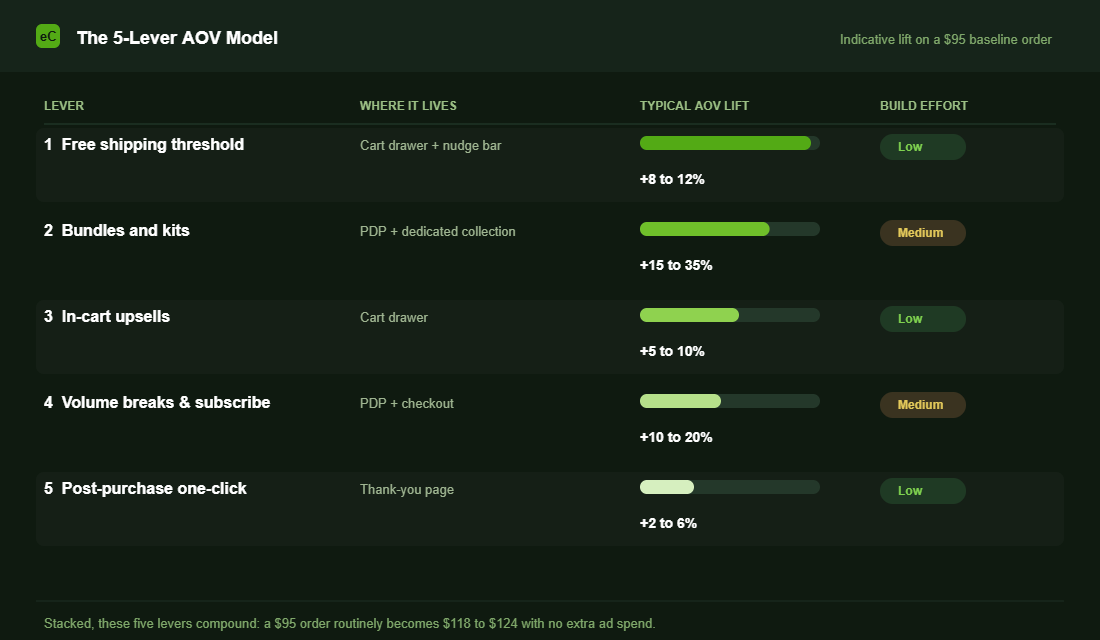
Build them in order of effort, not excitement. Switch on the free shipping threshold and progress bar this weekend, because it is the fastest win. Add cart upsells next, then your hero bundle, then volume breaks and subscribe and save, and finish with the post-purchase offer. Each one is live and earning before you start the next.
Then measure like an operator. Track AOV weekly, watch units per order, and attribute revenue to each lever separately so you know which one is carrying the load. The same discipline you apply to removing cart friction with trust signals applies here: isolate the variable, measure the lift, keep what works.
Your 5-Lever AOV Audit
Run this checklist against your store this week. One pass tells you exactly where your next few points of AOV are hiding.
- Threshold: Is your free shipping bar set 15 to 25% above your live AOV, with a visible progress nudge in the cart?
- Bundles: Do you have at least one merchandised hero bundle on its own product page?
- Cart: Does your cart drawer show one or two relevant add-ons, capped at two?
- Volume: Do your top consumables offer quantity breaks and subscribe and save?
- Post-purchase: Is there a one-click upsell on your thank-you page, matched to the order?
If you ticked fewer than three, that is not bad news. It is a map. Every unticked box is AOV sitting in your store that you have already paid the traffic for and are not yet collecting.
Inside eCommerce Circle, average order value is one of the core pillars we work on with every member, because it is the rare lever that lifts revenue and margin at the same time. If you want a second opinion on yours, let’s talk.