Shipping costs are the number one reason Australian online shoppers abandon their carts. Not price. Not product availability. Shipping. When a customer sees $12-15 in shipping charges added to their $60 order, over 50% of them will leave without completing the purchase. That is thousands of dollars in lost revenue every month from a problem that is entirely within your control to solve.
What’s in This Article
But the solution is not simply “offer free shipping on everything.” Absorbing $8-15 in shipping costs on every order will destroy your margins faster than any other decision. The brands that get shipping right find the sweet spot: a strategy that removes the conversion barrier of shipping costs while protecting (or even improving) their profitability.
Australia’s geography makes shipping uniquely challenging compared to the US or UK. The vast distances between capital cities, regional and remote surcharges, and limited carrier competition mean shipping costs are higher and delivery times are longer. Here is how to build a shipping strategy that works specifically for the Australian market.
The Free Shipping Threshold: Your Most Powerful AOV Lever
A free shipping threshold is not just a shipping policy. It is a pricing strategy. “Free shipping on orders over $100” does two things simultaneously: it removes the shipping cost barrier for your most valuable orders and it incentivises customers to add more to their cart to reach the threshold.
The optimal threshold is typically 15-25% above your current average order value. If your AOV is $82, set the threshold at $100. Customers who were going to spend $82 will add a $20-30 accessory to hit $100 and “save” on shipping. Your AOV increases by $18-22 while your shipping cost is $6-8, a net margin gain of $10-14 per order.
Display the threshold prominently everywhere. Add a progress bar in the cart: “You are $22 away from free shipping!” This visual nudge is one of the most effective AOV-increasing tactics in ecommerce. Studies show that cart progress bars increase AOV by 12-18% on their own.
For orders below the threshold, keep shipping rates reasonable. $8-10 for standard shipping and $12-15 for express is the acceptable range for most Australian consumers. Anything above $15 for standard shipping starts driving significant cart abandonment.
Choosing the Right Carriers for Australian Ecommerce
No single carrier is best for every situation. The smartest Shopify stores use a multi-carrier strategy: different carriers for different order types, destinations, and service levels. Here is the landscape:
- Australia Post. The default for most Shopify stores. Best regional and remote coverage. eParcel rates are competitive for stores shipping 50+ parcels per month. Delivery is typically 3-5 business days metro, 5-8 regional. The main downside is inconsistent delivery times during peak periods (Christmas, BFCM).
- Sendle. Excellent for lightweight items (under 5kg). Carbon-neutral shipping as standard, a marketing plus for eco-conscious brands. Competitive pricing, especially for metro-to-metro. Delivery is 3-5 days metro. The 100% carbon-neutral positioning is a genuine differentiator you can promote to customers.
- StarTrack. Best express service for time-critical orders. 1-2 day delivery to metro areas. More expensive but reliable and professional. Ideal for your express shipping option, especially for gift orders and last-minute shoppers.
- Aramex (formerly Fastway). Competitive pricing for metro areas. Good for stores doing high volume. Delivery is 2-4 days metro. Less reliable for regional areas, so pair with Australia Post for non-metro orders.
- CouriersPlease. Good middle ground between Australia Post and premium couriers. Competitive pricing and decent delivery times. Worth testing against your current carrier on a subset of orders.
Use a shipping management app like Starshipit, ShipStation, or Shippit to manage multiple carriers from a single dashboard. These apps auto-select the best carrier based on destination, weight, and service level, and handle label printing and tracking notifications.
Reducing Your Shipping Costs Without Slowing Delivery
Every dollar saved on shipping goes straight to your bottom line. Here are the practical cost reduction tactics that work:
Right-size your packaging. Australia Post and most carriers charge based on the larger of actual weight or cubic weight. Using a box that is too large for your product means you are paying for air. Audit your packaging sizes and stock 3-4 box sizes that fit your most common order configurations. Satchels and padded mailers are lighter and cheaper than boxes for soft goods and smaller items.
Negotiate carrier rates. Once you are shipping 50+ parcels per month, you have bargaining power. Contact Australia Post business, Sendle, and Aramex for volume pricing. Get quotes from all three and use the competing offers to negotiate better rates. Many stores save 15-25% on shipping costs simply by asking for a volume discount.
Use zone-based pricing in Shopify. Not all deliveries cost the same. Metro deliveries to Sydney, Melbourne, and Brisbane are cheaper than regional deliveries to rural Queensland or Western Australia. Set up shipping zones in Shopify that reflect your actual carrier costs (metro, regional, and remote) so you are not overcharging metro customers or subsidising remote deliveries.
Consider a 3PL for fulfilment. Once you are shipping 100+ orders per week, a third-party logistics provider can be more cost-effective than shipping from your garage or office. 3PLs negotiate bulk carrier rates, have efficient pick-and-pack processes, and often ship faster because they are located in warehouse districts near carrier hubs.
The Delivery Experience: What Happens After Checkout
Shipping is not just about getting the product to the customer. The delivery experience, from order confirmation to unboxing, is a customer touchpoint that shapes whether they return.
Send proactive shipping notifications. At minimum: order confirmed, order shipped (with tracking link), and order delivered. Many Shopify stores only send the default Shopify notifications, which are functional but not branded. Customise your shipping emails with your brand design, include product care tips, and add a CTA to your social media or loyalty program.
Include the estimated delivery date on your product pages and in your cart. “Estimated delivery: March 25-28” reduces purchase anxiety and sets clear expectations. Apps like Estimated Delivery Date by Buddy or Order Delivery Date can calculate and display this automatically based on carrier data.
Set clear shipping cut-off times. “Order before 2pm for same-day dispatch” tells customers exactly when they need to order to get their parcel moving. Display this prominently on product pages. It creates urgency while managing expectations.
Invest in your packaging experience. A branded box or satchel, tissue paper, and a small thank-you card turn a delivery into an unboxing moment. This does not need to be expensive: $1-2 per order in packaging upgrades generates significantly more social sharing, higher customer satisfaction, and stronger brand perception.
The Shipping Tech Stack That Saves You Hours Every Week
If you are still copying addresses into the Australia Post portal one order at a time, you are burning hours you could spend growing the business. Once you pass 10 to 15 orders a day, shipping automation pays for itself in the first week.
Three platforms dominate the Australian market:
- Starshipit. Built for ANZ retailers, integrates directly with Shopify, Australia Post, Sendle, Aramex and CouriersPlease. Plans start around $40 AUD a month and it handles label printing, manifesting and tracking notifications automatically.
- Shippit. Strong carrier allocation engine that picks the cheapest carrier per parcel based on your live rates. Good fit once you are shipping 500+ parcels a month across multiple carriers.
- ShipStation. The global player. Deep automation rules and batch processing, best if you also ship internationally or sell across multiple channels like eBay and Amazon.
The maths is simple. If fulfilment admin takes you 90 minutes a day and automation cuts that to 20, you get back over 8 hours a week. At even $50 an hour for your time, that is $400 a week of capacity for a $40 a month tool.
Automation also cuts errors. Mistyped addresses and wrong service selections cause the majority of delivery exceptions, and each redelivery costs $10 to $15 plus a frustrated customer. Stores that automate typically see delivery exception rates drop by a third.
Returns: The Other Half of Your Shipping Strategy
Most founders obsess over outbound shipping and ignore returns until they become a problem. In Australian ecommerce, returns run at roughly 10% of orders overall, and 15 to 25% in fashion and footwear. If you are not pricing that into your margins, your contribution margin numbers are lying to you.
A returns policy is also a conversion lever. Around 80% of shoppers check the returns policy before buying from a new brand. Here is the framework that balances trust with margin protection:
- Offer 30 days, not 14. Longer windows increase conversion more than they increase return rates. Most returns happen in the first week regardless.
- Push store credit over refunds. Offer free return shipping for store credit but charge $9.95 for a refund to card. Done well, 30 to 40% of returners choose credit, which keeps the revenue in your business.
- Automate it. Apps like Loop Returns or ReturnGO let customers self-serve, which cuts your support tickets and speeds up the exchange.
- Mine the data. If one product drives a disproportionate share of returns, you have a sizing guide problem or a product description problem. Fix the listing and the returns drop.
One more AOV note while you are here: if your free shipping threshold is working, product bundling is the cleanest way to help customers clear it. A well-built bundle lifts AOV 15 to 30% without discounting your margin away.
The Compound Effect of Shipping Excellence
When your shipping strategy removes conversion barriers, controls costs, and delivers a positive customer experience, every part of your business benefits. Cart abandonment decreases because shipping costs are transparent and reasonable. AOV increases because your free shipping threshold incentivises larger orders. Margins improve because you have negotiated better rates and right-sized your packaging. Customer satisfaction increases because deliveries arrive on time with clear communication. And repeat purchase rates improve because the delivery experience builds trust and delight.
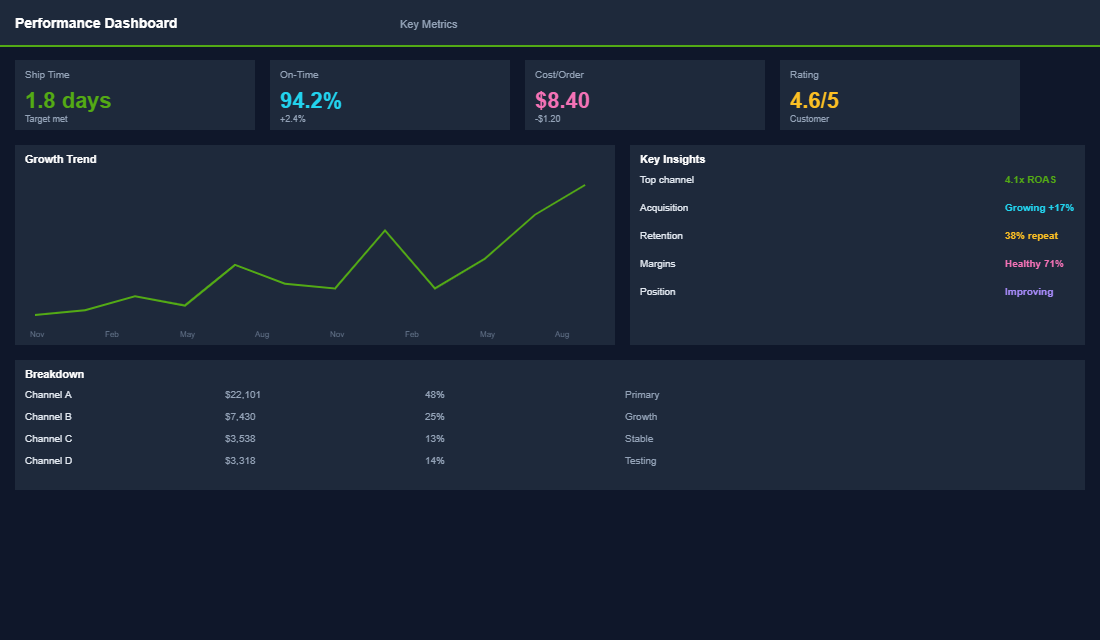
One eCommerce Circle member overhauled their shipping strategy using this framework. They reduced their average shipping cost from $10.60 to $8.40 per order, increased their AOV by $22 through an optimised free shipping threshold, and improved their customer NPS by 12 points through better delivery communication and packaging. The combined effect added $14,000 per month to their bottom line, from shipping strategy alone.
Inside eCommerce Circle, shipping and logistics optimisation is one of the core pillars we work on with every member. We help members audit their shipping costs, negotiate carrier rates, and build delivery experiences that customers love. If shipping is either costing you too much or costing you sales, let’s talk.