Most Aussie Shopify founders start planning Black Friday in October. By then, the game is already over. Your hero SKU has a 90-day lead time from Shenzhen, your freight forwarder has tripled their quote, and the safety stock you needed for Cyber Monday is sitting on a container ship that left two weeks too late.
What’s in This Article
This is how a $50,000 stockout happens. Or worse, the panic order goes the other way: you over-order by 40%, BFCM ends, and you walk into Christmas carrying $80,000 in dead stock that costs another $20,000 to warehouse for the next twelve months.
Australian Shopify merchants had their strongest BFCM on record in 2025, with a 15% year-on-year lift in local consumer purchases and Melbourne, Sydney, and Brisbane driving the bulk of orders. APAC merchants grew 28% YoY. The brands that captured that growth did not get lucky. They started planning six months out, in May and June, when the rest of the market was still sleeping.
BFCM 2026 falls on Friday 27 November. That gives you roughly six months from now. This is the inventory planning framework we walk every eCommerce Circle member through, broken into the six stages that determine whether you stack $300k in November or scramble through a stockout and pay for it all summer.

Why BFCM Inventory Planning Is the Single Biggest Decision You Make All Year
The average Shopify store sees 3 to 5 times normal traffic and 2 to 3 times daily revenue during the BFCM weekend. For most operators, the Friday-to-Monday window represents 8 to 15% of annual revenue compressed into four days. Get inventory right and BFCM funds Q1 cash flow. Get it wrong and the consequences stretch for months.
The two ways inventory planning goes sideways are mirror opposites, and both cost real money.
- The stockout. Up to 20% of expected sales evaporate when you run out at peak. Worse, 43% of consumers go straight to a competitor when faced with an out-of-stock product, and 36% of customers switch brands permanently after a stockout. The lost sale is the small problem. The lost customer is the big one.
- The dead stock hangover. Over-order by 30% and you carry inventory that costs roughly 25 to 30% of the purchase price every year just to store, insure, and finance. Industry data shows up to 30% of retail inventory at any moment qualifies as dead or slow-moving. A $50k dead stock pile becomes a $12,500 annual drag, not counting the markdown you eventually take to clear it.
This is why the founders who treat BFCM as a logistics problem (not a marketing problem) consistently outperform. You can have the best Meta creative on the internet, but if your hero SKU is out of stock by 10am AEDT on Black Friday morning, the campaign just trained a generation of buyers to shop your competitor instead.
Stage 1: The 90-Day Backwards Pass (May to June)
Every great BFCM inventory plan starts at the destination and works backwards. Most operators do the opposite: they look at last year’s stock holdings, add a fudge factor, and call it a forecast. That is how you end up with too much of last year’s hero and not enough of this year’s winner.
The backwards pass starts with a single number: target BFCM revenue. Pick a number you can defend. If you did $180k last BFCM and the business has grown 40% since, target $250k. Now break that target down to SKU level using this formula:
- Hero SKU revenue. Your top 5 SKUs typically account for 60 to 70% of BFCM revenue. Take 65% of your target. If the target is $250k, hero SKUs need to deliver $162k.
- Average BFCM AOV. Pull this from last year’s Shopify report, filtered to 25 November to 30 November. Most stores see AOV lift 10 to 25% during BFCM because of bundles and free shipping thresholds.
- Hero SKU units. Hero revenue divided by hero AOV, multiplied by 1.2 to account for safety stock. That is your unit target per hero SKU.
Now overlay your supplier lead time. If your hero SKU is 60 days on the water plus 21 days from warehouse to fulfilment, the purchase order needs to be in by Friday 12 September at the latest. Realistically, you want a 30-day buffer, which puts the PO at 12 August. That is your hard deadline. Working backwards from there, the design freeze, sample approval, and supplier deposit all sit in June and July.
The mistake we see most often: founders plan around the BFCM date instead of the supplier deadline. By the time November stress hits, the inventory decisions were made in June whether you realised it or not.
Stage 2: SKU Tiering (The 80/20 That Saves You from Yourself)
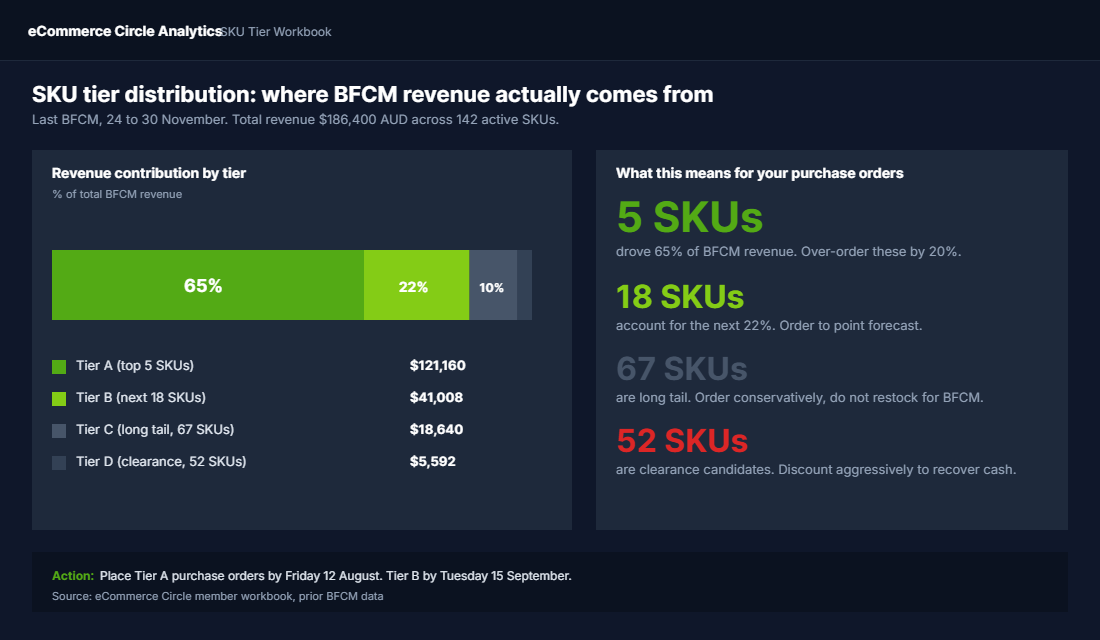
Not every SKU deserves the same treatment. In a typical Aussie Shopify catalogue of 80 to 200 SKUs, roughly 15 SKUs do the heavy lifting. The other 165 should either ride the slipstream or get cleared at margin during BFCM. SKU tiering is how you decide which is which.
We use a four-tier system:
- Tier A: Hero SKUs. Top 5 to 10 products. These drive 60 to 70% of BFCM revenue. Over-order 20% beyond forecast. Stocking out a Tier A on Black Friday is a brand-damaging event.
- Tier B: Support SKUs. Next 15 to 25 products. Drive 20 to 25% of revenue. Order to forecast, not over. These are the workhorses that fill out bundles and cross-sells.
- Tier C: Long tail. Anything else with positive contribution margin and reasonable velocity. Order conservatively, plan to sell through what you have, and do not reorder for BFCM.
- Tier D: Clearance candidates. Slow movers, end-of-life products, broken size runs. BFCM is the best clearance event of the year. Discount aggressively, recover working capital, and free up warehouse space for January receipts.
The simplest way to tier is to pull a 90-day Shopify sales report by SKU, sort by revenue, and run a cumulative percentage column. The first SKUs to hit 60% are your Tier A. The next 25% gets you Tier B. Everything else is C or D. This whole exercise takes 30 minutes in a spreadsheet and decides the next six months of inventory commitments.
If you are not sure how to read your own margin numbers per SKU, the Shopify contribution margin audit walks through exactly how to build the per-SKU view that this tiering depends on.
Stage 3: Demand Forecasting Without a Crystal Ball
Forecasting BFCM is not about predicting the future. It is about building a defensible range using three reference points. We call this the triple-anchor forecast.
- Anchor 1: Last year’s BFCM, SKU by SKU. Pull a Shopify sales report for 24 November to 1 December of the prior year, filtered to product variant. This is your baseline.
- Anchor 2: Trailing 90-day velocity, multiplied by the BFCM lift factor. Most stores see hero SKUs lift 4 to 6x their normal daily run rate over the four-day window. If your hero SKU sells 8 units a day right now, expect 30 to 50 units a day during BFCM, totalling 150 to 250 units across the weekend.
- Anchor 3: Growth-adjusted forecast. Take Anchor 1, apply your YoY growth rate (Shopify reports trailing 90-day vs prior year), and add a sanity check against new product launches or pulled forward demand.
Average the three anchors. That is your point forecast. Then build a range: 80% of that for the conservative case, 120% for the aggressive case. Order to the aggressive case on Tier A. Order to the point forecast on Tier B. Order to the conservative case on Tier C.
The brands that nail this part are not running magical algorithms. They are running three columns in a spreadsheet and trusting their own data over their own optimism.
Stage 4: Choosing Your Forecasting Tool (Stocky Is Dead, Now What)
If you are still running Stocky, you need a migration plan. Shopify confirmed Stocky is being deprecated in August 2026. That means by the time you are deep in BFCM execution, your inventory forecasting app will be on borrowed time. Plan the migration now, not in November.
The two main contenders we see members move to:
- Prediko. AI-driven, modern interface, fast onboarding (data syncs in minutes). Plans run $49 to $349 per month. Best for single-channel Shopify operators who want forecasting that just works without a CSV mapping nightmare. The forecasts pull from 25 million SKUs across 15+ industries, which gives the model real depth.
- Inventory Planner. Heavier, more configurable, designed for multi-channel retail. Two weeks to set up properly. Best if you are running Shopify plus Amazon plus a wholesale channel and need everything in one view.
For an Aussie Shopify operator doing $40k to $400k a month with one warehouse and one channel, Prediko is almost always the right call. The setup is fast enough that you can have it forecasting BFCM properly by July. Here is the 7-step setup:
- Step 1. Install Prediko from the Shopify app store. Connect your store with admin permissions.
- Step 2. Wait for the historical data sync (usually 10 to 30 minutes for stores under 500 SKUs).
- Step 3. Map your suppliers and lead times under Settings. Be honest. If your factory says 45 days but the average is 65 once you include shipping delays, log 65.
- Step 4. Set safety stock days per SKU tier. We use 30 days for Tier A, 21 days for Tier B, 14 days for Tier C.
- Step 5. Enable seasonal forecasting and tag November as your peak season. Set the multiplier to 4x for hero SKUs based on last year’s BFCM data.
- Step 6. Generate a purchase order forecast for the next 120 days. Review variant by variant before approving anything.
- Step 7. Set weekly reorder alerts. Every Monday morning, you get an email with anything trending toward stockout in the next 60 days.
This setup pays for itself the first time it flags a hero SKU heading into stockout four weeks before it happens.
Stage 5: The Supplier Conversation (July to August)
This is the stage most founders avoid because it is uncomfortable. You need to have a real conversation with your supplier about BFCM capacity, lead times, and what happens if they slip. The brands that win BFCM are the ones whose suppliers know exactly when the order is coming and have already blocked production capacity in October.
Lock these five points down in writing with every Tier A supplier by 31 July:
- Order date. The exact date you will place the purchase order and pay deposit.
- Production lead time. Number of days from deposit to goods leaving the factory. Get this in writing.
- Shipping mode and lead time. Sea, air, or split. Sea is cheaper. Air is faster. A 50/50 split is the smart move for Tier A: 50% sea for the bulk, 50% air for the safety reserve.
- Capacity reservation. Most suppliers will block capacity for a 10 to 20% deposit. This stops them quoting your slot to a competitor in September when everyone wakes up.
- Contingency plan. What happens if your hero SKU runs hot and you need a second run by 15 October. Most suppliers can do a rush run if you ask in July. Almost none can do it if you ask in October.
If you only have one supplier for your hero SKU, this is also the moment to question whether that is wise. Single-supplier risk is real, and the Shopify supplier risk playbook walks through how to audit and diversify before peak season hits.
Stage 6: Receiving, Pre-Positioning, and the Final Six Weeks
By 15 October, all Tier A and Tier B BFCM inventory should be physically at your 3PL or warehouse. Not on the water. Not at customs. In the bin, scanned, and available to allocate. The brands that miss this date are the ones running on caffeine and panic from 1 November onwards.
The final six weeks are about pre-positioning and protecting the inventory you already have. Three moves matter most:
- Pre-position by region. If you use a 3PL with multiple warehouses, push your Tier A stock to the warehouse closest to Melbourne and Sydney, since those two cities drove the largest BFCM purchase volume nationally in 2025. Same-day or next-day delivery becomes a real competitive edge in the four-day window.
- Quarantine BFCM inventory. Tag Tier A units as BFCM-reserved from 1 November. Do not let pre-orders or wholesale eat into the BFCM allocation. This is also the moment to update your Shopify inventory locations so the wrong warehouse does not drain first.
- Build the stockout playbook. Decide in advance what happens when (not if) something runs out. Auto-substitute to a cross-sell? Switch to backorder with a 7-day shipping promise? Hide the variant entirely? Every Tier A SKU needs a stockout response written down before BFCM week starts.
The brands that exit BFCM with healthy inventory, healthy cash, and zero customer service nightmares are the ones who built the playbook in October. You cannot improvise this on the morning of Cyber Monday.
The Compound Effect: Why Inventory Planning Funds Q1
Here is the bit that most operators miss. BFCM inventory planning is not just about November. It is about whether your January looks like a celebration or a hangover.
Get it right and you exit BFCM with three things: a cash position 2 to 3x larger than usual, a lean inventory profile heading into Q1, and a refreshed customer base you can market to all summer. That cash is what funds January and February ads while the rest of the market is recovering. The lean inventory is what lets you take on a new product line in Q2. The customer list is what lets you run a profitable post-BFCM retention sequence (the EOFY playbook is the natural sequel, since June 30 is the next major Aussie sales event).
Get it wrong and the picture inverts. You exit November with cash trapped in dead stock, an upset customer base who got “out of stock” emails, and an inventory profile that forces a markdown spiral through January and February. The damage compounds for two quarters.
This is why we tell every member: BFCM is a six-month build. Not a four-day event.
The Cash Flow Reality: How to Actually Fund the Order
The forecast tells you what to order. It does not tell you how to pay for it, and this is where BFCM planning breaks for most founders. A serious BFCM position often means committing $100k to $300k of cash in July and August against revenue that does not land until late November. That is a four-month gap your bank balance has to survive.
Three moves close the gap:
- Negotiate the deposit split before you negotiate price. The standard 30% deposit, 70% on shipment is not fixed. Suppliers you have worked with for 2+ years will often take 20/40/40 with the final tranche 30 days after delivery. On a $150k order, that shift keeps $60k in your account through the most cash-hungry stretch of the year.
- Price your funding options early. Shopify Capital, Wayflyer and bank overdrafts all have very different effective costs. Inventory funding at a 4 to 8% flat fee can be worth it if your BFCM contribution margin is 30%+, but only if you run the numbers in July, not in a panic in September when options shrink and pricing gets worse.
- Stagger Tier B and C orders. Hero SKUs need the long lead time. Your B and C tiers often ship faster or can come from domestic suppliers. Splitting the purchase orders by 4 to 6 weeks smooths the cash curve instead of one terrifying lump.
One number to hold onto: if paying for the inventory leaves you with less than 6 weeks of operating expenses in the bank, the order is too big, no matter what the forecast says. A stockout on your fourth-best seller is recoverable. Missing payroll in October is not.
Your BFCM Inventory Planning Checklist (Copy This Into Your Project Tracker Today)
If you only do one thing after reading this article, copy this checklist into Asana, ClickUp, Notion, or wherever you run your project board. Tag the dates against the calendar today.
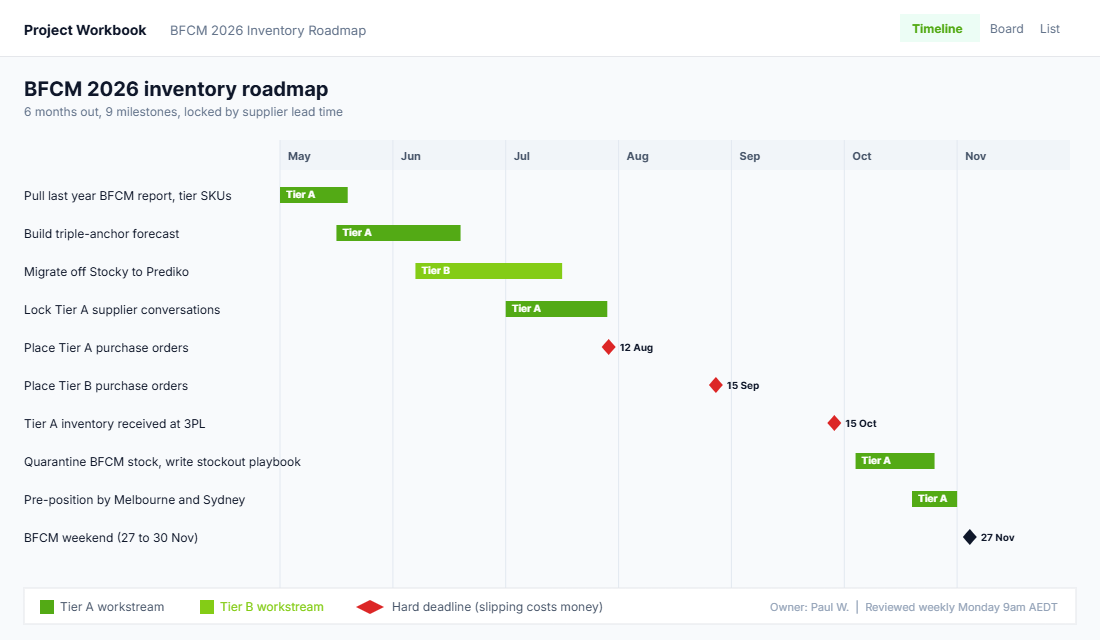
- By 31 May: Pull last year’s BFCM sales report. Identify Tier A, B, C, and D SKUs.
- By 30 June: Set target BFCM revenue and unit forecasts per hero SKU. Build the triple-anchor model.
- By 31 July: Migrate off Stocky if you have not already. Have Prediko or Inventory Planner forecasting BFCM properly.
- By 31 July: Lock Tier A supplier conversations in writing: order date, lead time, capacity, contingency, shipping mode.
- By 12 August: Tier A purchase orders placed and deposits paid. This is the hard deadline.
- By 15 September: Tier B purchase orders placed.
- By 15 October: All Tier A and Tier B inventory physically received and at the 3PL.
- By 1 November: Tier A inventory quarantined and tagged BFCM-reserved. Stockout playbook written for every Tier A SKU.
- By 20 November: Pre-position stock to warehouses closest to Melbourne and Sydney.
- 27 to 30 November: Execute. Daily inventory check at 8am AEDT and 8pm AEDT.
- By 15 December: Run the BFCM debrief. Document what sold, what stocked out, what bombed, and what the actuals were vs forecast. This is next year’s Anchor 1.
That is the six-month BFCM inventory playbook in one page. Print it. Tape it to the wall. Build the team around it.
Inside eCommerce Circle, BFCM inventory planning is one of the core pillars we work on with every member from May through October. If you want a second opinion on yours, let’s talk.