Most Shopify founders celebrate the moment they sign a new hire. Then six weeks later they’re quietly wondering why the new person hasn’t moved the needle — or worse, why they’ve just handed in their notice.
What’s in This Article
This isn’t bad luck. It’s a bad onboarding system. And the data is brutal: around 20% of employee turnover happens within the first 45 days of a job, and close to 30% of new hires quit within their first 90 days. Every one of those exits costs an Australian ecommerce brand somewhere between 50% and 200% of the role’s annual salary once you factor in recruitment fees, lost productivity, ramp time, and the opportunity cost of the founder stepping back into the role.
The brands that scale past $5M, $10M, $20M don’t have better luck hiring. They have a structured onboarding system that turns new team members into revenue drivers by day 90 instead of letting them drift for six months hoping they figure it out.
This is the 30-60-90 day playbook we coach members through inside eCommerce Circle. It works for a first VA, a fifth performance marketer, or a head of ecommerce. The rhythm is the same. The detail changes.
Why Most Ecommerce Onboarding Fails (And Costs You K Per Hire)
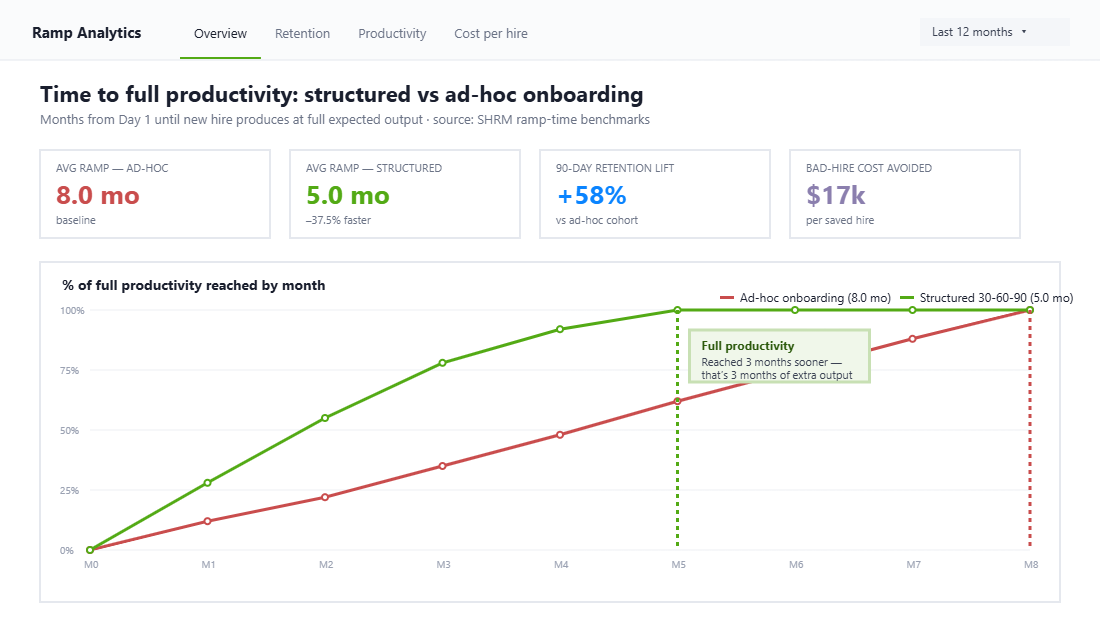
The average reported loss from a single bad hire sits around $17,000 in a CareerBuilder study, and 85% of hiring professionals say a bad hire negatively impacts the entire team. The costs compound. You lose the salary. You lose the recruitment fee. You lose the time your senior people spent training. You lose momentum on whatever project that hire was meant to own.
Most ecommerce founders don’t fail at hiring. They fail at the 90 days after hiring.
Here’s the pattern I see constantly:
- Day 1: Send them a laptop, a Shopify admin login, a Slack invite, and a Notion doc called “Welcome.” Tell them to “have a look around.”
- Day 7: Ask if they have questions. They say no (because they don’t want to look stupid). You take that as a green light.
- Day 30: You realise they’ve been working on the wrong thing for a month.
- Day 60: You start doing their job for them on the side because it’s faster than training them.
- Day 90: Either they leave, or you accept that this hire will never hit the expectations you had.
The fix isn’t more paperwork. It’s a structured ramp that makes it impossible for a new hire to get lost. Research by Gallup found 70% of new hires who had exceptional onboarding experiences say they have “the best possible job,” and they’re 2.6x more likely to be extremely satisfied with their workplace. That satisfaction translates directly into output, retention, and discretionary effort — the three things you desperately need from a new hire in a small ecommerce team.
Structured onboarding also cuts the ramp time to full productivity from roughly 8 months to 5 months, according to SHRM data. That’s 3 extra months of full-output work per hire per year. In a 10-person ecommerce business, that’s the equivalent of getting 2.5 free full-time employees.
The Core Principle: Front-Load Context, Then Shift To Output
The biggest mistake Aussie founders make is treating onboarding like a tour of the building and a password list. It’s not. Onboarding is the process of transferring the context from your head into someone else’s, in the right sequence, so they can make decisions the way you would.
There’s a reason The First 90 Days by Michael Watkins has been the onboarding bible for two decades. It argues that every new hire needs to move through four phases in order: business orientation, stakeholder connection, expectations alignment, and cultural adaptation. Skip any of them and the hire either underperforms or leaves.
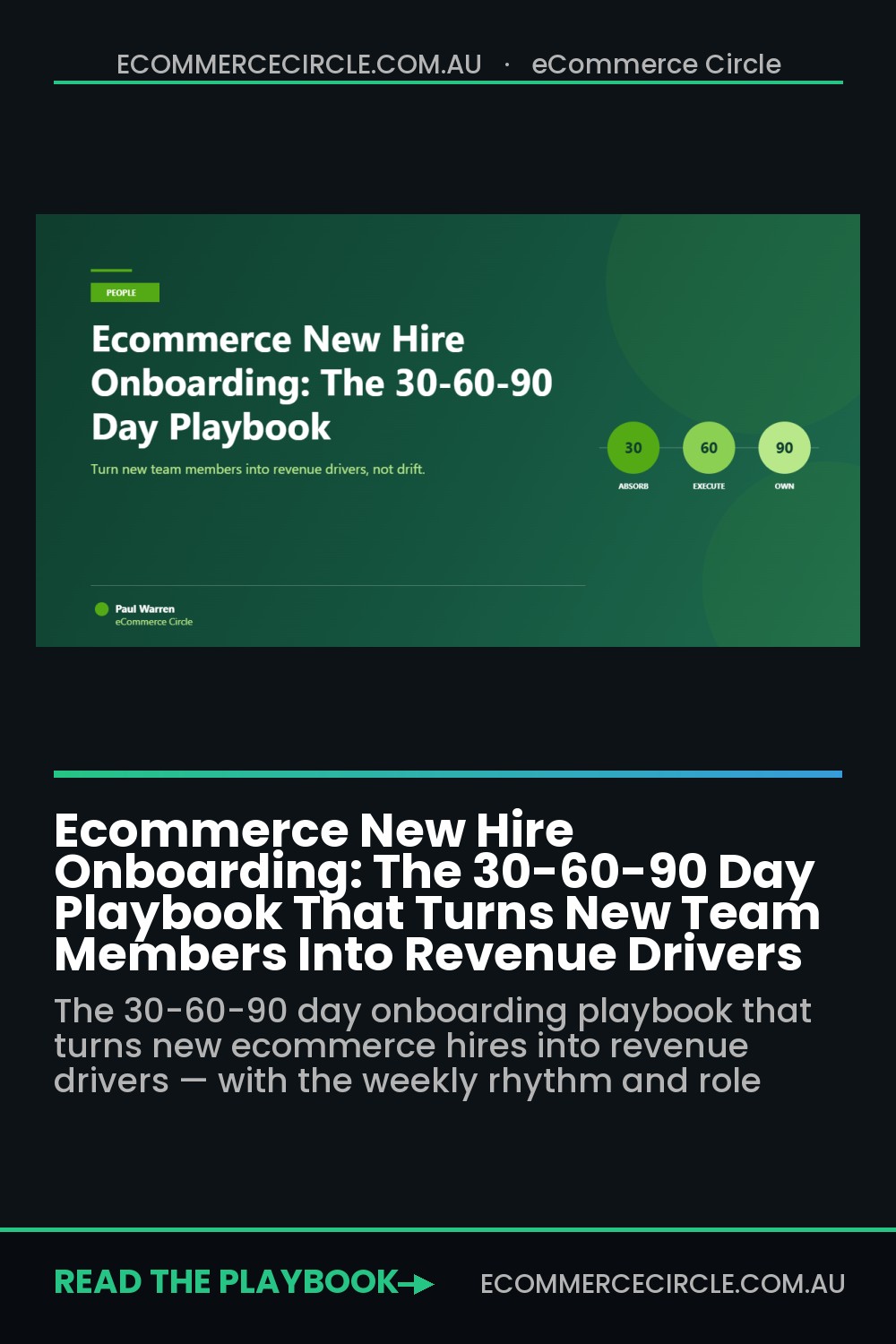
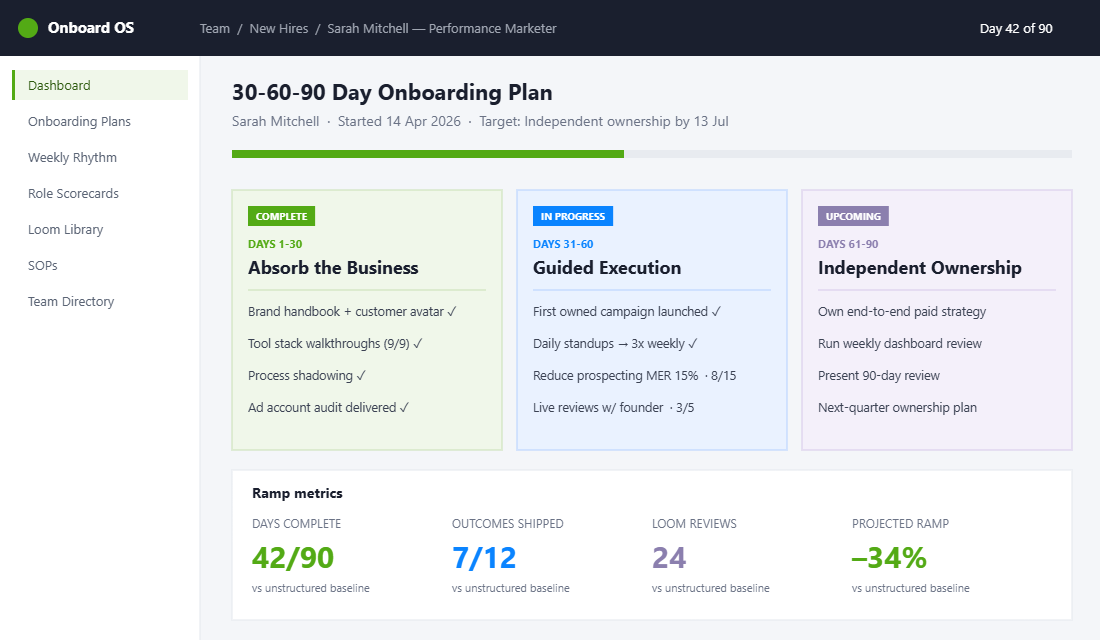
The 30-60-90 day playbook applies that same logic to ecommerce specifically. The first 30 days is context absorption. The next 30 is guided execution. The final 30 is independent ownership.
Get the sequencing wrong and you either overwhelm them in week one or leave them twiddling their thumbs in week four. Both are fatal.
Days 1-30: Absorb the Business (Not the Role)
The number one rule for the first 30 days: they should spend more time learning the business than doing the job.
This feels counterintuitive. You hired them to do a thing. You want them doing the thing. But a new hire who jumps straight into tactical execution before they understand your customer, your margins, your brand voice, and your systems will produce output that sounds right but misses the mark. You’ll spend the next six months correcting it.
Here’s what the first 30 days should actually contain:
Week 1 — Business immersion. Before they touch their specific role, they need to understand what the business does and who it serves. This means reading every product page, watching a recorded walkthrough of your customer avatar, reviewing your last quarter’s best-selling products, reading a month of customer service tickets, and watching a 20-minute Loom from you explaining the brand story, the founder origin, and the competitive positioning.
Week 2 — Tool stack and workflow orientation. Give them access to Shopify admin, Klaviyo, Google Analytics, Meta Business Manager, Zendesk, or whatever’s in your stack. They don’t need to use it yet. They need to know it exists, what it’s for, and how it connects to the other tools. Every tool should come with a 5-minute Loom from whoever owns it.
Week 3 — Process shadowing. They sit in on your weekly dashboard review, your team huddle, a supplier call, a customer service call, and ideally a paid media review. They’re taking notes, not contributing yet.
Week 4 — Small, low-risk first project. Give them one small, well-defined project that exposes them to the tools and the workflow but doesn’t have revenue consequences if they mess it up. For a performance marketer, it might be auditing your existing ad account and reporting back. For a VA, it might be cleaning up a backlog of unanswered reviews. For a customer service hire, it might be writing new macros for your 10 most common tickets.
The output of week 4 isn’t the project. It’s the questions they raise. If they come out of that project asking smart, specific questions about your business, you’ve got someone who’s going to compound value for years. If they come out asking nothing, you have a problem you need to address immediately.
Tool setup that actually works: Build a single Notion hub called “The [Your Brand] Handbook.” Inside it, create sections for: Company (origin, mission, founder story), Customer (avatar, segments, voice of customer research), Products (SKU structure, margin tiers, hero products), Brand (voice guidelines, visual identity, tone rules), Tools (every platform with a linked Loom walkthrough), and Rhythms (meeting cadences, reporting cycles, review cycles). Every new hire gets this as their homepage for the first 30 days. You’ll spend roughly 6-8 hours building it for the first hire, then you reuse it for every hire after.
Days 31-60: Guided Execution (Ramp Up With Rails)
Here’s where most founders blow the onboarding. At day 30, they pull the training wheels off and expect independent output. The new hire either freezes or produces work that’s technically correct but strategically off.
Days 31-60 should be guided execution — they’re doing the work, but with tight feedback loops and clear rails. You’re coaching, not just delegating. The goal is to calibrate their judgment so that by day 60, they’re making the same call you would make in 80% of situations.
What this looks like in practice:
1. Daily 15-minute standups for the first two weeks. Five minutes on what they did yesterday, five on what they’re doing today, five on what they’re stuck on. This is not a report. This is you catching misalignment before it becomes a rework cycle.
2. Weekly 1:1s with a structured agenda. The agenda should be the same every week: what moved forward, what’s stuck, what decisions they need from you, what they think you should know. Over time they become responsible for the agenda, but for the first 30 days you drive it.
3. A written 60-day plan with 3-5 measurable outcomes. Not tasks — outcomes. For a performance marketer, that might be: “Reduce MER on prospecting campaigns by 15%.” For a customer service hire: “Cut first-response time from 6 hours to 2 hours.” For a VA: “Fully own the weekly reporting dashboard by day 60.” Outcomes force clarity. Tasks let people hide behind activity.
4. Live work sessions for the first big project. Not “send me the draft and I’ll review it.” Sit with them (or co-work in a Zoom call) for the first product page they write, the first ad they build, the first email they schedule. You’re not doing the work. You’re showing them how you think while they do the work. This is where judgment gets transferred.
5. Loom feedback loops instead of text. When they send work for review, record a 3-minute Loom walking through your reactions. They see your face, hear your tone, and watch your cursor. A Loom saves you 20 minutes of typing and gives them 10x more context than a comment thread. Tools like Loom were built for exactly this — Huel reportedly onboards staff 9x faster on Shopify Plus by standardising exactly this kind of video-first knowledge transfer.
By day 60, you should be able to give the new hire a moderately complex task with no rails and trust that they’ll either execute it well or ask the right questions before doing anything silly.
If you’re not there by day 60, don’t ignore it. Have the conversation. Either you haven’t been clear enough, or this isn’t the right hire. Both are your problem to solve.
Days 61-90: Independent Ownership (And Accountability)
The final 30 days flip the script. You stop driving. They start driving. You become a coach, not a project manager.
By day 90, three things should be true:
- They own a defined scope. There’s a clear, bounded area of the business where they’re the accountable owner. Not a helper. Not a contributor. The owner.
- They’re producing weekly output without being chased. Reports, campaigns, content, tickets — whatever their role — come in on time without you asking.
- They’re surfacing problems, not just completing tasks. The real signal of a hire who’ll compound is that they start telling you what’s broken or underperforming, not just executing what you told them to do.
The structural shift in days 61-90:
- Daily standups drop to every-other-day, then weekly.
- 1:1s go from 60 minutes to 30.
- You stop reviewing their work before it ships (in low-risk areas).
- They run one piece of your weekly rhythm — the dashboard review, the team standup, the content calendar meeting — without you in the room.
- They present a 90-day review that includes what they accomplished, what they learned, and what they want to own in the next quarter.
This last point is the most important signal. A new hire who can tell you at day 90 what they want to own next is someone who’s taking responsibility for their own trajectory. That’s the difference between a hire who becomes a key player and a hire who becomes another seat you need to manage forever.
The Weekly Rhythm That Holds Onboarding Together
A 30-60-90 plan is worthless without a weekly operating rhythm. This is what actually delivers the plan.
The rhythm we coach inside eCommerce Circle for any new hire, at any level:
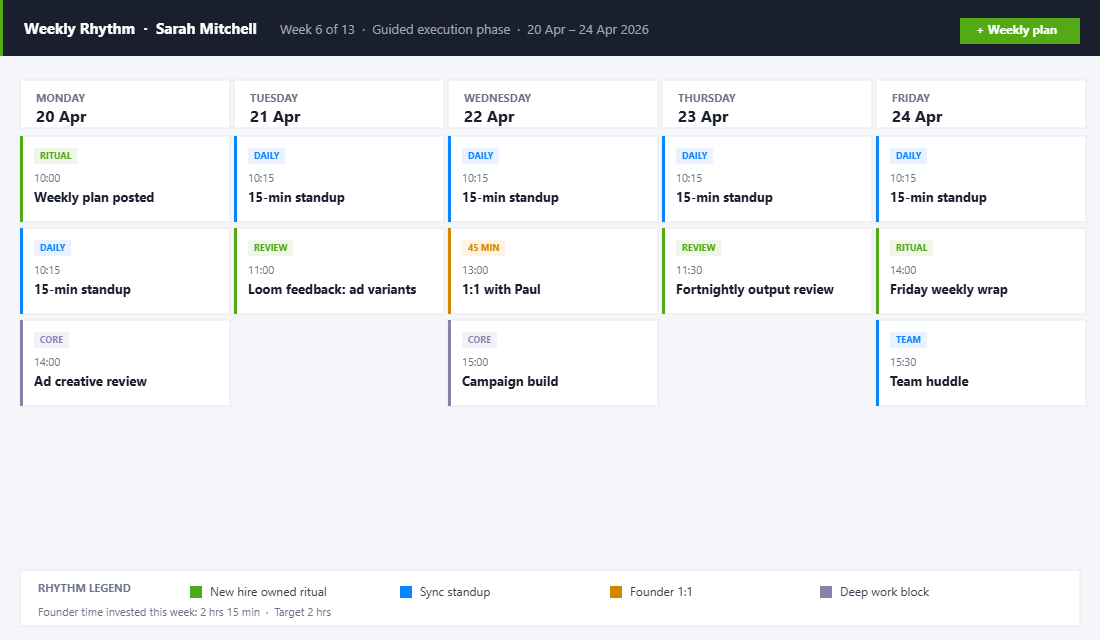
- Monday — Weekly plan. New hire writes out the 3 most important outcomes for the week, shares it in Slack by 10am. This is a public commitment, not a private to-do list.
- Daily — 15-minute standup. First 30 days only. Drops to 3x weekly in days 31-60, weekly in days 61-90.
- Friday — Weekly wrap. 3 bullets: what shipped, what got stuck, what I learned. Sent in Slack by 3pm Friday.
- Weekly — 1:1 with founder or manager. 45 minutes. Half agenda-driven, half open conversation.
- Fortnightly — Output review. Look at actual work product, not just status. Is it improving? Are edges getting sharper?
- Monthly — Business context refresh. One hour where the new hire asks the founder anything. This is where they get the unwritten rules of the business.
This rhythm takes about 2 hours of your time per week. It’s the single highest-leverage use of 2 hours you can make in the first 90 days of any hire.
The Delegation Mistake That Kills Onboarding
The most common founder mistake during onboarding is the opposite of the one you’d expect.
It’s not micromanagement. It’s abandonment.
Founders bring in a new hire, feel relieved to have help, and drop the ball on actually onboarding them because they want the time back. Two months later they’re frustrated that the hire “isn’t working out.” The hire isn’t working out because you didn’t invest the time to make them work out.
Onboarding is an upfront tax you pay to buy back your time for the next 3-5 years. If you skip the tax, you don’t get the time back — you get a new hire who performs at 40% of potential for 18 months until they leave.
This is why we’re so strict inside the eCommerce Circle that the founder blocks out 8-10 hours per week in the first 30 days for the new hire. That hour allocation drops to 4-5 hours per week in days 31-60 and 1-2 hours per week in days 61-90. If you can’t commit that time, don’t hire yet. You’ll waste more money trying to fix a broken onboarding than you would have spent delaying the hire by a quarter.
If delegation is where you keep getting stuck, work through our ecommerce delegation playbook before the new hire even starts. It’ll save you weeks of drift.
Role-Specific Onboarding Priorities
The 30-60-90 framework is the same for every hire. The content changes. Here’s how it shifts for the three most common ecommerce roles:
Performance marketer. Week 1 is heavy on customer avatar work and reading past ad creative. Week 2 is a full audit of your ad accounts — not to change anything, just to understand what’s been tried. Day 30 output: a written POV on what’s working and what’s broken. Day 60 output: first campaign they own end to end. Day 90 output: monthly ad performance dashboard and a 90-day strategic plan.
Ecommerce VA. Week 1 is heavy on tool stack and process shadowing. Week 2-3 is taking over small repeatable tasks with SOPs. Day 30 output: owning 2-3 recurring processes. Day 60 output: has built or improved at least one SOP. Day 90 output: running the weekly reporting pack and owning inbox triage. If you’re about to hire your first VA, don’t skip our deep dive on how to hire your first ecommerce VA and stop being the bottleneck in your business — it covers the pre-hire work that makes onboarding actually stick.
Customer service lead. Week 1 is reading 6 months of tickets and shadowing live chats. Week 2 is responding under supervision. Day 30 output: rewriting your 20 most common macros. Day 60 output: full ticket ownership for one channel (email or chat). Day 90 output: owning the entire CS function and reporting weekly on response times, CSAT, and ticket categories.
The pattern across all three: by day 30 they understand, by day 60 they’re executing with rails, by day 90 they own a defined scope.
The Documentation That Makes Onboarding Repeatable
The first hire takes 80% of your onboarding effort. Every hire after that should take half as much. That only happens if you document as you go.
The five artefacts worth building in the first 30 days of your first hire — because they become reusable for every hire after:
- Brand handbook. A single Notion doc with brand story, voice, customer avatars, and product positioning.
- Tool stack walkthroughs. A Loom library with a 5-minute walkthrough of every tool in your stack. Store them in a shared Notion or Loom workspace.
- SOP library. The 10 most repeatable processes in your business, written down. If you’re starting from zero on this, begin with our SOPs for Shopify playbook — it covers the exact 7 SOPs every Shopify brand should have.
- Meeting rhythm doc. Every standing meeting: purpose, cadence, attendees, agenda template, where notes live.
- Role scorecards. For every role, the 3-5 outcomes that define success at 30, 60, and 90 days.
Build these once, refine them every hire, and you turn a manual 90-day onboarding into a largely self-serve system within a year.
The Compounding Effect
Here’s the unsexy truth most founders miss. Onboarding isn’t about the hire. It’s about you.
Every new team member who ramps up properly buys back a chunk of your time. That time is the single scarce resource in an ecommerce business. You can’t buy more of it, you can’t manufacture it, and it’s the only thing standing between you at $2M and you at $10M.
A brand that onboards well in 90 days can add 4 hires a year who each buy back 15+ hours of founder time per week once they’re ramped. That’s 60+ hours per week of founder capacity unlocked annually. Nothing else in your business — not a new ad channel, not a new product launch, not a new collection — compounds at that rate.
The brands inside eCommerce Circle that scale fastest aren’t the ones with the best creative or the best product. They’re the ones who build onboarding like a growth channel.
Inside the eCommerce Circle, structured people systems like this are one of the core pillars we work on with every member — because the brands that scale past $10M all have one thing in common: a founder who’s no longer the bottleneck. If you’re at the point where your next hire matters more than your next ad test, let’s talk.