You finally hired help. A VA in the Philippines. A marketing contractor in Melbourne. Maybe a customer service rep working from their spare room in Brisbane.
What’s in This Article
And for the first two weeks, it felt like freedom. Then the cracks started showing.
Tasks slipping through the gaps. Misunderstandings that cost you a full day. That sinking feeling of checking Slack at 9am and realising nobody’s done the thing you asked for three days ago.
Here’s the uncomfortable truth: most ecommerce founders are terrible at managing remote teams. Not because they’re bad leaders — but because nobody taught them how. You went from doing everything yourself to suddenly managing people across different time zones, communication styles, and work habits. And the skills that made you a great founder (doing it all, moving fast, trusting your gut) are the exact skills that make you a terrible remote manager.
The brands that scale past the $500K–$1M mark aren’t the ones with the best products. They’re the ones that figured out how to get consistent output from people they don’t sit next to. Research shows that companies with structured remote management see 82% better retention and teams that are 70% more productive from day one.
This is the playbook for building a remote ecommerce team that actually works — without you becoming a full-time babysitter.
Set the Operating Rhythm (Not a Meeting Schedule)
The biggest mistake founders make with remote teams? They either micromanage with constant check-ins or they go completely hands-off and hope for the best. Both approaches fail.
What works is an operating rhythm — a predictable cadence of communication that gives your team clarity without suffocating them.
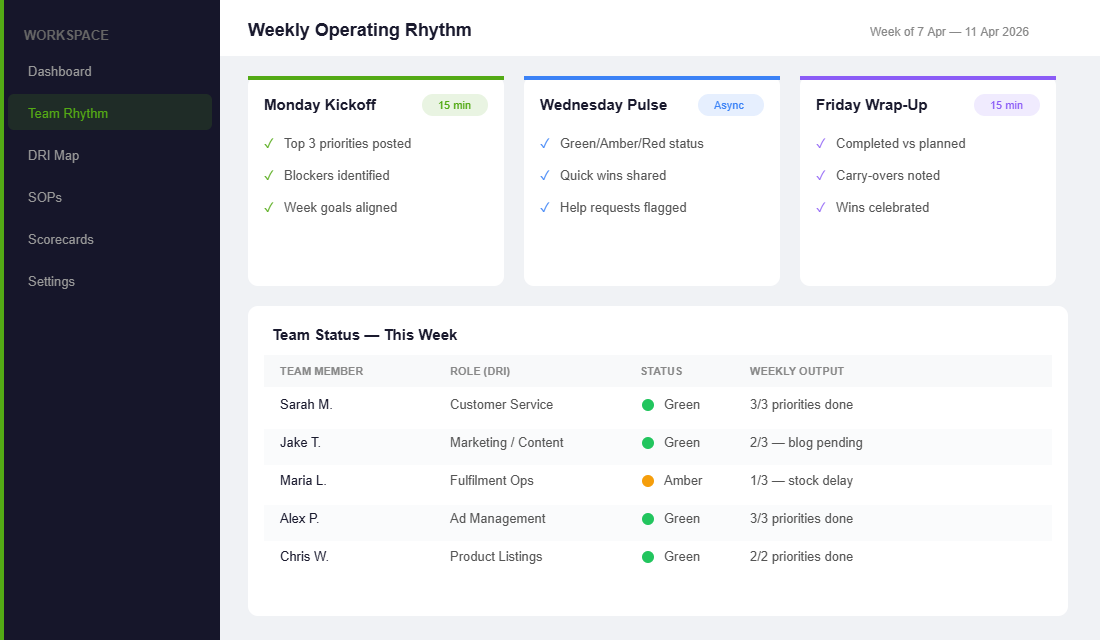
Here’s what a solid weekly rhythm looks like for a small ecommerce team:
- Monday kickoff (15 mins, async or live): Each team member posts their top 3 priorities for the week. Not a wish list — the three things that move the business forward.
- Wednesday pulse check (async): A quick status update in your project management channel. Green (on track), amber (needs input), red (blocked).
- Friday wrap-up (15 mins, async or live): What got done, what didn’t, what’s carrying over. No blame — just clarity.
That’s it. Three touchpoints a week. No daily standups that eat into productive time. Asana’s Anatomy of Work report found that remote workers spend an average of 4.1 hours per day in meetings — leaving less than four hours for actual work. Your team doesn’t need more meetings. They need the right meetings.
The key principle: async by default, synchronous by exception. Most updates should happen in writing. Reserve video calls for complex discussions, creative brainstorming, or relationship building.
Define Ownership With the DRI Model

When you’re running the show solo, accountability is simple — everything is on you. But the moment you add team members, you need a system or things fall apart fast.
The most effective model we’ve seen in ecommerce teams is the DRI (Directly Responsible Individual) approach. For every task, project, or recurring process, there’s one person who owns the outcome. Not “the team.” Not “we’ll figure it out.” One name.
Here’s how to implement it in your Shopify business:
Map every recurring function to a DRI:
- Product listings and updates → [Name]
- Customer service inbox → [Name]
- Social media content → [Name]
- Ad campaign management → [Name]
- Order fulfilment oversight → [Name]
- Weekly reporting → [Name]
Put this in a shared document that everyone can see. When something goes wrong (and it will), you don’t waste time figuring out whose job it was. You already know.
The 48-hour rule: If a DRI is blocked and can’t make progress, they have 48 hours to flag it. No sitting on problems hoping they’ll resolve themselves. This one rule alone eliminates 80% of the “I didn’t know what to do” excuses.
The most effective remote managers we work with inside the eCommerce Circle don’t track hours — they track outcomes. Set clear weekly deliverables for each DRI, and measure against those. A VA who gets their work done in 25 hours is more valuable than one who logs 40 hours of busywork. If you’re still figuring out your first hire, our guide on how to hire a virtual assistant for your Shopify store walks you through finding the right person.
Build Your Communication Stack (And Set the Rules)
Remote teams don’t fail because of bad people. They fail because of bad communication systems. If your team doesn’t know where to post an update, how urgently to respond, or which channel to use for what — you’ll get chaos.
Here’s the communication stack that works for most ecommerce teams between $300K and $3M:
Slack (or Microsoft Teams) — daily communication
Create dedicated channels that match your business functions: #orders-fulfilment for shipping issues and stock alerts, #marketing for campaign updates and content approvals, #general for team announcements and wins, and #urgent — the only channel with notifications on, reserved for genuine emergencies.
ClickUp or Asana — task and project management
Every task lives here. Not in Slack messages. Not in emails. Not in your head. If it’s not in the project management tool, it doesn’t exist. Set due dates, assign DRIs, attach briefs. For ecommerce teams, ClickUp stands out because it includes docs, goals, time tracking, and dashboards in a single platform — which means fewer tools to manage and fewer places for information to get lost.
Loom — async video updates
Some things are easier to explain on video than in text. Product walkthroughs, process demonstrations, feedback on designs. A 3-minute Loom replaces a 30-minute meeting. Every time.
The golden rule: Set response time expectations for each channel. Slack messages get a response within 4 business hours. Task comments within 24 hours. Urgent channel within 30 minutes during work hours. Write these down. Make them non-negotiable.
Onboard Like Your Business Depends on It (Because It Does)
Here’s a stat that should make every founder uncomfortable: only 12% of employees say they’ve had a great onboarding experience. And 23% of new hires quit within the first six months because of poor onboarding.
For remote ecommerce teams, bad onboarding is even more dangerous. There’s no office culture to absorb by osmosis. No desk neighbour to ask questions. If you don’t have a structured onboarding system, your new hire is flying blind.
The 30-60-90 Day Onboarding Framework:
Days 1–7: Foundation — Welcome video from you (personal, not corporate). Access to all tools and platforms (Shopify admin, email, project management, Slack). A company handbook covering who you are, what you sell, who buys it, and how decisions get made. Recorded walkthroughs of every key process using Loom. And assign a “buddy” — an existing team member who checks in daily for the first week.
Days 8–30: Guided Execution — Start with low-stakes tasks that build confidence. Daily 10-minute check-ins with their manager (drop to twice weekly after week 2). First feedback session at day 14 — what’s working, what’s confusing. Introduce them to the weekly operating rhythm.
Days 31–60: Increasing Autonomy — Assign their first DRI responsibility. Reduce check-in frequency to weekly. Set their first round of outcome-based KPIs.
Days 61–90: Full Integration — They should be operating independently within their role. Formal 90-day review against KPIs. Feedback loop: what would have made their onboarding better?
Companies that nail onboarding see new hires reach full productivity 34% faster. In a small ecommerce team, that’s the difference between your new hire contributing in 6 weeks versus 12 weeks. If you’re growing your team for the first time, our ecommerce team building roadmap covers the full hiring sequence from solo founder to scaling machine.
Create an SOP Library (Your Business Insurance Policy)
If a team member leaves tomorrow, could someone else pick up their work by next week? If the answer is no, you’ve got a single-point-of-failure problem — and it’s a ticking time bomb.
Standard Operating Procedures (SOPs) are the fix. They’re documented, step-by-step instructions for every repeatable process in your business.
Every ecommerce brand should have SOPs for at minimum: processing and fulfilling orders, handling customer complaints and returns, publishing product listings (photography specs, copywriting templates, SEO checklist), running weekly ad campaign reviews, monthly inventory reconciliation, and social media content creation and scheduling.
How to create SOPs without losing your mind:
- Record before you write. Use Loom to record yourself doing the task. Talk through each step as you go. This takes 10 minutes instead of an hour of writing.
- Let your team document their own processes. The person doing the work writes the SOP. You review and approve. This builds ownership and catches steps you might forget.
- Store everything in one place. A shared Google Drive folder, a Notion workspace, or ClickUp Docs. Not scattered across random files and Slack messages.
- Review quarterly. Processes change. SOPs that are 6 months old are probably already outdated.
The rule of thumb: if you do something more than twice, it needs an SOP. Le Petit Ballon, a Shopify wine subscription brand, launched into 5 new markets in just 2 months with a 3-person team — that kind of speed only happens when processes are documented and repeatable.
Manage Performance Without Micromanaging
This is where most founders either over-correct (watching every task) or under-correct (avoiding hard conversations until it’s too late). Neither works.
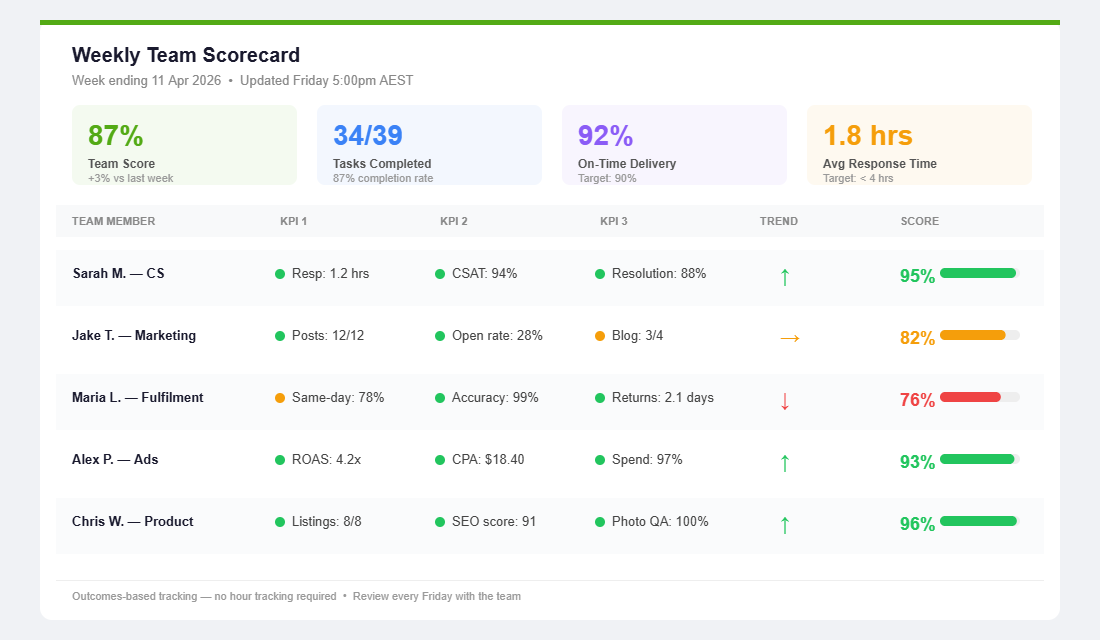
The Weekly Scorecard approach: Give every team member 3-5 key metrics they own. These should be numbers they can directly influence — not vanity metrics.
Examples for an ecommerce team: your customer service rep owns average response time, resolution rate, and CSAT score. Your marketing VA owns posts published, email open rate, and campaigns launched on schedule. Your fulfilment coordinator owns same-day shipping percentage, picking accuracy, and return processing time. Your ad manager owns ROAS, cost per acquisition, and ad spend vs. budget.
Review these weekly. The numbers tell the story — you don’t need to hover over someone’s shoulder. If the metrics are green, leave them alone. If they’re trending red, have a conversation. It’s that simple.
Having hard conversations remotely: When performance slips, address it quickly. Remote work makes it easy to avoid confrontation, but small problems left unaddressed become big problems fast. Use this framework: start with the observation (“I noticed your response time increased from 2 hours to 8 hours this week”), explain the impact (“That’s causing customer complaints to escalate”), ask the question (“What’s going on? Is there something blocking you?”), and reach an agreement (“What can we commit to for next week?”). No drama. No emotion. Just facts, impact, and a path forward.
Gallup research shows that remote workers who receive regular, structured feedback are twice as likely to be engaged compared to those who don’t.
Build Culture When You Can’t Share a Coffee
Remote teams can feel transactional if you let them. People log on, do their tasks, log off. Over time, they stop caring about your brand because they don’t feel connected to it.
Culture isn’t about pizza parties and ping pong tables. For remote ecommerce teams, it comes down to three things:
1. Visibility of impact. Share customer reviews with the team. Screenshot a great piece of feedback and post it in Slack. When your team sees the real humans their work is helping, it changes how they show up. If you’ve invested in your customer service system, your team already has these stories flowing in daily.
2. Casual connection. Create space for non-work interaction. A #watercooler Slack channel. A monthly virtual coffee catch-up where work talk is banned. It feels forced at first — and then it becomes the thread that holds the team together.
3. Recognition that’s specific and public. “Great job this week” means nothing. “Sarah, the way you handled that refund dispute on Tuesday saved us a customer who’s spent $2,400 with us over the past year — that’s exactly the kind of judgment call we need” means everything.
Companies offering flexible work arrangements with strong cultural foundations see 76% better retention and 78% higher engagement than those without.
What the Remote Team Actually Looks Like at 0K, M and M
Most founders do not have a management problem. They have a structure problem that shows up as a management problem. You cannot run a nine person team on the structure that worked at three.
Here is roughly what the shape looks like at each stage for an Australian DTC brand.
Around $500K a year: you plus two. Usually a part-time VA covering customer service and order admin, and one contractor on either creative or ads. You are still the DRI on everything strategic. Your job at this stage is not managing, it is documenting. Every task you hand over should leave a written SOP behind it. Founders who skip this step at $500K pay for it at $2M when they cannot onboard anyone without a week of their own time. Total people cost typically lands at 8 to 12% of revenue.
Around $2M: four to six people and your first real handover. A full-time operations or customer experience lead, a marketing coordinator, a designer or content person, and either an in-house media buyer or an agency. This is the stage where you stop being the DRI on daily operations and become the DRI on strategy, cash and hiring. It is also the stage where most founders stall, because handing over customer service or ad spend feels like handing over the business. People cost usually runs 12 to 18% of revenue.
Around $5M: eight to twelve people and a management layer. Two or three people now report to someone who is not you. Typically an ops lead with fulfilment and support under them, and a marketing lead with content and paid under them. Your weekly rhythm changes from a full team standup to two one-on-ones and one leadership meeting. If you are still in every channel and every decision at $5M, the constraint on growth is you, not the market.
The trigger for adding a management layer is not headcount, it is span of attention. Once you have more than five or six direct reports, the quality of your one-on-ones collapses. You start cancelling them, then you stop noticing problems until they are expensive. Five direct reports is a practical ceiling for a founder who is also running the business.
Two structural mistakes worth naming. Hiring a specialist before the generalist role is documented means you get someone excellent at a job nobody has defined. And hiring a manager before you have anyone worth managing gives you an expensive person building process for a team of two. Sequence matters more than speed. If you are still working out the first hire, the first hire playbook covers where to start, and the delegation playbook covers what to hand over first.
The Tools That Do Some of the Managing For You
A remote team without a system runs on your memory. That works until it does not, usually around the fifth person or the first time you take a proper holiday.
You do not need a big stack. You need one tool for each of five jobs, and the discipline to not use a sixth.
- Work tracking: ClickUp, Asana or Trello. Pick one and put every task in it. The rule that matters is not which tool, it is that no task exists anywhere else. If it is in a DM, it does not exist. Expect two to three weeks of nagging before this sticks.
- Async communication: Slack for conversation, Loom for anything you would otherwise explain on a call. A three minute Loom replaces a thirty minute meeting across three time zones and, unlike the meeting, it is still there in six months when you onboard the next person.
- SOPs and knowledge: Notion or Google Docs. Every SOP needs an owner, a last-reviewed date and a screenshot of the actual screen. Undated SOPs rot quietly and nobody tells you.
- Time and availability: a shared calendar with everyone’s working hours and public holidays visible. If you have people in Manila, Sri Lanka or Eastern Europe, put their local public holidays in the shared calendar too. This one takes ten minutes and prevents a surprising amount of friction.
- Performance: a simple one-on-one doc per person that both of you edit before the meeting. No performance software needed under twelve people. The 1:1 scorecard system gives you a structure that takes fifteen minutes to run and still catches problems early.
One habit is worth more than any tool: a written weekly update from every person, same format, same day. Three lines each. What I shipped, what I am doing next, what is blocking me. Ten minutes of your time to read the lot, and it surfaces almost every problem before it becomes a crisis. It also gives you a written record when it comes time to review performance or decide who is ready for more.
If your team is drowning in ad-hoc requests rather than running to a system, start with the SOP framework. Structure and rhythm fix more remote management problems than any amount of extra check-ins.
The Compound Effect — When Your Remote Team Becomes a Growth Engine
Here’s what happens when all these pieces click together:
Your operating rhythm means nothing falls through the cracks. DRI ownership means everyone knows what they’re accountable for. Your communication stack means information flows without friction. Onboarding means new hires contribute faster. SOPs mean you’re not dependent on any single person. Performance management means standards stay high. Culture means people actually want to be there.
This is the shift from “founder doing everything” to “founder leading a team that runs the business.” And it’s non-negotiable if you want to scale past the $1M–$2M mark.
The brands we work with inside the eCommerce Circle who nail remote team management consistently tell us the same thing: they wish they’d systematised this stuff years earlier. Not because it’s complicated — but because every month they spent without systems was a month of lost productivity, missed opportunities, and unnecessary stress.
Your Next Step
Inside the eCommerce Circle, team management and delegation is one of the core pillars we work on with every member. Because your product, your marketing, and your systems don’t matter if you don’t have the right people running them — and the right structure to keep everyone aligned.
If you’re stuck managing people instead of growing your business, let’s talk about how we can help.