Most Shopify founders spend their time worrying about the wrong number.
What’s in This Article
They obsess over how many SKUs are live, how many products are in development, how many collections are launching this season. What they should be obsessing over is which one product is paying for everything else, and whether they are doing enough to keep it on the throne.
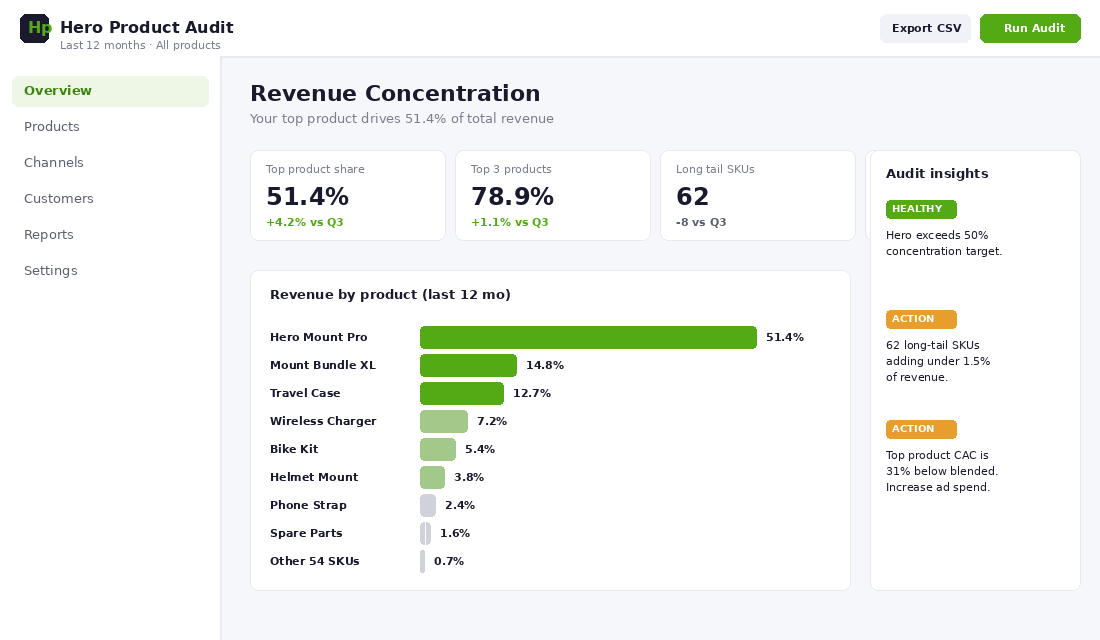
Across thousands of ecommerce brands, one product consistently drives 40 to 60 percent of total revenue. Another two or three products make up another 25 to 30 percent. The rest of the catalogue, often 70 to 80 percent of your SKUs, contributes less than 20 percent of sales. That is the 80/20 rule of ecommerce, and it is not optional. It is gravity.
The brands that scale profitably understand this and lean into it. They identify their hero product early, allocate creative, ad spend, and inventory accordingly, and build their entire growth engine around making that one product unstoppable. The brands that stay stuck spread their attention thin, launch SKU after SKU hoping the next one will pop, and wonder why their ad costs keep climbing while the bottom line does not.
This is the playbook for finding your hero product and scaling it without getting distracted by everything else.
What a Hero Product Actually Is (And What Most Founders Get Wrong)
A hero product is not just your best seller. It is the product that defines your brand, drives the majority of your revenue, has the lowest customer acquisition cost in your portfolio, and acts as the front door for everything else you sell.
The numbers back this up. NARS cosmetics has been around for over thirty years and sells more than 60 SKUs, yet a single blush called Orgasm still accounts for 23 percent of US sales volume. Nike makes hundreds of footwear models, but the Air Force 1 alone generates $2.14 billion in annual revenue, which is 22.4 percent of total Nike footwear sales. These are not edge cases. They are the rule.
Australian ecommerce is the same story. Quad Lock built a global business off one core product, a phone mount system. The Oodie scaled past nine figures with a wearable hooded blanket. Frank Body became a global skincare brand off the back of a single $14.95 coffee scrub. Bondi Sands built an empire on one tanning foam. None of these brands started with a sprawling catalogue. They found one product the market wanted and concentrated everything around it.
Here is what most founders get wrong. They confuse breadth with growth. They think more SKUs means more revenue. The data says the opposite. A wide catalogue dilutes your ad creative, fragments your inventory, complicates your supply chain, and confuses your customer. Concentration scales. Spread does not.
The 80/20 Audit: How to Find Your Real Hero Product
Before you can scale a hero, you have to know which product actually deserves the title. This requires a clear-headed look at your data, not a guess based on what you launched most recently or which product you are most emotionally attached to.
Open Shopify Analytics. Pull the last 12 months of product-level revenue data. Sort by gross revenue, then layer in three more columns: gross margin per unit, customer acquisition cost (if you can attribute it), and repeat purchase rate from customers whose first order included that product. You are looking for the product that wins on all four dimensions, not just revenue.
Most stores find one of three patterns when they run this audit:
- The clear hero. One product is doing 35 percent or more of revenue, has the highest margin, and drives the highest repeat rate. This is the easy case. Lean in.
- The hidden hero. Your top revenue product is not actually your highest margin or highest LTV product. The real hero is sitting at number two or three on the revenue list, but it has 30 percent better unit economics. This product deserves the marketing budget.
- No hero yet. Revenue is spread evenly across five or more SKUs, and no single product is breaking out. This is the most common pattern in stores doing under $1M, and it is a problem. Without a hero, your CAC will keep climbing because you have nothing concentrated enough to scale ad creative around.
Run this audit quarterly. Hero products can change, especially as new lines launch or seasonal patterns shift. The brand at $5M with one hero looks different from the brand at $20M, and that is fine.
The CAC Test: Why Heroes Are Cheaper to Acquire Customers For
Here is the metric most Shopify owners never look at, and the one that separates real hero products from glorified best sellers.
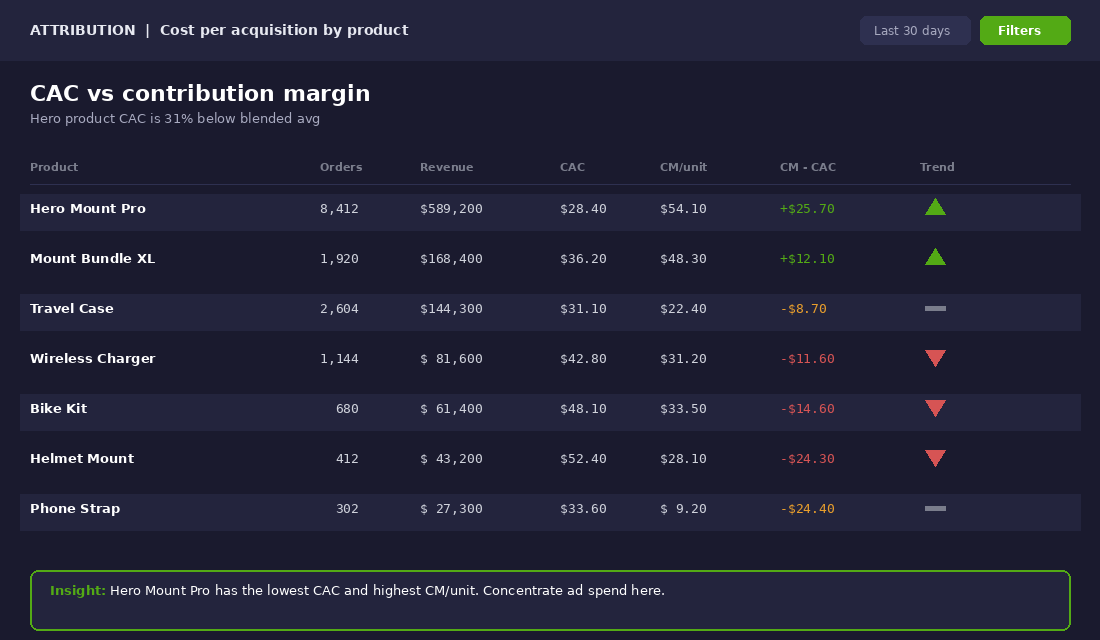
Hero products typically have a customer acquisition cost 30 to 50 percent lower than the rest of your catalogue. There are three reasons for this. First, hero products tend to have stronger product-market fit, which means ad creative converts better. Second, they generate organic word-of-mouth and search demand, which means you are paying less for the click. Third, they can support more aggressive bidding because the unit economics are stronger.
If you are not measuring CAC at the product level, you are flying blind. Most Shopify stores measure CAC at the store level or the channel level, then wonder why scaling ad spend stops working. The truth is that some of your products are subsidising the others. Your hero product is profitable at $40 CAC. Your secondary line breaks even at $25 CAC. When you average them together, your blended CAC looks fine, until you push spend and the secondary line drags everything underwater.
To run the CAC test, take each of your top five products and calculate three numbers per product: unit contribution margin, blended CAC for orders containing that product as the first item, and contribution margin minus CAC. The product with the highest contribution margin minus CAC is your real hero, regardless of revenue rank. That is the product where every additional dollar of ad spend creates the most leverage.
This is also why we put so much emphasis on contribution margin in the eCommerce Circle. It is the one number that tells you whether you can actually scale, and it is the lens through which every hero product decision should be made.
Scaling the Hero: Where to Concentrate Your Resources
Once you know which product is your hero, the job is to concentrate every lever in your business around it. This is the part most founders get wrong. They identify the hero, congratulate themselves, then go right back to launching new SKUs and spreading their creative budget thin. Concentration is uncomfortable. Do it anyway.
There are five places to concentrate. Get these right and the rest of the business gets dragged forward.
Ad creative
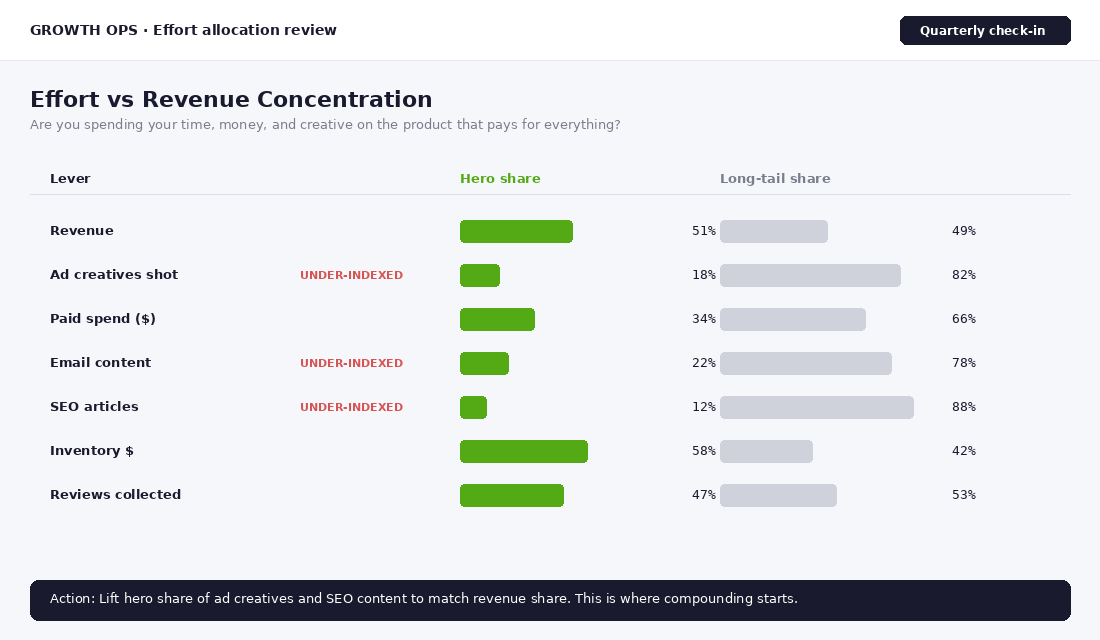
If your hero product drives 50 percent of revenue, it should consume 50 to 70 percent of your ad creative production. Most brands shoot one or two ads for the hero, then spend the rest of their creative budget on the long tail. This is upside down. The hero should have ten to twenty creatives running at any given time, refreshed weekly, across multiple angles: founder story, customer testimonial, problem-solution, comparison, before-and-after, and unboxing. This is how you beat creative fatigue at scale.
Email and SMS automation
Your welcome flow should sell the hero. Your abandoned cart flow should reference the hero. Your post-purchase flow should cross-sell from the hero into the rest of the catalogue, not the other way around. Most brands fragment their email content across all products. The brands that scale make the hero the entry point and let everything else stack on top.
Content and SEO
Build a content cluster around the hero product. Write guides, comparisons, and how-to-use content that ranks for hero-related queries. If your hero is a phone mount, you want to rank for “best phone mount for cycling,” “phone mount for motorbikes,” and every variant. Each piece of content drives qualified traffic that already wants what you sell. Do this once and it pays you for years.
Inventory and supply chain
Stockouts on your hero are catastrophic. Stockouts on a secondary product are an inconvenience. Treat them differently. Forecast hero inventory aggressively, hold deeper safety stock, and make sure your supplier relationships protect that one SKU above all others. A single 14-day stockout on your hero can cost you more revenue than a quarter of secondary line losses combined.
Shopify product page
Your hero product page should be the most polished, most tested, most optimised page on your store. It should have video, customer reviews, comparison tables, FAQs, sizing guides, and trust badges. Test it monthly. The 0.5 percent conversion rate lift you find on the hero is worth more than a 3 percent lift on a long-tail SKU. We covered the full anatomy of this in our 7-layer product page optimisation framework, and it applies tenfold to the hero.
The Line Extension Trap: How Brands Kill Their Own Hero
This is where most founders shoot themselves in the foot. The hero is working. Revenue is growing. The team gets excited and starts launching extensions. New colours, new sizes, new variants, new related products, new flavours. Within twelve months, the hero’s share of revenue drops, total revenue is flat or growing slowly, and the team cannot work out why scaling stopped working.
The reason is dilution. Every new SKU divides your team’s attention, your ad creative budget, your inventory dollars, and your customer’s decision. Choice paralysis is real. Add too many options to the buying journey and conversion rate drops.
There is a right way to extend, and a wrong way. The right way looks like this:
- Anchor the hero first. Do not extend until your hero is doing at least 50 percent of revenue and you have run out of ways to scale it harder. If there is more juice in the hero, squeeze it.
- Extend within the hero, not away from it. New colours, new sizes, new bundles built around the hero are extensions that compound. New product categories are dilutions.
- Test before committing. Use small inventory runs and pre-orders to validate demand before you go deep on a new SKU. The brands that scale launch new products with data, not hope.
- Kill the losers fast. If a new SKU is not contributing to revenue or margin within 90 days, deprecate it. Most stores carry too many losing SKUs because no one wants to make the call.
The discipline here is what separates the brands that compound from the brands that plateau. We see this constantly inside Connect, our 90-day program. The founders who scale fastest are the ones willing to say no to new SKU ideas and stay locked in on making the hero unstoppable.
Real Aussie Brand Examples: Hero Product Concentration in Action
Theory only goes so far. Here are three Australian Shopify brands that built nine-figure businesses by concentrating around a single hero product.
Quad Lock
Started with a single phone mount system. Built the entire brand around making one product the best in its category, period. They have since extended into accessories like wireless chargers, cases, and helmet mounts, but every extension serves the original hero, not competes with it. Their content marketing, ad creative, and product roadmap all point back to the core mount system. That is hero discipline.
The Oodie
Launched in 2018 with one product: an oversized hooded blanket. Within three years they were doing over $50 million AUD annually, almost entirely off variations of the same hero product. New prints, new sizes, new collaborations, but the same product. They did not chase adjacent categories. They made the hero unstoppable.
Frank Body
Started in 2013 with a single $14.95 coffee body scrub. They scaled to over $20 million annually before meaningfully extending the line. Even today, the original coffee scrub remains the gateway product, the customer’s first purchase, and the brand identity. New launches are built around the hero, not in spite of it.
The pattern is consistent across all three. Find the one thing the market wants. Concentrate everything around it. Resist the temptation to extend prematurely. Win the category, then earn the right to expand.
The Compound Effect: Why Hero Concentration Beats Broad Catalogues
Here is what makes hero product concentration so powerful. It compounds.
When 50 percent of your revenue comes from one product, your ad creative gets sharper because you are testing variants of the same hero angle. Your customer reviews stack up on one product page, building social proof. Your SEO content cluster reinforces itself. Your supply chain gets better because you have more volume on a single SKU. Your repeat purchase rate climbs because customers know exactly what to buy. Every system in your business gets better at the one thing that matters most.
A fragmented catalogue cannot compound the same way. Reviews are spread thin. Ad creative cannot get optimised because you are testing across too many products. Inventory gets bloated because you are forecasting twenty SKUs instead of one. Customer service complexity grows linearly with SKU count. Every dollar of effort spreads thinner.
This is why brands at $1M with one hero often outperform brands at $3M with twenty SKUs. The compounding effect is not just about revenue. It is about the quality of every operational lever in your business.
Concentration is also what makes your unit economics work as you scale. We covered this in detail in the contribution margin article, but the short version is this: the brands that hold contribution margin steady as they scale are the ones with concentrated revenue and disciplined SKU management. The brands whose margins erode at scale are the ones who tried to do too many things at once.
The Hero Product Audit Template: Use This Quarterly
Here is the simple framework we use inside the More Orders Operating System to keep clients locked in on hero product concentration. Run this every quarter.
Step 1: Pull the data. Last 90 days. Product-level revenue, units sold, gross margin per unit, repeat purchase rate, and CAC by first-order product (if attributable).
Step 2: Rank by contribution margin minus CAC. Not revenue. Contribution margin minus CAC. This is the number that tells you which product creates the most operating leverage when you scale.
Step 3: Calculate the concentration ratio. Top product as a percentage of total revenue. Below 30 percent is a problem. 30 to 50 percent is healthy. Above 50 percent is the goal for sub-$5M brands.
Step 4: Audit your concentration of effort. Ad creative shot per product, email content per product, paid spend per product, inventory dollars per product. Does your effort concentration match your revenue concentration? Most brands fail this test.
Step 5: Pick three actions for the quarter. Three things you will do to deepen your hero advantage. New creative angles. New content cluster. New variant of the hero. Better post-purchase flow. Pick three. Execute. Measure.
If you do this every quarter, you will be in the top 10 percent of Shopify operators within a year. Most brands never do this work, which is exactly why most brands stay stuck.
The Hero Product Scoring Rubric: Score Every SKU Out of 50
Don’t pick your hero by gut feel. Score every product candidate on a weighted rubric and let the numbers commit you to one. Here is the framework I use with every Circle member who is wrestling with this decision:
- Contribution margin (1–10): 50%+ contribution margin scores 10. Below 30% scores 1. This is the highest-weighted criterion because it determines how much you can spend on ads.
- Repeat purchase rate (1–10): 30%+ of buyers reorder within 90 days scores 10. Single-purchase products score 3 or below. Repeat rate is what makes a hero scalable beyond your first sale.
- Story strength (1–10): Score 10 if you can explain the product’s unique value in one sentence and a 30-second video. Score low if it needs paragraphs of explanation.
- Operational simplicity (1–10): Single SKU or single variant scores 10. 8+ size/colour combinations scores low because forecasting and ad creative get exponentially harder.
- Demand signal (1–10): Already pulling 30%+ of revenue or showing the lowest CPA in your account scores 10. This is the clearest “the market is voting” data point.
Total a score out of 50. Anything 40+ is a hero candidate. 30–40 is a strong supporting product. Below 30, do not bet your scaling cycle on it. Re-score quarterly — heroes shift as the brand matures.
A Real-World Example: How an Aussie Brand Found Their 80/20
One of our Circle members runs a skincare brand doing about $80K AUD/month with 14 SKUs. They were spreading ad spend across the catalogue and watching ROAS bounce between 1.4x and 2.1x. We ran the rubric on every product. Result: their entry-level cleanser scored 44/50 — highest contribution margin (62%), best repeat rate (38% within 60 days), one-line story (“the cleanser that does not strip your barrier”), and a single 150ml SKU.
Next 90 days: 70% of ad budget went to that single product, with the remaining 30% running brand-awareness creative. ROAS climbed from 1.7x to 2.9x average. CAC dropped 28%. Repeat-purchase revenue became predictable enough to forecast cash flow weekly. The other 13 SKUs did not get killed — they became the second and third order in the customer journey, lifting LTV by an estimated 22%.
Scaling the Hero: Cross-Sell Maths That Actually Work
Once your hero is scaling, the leverage is in attaching a second product on the same order. Three plays I see consistently work:
- Product-page bundle. “Add the [complement] for 20% off” inline on the hero PDP. Lifts AOV by 8–18% and only takes a Shopify-native bundle app like Shopify Bundles or Frequently Bought Together.
- Post-purchase upsell. One-click upsell on the thank-you page (ReConvert, AfterSell). Take rate sits at 8–15% on a relevant offer. Free incremental margin — no additional ad spend.
- Day-7 email cross-sell. Klaviyo flow that arrives 7 days after delivery, recommending the next-best product based on what they just bought. Conversion rate 3–6% on a list of recent buyers — your warmest possible audience.
Layer in proper attribution to make sure you are seeing the full picture. Triple Whale ($129–$299/mo) and Northbeam ($1,000+/mo) attribute hero-driven sales to the right channels — Klaviyo, Meta, Google, organic — instead of letting GA4 mis-credit the last touch. Brands using Triple Whale typically see Meta’s contribution at 30–50% higher than Meta’s own attribution claims, which changes how you scale your hero’s ad budget.
Why This Is the Hardest Discipline in Ecommerce
The reason hero product concentration is so rare is that it requires saying no. No to new product ideas. No to category expansion. No to launching the thing that excites your team but dilutes your business. Founders are wired to create. Saying no to creation feels like death.
But scaling is not about creation. Scaling is about concentration. Find the one thing the market wants from you. Build the deepest moat you can around it. Make every system in your business better at delivering that one thing. Earn the right to extend by first making the hero unstoppable.
Inside the eCommerce Circle, hero product concentration is one of the first things we work on with every new member. It is the foundation underneath the 10 P’s. Get this wrong and nothing else matters. Get this right and the rest of the operating system has something to compound on top of.
If you are scaling a Shopify brand and you are not sure whether your hero product is doing the heavy lifting it should, that is the conversation worth having. We help Aussie ecommerce founders identify their hero, concentrate their growth engine around it, and stop diluting their best opportunity with too many SKUs. Let’s talk.