Most Aussie Shopify founders treat a product launch like a wedding announcement. They polish the product page, line up a couple of social posts, fire off a single email to the whole list on Monday morning, and then refresh the dashboard for the next 48 hours wondering why the numbers are flat.
What’s in This Article
Then they blame the product. Or the algorithm. Or the price.
Here is the uncomfortable truth. Stores that follow a structured launch sequence generate 3 to 5 times more first-week sales than stores that simply press publish and hope. A Harvard Business School study of 200 product launches found that brands spending 60% of their launch budget on pre-launch activities (not launch week itself) hit 3.4x higher first-year revenue. Your product is rarely the problem. The system around it is.
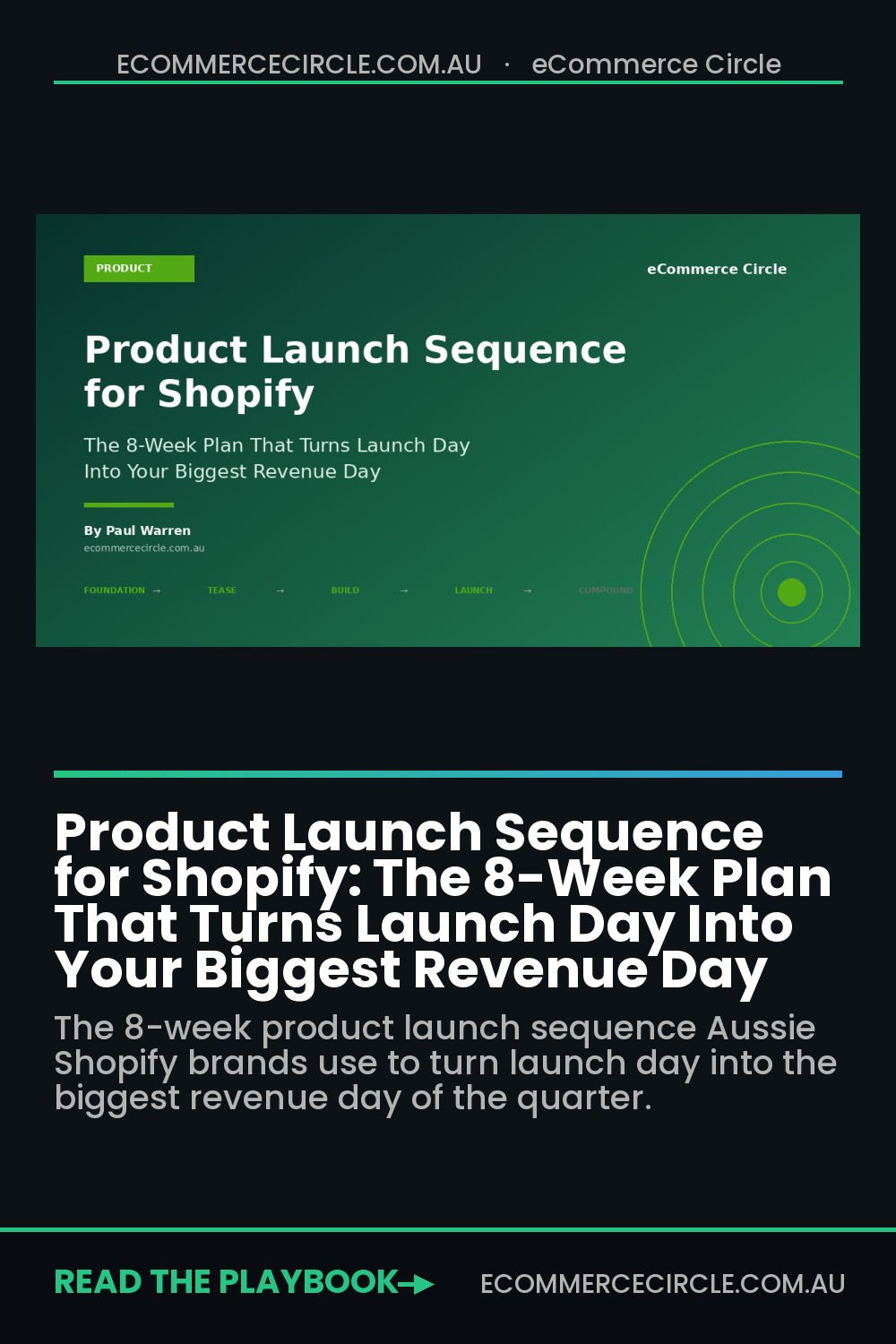
This article is the 8-week sequence we run with eCommerce Circle members when they are bringing a new product, collection, or hero SKU to market. It is the same scaffold that lets a $200k per month Shopify brand turn launch day into the single biggest revenue day of the quarter, and it does not require a bigger team or a bigger ad budget. It requires choreography.
Why Most Shopify Launches Land With a Thud
If your last launch did not feel like a launch (just another day of orders, maybe a small bump, then back to baseline), you are not alone. Three patterns show up almost every time we audit a quiet launch.
- The audience finds out at the same time as Google does. No waitlist, no warmup, no anticipation. The launch is a cold ask to a cold audience.
- The launch is one email and a couple of stories. One single touchpoint inside a 70 to 80% cart abandonment market means most of the revenue you could have captured walks straight out the door.
- There is no post-launch plan. The first 14 days after launch are where reviews, UGC, and repeat-buyer data compound. Most stores treat them as a return to normal trading.
The sequence below fixes all three. It does not need a celebrity, an agency, or a paid PR firm. It needs a calendar, a few flows, and discipline.
The Two Numbers That Predict Whether Your Launch Will Hit
Before we touch the calendar, set targets. Without numbers your launch is a vibe, and a vibe cannot be optimised.
Two metrics decide nearly everything in a Shopify launch.
- Waitlist size at T minus 7 days. Your waitlist is the leading indicator. As a rough benchmark, a 2 to 5% B2C email list to customer conversion rate means a 1,000-strong waitlist should produce 20 to 50 launch-day orders before you spend a cent on ads. If your AOV is $120, that is $2,400 to $6,000 in launch-day revenue from the list alone.
- Launch-day conversion rate vs. your store baseline. A successful launch beats your store-wide conversion rate by 1.5 to 2x because traffic is warmer and intent is higher. If your store usually sits at 2.5%, launch day should feel closer to 4 to 5%. The top 10% of Shopify stores hit a 4.7% conversion rate on a normal day, so a hot launch should outperform that.
Write both targets at the top of your launch brief. Reverse engineer everything else from there.
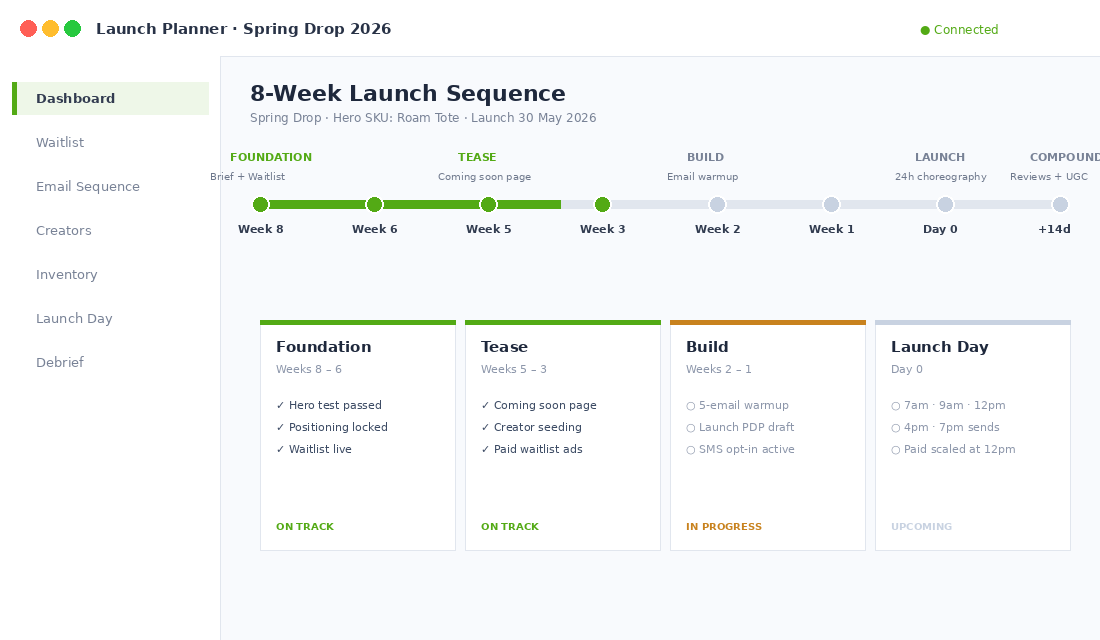
Stage 1: Weeks 8 to 6, Build the Demand Backbone
This is the stage most founders skip, and it is the stage that decides whether you have a launch or a whimper. Eight weeks out, you should not be building creative or briefing influencers. You should be making sure the product is worth launching at all.
Validate the product is hero-worthy. If you are launching something into your existing range, run it through the hero product test (see our Hero Product Playbook). Hero potential = strong margin, broad demographic appeal, low return rate, and a clear “this is for me” moment on the PDP. If three out of four are weak, do not anchor a full launch around this SKU. Run it as a soft drop instead.
Lock the launch positioning in one sentence. The format we use inside Connect is: “[Product] is the [category] for [who] who want [outcome] without [common tradeoff].” Example: “Roam is the everyday tote for Aussie mums who want premium leather without the premium-leather price tag.” If you cannot fill that template in under five minutes, the positioning is muddy and every asset downstream will be muddy too.
Build the launch brief. One page. Product, hero positioning sentence, target waitlist size, target launch-day revenue, target launch-day conversion rate, list of every asset required (hero image, lifestyle photos, founder video, packaging, PDP copy, email creative), owner, and due date. This brief is the single source of truth for the next 8 weeks.
Set up the waitlist mechanic. This is non-negotiable. The waitlist is your launch. Use Klaviyo Forms or Shopify Forms to capture name, email, and a single qualifying question (size, scent, colour preference, whatever segments your audience usefully). Pipe captures into a dedicated Klaviyo list called “Launch Waitlist [Product Name]” so you can flow it independently of your normal welcome series.
Stage 2: Weeks 5 to 3, Tease Without Saying Everything
You are now five weeks out. The product is locked, the brief is signed off, the waitlist mechanic is live. Job one in this stage is filling the waitlist. The aim is to drive every existing channel to the waitlist page, not to the product page (which does not exist yet). Restraint here is everything. If you reveal the product fully, you forfeit anticipation.
- Coming soon page on the live store. Replace one navigation slot with “Coming Soon” or pin a homepage strip that says “Something is coming on [date]. Get early access.” One CTA: join the waitlist. Stripe of social proof underneath (“12,847 subscribers already in line”) if you have the numbers.
- Organic content cadence. Three to five teaser posts per week across Instagram, TikTok, and email. Show fragments. The packaging close-up. A factory-floor 10-second clip. The founder explaining why this product had to exist. Never the full product. Caption every post with “Get early access link in bio.”
- Paid teaser layer. Spend 10 to 15% of your normal Meta budget on a dedicated waitlist ad set targeting your warm audience (engaged 30, 60, 90, page visitors, lookalikes of past buyers). Single objective: email opt-ins to the waitlist landing page. CPL benchmark for AU DTC is $1.50 to $4 depending on niche.
- Creator seeding. Send the product to 10 to 30 micro-creators (5k to 50k followers) under embargo. They cannot post until launch. They get a code that pays them on launch-day sales. This is creator-led launch volume that is far cheaper than paying for posts after the fact.
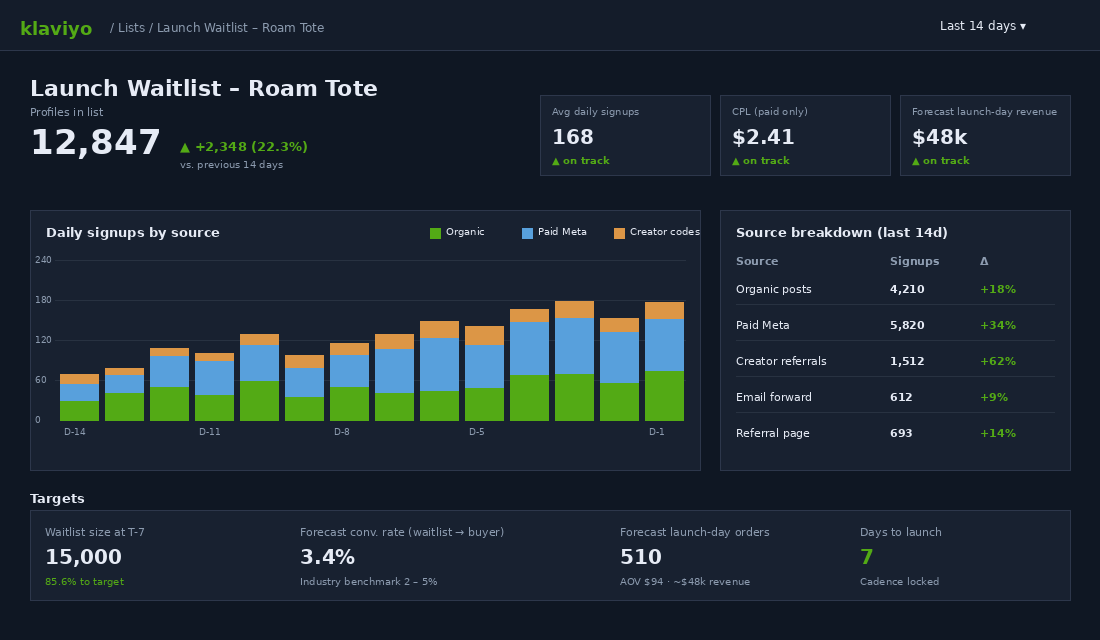
By the end of week three you should know your waitlist trajectory. If growth is flat, do not push through. The launch is at risk. Either lean harder into paid spend, recruit more creators, or push the launch date back two weeks. A launch with no waitlist is a soft drop pretending to be a launch.
Stage 3: Weeks 2 to 1, Build the Pressure
Two weeks out the temperature changes. Anticipation has to start feeling specific. This is the stage where most launches start to leak energy because founders run out of content ideas. Have the calendar built before you arrive at week two.
Email pre-launch sequence to the waitlist. Run a five-email warmup, not one. Welcome flow open rates average 51%, with placed-order rates near 10%. Your launch sequence should feel just as warm because the audience has consented to hear from you. Sequence we run:
- Email 1 (T minus 14): Welcome to the waitlist. Origin story. What this product solves and why now.
- Email 2 (T minus 10): Behind the build. Materials, suppliers, real photos of the factory or studio. Permission to be opinionated about why your version is different.
- Email 3 (T minus 7): The “first reveal” hero shot. Drop the launch date as a calendar invite. Add a sneaky early-access perk for waitlist members (24-hour head start, free shipping, a free gift over $X).
- Email 4 (T minus 3): Founder video. 90 seconds. Phone-shot. Talk to the camera. This email consistently drives the highest click-through in the warmup because it cannot be replicated by a competitor.
- Email 5 (T minus 1): Tomorrow at 7pm. Set the alarm. One CTA. No fluff.
Build the launch landing page now. The PDP for the launch product should already be live (set to draft or hidden). Hero image, scroll-stopping headline, the positioning sentence, three benefit blocks with photography, lifestyle gallery, founder video, FAQs, and reviews lifted from creator seeding (with permission). Do not rely on the same template you use for everyday products. Launches deserve a custom PDP.
SMS opt-ins. Add SMS as a second waitlist channel from week two. SMS open rates are 90%+ within five minutes. For launch-day choreography, SMS is the final reminder you cannot afford to skip. Use Klaviyo SMS, Postscript, or Attentive depending on your stack.
Schedule a Klaviyo flow trigger for launch. Build a “Launch Day” flow that triggers off product availability or a custom event. Do not rely on hitting send manually at 7pm. Manual send fails are responsible for half the missed launches we have audited. (For more on flow architecture, our Klaviyo Segmentation guide walks through the segment logic that should sit underneath every launch flow.)
Stage 4: Launch Day, The 24-Hour Choreography
Launch day is not one moment. It is a 24-hour wave with three distinct peaks. Most stores run one big email blast at 9am and call it a day. The brands that turn launch day into the biggest revenue day of the quarter run three.
The cadence we use:
- 7:00am AEST: Waitlist exclusive email. “It is live. You get first access. The general public sees it at 12pm.” Subject line: “[First name], you are in. The doors are open.”
- 9:00am AEST: SMS to the waitlist. Single line. “[First name], it is live. Tap here.” Drives the rush of mobile orders before the day fills up.
- 12:00pm AEST: Public launch email and social blast. Now everyone hears about it. Stories, feed posts, paid ads switch on. Creators drop their content with the affiliate code.
- 4:00pm AEST: Inventory pressure email. If the launch is moving (and you have prepared this email in advance), a “running low on [size/colour]” email lifts urgency without manufacturing fake scarcity. If the launch is slow, swap this email for a behind-the-scenes update or a customer first-impression highlight.
- 7:00pm AEST: Last-call email. Closes the day. Targets non-buyers from the launch list. Includes one strong piece of social proof from the day (orders, photos, reviews).
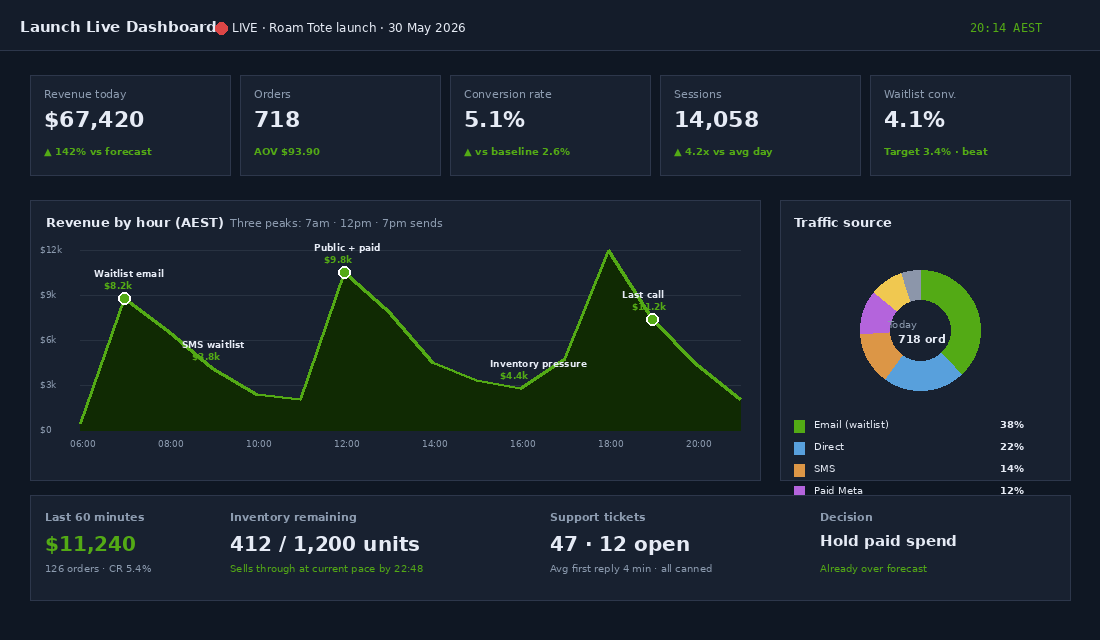
Watch the live dashboard, but do not move spend until the data is real. A spike at 8am does not mean you should triple your ad budget at 9am. Hold paid spend at the planned level for the first three hours. After 12pm noon, when the public window opens, you can scale Meta and Google budgets if conversion rate is at or above target. Triple Whale or Shopify Live View are both fine for tracking, just pick one and stay disciplined.
Customer service is not a passive role today. Have your support team in Slack or Front, watching for size, fit, and stock questions. Pre-build the five most-likely FAQ replies as canned responses. A 10-minute reply on launch day converts. A 6-hour reply does not.
Stage 5: Weeks 1 to 2 Post-Launch, Convert Curiosity Into Compounding Revenue
The launch is not over at 11:59pm on launch day. The next 14 days are when the launch becomes a category-shaping product or fades into the back of the catalogue. Three workstreams run in parallel.
Reviews and UGC harvest. Trigger a Klaviyo flow that asks for a review on day 7 (after typical AU shipping arrives) and a photo or short video on day 14. Aim for a 10 to 15% review submission rate. Reviews placed on the PDP within the first 21 days do double duty: they convert post-launch traffic and feed the next paid creative round.
Cart and browse abandonment for non-buyers. A 70%+ cart abandonment rate is the industry average, and on launch day that number is often higher because new visitors are still deciding. Flow architecture: cart abandon at 1 hour and 24 hours, browse abandon at 4 hours and 48 hours, both with a soft incentive (free shipping, a free gift) on the second touch only.
Cross-sell into the rest of the range. Anyone who bought the launch product should hit a post-purchase flow that introduces complementary products inside 7 days. AOV on cross-sell flows averages 15 to 25% higher than your store baseline because the customer is in a buying mindset. Klaviyo flows are 13x more likely to drive a placed order than a campaign blast, so this is not optional.
Add a launch debrief to the calendar for day 14. Pull launch-day revenue, week-one revenue, waitlist conversion rate, AOV vs. baseline, top traffic source, top creator, and customer service ticket themes. Half a page. The debrief is what makes the next launch better. (We bake this into the founder weekly cadence we describe in The Weekly Operating Rhythm.)
The Compound Effect: Why This System Beats Press Publish and Hope
Run this once and the launch wins. Run it three times in a year and the system itself starts compounding.
- Your waitlist becomes a permanent asset. Subscribers who joined for one launch convert at 2 to 4x normal cold rates on the next one. Build it once, harvest it on every release.
- Your creators get faster and cheaper. The 30 micro-creators you seeded for launch one will produce content for launch two without renegotiation. Most will lift their effort because they earned commission the first time.
- Your launch creative library compounds. Lifestyle, founder, factory, and unboxing assets you produced for the first launch get cut into ads, emails, and PDP copy for the next 18 months.
- Your team stops freaking out on launch day. The first launch is chaos. The third launch is choreography. The fifth launch is the most enjoyable revenue day of the year.
The brands we work with that treat launches as a repeatable system (rather than a once-a-year stunt) are the ones who scale from $200k per month to $500k per month without doubling their ad spend. The ones who launch by vibe stay flat.
Your 8-Week Launch Checklist (Steal This)
Print this and stick it on the wall. Every box gets ticked, in order, before launch day.
Weeks 8 to 6: Foundation
- Hero product test passed (3 of 4 criteria minimum).
- Positioning sentence locked.
- One-page launch brief signed off.
- Waitlist mechanic live (Klaviyo Forms or Shopify Forms).
- Launch date set in the team calendar with named owners per asset.
Weeks 5 to 3: Tease
- Coming soon page live on the homepage and a navigation slot.
- 3 to 5 teaser posts per week across IG, TikTok, and email.
- Paid waitlist ad set running at 10 to 15% of normal Meta budget.
- 10 to 30 creators seeded under embargo with launch-day affiliate codes.
- Daily waitlist tracking by source.
Weeks 2 to 1: Build
- 5-email warmup sequence drafted, scheduled, tested.
- Custom launch PDP built and reviewed on mobile.
- SMS waitlist opt-in active.
- Klaviyo Launch Day flow scheduled (not manual).
- Customer service canned responses written for 5 most likely questions.
Launch Day
- 7am AEST: waitlist exclusive email.
- 9am AEST: SMS to waitlist.
- 12pm AEST: public email, social, paid switch on.
- 4pm AEST: inventory or social proof email.
- 7pm AEST: last-call email to non-buyers.
- Live dashboard monitored, paid spend held until 12pm.
- Support team active in Slack or Front.
Weeks 1 to 2 Post-Launch
- Day 7 review request flow live.
- Day 14 UGC photo or video request flow live.
- Cart and browse abandonment flows running with second-touch incentive.
- Cross-sell flow to launch buyers triggered within 7 days.
- Day 14 launch debrief booked, half a page, named owner.
That is the entire system. It does not require new tech. It does not require a bigger team. It requires the discipline to plan eight weeks ahead and run the cadence even when the launch feels small.
One Last Thing
The single biggest mistake we see is founders who run a beautiful 8-week sequence for one launch, hit the number, and then go back to “press publish and hope” for the next three drops. The system only compounds if you treat every launch like a launch. New colourway? Run the sequence. Restock of a sold-out hero? Run the sequence. Limited-edition collab? Run the sequence at half the duration with double the urgency.
Every product is worth a launch. The question is whether you are willing to choreograph it.
The Launch Post-Mortem: The 6-Question Debrief You Run in Week 3
The launch is not finished when the revenue lands. It is finished when you have written down what you learned, because the next launch either compounds on this one or starts from zero again. Block 45 minutes in week 3, while the numbers are fresh and the emotion has drained out.
1. What percentage of launch-day revenue came from the waitlist? This is the single most predictive number you have. A well-built waitlist should produce 40 to 60% of day-one revenue. Under 25% means you launched to strangers and paid for the privilege in ad spend. Over 70% means your waitlist is doing all the work and your paid and organic reach needs attention before the next drop.
2. What was the waitlist-to-purchase conversion rate? A warm, well-nurtured list converts at 8 to 15% on launch day. If yours converted at 3%, the list was collected but never warmed, and the fix sits in weeks 5 to 3 of the sequence rather than on launch day itself.
3. Which single asset drove the most add-to-carts? Check the Shopify product page analytics alongside your Klaviyo click data. Usually it is one specific email, one specific piece of creative, or one specific piece of user-generated content. Whatever it was, that is your lead asset for the next launch, not the thing you personally liked most.
4. Where did the sequence lose people? Pull open and click rates for every email in the run. A drop of more than 30% in click rate between two consecutive sends usually means one email over-promised and the next under-delivered. Rewrite that pair, not the whole sequence.
5. Did you sell out too fast or too slow? Selling out in four hours feels good and is usually a pricing signal, not a marketing win. If demand cleared inventory that quickly, you either underpriced the product or under-ordered it. Selling through 60 to 80% of launch inventory in the first week is the healthy band for most Aussie DTC brands, because it leaves stock for the post-launch conversion window without leaving you sitting on dead capital.
6. What is the 60-day repeat rate on launch buyers? You cannot answer this in week 3, so diarise it. Launch buyers are usually your highest-intent customers of the quarter. If they never come back, the product excited people but did not satisfy them, and that is a product problem no launch sequence fixes.
Write the answers into a single doc and open it on day one of the next launch. If demand keeps outrunning stock, the pre-order playbook lets you capture the revenue you are currently turning away at the sold-out banner.
Inside eCommerce Circle, the launch sequence is one of the core playbooks we work on with every member, alongside their hero product, their email infrastructure, and their post-purchase flow. If you are about to push a launch and want a second pair of eyes on the brief before you commit, let’s talk.