Most Shopify founders are busy, not productive. They spend their days putting out fires: a Meta campaign that stopped working, a customer complaint that blew up, an app that broke checkout. They know something needs to change, but the week disappears before they get to the strategic work.
What’s in This Article
The irony? The stores consistently hitting $500k, $1M, and beyond are not working harder. They’re planning better. They run their business in 90-day sprints, picking one primary focus for the quarter, executing it, and reviewing before they start the next one.
One Aussie operator was stuck at $22k/month for six months. She picked one P to fix for the quarter: her post-purchase email sequence. Ninety days later, she was at $31k/month — a 40% lift with zero increase in ad spend. That’s the 90-day sprint in action.
Why Most Shopify Founders Plan Poorly (And Why It’s Not Their Fault)
No one teaches ecommerce operators how to plan. You get good at building products, running ads, and fulfilling orders. Strategic planning is an afterthought — something you do in January with a fresh notebook and good intentions, then forget about by February.
The result is a predictable pattern: you react to whatever’s loudest each week. Your Meta cost-per-click goes up, so you spend three weeks rebuilding your ad creative. A competitor launches a new product, so you pivot your range. A customer complains about shipping, so you spend a fortnight negotiating with your 3PL.
None of this is wrong. But it’s reactive, not strategic. And reactive businesses plateau. Research consistently shows that businesses running structured quarterly planning cycles grow 30 to 40% faster than those operating without one. The reason is compound consistency: small improvements across multiple business pillars, executed every 90 days, stack on each other in ways that feel exponential by year’s end.
Why 90 Days Is the Sweet Spot for Ecommerce Planning
Annual plans are too long. By month three, reality has diverged enough from the plan that you’re either ignoring it or guessing. Weekly plans are too short: you never get to the work that actually moves revenue.
Ninety days hits the sweet spot. It’s long enough to see real results from a new strategy — email flows, SEO, product repositioning, checkout optimisation — and short enough that you can course-correct before too much damage is done.
It also maps naturally to Australian business cycles. Q3 (January to March) is post-Christmas recovery and new-year momentum. Q4 (April to June) is the EOFY push. Q1 (July to September) is mid-year growth. Q2 (October to December) is BFCM and Christmas run. Each quarter has its own natural focus, which makes planning less abstract and more actionable.
Shopify operators who run structured 90-day sprints consistently report meaningful gains within the quarter. One brand saw a 60% lift in monthly revenue inside a single sprint by focusing exclusively on checkout friction and email flows — not by adding new traffic or increasing their ad budget.
The Pre-Sprint Audit: Finding Your Highest-Value P
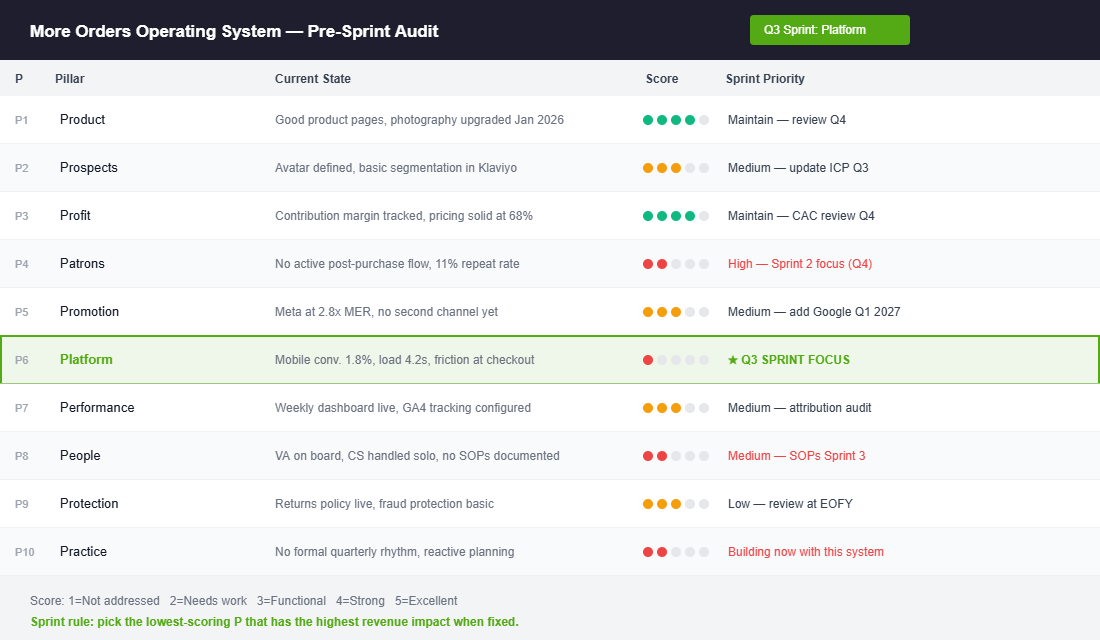
Before you pick your sprint focus, you need to know where the biggest opportunity sits in your business right now. This is the Most Valuable P audit — a quick score across all 10 pillars of the More Orders Operating System.
Score each P from 1 to 5 based on how strong it is today (5 = excellent, no obvious gaps; 1 = broken or unaddressed). Then identify the P with the lowest score that also has the highest revenue impact if fixed. That’s your sprint focus.
Here’s the quick scoring guide:
- Product: Are your product pages converting at 3 to 5% on warm traffic? Do your photography and copy do the heavy lifting, or are you relying on price alone?
- Prospects: Do you know exactly who your best customer is? Could you describe them in two sentences from memory?
- Profit: Do you know your contribution margin per order? Is your pricing architecture leaving money on the table?
- Patrons: What’s your 60-day repeat purchase rate? Do you have an active post-purchase sequence working in the background?
- Promotion: Is your primary acquisition channel profitable at your current volume? Do you have a second channel in play or being tested?
- Platform: Is your Shopify store converting mobile visitors at 2.5% or above? Is checkout genuinely frictionless?
- Performance: Are you tracking the five metrics that matter each week, or are you drowning in a 40-column spreadsheet nobody reads?
- People: Do you have the right support in place, or are you the bottleneck across every function in the business?
- Protection: Are your margins protected from returns, fraud, and chargebacks? Do you have a policy framework that holds?
- Practice: Do you have a repeatable operating rhythm, or does each week feel improvised and reactive?
Once you’ve scored each P, the answer usually becomes obvious. Most founders find two or three P’s sitting at a 1 or 2. Pick the one that, if fixed, would have the biggest downstream revenue impact. That’s your sprint focus.
Building Your 90-Day Sprint Plan
A sprint plan is not a to-do list. It has four components: one primary focus (your chosen P), three to five key initiatives within that P, weekly milestones, and a single success metric you’ll use to judge the sprint.
Your sprint focus (the P): This is the one pillar you’re committing to improve this quarter. Not two, not five. One. Focus is the mechanism that makes the compound effect work.
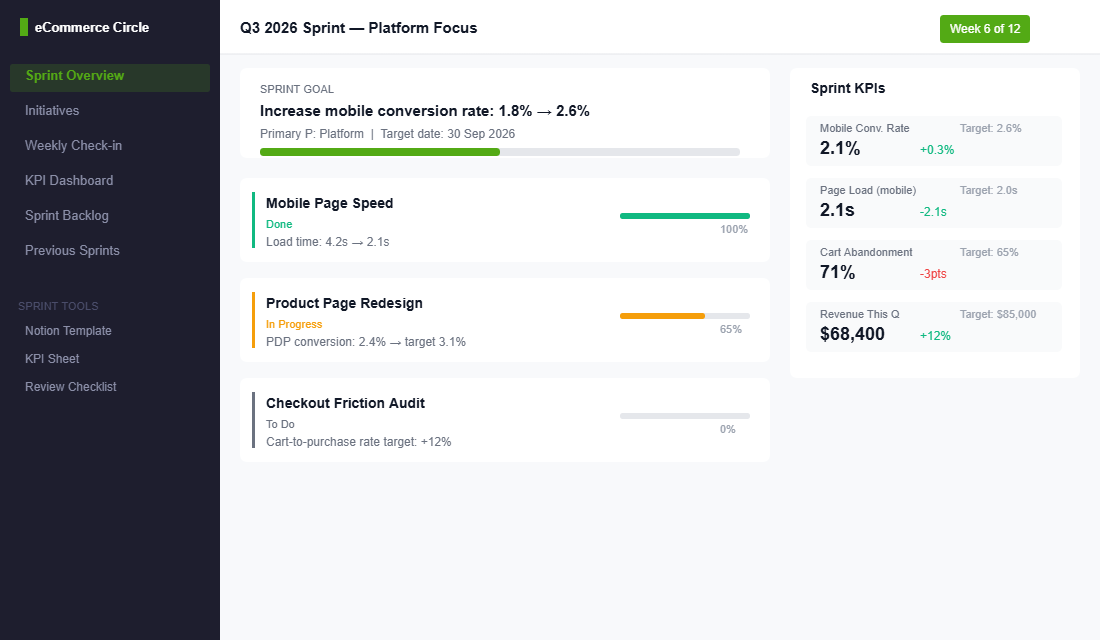
Three to five initiatives: These are the specific projects that will move the needle on your chosen P. If you picked Platform, your initiatives might be: (1) get mobile load time under 2.5 seconds, (2) redesign your product page layout for mobile-first, (3) reduce checkout steps from four to two.
Weekly milestones: Break each initiative into weekly actions. Week 1 is audit and benchmark. Weeks 2 through 6 are implementation. Weeks 7 through 11 are testing and refinement. Week 12 is the sprint review and documentation. This structure turns a 90-day goal into a manageable weekly rhythm.
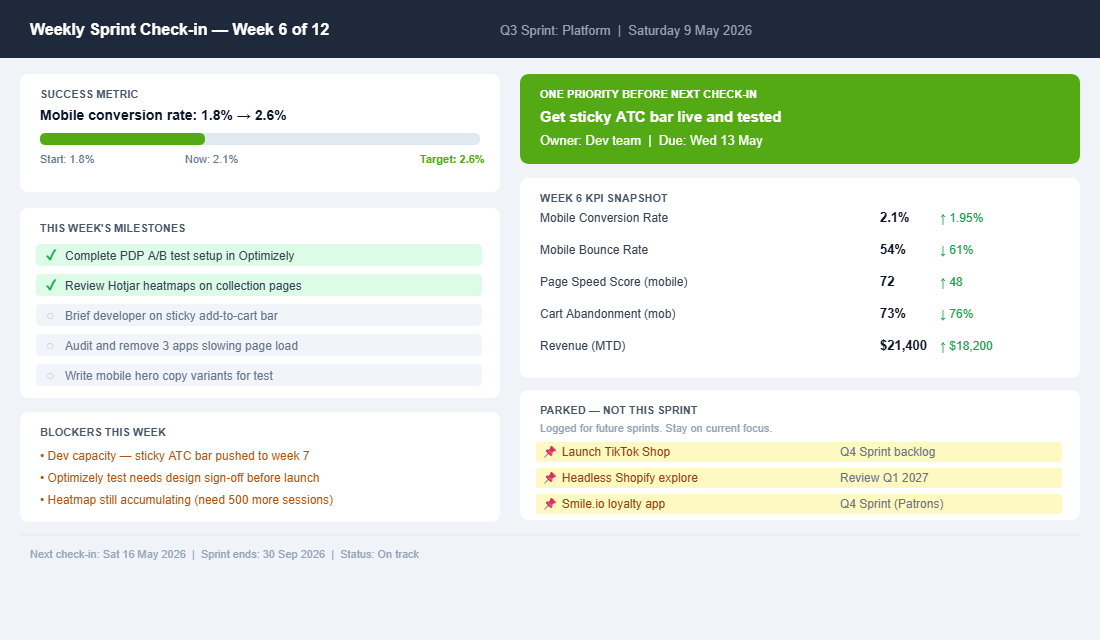
Your success metric: This is the single number you’re trying to move. If you picked Platform, your metric might be “increase mobile conversion rate from 1.8% to 2.6%.” If you picked Patrons, it might be “increase 60-day repeat purchase rate from 12% to 20%.” One metric. Not five.
A great sprint plan fits on one page. If it doesn’t, you’re doing too much.
The Tools to Run Your Sprint (Without Overcomplicating It)
You don’t need expensive software to run a 90-day sprint. Most high-performing operators we work with use one of three setups:
Option 1: Notion. Create a Sprint HQ page with your sprint goal, initiatives, weekly check-in template, and KPI dashboard. Notion’s flexible layout makes it easy to see everything in one place. The free tier handles everything you need.
Option 2: A Google Sheet. Column A is the week number. Column B is the initiative. Column C is the weekly task. Column D is the metric for that week. Simple, portable, visible to the whole team. This is the most underrated setup — the simplicity keeps you honest.
Option 3: Trello. Set up a board with four columns: To Do, In Progress, Done, and Blocked. One card per initiative. Move them as you execute. Pin your success metric to the board header so it’s visible every time you open it.
The tool matters less than the habit. What makes sprint planning work is a weekly 20-minute check-in where you review progress, update your tracking, and identify what’s blocked. If you have a team — even a VA or a part-time contractor — run this check-in with them. The accountability effect alone drives an extra 10 to 15% execution rate compared to solo planning.
Sprint Accountability: The Weekly Check-in That Makes It Stick
The biggest killer of quarterly plans is mid-sprint drift. You start strong, get distracted by a new ads strategy in week five, and by week eight you’ve completely abandoned the original focus.
The antidote is a weekly 20-minute Sprint Check-in. Here’s the format that works:
- Review your success metric: Where is it today versus where it needs to be by week 12?
- What got done this week against your weekly milestone?
- What didn’t get done, and what was the specific blocker?
- What’s the single action to complete before next week’s check-in?
This is not a strategy session. It’s a progress check. Keep it tight. The moment it becomes a two-hour brainstorm, it stops working.
Shiny object syndrome is real and it peaks around weeks five through eight. Every operator hits a point mid-sprint where something new arrives — a new channel, a competitor’s strategy, a podcast recommendation — and the temptation to pivot is strong. The rule is simple: note it in your Shiny Object Log, and stay on the current sprint. Nothing gets added to this quarter’s plan without removing something else.
The Compound Effect: What Four Disciplined Sprints Looks Like
Here’s what the maths looks like when you run four focused 90-day sprints across a year:
- Sprint 1 (Q3): Platform. Mobile conversion rate goes from 1.8% to 2.6%. Revenue lifts 15 to 20% with the same ad spend and the same traffic.
- Sprint 2 (Q4): Patrons. Repeat purchase rate goes from 10% to 18% with a proper post-purchase email sequence. Revenue from existing customers nearly doubles.
- Sprint 3 (Q1): Promotion. Launch a second acquisition channel — Google Shopping — that brings in an extra 20% of revenue at a lower cost per acquisition than Meta.
- Sprint 4 (Q2): Profit. Contribution margin per order lifts from $18 to $26 by renegotiating COGS and adjusting the free shipping threshold. Every existing order becomes more profitable.
None of these improvements are dramatic in isolation. But compounded across four quarters, you’re looking at a business generating 50 to 70% more revenue with the same core team and the same traffic. That’s the power of the sprint system.
The critical insight is that each sprint’s gains don’t disappear when the next one starts. A better-converting mobile experience stays better. A post-purchase sequence keeps working while you’re building the next thing. Each sprint builds on the last, which is why founders who stick to the system for a full year consistently report results that surprise even them.
The Sprint Review: How to Close the Loop
The last week of your sprint is review week. Don’t skip this. It’s the most underrated part of the whole system and the step most operators cut when things get busy.
Block two hours in week 12 to answer four questions:
- Did we hit our success metric? By how much, or by how little?
- What were the one or two decisions that had the biggest positive impact this quarter?
- What would we do differently if we ran this same sprint again?
- Based on today’s P scores, what’s the focus for the next sprint?
Document this in your sprint HQ. Over time, this becomes your business playbook: a record of what worked, what didn’t, and how you’ve improved across each pillar. By year two, it’s an extraordinary document. You can see your own growth pattern and start to predict which P will need attention next.
The review also resets your energy. Finishing a sprint — even if you didn’t fully hit the metric — is energising. You’ve moved the business forward intentionally. That’s worth acknowledging before you start the next one.
Your 90-Day Sprint Quick-Start Template
Use this framework to plan your next quarter. Copy it into Notion, a Google Doc, or print it out:
- Sprint period: [Start date] to [End date — 90 days]
- Primary P focus: [The P you scored lowest with highest revenue impact]
- Success metric: [The one number you’re moving — current value → target value]
- Initiative 1: [Project + owner + weekly milestone]
- Initiative 2: [Project + owner + weekly milestone]
- Initiative 3: [Project + owner + weekly milestone]
- Weekly check-in: [Day + time — recurring, non-negotiable]
- Sprint review date: [Week 12 — two hours blocked]
- Shiny Object Log: [Running list of ideas parked for future sprints]
Most Shopify stores are not short on tactics. They’re short on focus and follow-through. The 90-day sprint is how you fix both.
Pick your lowest-scoring P. Build a one-page plan. Run the weekly check-in. Review at week 12. Repeat four times. That’s the whole system.
When the Sprint Goes Sideways at Week 6: The Mid-Sprint Correction
Roughly half of all 90-day sprints hit trouble somewhere around week five or six. The novelty has worn off, the easy tasks are done, and the hard one is still sitting there. This is the moment most founders quietly abandon the plan and go back to firefighting.
Don’t abandon it. Diagnose it. There are only three reasons a sprint stalls, and each has a different fix.
- Capacity problem. The work is right, you just don’t have the hours. Symptom: the same task rolls over three weeks running. Fix: cut sprint scope by a third and finish what’s left. A half-finished sprint delivers zero. A two-thirds sprint delivered fully compounds.
- Diagnosis problem. You picked the wrong P. Symptom: you’re shipping the work but the metric hasn’t moved at all by week six. Fix: re-run the pre-sprint audit with fresh data. If conversion rate is flat after five product page changes, the bottleneck was never the page – it was traffic quality.
- Clarity problem. Nobody knows what “done” looks like. Symptom: lots of activity, no completed items. Fix: rewrite every open task so it has a verb, an owner and a date. “Improve the welcome flow” is not a task. “Rewrite email 2 with the founder story, live by 5 Sept, owner: Sarah” is.
Here’s the honest benchmark: a healthy sprint completes 70 to 80% of planned items. If you’re consistently landing above 95%, you’re not being ambitious enough. Below 50% and you’re planning fiction, not strategy. Track your completion rate across four sprints and you’ll quickly learn your real capacity, which is usually about 60% of what you think it is.
The Two Numbers That Tell You a Sprint Actually Worked
Completion rate tells you whether you executed. It doesn’t tell you whether it mattered. For that you need a leading and a lagging metric, chosen before the sprint starts and not changed halfway through.
The leading metric moves within two to three weeks and tells you the work is landing. The lagging metric moves at week ten to twelve and tells you it paid. If you’re running a Patrons sprint on repeat purchase, your leading metric might be flow open and click rate in Klaviyo, and your lagging metric is 90-day repeat purchase rate – which sits around 20 to 30% for a healthy Aussie DTC brand. Run a Promotion sprint and the leading metric is ad click-through rate, the lagging one is blended MER.
Write both numbers at the top of the one-page plan with the date you measured them. Screenshot the baseline in GA4 or your Shopify analytics on day one. Founders routinely forget where they started and end up arguing about whether a sprint worked instead of reading the answer off a chart. If you’re not confident the baseline is trustworthy, fix your tracking first with the GA4 setup guide – a sprint measured on bad data is worse than no sprint at all, because it teaches you the wrong lesson for the next quarter.
Inside eCommerce Circle, the 90-day sprint framework is one of the core tools we work through with every member. If you want a second opinion on your current P scores and which sprint to run first, let’s talk.