Why Most Ecommerce Brands Need a Marketing Calendar (And Don’t Have One)
Here’s a pattern that plays out in ecommerce stores every single year: a sale event sneaks up, the team scrambles to throw together some discount codes and a quick email blast, and the promotion underperforms. Sound familiar?
What’s in This Article
Most store owners run their marketing reactively. They see competitors launching a sale, panic, and rush something out the door. The result? Sloppy creative, thin margins, and email lists that get trained to ignore you until the next desperate discount.
The brands that consistently hit their revenue targets do the opposite. They plan their entire year in advance – mapping out every campaign, promotion, content push, and channel activation on a single calendar. BCG research found that 30-40% of retail promotions are either inefficient or unprofitable, largely because they’re reactive rather than strategic. A marketing calendar fixes that by forcing you to think about the “why” before the “what.”
A marketing calendar does three things that reactive marketing can’t. First, it gives your team clarity – everyone knows what’s happening and when. Second, it protects your margins by spacing out promotions strategically. Third, it compounds your results because each campaign builds on the one before it.
Businesses that plan their seasonal strategy 8-12 weeks ahead capture significantly more organic traffic during peak periods compared to those who wait until the event is imminent.
Step 1: Map Your Annual Revenue Peaks
Before you fill in a single campaign, you need to understand your store’s natural rhythm. Pull your last 12 months of sales data from Shopify Analytics or GA4. US Census data shows e-commerce sales in Q4 2025 hit $365.2 billion, a 21.8% jump from Q3. Your store likely follows a similar seasonal pattern.
Identify three tiers: Tier 1 Peak months (40-50% of budget), Tier 2 Growth months (30-35%), and Tier 3 Foundation months (15-25%).
Step 2: Plot the Key Australian Retail Dates
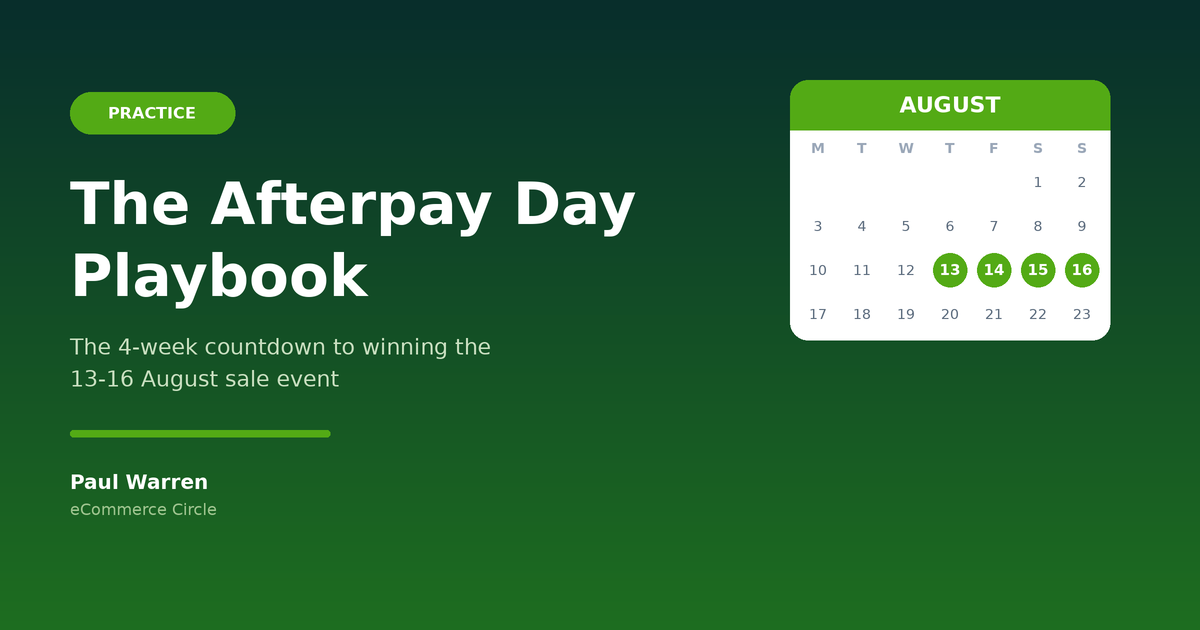
Key 2026 dates: Afterpay Day (March & August), Easter (April 5-6), Mother’s Day (May 10), Click Frenzy Mayhem (May 13-16), EOFY (June 1-30), Father’s Day (September 6), BFCM (November 27-30), Boxing Day (December 26).
For each date, work backwards: creative 3 weeks out, emails built 2 weeks out, ads in review 10 days out, landing pages 1 week out.
Step 3: Layer in Your Always-On Content Rhythm
Weekly rhythm: 1-2 emails, 3-5 social posts, 1 blog post, 1 SMS per fortnight.
Step 4: Build Your Campaign Briefs
Seven-question brief framework: Objective, Offer, Audience, Channels, Creative, Timeline, Success Metrics.
Step 5: Use the Right Tools
Google Sheets for solo operators, Notion/Asana for growing teams, Klaviyo Campaign Calendar for email-heavy brands.
Step 6: Run Monthly Reviews
60-minute monthly review: Last month’s results, this month’s plan, next month’s prep, calendar adjustments.
The Calendar Effect
With 62% of online shoppers conditioned to wait for discounts, having a calendar that spaces promotions strategically is the single biggest thing you can do to protect margins while growing revenue.
Quick-Start Template
Columns: Date, Campaign Name, Type, Channel, Offer/Angle, Status, Result. Fill in retail dates, weekly content rhythm, and next 3 campaign briefs today.
The Australian Retail Calendar: The 12 Dates That Move the Most Revenue
A calendar built on the US retail year will quietly cost you money. Aussie buying behaviour runs on its own rhythm, and your seasons are flipped. Build your year around the dates that actually shift revenue here.
- January: New Year reset and Australia Day (26 Jan). Strong for health, fitness, and homewares.
- February: Valentine’s Day, plus back to school and back to work spending.
- March: Afterpay Day, one of the biggest BNPL sale events in the country.
- May: Mother’s Day (second Sunday). One of the top three gifting weeks for most Aussie stores.
- June: EOFY. End of financial year clearance runs the whole month and peaks at 30 June. Business buyers spend before the books close.
- September: Father’s Day in Australia (first Sunday), not June like the US. Get this date right.
- November: Click Frenzy, then Black Friday and Cyber Monday. The single biggest revenue window of the year.
- December: Christmas, then the Boxing Day sales that run through to mid January.
BFCM alone now drives a meaningful share of annual sales for most Aussie DTC brands, often 15 to 25% of yearly revenue compressed into one week. If you walk into November without a plan, you are improvising on your most important trading days. Map these dates first, then build everything else around them.
The 6-Week Campaign Runway: How Far Ahead to Plan Each Promotion
A date on a calendar is not a plan. Every major promotion needs a runway, and the brands that win on BFCM started building it in September. Here is the runway that keeps you out of the last-minute scramble.
- Week 6 to 5 out: Lock the offer, the margin maths, and the hero products. Brief creative and photography.
- Week 4 to 3 out: Build landing pages, email and SMS flows, and ad creative. Set up tracking so you can measure each channel.
- Week 2 out: Warm the list. Tease the event, grow your VIP segment, and build an early-access waitlist.
- Week of: Launch, then watch the data daily and adjust spend toward what is working.
- Week after: Run the post-sale flow, win back non-buyers, and write the debrief while it is fresh.
Creative is almost always the bottleneck. A single hero video plus a set of static ads can take two to three weeks once you factor in shoots, edits, and approvals. Plan backwards from the launch date, not forwards from today. Pair your campaign pages with proven conversion tactics from our urgency and scarcity playbook so the traffic you drive actually converts.
Promotional Cadence: How Often to Discount Without Training Buyers to Wait
Here is the trap most stores fall into. They discount so often that customers learn to never pay full price. Once your list is trained to wait for the next sale, your margin is gone and your full-price weeks die.
A healthy cadence for most Aussie DTC brands is four to six major promotional events per year, not twelve. Between those events, you protect full price and sell on value, not on discount. If every second email is a percentage off, you have a pricing problem dressed up as a marketing strategy.
Track two numbers to keep yourself honest: the share of revenue that comes from discounted orders, and your blended gross margin across the quarter. If discounted revenue creeps above 40% of the total, you are leaning on price too hard. Use your calendar to schedule deliberate full-price content pushes, product launches, and education between the sale events so the quiet weeks still pull their weight.
The Tools That Run Your Calendar
You do not need a fancy stack to run a marketing calendar, but the right tools make it repeatable. Here is a setup that works for a lean team.
- Notion or Asana: The master calendar and campaign briefs. One source of truth the whole team works from.
- Google Sheets: The promotional plan with offer, margin, target revenue, and owner for each event.
- Klaviyo: Email and SMS campaign scheduling, plus the segments you warm before each event.
- Shopify: Discount codes, automatic discounts, and scheduled publishing of collections and landing pages.
- Triple Whale or the Shopify analytics dashboard: Daily revenue and channel tracking during live events. Get your data house in order first with our GA4 setup guide.
A Worked Example: Mapping Q3 for an Aussie Skincare Brand
Imagine you run a skincare brand doing 80k AUD a month. Your Q3 (July to September) calendar might look like this. It is not a wall of discounts. It is a mix of full-price pushes and two deliberate sale moments.
- July: Post-EOFY recovery. A new product launch at full price, supported by education content and a refreshed welcome flow for new subscribers.
- August: A loyalty and review push. No sitewide discount. You drive repeat orders with a points bonus and collect user content with a reviews campaign.
- September: Father’s Day gifting (first Sunday). A curated gift edit, bundles, and a 72-hour early-access window for your VIP segment built from retargeting audiences.
That single quarter has two revenue events, one launch, one retention play, and zero panic. When you can see the whole quarter on one page, you stop reacting to competitors and start running your own race. That is the entire point of a calendar: it turns marketing from a monthly scramble into a system you can forecast against.
The Annual Planning Session: How to Build Next Year’s Calendar in One Afternoon
You do not need a week-long offsite to build a calendar. You need a focused half day, last year’s numbers, and a blank twelve-month grid. Here is the session that gets it done.
- Step 1 (30 min): Pull last year’s monthly revenue. Mark your three best and three worst months. Patterns jump out fast.
- Step 2 (30 min): Drop the fixed dates onto the grid first: EOFY, BFCM, Mother’s Day, Father’s Day, Boxing Day. These never move.
- Step 3 (45 min): Add your own moments: product launches, brand birthday, a winter or summer edit, a loyalty push. Aim for four to six revenue events total.
- Step 4 (30 min): Set a rough revenue target for each event and each quiet month. Now you have a number to plan against.
- Step 5 (15 min): Assign an owner to every campaign. A calendar with no owners is a wish list.
Revisit the grid at the start of each quarter, not each month. Quarterly check-ins let you adjust for what the market is doing without throwing the whole plan out. The goal is a living document, not a stone tablet.
The Three Calendar Mistakes That Quietly Cost You Sales
Even brands that build a calendar leave money on the table by making the same three mistakes. Watch for these.
- Planning the sale but not the warm-up. The two weeks before an event matter more than the event itself. If you are not growing your VIP segment and teasing the offer early, you launch to a cold list and wonder why day one is flat.
- No plan for the quiet months. The weeks between sales are where brand and margin are built. Fill them with education, launches, and retention plays, not silence.
- Skipping the debrief. The hour after a campaign is the most valuable hour of the whole event. Write down what the offer did, what the open and conversion rates were, and what you would change. Next year’s calendar should be built on this year’s data, not last year’s guesses.
Get these three right and an average calendar starts to outperform a brilliant one that nobody warms up for or learns from. Consistency beats cleverness here. A simple calendar you actually run will always beat a sophisticated one that lives in someone’s head.
Inside the eCommerce Circle, campaign planning is one of the core pillars we work on with every member. Let’s talk.
Inside eCommerce Circle, a sharp marketing calendar is one of the core pillars we work on with every member. If you want a second opinion on yours, let’s talk.