Most Aussie Shopify founders hire their first marketing manager 12 months too late and pay a $40,000 lesson for the privilege. The signs were there. Ads were drifting north of a 4x ROAS target into the 2s. Email was sending the same three flows it had for two years. The Klaviyo dashboard had a “Welcome Series” from 2023 still pumping out a 7% click rate while the founder was up at midnight rewriting subject lines.
What’s in This Article
The other half hire too early. They drop $95k plus super on a “Head of Marketing” before their store is doing $80k a month, hand them a P&L with no margin for experiments, and wonder why the relationship implodes inside 90 days. Either move is a brand killer. The marketing manager hire is one of the highest-impact decisions you will make between $1m and $5m, and it is one of the most consistently botched.
After working with hundreds of Aussie Shopify founders through the hiring cycle, the pattern is stark: the founders who get this right are not the ones who pay the most or hunt the fanciest LinkedIn pedigree. They are the ones who decide what the role actually is, hire to a specific stage of the business, and run a structured onboarding that gets the new hire making revenue decisions inside 60 days. This article is the 5-stage roadmap we use to make that happen. It is the companion piece to The Operations Manager Hire, and it follows the same structure: clear triggers, defined archetypes, exact compensation, real interview questions, and a 90-day plan.
Stage 1: The 4 Signals You Are Not Ready Yet
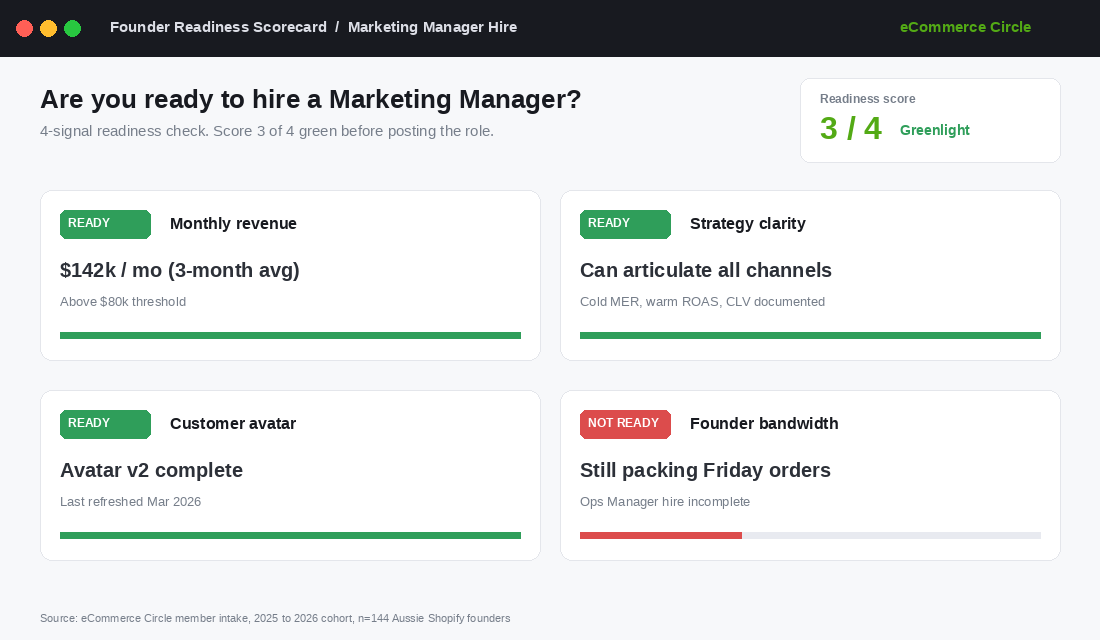
Before we talk about the right time, let’s kill the wrong time. Hiring a marketing manager when you are not ready is the fastest way to torch $60k to $120k of runway and end up further behind than where you started. There are four hard signals that mean wait.
- You are doing under $80k a month in revenue. Below this threshold there is not enough margin to fund a $95k AUD salary plus the budget that hire needs to actually do their job. You are better off hiring a great media buyer on retainer for $3.5k a month and a Klaviyo specialist for $1.5k a month. That combo costs you $60k a year and gives you specialists where it counts.
- You cannot articulate what is and is not working. If you cannot tell a candidate “our cold Meta is doing 1.4x ROAS but warm is 5.2x, our welcome flow is converting at 4%, and our SMS list is dead”, you are not ready to manage a marketing manager. They will ask. And if you cannot answer, they will either invent a strategy that is wrong or do whatever they did at their last job.
- You have not finished your customer avatar. Marketing managers convert strategy into execution. If there is no clear strategy on who you sell to, why they buy, and what makes you different, you are hiring someone to operate a machine that does not exist. The avatar work needs to be 80% done before the role gets advertised.
- You are still hands-on in product and ops. If you are also packing orders, talking to suppliers in China at 11pm, and writing PDP copy, a marketing manager is not the right next hire. The Operations Manager comes first. Get the back of the house running on autopilot, then bring marketing in-house. The order matters.
If you are nodding at two or more of these, close this tab and bookmark it for six months from now. The discipline of waiting is the discipline that protects your hire.
Stage 2: The 5 Signals You Are Ready Now
The right time to hire is when the cost of you doing marketing yourself exceeds the cost of paying someone else to do it better. That sounds obvious. In practice almost every founder we work with crosses this line and keeps doing it themselves for another six months out of habit. Here are the five signals that the math has tipped.
- You are doing $120k to $400k AUD a month consistently for at least three months. This is the sweet spot. Below $120k the salary swallows your margin. Above $400k you should already have one in seat, and if you don’t, the urgency is severe. The brand-new hire needs revenue to work with, and you need the cash flow to absorb 90 days of ramp.
- You are spending 25+ hours a week on marketing tasks. Track it for a fortnight. Ad management, briefs to designers, email writing, content planning, agency calls, analytics. If the number is north of 25 hours and you are the CEO, your hourly rate is being burned on $50 work. The hire pays for itself in your time alone.
- Your ROAS is flat or declining at the same spend. The most common trigger. You hit a ceiling on what one person juggling everything can squeeze out of the channel mix. A dedicated marketing manager opens up the next layer: better creative testing cadence, proper post-purchase journeys, owned-channel diversification.
- You have one untapped channel you know is leaving money on the table. Could be SMS. Could be organic TikTok. Could be a content engine. You have not built it because you do not have the hours. A marketing manager makes that channel happen inside 90 days.
- You can fund a $30k experiment budget on top of the salary. This is the one most founders miss. The salary is not the whole cost. A marketing manager needs $20k to $40k a year to test new ad creative, try a new platform, run a giveaway, or commission a content shoot. Without it they become an executor of your existing strategy with no upside.
Hit four of five and the hiring brief gets written this week. Hit five of five and you are already late.
Stage 3: The 5 Marketing Manager Archetypes (Pick One, Not All)
This is where most founders blow up the hire. They write a job description for a “marketing manager” and list every single marketing skill they can think of. Paid ads. Email and SMS. Influencer. SEO. Content. Brand. Analytics. Photography direction. Reporting. The role becomes a Frankenstein mix of every junior, mid, and senior marketer the founder has ever met, and the salary on offer is enough for exactly one of them.
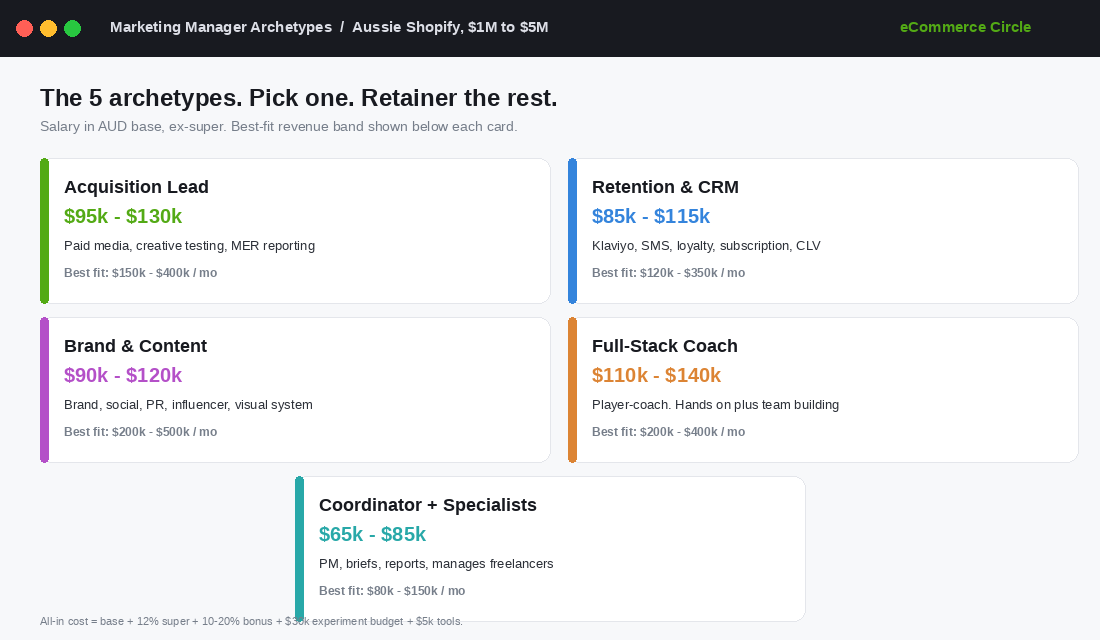
The fix is to pick an archetype. Each archetype carries a defined skill load and a defined budget. You hire one and outsource everything else to specialists or your agency. Here are the five archetypes that work for Aussie Shopify brands in the $1m to $5m band.
- 1. The Acquisition Lead. Owns paid media (Meta, Google, TikTok), works with your agency or in-houses the channel, runs the creative testing pipeline, reports on MER and contribution margin weekly. Pairs with an external Klaviyo specialist on retention. AUD $95k to $130k. Best for brands where 70%+ of new revenue is paid and the founder is the bottleneck on creative briefs.
- 2. The Retention & CRM Manager. Owns email, SMS, loyalty, subscription, post-purchase. Lives inside Klaviyo, your loyalty platform, your subscription app, and your CRM segments. Pairs with an external paid media agency. AUD $85k to $115k. Best for brands with strong paid efficiency but flat repeat rate and a CLV problem.
- 3. The Brand & Content Marketer. Owns brand voice, content strategy, social, PR, influencer, and the visual system. Drives the demand-gen layer that paid converts. Pairs with a paid agency and a CRM freelancer. AUD $90k to $120k. Best for brands competing in saturated categories (skincare, supplements, apparel) where brand is the moat.
- 4. The Full-Stack Player-Coach. Mid-senior generalist who can hands-on-keyboard execute across all channels but is also briefing freelancers and running the marketing budget like a CEO. AUD $110k to $140k. Best for brands at $200k to $350k a month doing $2m to $4m a year. The hardest archetype to find because the talent pool is thin, but the highest-impact hire when you find one.
- 5. The Marketing Coordinator (Plus Specialists). Junior to mid coordinator who owns project management, briefs, reporting, and the marketing calendar. Sits beneath you and above your specialists/agencies. AUD $65k to $85k. Best for founders who do not want to give up strategic control but desperately need execution muscle. The most common “right” first hire for brands at $80k to $150k a month.
The discipline is to commit to one and run the others as paid retainers. The minute you try to hire all five in one body you will pay $130k for a senior who turns out to be excellent at paid and average at brand, and you will resent them for not being good at the thing they were never going to be good at.
Stage 4: The Compensation Framework (Aussie 2026 Numbers)
Pay is where founders get cute, and cute usually costs you. The Aussie ecommerce marketing talent market in 2026 is competitive. Good people have multiple offers. Below-market gets you below-market candidates, and you will replay this hire inside 18 months. Here is the framework we use.
- Base salary. Use the archetype ranges above as your guide. Add 12% super on top (mandatory from July 2025 onwards). For Sydney and Melbourne, sit in the upper half of the range. For Brisbane, Adelaide, Perth, or remote, the middle is fine. Going below the median to “see if we can get someone hungry” is a strategy that costs you when they take a counter-offer four months in.
- Performance bonus. 10 to 20% of base, paid quarterly, tied to two metrics. The most common pair: a contribution margin target and a marketing-driven new customer count. Avoid bonuses tied to vanity metrics like impressions, reach, or follower count. The bonus exists to align the hire with profit, not activity.
- Equity or revenue share. Optional, but for senior hires (the Full-Stack Player-Coach and the Brand Marketer specifically) a small revenue share (0.5% to 1.5% of net new revenue above a baseline) can turn an employee into a co-conspirator. Discuss with your accountant. Aussie taxes on equity are nuanced, and getting this wrong creates problems.
- The marketing budget they control. Define this in the offer letter. Most founders forget. The marketing manager needs a defined monthly experiment budget (start with $3k to $6k AUD/month) that they can deploy without asking. Without a budget of their own, they become an executor of your strategy, not the owner of theirs.
- The tools and stack. They will want a say in this. Klaviyo, Shopify analytics, Triple Whale or Northbeam, Motion, Asana or Notion, a Loom or Tella account. Budget $400 to $700 AUD per month for the marketing tool stack. Cheap to operate, expensive to be without.
Total all-in cost for a mid-archetype hire (say a Retention Manager at $95k base): $95k base + $11.4k super + $14k bonus pool + $36k experiment budget + $6k tool stack = $162.4k. That is the real number. Founders who plan for the base and forget the rest end up at month four with a marketing manager who cannot do their job because the budget is not approved. Plan the whole stack on day one.
Stage 5: The 4-Stage Interview Process That Actually Works
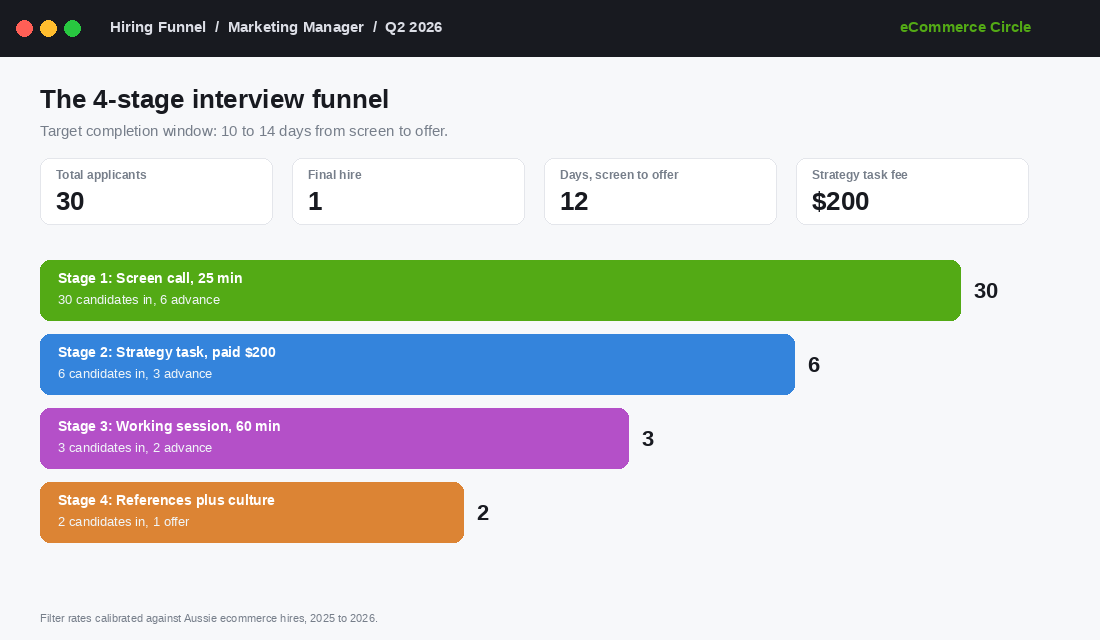
The hiring process for a marketing manager is not the hiring process for a VA. You are buying judgment, not output. The interview must test judgment under realistic constraints, not pattern-match against a CV. Here is the four-stage process we run.
- Stage 1: Screen call (25 minutes). You or a hiring manager. Three questions. Walk me through your last role and the three numbers you moved most. What is your favourite Aussie DTC brand right now and why? If our cold Meta ROAS was 1.6x at $40k a month spend, what are the first three things you would check? You are filtering for specificity, brand fluency, and analytical instinct in under half an hour.
- Stage 2: Strategy task (90 minutes of their time, paid). Send them your real store, real analytics screenshots (anonymise revenue if you must), and ask them to write a 1-page 90-day marketing plan. Pay them $200 AUD for the task. The pay is non-negotiable. It signals professionalism, weeds out the time-wasters, and respects their time. The output reveals more than any interview will.
- Stage 3: Working session (60 minutes, live). Walk through their plan together. Push back on three of their recommendations. Watch how they handle the pushback. Do they fold? Do they get defensive? Do they hold their ground with evidence? You are hiring an adult who will disagree with you. This stage tells you whether they will.
- Stage 4: Reference and culture call. Two references, both former managers if possible. One specific question per call: “Would you hire them again, and if not, what would you do differently?” That single question collapses most of the BS reference theatre into one honest answer. Pair with one founder-led culture call where you walk them through the operating rhythm, the tools, and the team. They are choosing you as much as you are choosing them.
The whole process from screen to offer should take 10 to 14 days. Drag it longer than three weeks and you will lose your top candidate to a competitor. Aussie ecommerce hires move fast in 2026, and good marketers know it.
The 90-Day Onboarding Plan
The single biggest predictor of whether a marketing manager hire works is what happens in the first 90 days. Onboard poorly and even an A-player turns into a B-player. Onboard well and a B-player gets dragged up to A-level performance by the system you put around them. Here is the 30-60-90 we use.
- Days 1 to 30: Audit and understand. No new campaigns. No big changes to the ad account. The job is to learn the brand, the customer, the numbers, and the stack. Deliverable at day 30 is a written audit covering customer avatar review, brand voice notes, channel performance teardown, and three “quick wins” plus three “structural fixes” they have identified. No revenue target yet. The KPI is depth of understanding.
- Days 31 to 60: Quick wins and rebuild. Ship the three quick wins. Start rebuilding one structural fix (most often the welcome flow, the BFCM plan, or the creative testing pipeline). Get into the weekly operating rhythm with the founder and the broader team. Take ownership of one weekly KPI report. Revenue target is “do not break what is working”. Focus is execution velocity.
- Days 61 to 90: Strategy ownership. The marketing manager presents the next-quarter marketing plan to the founder, with specific channel-by-channel targets, an experiment portfolio, and a budget request. From day 90 onwards, the founder reviews and approves the plan but does not write it. This is the handover moment. If the founder is still writing the plan at day 120, the hire is not working.
Anchor the 90-day with a weekly 60-minute 1:1, a fortnightly creative review, and a monthly P&L check-in. The cadence is everything. Marketing managers who go silent for three weeks at a time are not being held accountable. The 1:1 fixes that.
The Compound Effect: Why This Hire Multiplies Everything Else
Done well, the marketing manager hire compounds in three directions at once, and that compound is what most founders miss when they look only at the salary line.
The first compound is on revenue. A focused marketing manager owning a single archetype typically lifts blended marketing efficiency 15 to 25% inside six months by tightening creative testing cadence, fixing leaky retention flows, and killing the underperforming experiments faster. On a $3m business that is $450k to $750k of incremental revenue annually, against an all-in cost of $160k. The ROI is not subtle.
The second compound is on your time. A founder who reclaims 25 hours a week by handing off marketing reinvests those hours into product, partnerships, hiring, and CEO-level work that nobody else can do. That time arbitrage is invisible on the P&L for the first two quarters and then shows up in product margin, new SKU launches, and stronger supplier terms. Founders who track this carefully report the time recapture is worth more than the revenue lift.
The third compound is on the team. A marketing manager in seat changes the gravity of the business. You can now hire a marketing coordinator beneath them. You can ask your agency to up-level their work because there is a sophisticated buyer in the seat. You can run real experiments that need someone with the focus to design and read them. The next three hires get easier because the foundation is set. This is the part of the More Orders Operating System that lives inside the People pillar, one of the 10 P’s: the right person in the right seat at the right time is the catalyst for the next chapter of growth.
The Founder’s Final Checklist Before You Post the Role
Print this. Pin it next to your desk. Do not advertise the role until every box is ticked.
- Revenue check. Three consecutive months at $120k AUD+, or the equivalent contribution margin to fund the all-in cost.
- Archetype decision. Acquisition, Retention, Brand, Full-Stack, or Coordinator. Picked, written down, defended in one paragraph.
- Compensation envelope. Base, super, bonus, experiment budget, and tool stack all approved and modelled into the next 12 months of cash flow.
- Strategy task brief ready. The take-home task is written, the $200 paid honorarium is set up, the analytics screenshots are anonymised and saved.
- Onboarding plan drafted. The 30-60-90 is written. Not perfect, just written. Day-1 calendar invites are templated for the first fortnight.
- Operating rhythm scheduled. The weekly 1:1, the fortnightly creative review, the monthly P&L check-in are blocked in the calendar before the offer goes out.
- The “no” muscle. You are mentally prepared to wait an extra two weeks for the right hire rather than settle for the available one.
Inside eCommerce Circle, the marketing manager hire is one of the core conversations we run with every member crossing the $1m mark. Most founders walk in thinking the problem is “who should I hire”, and walk out understanding the problem was “what am I actually hiring for”. If you want a second opinion on yours before you write the JD, let’s talk.
