Most Aussie Shopify founders treat wholesale like it belongs to a different kind of brand. The big legacy labels. The ones with sales reps and trade shows and warehouses full of pallet wrap. Not us. We are the DTC crowd. We run ads, build email lists, optimise PDPs, and chase ROAS.
What’s in This Article
That mindset is leaving real money on the table. Shopify saw 96% B2B GMV growth in 2025. Merchants using its native B2B features have seen up to a 33% lift in self-serve orders within six months and a 20% lift in reorder frequency. Aussie brand TileCloud reported a 24% surge in new wholesale signups and a 34% jump in average order value in their first year on a dedicated Shopify B2B store. And outdoor brand DARCHE anticipated a 3x year-on-year B2B sales increase after moving onto Shopify Plus.
This is not a story about adding a marketplace. It is a story about adding a second revenue stream that quietly outperforms your ad account, costs almost nothing to acquire, and gets stronger the longer you run it. Inside eCommerce Circle we have watched founders go from “wholesale is for someone else” to wholesale producing 20 to 40% of total revenue inside 18 months. Here is the 5-stage playbook they use.
Why Most Aussie DTC Brands Walk Past the Wholesale Opportunity
The default founder objection sounds reasonable. “Our margins are not built for wholesale.” “I do not want to commoditise the brand.” “I am not running a B2B sales team.” Each is valid in isolation. None of them survive contact with the actual numbers.
Look at what your DTC channel actually costs you. By the time you have paid Meta, Google, the freight carrier, the returns processor, the 3PL pick fee, the Klaviyo subscription, the influencer gifting, the agency retainer, and the Shopify transaction fee, your contribution margin on a $90 order is usually somewhere between 25 and 38%. A wholesale order at 50% off retail with no acquisition cost, no returns, and 12 to 30 units per drop often delivers a higher absolute contribution dollar amount per order than DTC, even at half the gross margin.
The other thing founders miss is the compounding nature of wholesale. A new DTC customer is a one-shot bet. A new stockist is an annuity. Once a boutique buyer trusts your brand and your fill rate, they reorder on a 6 to 12 week cadence. Shopify’s own data shows up to a 20% reorder frequency lift for merchants using B2B features. That is not a campaign. That is recurring revenue.
And the third thing they miss is brand distribution as marketing. A great Aussie boutique stocking your candle, your sock, your hat, your wine puts your brand in front of new customers every single day at zero variable cost. Business & Pleasure Co. built a wholesale relationship with West Elm before they ever opened a North American store. The shelf placement was the marketing.
Stage 1: The 5-Filter Wholesale Fit Test
Before you build anything, run your brand through five filters. If you fail three or more, wholesale will hurt your business instead of helping it. If you pass at least three, the rest of this playbook is for you.
- Filter 1: Gross margin floor. Your blended gross margin needs to be at least 65%. That gives you room to offer 50% off retail to stockists and still hold a healthy contribution margin. If you are sitting at 50% gross margin or below, fix the cost side first. Read our contribution margin audit before you touch wholesale.
- Filter 2: Repeat-purchase pattern. Wholesale works hardest for brands with consumable, replenishable, or collectable products. Candles, skincare, food, drinks, supplements, accessories, kids’ clothing, pet products. If you sell one $400 lifetime-use product, wholesale is a tougher fit.
- Filter 3: Inventory headroom. Wholesale forces you to hold deeper stock per SKU. If you are running 4-week cover today, you will need 8 to 12-week cover to service trade buyers without starving DTC. Look at the 8-week rolling cash flow forecast before you commit.
- Filter 4: Brand fit. If your product photography, packaging, and Instagram look like they belong in a curated boutique, wholesale buyers will say yes. If your brand reads as a discount-driven Meta ad business, retailers will quietly pass.
- Filter 5: Operational capacity. Can you fulfil a 40-unit order on 48-hour turnaround without breaking your DTC despatch? If the answer is “maybe”, wait one quarter, hire a 3PL, then come back.
Founders who skip this test usually end up with a small handful of unprofitable wholesale accounts, a bruised brand, and a strong opinion that wholesale “did not work”. The test is the work.
Stage 2: Pick the Right Channel Architecture (Without Building a Second Site)
The platform decision used to be painful. You either rebuilt your store as a B2B site, ran a janky password-protected wholesale section, or signed your soul over to a marketplace. None of that is necessary in 2026. You have four real options. Pick the one that matches your stage.
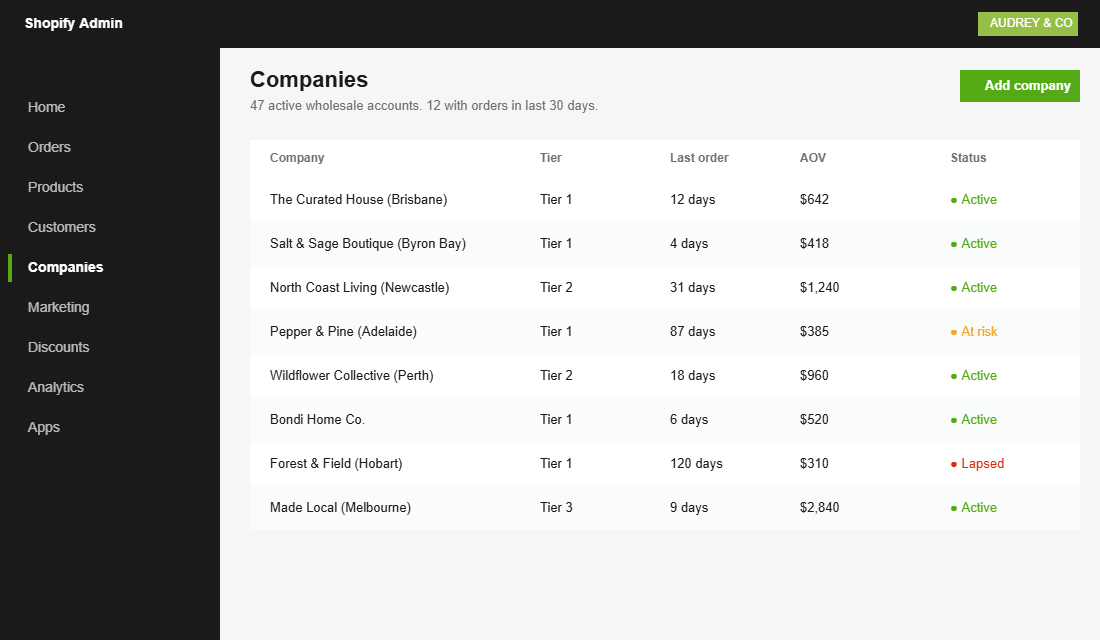
- Option A: Shopify Plus B2B (native). If you are on Plus, this is your default answer. B2B is built into the platform. You set up a “Company” record for each stockist, assign location-specific catalogues, pricing, payment terms (net 30, net 60), minimum order quantities, and volume discounts. You run B2B and DTC from the same admin, same product catalogue, same inventory pool. No second site. No double data entry.
- Option B: Wholesale app on standard Shopify. If you are not on Plus yet, apps like SparkLayer, Wholster, or Wholesale Gorilla layer trade pricing, tax-inclusive toggles, and tiered discounts onto your existing Shopify. SparkLayer pricing starts around $49 USD per month and scales with order volume. You will hit limits as you grow past 50 active stockists, but for the first 6 to 12 months it is the cheapest path in.
- Option C: Faire (or another marketplace). Faire is a discovery engine. It charges a 15% commission on orders from new retailers you find through the platform, dropping to 0% on reorders through Faire Direct. Useful if you have zero existing trade relationships and want exposure to over 100,000 independent retailers across the US, Canada, Australia, New Zealand, and Europe. Useful as an acquisition channel. Bad as a long-term home for your best accounts.
- Option D: JOOR (fashion only). If you are an apparel, footwear, or accessories brand and you want serious wholesale buyer reach, JOOR has over 14,000 brands and 650,000 buyers globally. Offices in Melbourne. This is a different price point and a different game. Optional for most.
The pattern smart Aussie brands run is a stack, not a single choice. They use Faire as the top-of-funnel discovery engine, then migrate established accounts to their Shopify B2B store as soon as a buyer has placed two reorders. Faire pays you net-3, but it takes 15% on net-new buyers forever unless they reorder through Faire Direct. Your Shopify B2B store gives you zero commission, full data ownership, branded checkout, and full pricing control.
Stage 3: Trade Pricing, Terms, and MOQs That Will Not Cannibalise DTC
This is where most founders quietly torch their margin. They copy the “RRP minus 50%” approach without thinking through the cascade. Then they discover their stockists are running 30%-off-RRP weekend sales that compete with their own DTC homepage. Build the pricing architecture properly the first time.
- Set RRP, not “Shopify price”. Your DTC site sells at recommended retail. Stockists sell at recommended retail. Wholesale price is the trade price they pay you, usually 50% off RRP for the standard tier. This protects every channel.
- Build a 3-tier wholesale price ladder. Tier 1 (small boutiques, 12 to 24 unit MOQ): 50% off RRP. Tier 2 (mid-size retailers, 50+ unit MOQ): 53% off RRP. Tier 3 (key accounts, container-level commitments): 57% off RRP. Volume discount is non-negotiable in trade, but it must be earned.
- Lock down resale policy. Your wholesale Terms & Conditions must include a Minimum Advertised Price (MAP) clause. Stockists cannot publicly advertise below RRP without your written approval, and cannot run promos that overlap your own published sale calendar. Soft enforcement: a single warning, then de-listing.
- Decide on payment terms before you launch. The default for new stockists in Australia is “pro-forma” (pay before despatch) for the first three orders. After three clean orders, you offer net 14 or net 30. Stretching to net 60 is for established department-store accounts only. If you read our 5-layer pricing architecture you already know how much your cash conversion cycle matters here.
- MOQ rules. Set a minimum opening order in dollars, not units. $400 ex-GST is a sensible first-order floor for most consumable categories. Reorder MOQ can drop to $250 to keep the buying cadence high.
One detail most founders forget: GST. In Australia, wholesale invoices are typically displayed ex-GST because most of your trade buyers are GST-registered businesses claiming the input credit. Your Shopify B2B catalogue or wholesale app must support tax-exclusive pricing on the trade channel and tax-inclusive on DTC. Get this wrong and you either lose 10% margin or scare buyers with confusing totals.

Stage 4: Find Your First 20 Stockists Without a Sales Team
You do not need a 6-figure BDR. You need a list, an outreach script, and a deliverable line sheet. Here is the system that works for sub-$5M Aussie brands.
- Build a 200-account target list. Use a spreadsheet, not a CRM (yet). For every account, capture: business name, contact name, email, Instagram, store type (gift, lifestyle, specialty, department), location, why they fit. Source from Instagram (search the brands your DTC customers tag), local “best gift shops in [suburb]” lists, and physical scouting trips through your top 3 nearest retail districts.
- Send a 3-touch outreach sequence. Email 1 (day 0): introduce the brand in three sentences, attach the line sheet, include one social-proof line (“Stocked at <3 known stores>”). Email 2 (day 4): one new piece of information, plus the line sheet again. Email 3 (day 11): a soft close. “Should I send a sample pack or close the file?” Reply rates on this exact sequence run 15 to 25% from cold for well-photographed brands.
- Send physical sample packs to high-priority replies. A small, branded box with 2 to 3 hero SKUs, a printed line sheet, your trade T&Cs, and a handwritten note. Cost: $35 to $60. Conversion to first order: 30 to 45% when the products are right.
- Use Faire as an inbound funnel. Set your Faire catalogue live with strong product photography and a clean “About” story. Aussie brands routinely report 4 to 15 new stockist inquiries per month in their first quarter on Faire. Migrate the best to direct after two reorders.
- Attend two trade events a year. Reed Gift Fairs (Sydney and Melbourne), Life Instyle, AGHA Gift Fair. Most Aussie giftware buyers literally write their annual order plan from these events. You do not need a $25K stand. A $4K shared booth with two other complementary brands often outperforms.
One numbers-anchored example. A Melbourne-based skincare brand we work with sent 142 cold emails in their first month using the script above. They got 31 replies, sent 19 sample packs, and converted 11 new stockists with an average opening order of $620 ex-GST. That is $6,820 of new wholesale revenue from one founder’s part-time effort, with a fully-loaded cost of around $480 (samples, packaging, postage, line sheet design). The contribution margin on that first month alone paid for the next six months of outreach.
Stage 5: The Stockist Onboarding and Reorder System
Acquiring a stockist is the easy half. The half that prints money is the reorder loop. Treat each stockist as a 3-year relationship and build the system to support that.
- Day 1: Welcome pack. When the first order ships, include a one-page “How to Sell Our Brand” insert. Best-selling SKUs in their store type, suggested shelf placement, top three story angles for staff. This single document lifts sell-through rates by 10 to 20% in the first 60 days.
- Day 30: Sell-through check-in. Send a templated email asking which SKUs are moving and which are sitting. Use the data to plan reorder recommendations. Soft-sell the reorder when stockists tell you their bestseller is below 8 units on hand.
- Day 45 to 60: Reorder nudge. Built-in feature in Shopify B2B and most wholesale apps: a self-serve reorder portal with prior-order history visible. Email a personalised reorder suggestion with one-click checkout. Aim for a 60 to 90 day average reorder cycle.
- Quarterly: Co-marketing drop. Send your stockists a 90-day campaign calendar. New product launches, gift guide windows, Mother’s Day, Father’s Day, Christmas. Pre-empt their planning. Stockists who feel like partners reorder 2 to 3x as often as stockists who feel like wholesale accounts.
- Twice a year: Founder visit (or video call). Spend a day every six months either visiting your top 10 in-person stockists or running a Loom catch-up. The retention math on this is silly. A $200 round-trip flight to a top-5 account in Brisbane saves you a $40K lost annual reorder if that buyer was on the fence.
Track three numbers per stockist, monthly: number of orders in the last 90 days, average order value, days since last order. Any account that hasn’t ordered in 90+ days drops to “at risk”. Any account at 120+ days gets a direct founder email. This is your wholesale churn-prevention system, and most Aussie brands run nothing like it.

The Compound Effect: Why Wholesale Outperforms Ads as You Scale
Here is the model that makes founders take wholesale seriously. Year 1 you sign 20 stockists at $4,000 average annual order value. That is $80,000 of new revenue at a 50 to 55% contribution margin, which throws off roughly $40,000 to $44,000 of contribution dollars. Cost of acquisition: under $5,000 (samples, time, software, one trade fair). Implied payback: less than two months.
Year 2 you keep 17 of those 20 and add another 30. Now you have 47 active stockists at an average annual value of $5,200 (existing accounts grow as they trust you). That is approximately $244,000 of wholesale revenue, $125,000 of contribution dollars, on cumulative acquisition cost still well under $20,000. Your DTC ad account would have to lift ROAS by 30 to 40% to deliver equivalent contribution at that scale.
Year 3 your top 10 stockists are 50% of wholesale revenue. They reorder every 7 weeks. You have a part-time wholesale ops person earning $35 per hour managing the reorder cycle. Your channel mix is now 75% DTC, 25% wholesale, and the wholesale channel is delivering a higher contribution margin per dollar than your blended DTC.
The brands that actually go this way share a couple of habits. They review wholesale and DTC channel P&Ls side by side every month. They never let the wholesale price ladder drift, even when a big retailer asks for an extra 5 points. And they invest in the stockist experience the same way they invest in their DTC homepage. Wholesale is not a “set and forget” channel. It is a channel that pays back the operator who treats it like a real product.
The Wholesale Launch Checklist (Print This)
Before you send your first cold email to a stockist, every line below should be a yes.
- Brand readiness. Line sheet exists (PDF, 1-page front, 1-page back). High-resolution product photography. Brand one-pager. Trade T&Cs document.
- Pricing readiness. RRP locked across every SKU. 3-tier wholesale price ladder set. MAP policy written. Minimum opening order ($400 ex-GST default) decided.
- Platform readiness. Shopify B2B catalogue live (if on Plus) or wholesale app installed and tested (if on standard). Trade-only product visibility configured. Tax-exclusive pricing toggled correctly.
- Operational readiness. 8-week inventory cover on top 20% of SKUs. 48-hour despatch SOP. 3PL or pick team capacity to handle 40-unit orders.
- Sales readiness. 200-account target list built. 3-touch email sequence loaded into the system you actually use. Sample pack assembled and tested (cost, weight, presentation). Faire catalogue draft staged.
- Reorder readiness. “How to Sell Our Brand” one-pager designed. Quarterly co-marketing calendar built. Stockist health metrics (orders/90 days, AOV, days since last order) tracked in a shared sheet.
If three or more lines are still red, you are not ready to launch. Spend the next two weeks closing them. Wholesale punishes half-built operators and rewards the ones who launch with the full kit.
