You are paying an agency $8,000 a month to manage your Meta and Google ads. Your spend has crept past $30,000 a month. Your ROAS is fine, not amazing, and every time you ask for a creative test, you wait four days for it to go live. The thought hits you in the shower one morning: I could hire someone in-house for less than this.
What’s in This Article
And you are not wrong. The numbers do work at a certain scale. But most Aussie founders make the call too early, hire the wrong profile, or skip the 90-day onboarding that turns a good media buyer into a brand asset. The result is six months of flat performance, a quietly disengaged hire, and a return to the agency you just left.
We have helped hundreds of Aussie Shopify founders make this exact transition. Some of them now run lean in-house pods that beat their old agency by 30 to 50% on blended ROAS. Others tried, failed, and went back to a hybrid model that suits their stage. This article is the playbook we wish every founder had before they posted the job.
The Threshold Math: When the In-House Move Actually Pays Off
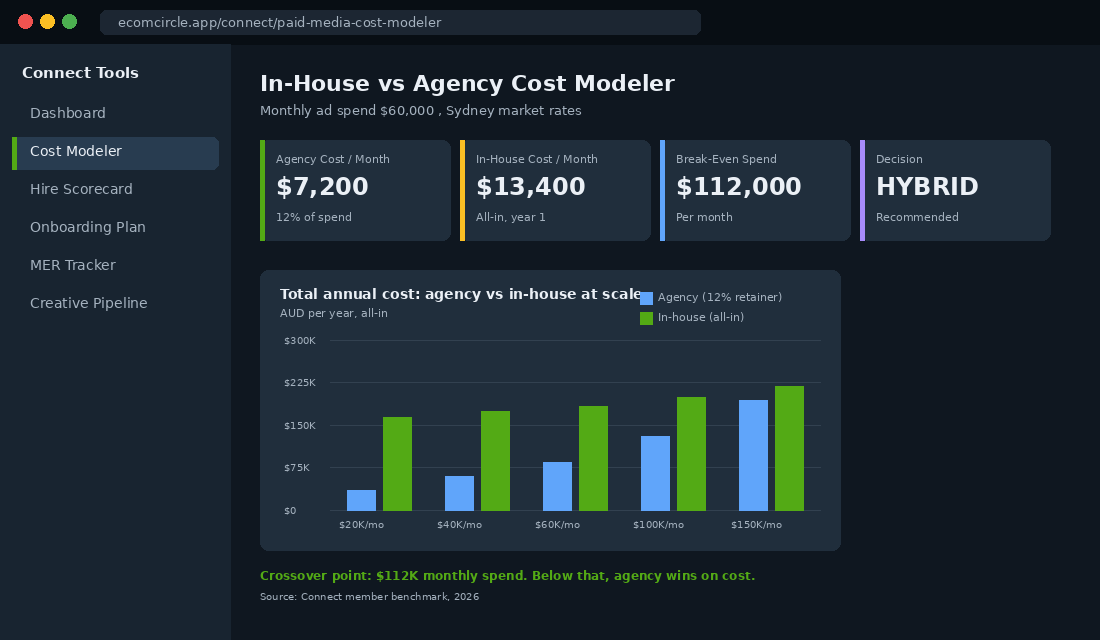
The single most common mistake we see is founders pulling the trigger at $15,000 to $20,000 a month in ad spend, then resenting the cost. The maths is brutal. A capable Australian paid media specialist costs $85,000 to $105,000 in base salary alone, and the all-in cost (super, tools, software, training, recruiting) lands closer to $120,000 to $140,000 a year. That is $10,000 to $11,500 a month before they have placed a single ad.
Compare that to an agency at 10 to 15% of spend. At $20,000 a month, you are paying $2,000 to $3,000 a month for the same execution, plus strategy, plus three to five team members in the background. The in-house move is a 4x cost increase for the same output. It only makes sense when the output upside is real.
Here is the threshold table we walk every member through:
- Under $30,000/month in ad spend. Stay with an agency or a strong freelancer. The maths simply does not work.
- $30,000 to $60,000/month. Consider a hybrid: a freelance media buyer paid $3,000 to $5,000 a month, with you (or your marketing manager) directing strategy and creative.
- $60,000 to $120,000/month. The hire starts to make sense, especially if you also need someone owning email and creative briefs. This is where most Aussie founders pull the trigger.
- $120,000+/month. You almost certainly want at least one in-house specialist, often two: one for Meta and one for Google or TikTok. Plus a creative producer feeding them.
The exception to this rule is when your brand is genuinely complex (subscription, B2B hybrid, multi-region, deep product catalogue). Brand context matters more than spend volume in those cases, and in-house pays off earlier.
The Full Cost: What That $90K Hire Actually Costs You
If you only budget for the base salary, you are setting yourself (and the new hire) up to fail. Every Aussie founder we coach is shocked by the second-order costs. Let us lay them out properly.
- Base salary. $85,000 to $105,000 for a mid-level specialist with 3 to 5 years of ecommerce experience. Senior specialists managing $150K+ monthly spend command $115,000 to $135,000.
- Superannuation. 12% on top in 2026. That is $10,000 to $13,000 a year.
- Tools and platforms. Triple Whale or Northbeam ($300 to $800/month), Motion or AdScout ($200/month), Klaviyo (if also owning email), GA4 audit tools, Supermetrics or similar reporting layer. Budget $1,500 to $2,500 a month.
- Creative production. A specialist with no creative pipeline is a glorified button-pusher. Budget $3,000 to $8,000 a month for a UGC creator, a freelance editor, or a Canva-fluent assistant.
- Training and conferences. $3,000 to $5,000 a year if you want them current on iOS changes, new Meta API features, GA4 quirks, and platform betas.
- Recruiting cost. A specialist recruiter charges 12 to 20% of first-year salary. DIY hiring costs you 30 to 60 hours of founder time, which is its own line item.
All in, a properly resourced in-house paid media function in Australia costs $160,000 to $220,000 in year one, sometimes higher if you add a junior or a creative producer. That is roughly equivalent to agency fees on $130,000 to $180,000 a month in spend. If your spend is below that line, you are paying for a worse outcome.
The 5-Skill Profile That Actually Performs (And the Profile That Disappoints)
Most founders write a job ad asking for “Meta and Google ads experience” and end up with 200 applicants who all sound the same. The pattern we see is that the candidates who can actually move the needle in the first 90 days share five specific traits. The ones who disappoint usually look great on paper and crumble inside the brand.
Here is the profile filter we give Connect members:
- 1. Ecommerce-native, not B2B-converted. A specialist who came from lead-gen or SaaS has a completely different mental model. They optimise for cost-per-lead, not contribution margin. They get lost in 8-week sales cycles. You want someone who has spent at least 18 months managing Shopify ad accounts with daily revenue feedback.
- 2. Creative literacy. The single biggest lever in paid social in 2026 is creative volume and quality. Your hire needs to brief, judge, and iterate on ads, not just upload them. Ask candidates to walk you through three creative concepts they greenlit and three they killed. Listen for craft.
- 3. Margin awareness. A specialist who only watches ROAS will quietly burn your margin. The good ones know your MER target, your contribution margin per order, your repeat purchase rate, and the difference between blended new-customer CAC and last-click CAC. If the candidate cannot define MER, keep interviewing.
- 4. Platform humility. Meta is changing every quarter. Google is being eaten by AI overviews. TikTok is volatile. The hires who fail are the ones who tell you they have “cracked” Meta. The hires who win are the ones who say “here is what I would test in your first 30 days, and here is what I would measure to know if it worked”.
- 5. Founder communication cadence. A great specialist sends you a 5-bullet Friday update without being asked. They surface bad weeks before you have to ask. They know what numbers you care about and put those first. This is the trait you cannot train.
If you are also considering a marketing manager hire, your paid media specialist will likely sit under them. Make sure the org chart is clear before you post the job, otherwise the specialist gets pulled in three directions and burns out.
Where to Find Them: The Aussie Paid Media Talent Map
The Australian paid media talent pool is small. Around 4,200 people in Australia list “Meta Ads” or “Paid Social” as a primary skill on LinkedIn. Of those, maybe 600 to 800 are genuinely ecommerce-native at the level you want. Job boards alone will not get you there. Here is where the strongest hires actually come from:
- Agency poaching. The fastest way to a 90th-percentile hire is to poach a senior account manager from a respected Aussie ecommerce agency (think Foxxr, Marketing Sweet, Bambrick, Sandtoes Digital, Webelong, or similar). They already manage $250K+ in monthly spend across 8 to 12 brands. Working on one brand at a 30% pay rise feels like a promotion.
- Direct competitor in-house teams. If a brand at your scale has been quietly winning, their media buyer is on LinkedIn. A polite DM, a specific compliment about a campaign of theirs you have seen in the feed, and a real founder-to-operator conversation goes a long way.
- Specialist recruiters. RGF, S2M, ThinkingAhead, Resourceful, and Six Degrees all run paid media desks in Sydney, Melbourne and Brisbane. Fees are 12 to 20% of first-year salary, but a good recruiter shortlists 5 strong candidates in 3 weeks, which compresses the timeline meaningfully.
- SEEK and LinkedIn Jobs. Useful for volume, low for signal. Expect to filter 150+ applicants to find 8 worth calling. Budget 12 to 20 hours of founder time across the funnel.
- The Aussie ecommerce founder network. Half the strong hires we have placed inside Connect came through founder referrals. If you know 30 other Aussie founders, post in your group chat first. Someone is letting a great person go for non-performance reasons.
If you cannot find the budget for a full Australian hire, the next-best move is a Filipino specialist with 3 to 5 years of Shopify experience, paid $2,500 to $4,500 AUD a month through a platform like Hire with Jarvis or OnlineJobs.ph. The trade-off is meaningful: timezone overlap is good, English is excellent, but you (or your marketing manager) need to own strategy and creative. The buyer executes.
The 90-Day Onboarding Playbook
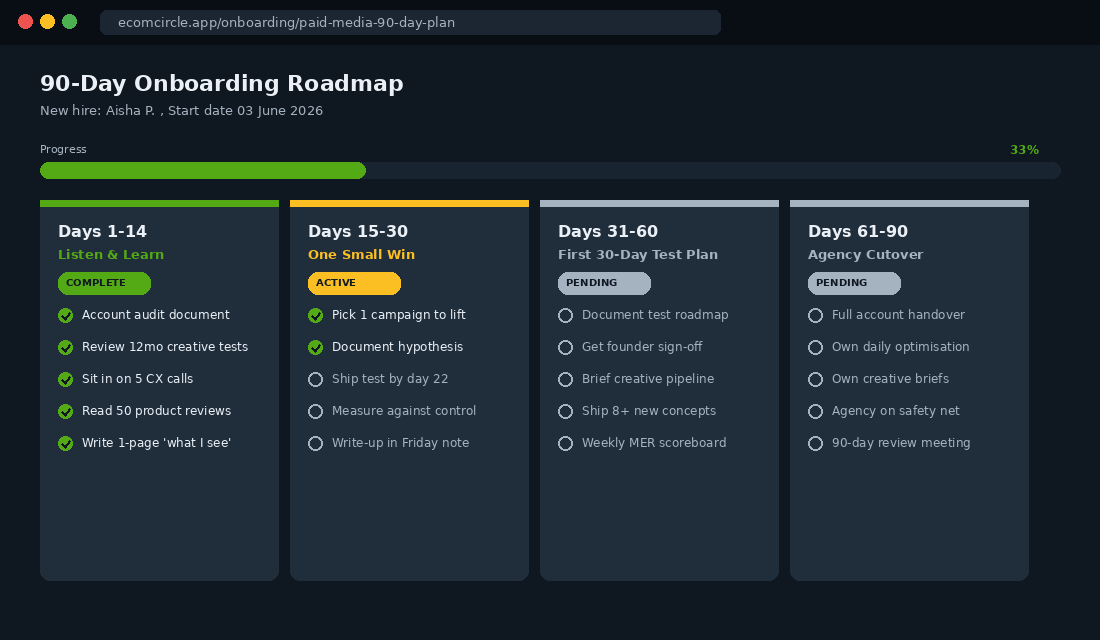
The 90-day window is where most in-house transitions fail. Founders hand over the keys, fly to Bali, come back to flat numbers, and lose patience. The fix is to map the first 90 days deliberately, with weekly checkpoints. Here is the structure we use:
- Days 1 to 14: Listen and learn. No new campaigns. The specialist audits the existing account, reads the last 12 months of creative tests, sits in on customer support calls, reads 50 product reviews, and writes a one-page “what I see” document. You read it together at end of week 2.
- Days 15 to 30: One small win. Pick one campaign or one audience to improve. Goal is a measurable lift on a single line, not a re-architecture. This builds confidence on both sides and gives you a data point on judgement.
- Days 31 to 60: The first 30-day test plan. The specialist writes a documented test roadmap (creative angle, audience structure, bidding test, landing page test) with hypotheses, success criteria, and a kill date for each. You approve. They execute.
- Days 61 to 90: The handover from agency. If you are still running an agency, this is the formal cutover. The specialist now owns daily optimisation, weekly reporting, and the creative brief pipeline. The agency stays on retainer for 30 more days as a safety net, then exits.
The single most important artefact in this 90 days is the weekly Friday update. Five bullets: spend, revenue, MER, what we tested, what we are testing next. Two paragraphs max. If you do not get this without asking by week 4, you have made the wrong hire.
The KPI Scoreboard: What to Measure (And What to Ignore)
A new in-house specialist will instinctively manage to the metric you focus on. Pick the wrong one and they optimise for it at the expense of the business. We have watched specialists hit a 4.2x ROAS for six months while the brand silently lost money because new-customer share collapsed. Here is the scoreboard we use:
- MER (blended Marketing Efficiency Ratio). Total revenue divided by total ad spend. This is the number that actually maps to whether marketing is paying for itself across the whole brand. Target is brand-specific, usually 3.0 to 4.5x for established Aussie DTC.
- New-customer contribution margin per order. Not just CAC. What does the average new customer contribute in margin after COGS, shipping, packaging, and ad cost? If this number is negative, you are paying to lose money.
- Creative throughput. Number of new creative concepts tested per month. A healthy in-house account ships 8 to 15 new creative concepts a month. Anything under 5 and the account will fatigue inside 90 days.
- Account structure health. Number of active ad sets, percentage of spend in your top 3 ad sets, audience overlap. Bad structure leaks 10 to 20% of spend invisibly.
- Lead indicators of fatigue. CPM trend, CTR trend, frequency on top creatives. These tell you 2 weeks ahead of a ROAS drop. Your specialist should report these unprompted.
Two metrics to actively de-emphasise: last-click ROAS in platform (Meta-reported ROAS is structurally inflated and gets worse every iOS release) and CAC by itself (without margin context, it tells you nothing about profitability). If your specialist defends decisions using only in-platform ROAS, that is a coaching moment.
If you have not yet run a proper attribution sense-check, this is the moment. Our geo-holdout incrementality test is the cleanest way for an Aussie brand to know how much your ads are actually causing revenue, not just taking credit for it. Run this once a quarter with your new hire and you will short-circuit 80% of the “is the agency lying to us” arguments.
Three Hybrid Models That Actually Work
Going from full agency to full in-house in one move is the riskiest version of this transition. Most founders we coach end up in a hybrid for 6 to 18 months while they figure out what the brand actually needs. Three hybrid models we have seen work:
- The In-House Buyer + Creative Agency. You hire one specialist who owns Meta, Google, and TikTok execution. You keep a small creative agency or freelance creative producer feeding them 6 to 12 fresh ad concepts a month. Best for brands where creative is the bottleneck and the in-house buyer is strategic.
- The In-House Strategist + Offshore Buyer. Reverse model. Your senior in-house person owns strategy, creative briefs, and brand context. A Filipino or South African specialist owns daily account work for $3,000 to $5,000 a month. Best for $30K to $80K monthly spend brands that need execution capacity but not seniority.
- The Channel-Split In-House + Agency. In-house owns Meta and email. Agency owns Google, Performance Max, and Bing. Common for brands at $150K+ monthly spend where Google needs deep technical chops your in-house person does not yet have.
What we almost never recommend is the “two agencies, no in-house” model. Two agencies guarantees three things: turf wars, double-counted credit in reporting, and no one who actually knows your brand. If you cannot afford in-house leadership yet, pick one agency and give them everything.
The Hiring Scorecard: A Template You Can Use This Week
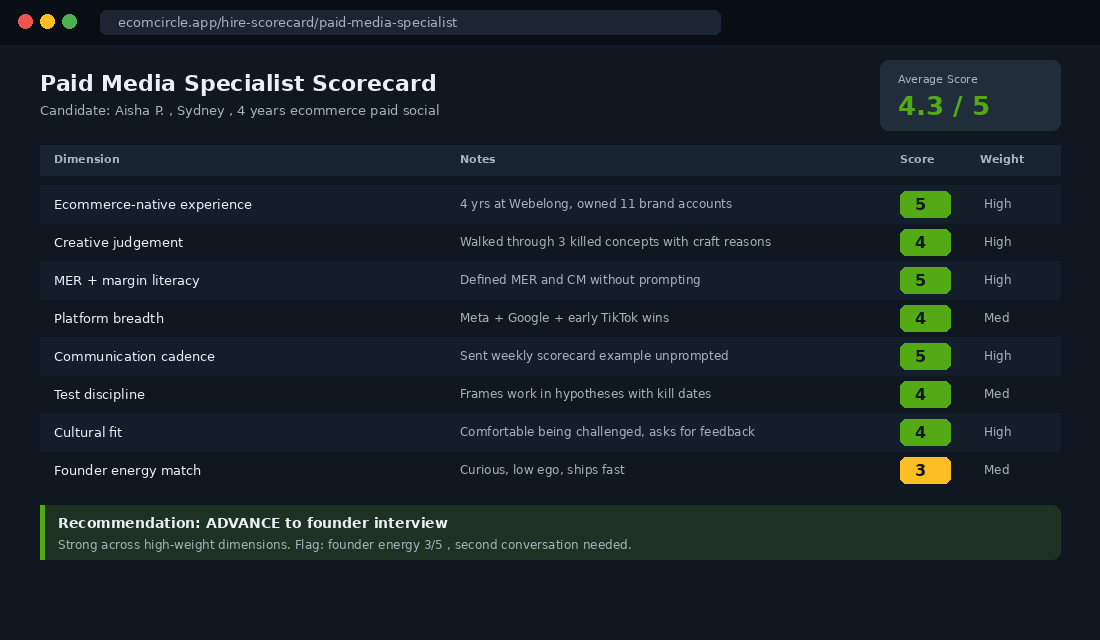
Most founders interview on vibes. The hires that work out best (and the worst ones we have seen avoided) come from a written scorecard that every interviewer fills out independently. Score each candidate 1 to 5 on these 8 dimensions before you read anyone else’s scores. Hire only candidates who average 4.0+ with no individual score below 3.
- 1. Ecommerce-native experience (1 to 5). 18+ months managing Shopify ad accounts with daily revenue feedback.
- 2. Creative judgement (1 to 5). Can walk through 3 ads they killed and 3 they greenlit, with reasons that match how customers actually buy.
- 3. Margin and MER literacy (1 to 5). Defines MER, contribution margin, and blended CAC without prompting. Has actually optimised against these, not just heard the terms.
- 4. Platform breadth (1 to 5). Has shipped real campaigns on at least 2 of: Meta, Google, TikTok, Pinterest. Bonus: has lived through an iOS or attribution shift and adapted.
- 5. Communication cadence (1 to 5). Provides examples of weekly updates or scorecards they ran. Asks great clarifying questions in the interview itself.
- 6. Test discipline (1 to 5). Frames thinking in hypotheses, success criteria, and kill dates. Not in “let’s try this and see”.
- 7. Cultural fit (1 to 5). Comfortable being told they are wrong. Asks about how your team gives feedback. Does not name-drop or chest-beat.
- 8. Founder energy match (1 to 5). Would you be happy on a Slack with this person every weekday for 2 years?
Keep this scorecard simple and on one page. Every interviewer fills it out within an hour of the conversation. Compare scores at the end. The candidate who looked best in the room is not always the one with the highest average across 4 interviewers.
Why Founders Get This Wrong: The Compound Effect
Here is the pattern we see again and again across hundreds of Aussie Shopify founders. The first in-house hire is rushed because the founder is frustrated with the agency. The job ad is generic. The interview process is two coffees and a gut feel. The hire starts with no 90-day plan, no documented brand context, and no creative pipeline behind them. Three months in, performance dips. Six months in, the founder fires the specialist and goes back to an agency. The narrative becomes “in-house does not work for us”.
What actually failed was not the model. It was the hiring rigour, the onboarding plan, and the support system around the hire. The brands that do this right treat the first 90 days like a product launch: planned, resourced, measured, and adjusted in real time. They build the org chart before they post the job. They scope the creative pipeline before the specialist sits down. They write the scoreboard before they hand over the keys.
Done well, an in-house paid media specialist becomes the single highest-return hire most Aussie Shopify founders make between $2M and $10M. They compound creative output, deepen brand context, get faster on iteration, and (over 12 to 18 months) make decisions you would not have made yourself, but that turn out to be right. The agency relationship was transactional. The in-house relationship is generative.
Done poorly, you are out $150,000 and a year of momentum. The difference is not the candidate. It is the system you put around them.
Worked Example: Two Aussie Brands, Same Ad Spend, Opposite Outcomes
Imagine two Melbourne apparel brands, both spending about $40K a month across Meta and Google, both paying an agency roughly $6K a month, both deciding to bring paid media in-house in the same quarter.
Brand A hired a $95K “performance marketer” whose experience was two years running $8K a month for a local services company. No creative pipeline existed; the founder assumed the hire would “sort that out”. By day 60 the account was under-tested, MER had slipped from 3.4 to 2.8, and the specialist was spending half the week in Canva. The agency was re-engaged at day 110. Cost of the detour: roughly $45K in salary, super and recruiter fees, plus an estimated $60K in lost contribution margin over the quarter.
Brand B waited one extra quarter and used it to build a creative supply of 15 to 20 new assets a month through a UGC creator roster and a part-time designer. Then they hired a $110K specialist who had personally scaled a $50K-a-month DTC account and could show the ad-account screenshots. The 90-day roadmap was followed to the letter: two weeks of shadowing the agency, a structured handover, then full control at day 45.
- Day 90 MER: 3.6, up from 3.1 under the agency, with spend up 22% at the same efficiency.
- Creative testing velocity: 14 new ads a week, up from 4 under the agency.
- Total cost of the hire in year one: about $138K including super, tools, training and a $4K recruiter fee, against $72K of agency fees saved and an estimated $190K in additional contribution margin from the extra scale.
- Founder time reclaimed: roughly six hours a week previously spent managing the agency relationship.
The difference was not the person. It was sequencing: creative supply first, hire second, and a threshold that had actually been crossed rather than one the founder wished had been.
The Interview Test That Separates Operators From Report-Readers
Most paid media interviews fail because they test vocabulary, not judgment. Anyone can define ROAS. Very few can make a good decision on a Tuesday afternoon with incomplete data. Run these three exercises, live, with a real anonymised account if you can.
- The 20-minute account audit: give them read-only access to your ad account (or a sanitised export) and ask for the three things they would change this week and why. Strong candidates go straight to campaign structure, attribution settings and creative fatigue. Weak candidates talk about audiences and bid strategies.
- The budget question: “Meta says ROAS is 4.2, Shopify says blended MER is 2.6, and I have $10K extra to spend this month. What do you do?” You are listening for incrementality thinking, a holdout or geo test, and a refusal to trust the platform number on its own. Anyone who says “scale the 4.2 campaign” is not ready.
- The creative brief: hand them your three best-performing ads and ask for two new concepts with a hypothesis each. This tests whether they can feed the creative engine or only consume it. In-house paid media without creative judgment is an expensive way to change bids.
Score each exercise out of five and hire nobody who averages under four. If the candidate is strong on the account but weak on creative, that is fixable by pairing them with a dedicated creative hire. If they are strong on creative and weak on incrementality, the marginal ROAS playbook is the first thing you put in their onboarding folder.
Your Move This Week
If you are sitting at $30,000+ a month in ad spend and you have been thinking about this for more than a quarter, here is what to do this week:
- Monday. Write down your real all-in agency cost. Include retainer, percent-of-spend, creative production, and the hours you spend managing them. Compare to the $160K to $220K full in-house cost above.
- Tuesday. Map your org chart. Who would the specialist report to? Who briefs creative? Who owns email? If those answers are fuzzy, the hire will be too.
- Wednesday. Write the job ad using the 5-skill profile in this article. Resist the urge to list 30 nice-to-haves. Five must-haves attract better candidates than a kitchen sink.
- Thursday. Tap your founder network. Send 5 specific DMs to other founders at your stage. Ask if they know anyone moving on or unhappy.
- Friday. Brief one specialist recruiter and run one SEEK ad. Two channels in parallel beats one channel sequentially every time.
If your spend is below $30,000 a month, the answer is almost always: not yet. Keep building demand quality, stay with your best freelancer or agency, and revisit when you cross $40K to $50K a month for two consecutive quarters. Premature in-house hires are one of the most expensive mistakes a $1M to $3M Aussie founder can make.
Inside eCommerce Circle, the paid media hiring decision is one we walk every member through, with their real numbers, their real team, and their real ad account. It is rarely a clean “yes” or “no”. The right call depends on what else is on your plate, how strong your creative pipeline is, and what your next 12 months actually need. If you want a second opinion on yours, let’s talk.
