Most Aussie Shopify founders treat subscriptions like a tick-box exercise. They install Recharge, drop a 10% off Subscribe and Save widget on a product page, and wonder why three months later their subscriber count is hovering at 4% of orders. Then they go back to spending more on Meta and pray the next launch carries the quarter.
What’s in This Article
The brands quietly compounding past $1m, $3m, $10m in revenue are doing the opposite. They build subscriptions as a system. A specific product strategy, a specific offer, a specific four-stage conversion flow, a specific retention stack. Done well, that system delivers 12 to 18% of orders on subscription within six months, lifts customer lifetime value 30 to 60%, and produces the one metric every Aussie founder needs heading into 2026: monthly recurring revenue you can forecast.
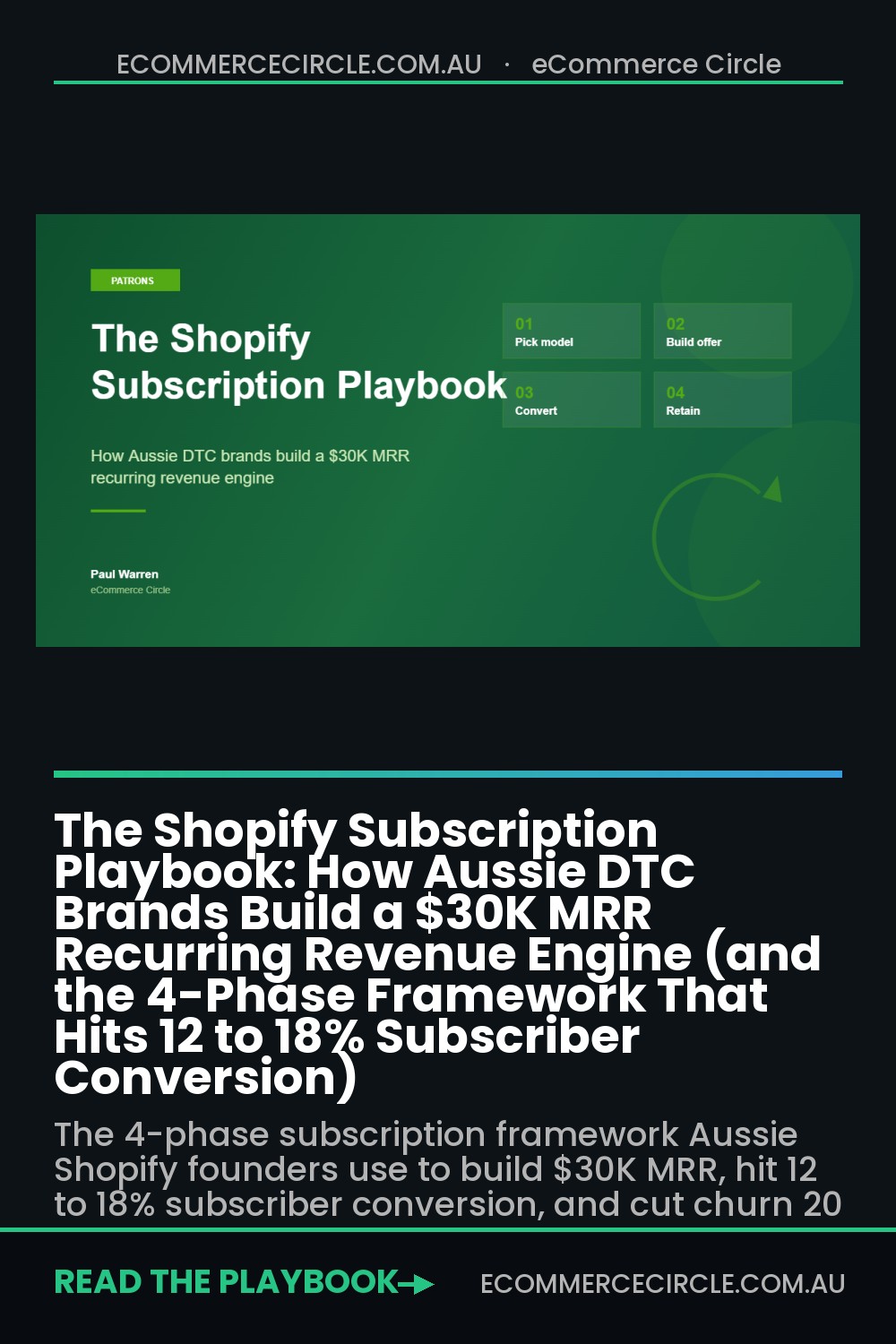
This playbook is the 4-phase framework we use inside eCommerce Circle to launch subscription programs that move the needle. Real stats, real Aussie brand examples, real tool stack. If you sell anything consumable, replenishable, or curatable, you should be running this. The recurring revenue gap between brands that get this right and brands that wing it is now the single biggest valuation gap in Australian DTC.
Why Subscriptions Are the Recurring Revenue Moat in 2026
Customer acquisition cost has tripled across DTC since 2015. Aussie founders are now paying $78 to $82 to acquire a customer who used to cost $24 to $28. Meta CPMs in Australia are up year on year. Google Performance Max has eaten margin in every category we audit. The only escape route that scales is a higher second order, third order, fourth order from the customers you already have.
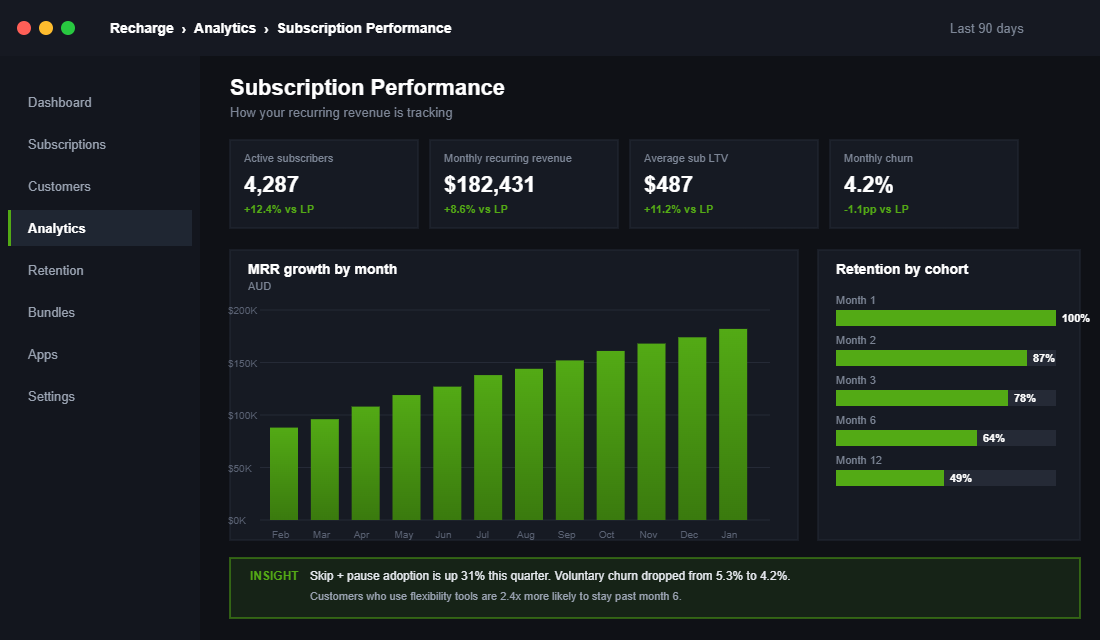
Subscriptions solve this at the structural level. Recharge’s latest merchant report shows subscription brands grew LTV 12% year on year, AOV 11%, and MRR 7%, with recurring revenue outpacing one-time commerce across every category. DTC subscription LTV to CAC crossed parity with SaaS at 4.1 to 1, driven by replenishment categories like vitamins, beauty refills, and pet food. If your CAC is $80 and your subscriber LTV is $320, you do not have a paid media problem. You are not getting enough out of each customer you have already paid for.
There is a second moat that is harder to see. Forecastable revenue. When 18% of your orders ship on the same date every month, you can negotiate better terms with suppliers, plan inventory six months out, hire confidently, and present a cleaner balance sheet to lenders or buyers. The Aussie founders we work with who exited at the strongest multiples all had one thing in common. They had a subscription book that proved the customer base was retained, not just acquired.
Phase 1: Pick the Right Subscription Model (Most Brands Pick the Wrong One)
There are three subscription models that work in DTC. Most founders default to the easiest one and leave the most valuable one on the table.
- Replenishment. The customer runs out of the product on a predictable cycle. Coffee beans, supplements, pet food, skincare refills, cleaning products, period care. This is the easiest model to launch and has the lowest churn (below 4% monthly for top performers). It works because the customer was going to buy again anyway. You just remove the friction.
- Curation. A curated box of products the customer would not pick on their own. Beauty boxes, wine clubs, snack boxes, mystery drops. Higher engagement, higher churn (10 to 12% monthly is normal), and requires editorial discipline. Works when the brand has strong taste and the customer wants discovery.
- Access. A membership that gives access to member pricing, free shipping, early access, or exclusive products. Aussie brands like Frank Body and Hismile use access models alongside replenishment. Lower direct revenue but enormous influence on order frequency and AOV from one-time buyers.
The rule of thumb. If your product is consumed in 30 to 90 days and the customer reorders the same item, replenishment is the winning model. If your brand is built on taste, discovery, or limited drops, curation. If you sell across many SKUs and want to lift order frequency across the board, access. Most Aussie DTC brands should start with replenishment, layer curation as a premium tier, and run access as a loyalty wrapper later.
Who Gives A Crap is the canonical Aussie example. Toilet paper is the most boring product imaginable, but it is consumed on a predictable cycle, customers want the convenience of never running out, and the brand stacks values (sustainable, donates 50% of profits) on top of utility. They built past one million orders on this exact replenishment playbook using Shopify and Recharge. The lesson for every Aussie operator: if your product is even slightly consumable, replenishment is your floor.
Phase 2: Build the Offer (Discount, Frequency, Prepaid)
The offer is where most brands either over-discount and erode margin or under-discount and never convert anyone. The data on this is clearer than you would think.
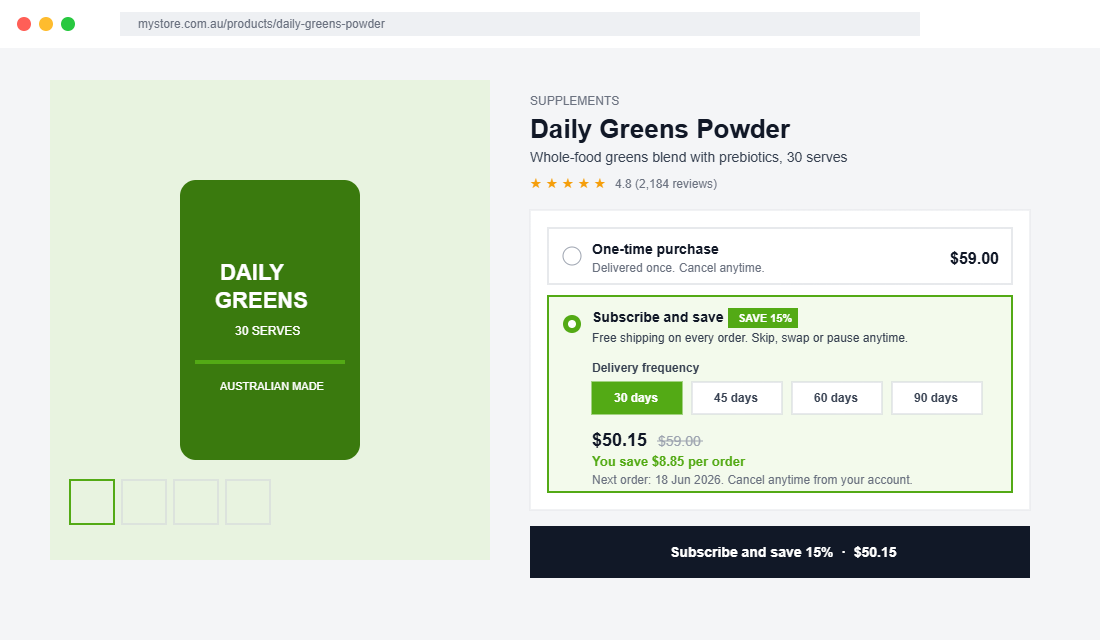
Amazon’s published Subscribe and Save data shows a 10 to 15% discount drives up to 1.8x more subscriber conversion versus no discount. Below 10%, conversion stays flat. Above 15%, margin compression kicks in faster than the conversion lift can carry. The sweet spot for most Aussie brands sits at 12 to 15% for the base tier, with the ability to step up to 20% for prepaid or annual commitments.
- Discount tier. Start at 15% off recurring orders. This is the number that consistently drives conversion above 10% on PDPs in our portfolio. Add a second tier (typically 20%) for customers who prepay 3 or 6 months upfront. Prepaid subscribers churn at roughly half the rate of pay-as-you-go.
- Frequency options. Default to the customer’s actual consumption cycle, then offer two flanking options. If your product lasts 30 days, offer 30, 45, and 60. Do not offer 90 by default. Long intervals mean the customer forgets they have a subscription, which causes both churn and disputes.
- Free shipping. Bundle free shipping into every subscription order. The maths almost always works because the LTV lift more than covers the shipping cost. Frank Body, Vush, and Bondi Sands all run this play.
- Sweetener for first order. Offer a free gift, sample, or bonus item on the first subscription order. Conversion lift is real and the cost is amortised over the lifetime of the subscriber.
Avoid one trap. Do not run a flat percentage off forever. Test a higher discount on the first order (a true incentive to start) and a sustainable discount on every order after (a fair value exchange). A 25% off first order, 15% off ongoing structure outperforms a flat 15% in almost every test we have run. The customer feels rewarded for committing and the brand keeps margin once the habit is formed.
Phase 3: The 4 Placements That Convert (Where Most Brands Fail)
A subscription program lives or dies on placement. The widget exists. The discount is set. Now the question is where the customer sees it and how the offer is framed at each touchpoint. There are four placements that matter, and most Aussie stores are only using one.
- 1. Product detail page (PDP). The primary placement. The Subscribe and Save option needs to be visible above the fold, selected by default if your conversion data supports it, and framed around savings plus convenience. The widget should show the discount amount in dollars (not just percent), the next delivery date, and the ability to skip or cancel anytime. This single placement should drive 60 to 70% of new subscribers.
- 2. Cart drawer upsell. When a customer adds a one-time item, the cart drawer offers a single tap conversion to subscription. “Switch this to Subscribe and Save 15%. Skip or cancel anytime.” Convert 15 to 25% of one-time carts to subscriptions on this placement alone with the right offer wording.
- 3. Post-purchase upsell. Immediately after checkout, before the thank-you page, offer to add a subscription on the next purchase. Klaviyo plus a tool like Rebuy or Aftersell handles this. Lower conversion (3 to 6%) but pure incremental revenue and no acquisition cost.
- 4. Email flow at order 2 and order 3. The customer who has bought from you twice is the warmest subscription lead you have. A two-email flow timed seven days after order delivery (asking for the review, then a follow-up offering subscription with a sweetener) typically converts 8 to 14% of repeat customers.
The bigger lesson. Subscription conversion is not a checkout problem, it is a brand experience problem. The brands that hit 18% of orders on subscription have made the offer feel like the obvious default at every touchpoint, not a buried option for “loyal customers”. The customer should encounter the subscription offer at least three times during their first purchase journey, each time framed slightly differently.
Phase 4: The Retention Stack That Cuts Churn 20 to 40%
Getting subscribers is the start. Keeping them is the entire business model. Subscription brands that ignore retention end up with the same revenue problem they had before, just dressed up in different metrics. The retention stack that actually works has four pillars.
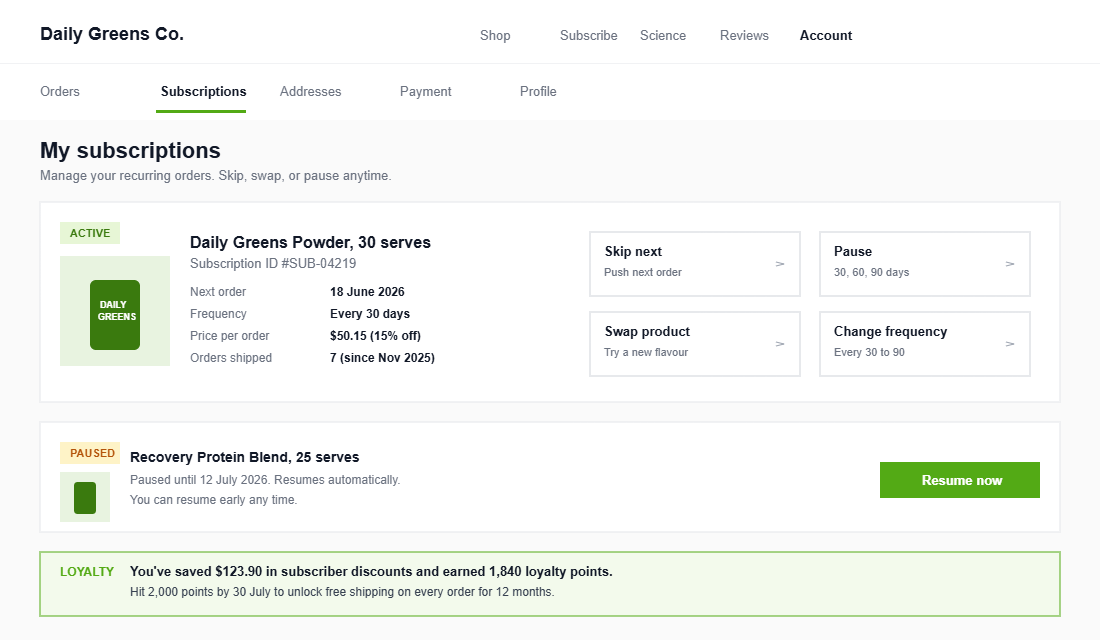
- Customer flexibility (skip, swap, pause, change frequency). 35% of subscribers actively adjust their orders. The brands that make adjustment easy keep them. The brands that make adjustment hard see them cancel. Recharge data shows offering a pause option alone reduces cancellations by 18%, and 25% of subscribers who would have cancelled choose to pause instead. Stack all four flexibility levers and you get to the 20 to 40% retention lift top brands report.
- Smart dunning and card updater. Failed payments are the silent killer of subscription programs. Up to 30% of involuntary churn is just a card that expired or a transaction that flagged. Recharge’s dunning settings, paired with a card updater service, recover 30 to 50% of failed payments within the first month. Set retry windows at day 1, day 3, and day 7 with personalised email at each stage.
- Cancellation retention flow. When a customer clicks cancel, do not just process the cancellation. Offer a pause, a discount on the next order, a swap to a different product, or a frequency change. A well-designed retention flow saves 20 to 40% of cancel attempts. Tools like Loop or Smartrr run this natively.
- Subscriber-only perks. The Recharge insight is that subscribers expect more than just a discount. Free shipping on every order, early access to new products, exclusive bundles, and birthday gifts all keep the perceived value of the subscription above the cost. The relationship needs to feel like a club, not a contract.
If you only run one of these, run the cancellation flow. It is the lowest-cost, highest-return retention tool you can deploy. A good flow asks “Why are you cancelling?”, routes to a tailored offer (too much product means skip 2 orders, too expensive means a discount, not using it means swap to a different variant), and tracks the save rate. We have audited Aussie brands where the cancellation flow alone added $40k to $80k a year in saved MRR.
The Economics: How MRR Maths Actually Work
The reason subscription programs feel different is that the unit economics shift. One-time commerce is a series of disconnected transactions. Subscription commerce is a stream of forecastable revenue with a known churn rate. The maths everyone should know:
- MRR = Active subscribers x average order value x average orders per month. If you have 1,000 active subscribers at $55 AOV ordering monthly, your MRR is $55,000. The number compounds because new sign-ups stack on top of retained subscribers.
- Subscriber LTV = AOV / monthly churn rate. At 4% monthly churn and $55 AOV, your subscriber LTV is roughly $1,375. At 10% churn (subscription box norm), the same AOV gives you a $550 LTV. The difference of 6 percentage points of churn is the difference between a healthy business and a treadmill.
- Healthy LTV to CAC ratio. Aim for 4 to 1 or better on subscriber LTV. At a $78 CAC, your subscriber LTV needs to clear $312 minimum, $400 to be comfortable. Replenishment models hit this easily. Curation models need to work harder.
- The compound effect. Even a modest 8% of orders on subscription, with 4% monthly churn, doubles your MRR contribution in 12 months because new sign-ups outpace cancellations.
Run these numbers for your own store before you launch. If your AOV is $35 and your category has 12% monthly churn benchmarks, the model has to flex differently than if your AOV is $90 in a 4% churn category. The brands that get this right pick the model and the offer that produce a defensible LTV to CAC ratio, then double down. The brands that wing it end up with a subscription program that runs at break-even or worse.
The 90-Day Launch Roadmap
If you are starting from zero, this is the sequence we run with coaching clients. Ninety days from kickoff to a working subscription program contributing 5 to 10% of orders. Faster than most agencies will quote you and slower than the “install a widget tonight” advice you will see in Facebook groups.
- Days 1 to 14: Audit and pick model. Pull your repeat purchase rate by SKU. Identify which products are consumed on a predictable cycle. Pick replenishment, curation, or access (or a hybrid). Choose your subscription platform (Recharge, Loop, Smartrr, or Skio depending on stack and use case).
- Days 15 to 30: Build the offer. Lock in your discount tier, frequency options, prepaid structure, and shipping policy. Build the financial model. Sign off margin. Write the customer-facing copy across PDP, cart, post-purchase, and email.
- Days 31 to 60: Ship the placements. Implement PDP widget, cart drawer upsell, post-purchase upsell, and the two-email follow-up flow. Test on staging. Soft launch to a small segment. Iterate on conversion data.
- Days 61 to 90: Retention stack. Build the customer portal with skip, swap, pause. Configure smart dunning. Build the cancellation retention flow with branching offers. Layer subscriber-only perks. Monitor early cohort data.
The mistake most founders make is to do all four phases at once and ship a half-built version of each. Build the model first. Build the offer second. Ship the conversion placements third. Layer the retention stack last. Each phase needs the previous one to be in place. Skip steps and you end up with subscribers who cancel because the experience after sign-up does not match the promise at the PDP.
The Failed Payment Layer: Recover the 9% of Renewals That Die Silently
Involuntary churn is the quietest leak in any subscription program. Between 8 and 12% of recurring charges fail on a given billing run, and most of those failures have nothing to do with the customer wanting out. Expired cards, a reissued card number, a daily limit, or a temporary hold on funds.
If you are not recovering those charges you are losing roughly one renewal in eleven for a reason the customer never chose. On a $30k MRR program that is about $2,700 a month walking out the door, and it compounds, because a failed renewal usually ends the subscription altogether.
A working dunning stack has four parts.
- Smart retries. Do not hit the same card the same way three days running. Retry on day 1, day 3 and day 7, and vary the time of day. Payday timing matters here, so a Thursday retry consistently outperforms a Sunday one.
- A card account updater. Recharge and Loop both support network updater services that pull the new card number when a bank reissues. This alone recovers 20 to 30% of failures with no customer contact at all.
- A three-email dunning flow in Klaviyo. Email 1 on the day of failure, plain text, no branding, from a real person. Email 2 on day 3 with a one-click update link. Email 3 on day 7 saying the subscription will pause, not cancel. Pause language holds 15 to 20% more customers than cancel language.
- An SMS on the final attempt. SMS open rates in Australia sit above 90%, and a payment failure is one of the few messages where a text reads as helpful rather than pushy.
Measure it with one number: recovery rate, meaning failed charges that end up paid within 14 days. Under 40% means the flow is broken. A properly built stack recovers 60 to 75%.
Then look at your billing date. Charging the entire subscriber base on the 1st concentrates every failure into a single day and buries your support inbox. Stagger billing to each customer’s original order date so failures spread across the month and your team can actually work them.
One compliance note for Australian brands. Under Australian Consumer Law you need clear disclosure of the renewal amount, the frequency, and the cancellation method before sign-up, and a cancellation path no harder than the sign-up path. A buried cancel button is not a retention tactic, it is a chargeback generator. If you want the wider view of how repeat buyers behave once this is running, the RFM segmentation playbook is the natural next read.
The Compound Effect: Why This Is the Most Valuable Project You Will Ship This Year
Each piece of this playbook produces a meaningful but modest lift in isolation. The 15% discount lifts conversion. The cancellation flow saves cancels. The frequency flexibility cuts churn. None of these individually is going to transform your business. Stacked together, they compound.
The brand at 5% of orders on subscription with 12% monthly churn has a subscription program that produces a fraction of MRR and falls behind acquisition cost. The same brand, after 90 days of disciplined execution, sits at 15% of orders on subscription with 4% monthly churn. The MRR base triples. The forecastability changes how the founder makes every other decision: how aggressively to spend on Meta, how much inventory to commit to, when to hire the next role.
This is why subscription programs sit inside the Patrons P in our More Orders Operating System. The same customers driving your subscription book are the customers who anchor your loyalty program, who buy the replenishment products, and who get the welcome and post-purchase flows that build long-term value. If you have not yet calculated your customer lifetime value, do that before you launch the subscription. LTV is what makes the offer maths defensible. And if your replenishment cycle is the foundation, our replenishment flow playbook covers how to predict reorder dates and win the second order before Amazon does.
One last word. Subscription programs are not “set and forget”. Treat them like a product you run, not a widget you installed. Look at MRR weekly. Look at churn monthly. Look at LTV by cohort quarterly. The brands that build $30k, $80k, $200k MRR books are the brands that ship one improvement to the subscription system every month for two years. The compound effect is real, and it is the difference between trading time for revenue and owning a forecastable business.
Inside eCommerce Circle, the subscription playbook is one of the core pillars we work on with every member running a consumable, replenishable, or curatable product. If you want a second opinion on yours, let’s talk.