There is a traffic source quietly feeding revenue into Aussie Shopify stores right now, and most founders have no idea it exists in their GA4. It does not look like Google. It does not look like Meta. It shows up as a thin trickle of referrals from chat.openai.com, perplexity.ai, and copilot.microsoft.com. And the buyers behind it convert like nothing else.
What’s in This Article
A 12-month GA4 study across 94 ecommerce brands found ChatGPT referral traffic converts at 1.81% versus 1.39% for non-branded organic. That is a 31% gap. ChatGPT-referred users also spend 15 minutes on site versus 8 for Google referrals, and view 12 pages versus 9. ChatGPT referral traffic to ecommerce sites grew more than 200% year on year from Q1 2025 to Q1 2026.
And here is the kicker. 49% of Australians used generative AI in the last 12 months, up from 38% in 2023. Most are not just chatting. They are asking ChatGPT, Perplexity and Copilot to recommend brands, compare products, and pre-vet purchases. If your Shopify store is not being cited in those answers, you are invisible in a channel that is doubling every quarter.
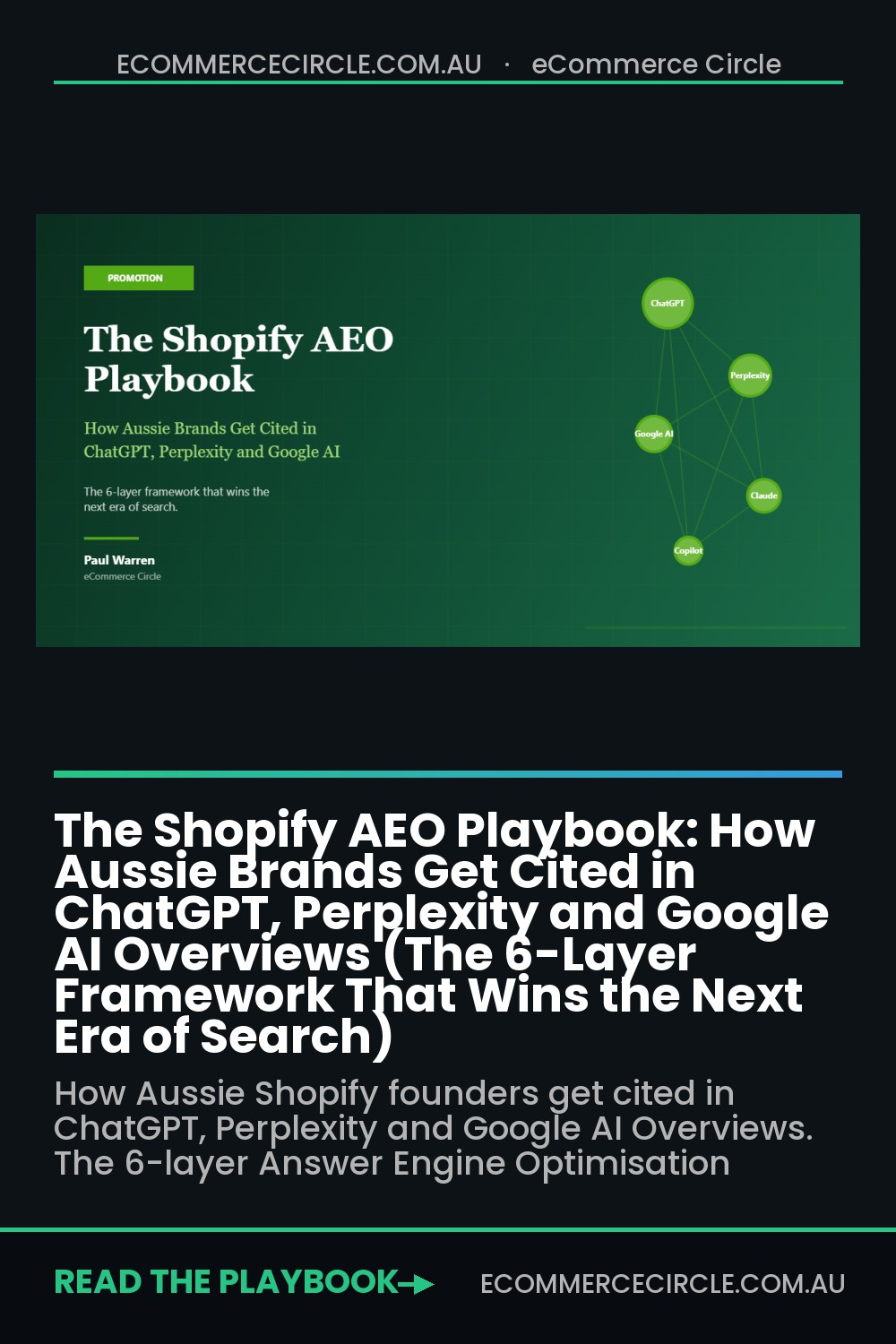
This is the Shopify AEO Playbook. Answer Engine Optimisation. The 6-layer framework that gets your brand cited in ChatGPT, Perplexity and Google AI Overviews. Built specifically for Aussie founders running between $40K and $500K per month who want a moat in the next era of search, not just rankings in the old one.
The new traffic source most Aussie founders are not measuring yet
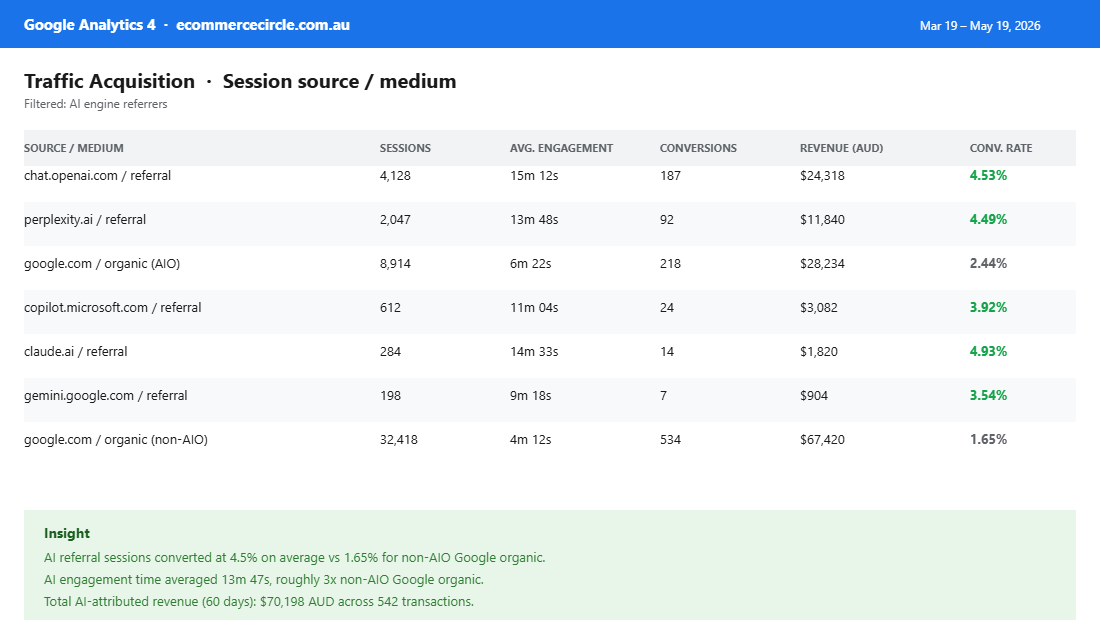
Here is what the data is showing in May 2026. Target receives roughly 15% of its referral traffic from ChatGPT. Etsy is over 20%. eBay sits around 10%. Amazon, the platform that should logically dominate, is under 3% and declining 18% month on month. The brands AI engines are surfacing are not the biggest. They are the ones that look the most credible and the most extractable to a language model.
Meanwhile, traditional Google is bleeding. Organic CTR drops between 34% and 61% when an AI Overview appears above the blue links. 60% of Google searches now end without a single click to any website, up from 58% in 2024. AI Overviews are present in 25.8% of US searches as of January 2026. Ecommerce queries trigger AIOs less often (around 4%), but informational queries that touch ecommerce, the very queries that fed your top-of-funnel for the last decade, trigger them 39.4% of the time.
If you sell skincare, you used to win when someone googled “best face serum for dry skin Australia.” A blog post, some long-tail copy, you ranked, they clicked. Today that same query returns an AI Overview that names three or four brands. If you are not one of them, you are not in the consideration set. Full stop.
The Aussie brands quietly winning here are doing two things at once. Woolworths has built AI personalisation into Olive, their chatbot, to handle thousands of daily customer interactions, but the AEO play is bigger. They show up in ChatGPT and Perplexity answers because their content is structured, their entity is well-defined, and they are cited everywhere online. Cotton On is using AI internally for content strategy and shows up in fashion answer sets because their brand is referenced across hundreds of style blogs and editorial sites. That off-site density is doing the heavy lifting.
You do not need to be Woolworths. You need to look like a credible, citable source to a language model. That is what the next six layers will do.
How AI engines actually pick what they cite (the 3-input model)
Before the tactics, you have to understand the mental model. ChatGPT, Perplexity, Copilot and Google AI Mode do not crawl the web like Googlebot. They retrieve. When a user asks a question, the engine runs a retrieval pass against a curated index, scores candidate passages, then composes an answer with inline citations.
Three inputs decide whether your page makes the shortlist:
- Extractable content structure. Short, declarative answers placed at the top of each section. Question-format H2s. Definitive language. The retrieval system needs to lift a clean 50 to 80 word passage and drop it into an answer.
- Schema markup that defines what the page is. Article, FAQPage, Product, HowTo and Organization schemas tell the AI engine the type, the author, the date, and the entity behind the content. Schema is how a language model knows you exist as a thing in the world.
- Authority signals. A named author entity with credentials. A consistent brand name across the web. Inbound mentions in third-party sources the engine already trusts (Reddit, niche editorial sites, Wikipedia, news outlets). This is what tips a passage from “candidate” to “cited.”
Sites that ship all three earn citations within 4 to 8 weeks. Sites that ship only one or two rarely get cited at all. Most Shopify stores in Australia are stuck on one (basic auto-generated Product schema) and have nothing else. That is the gap. Closing it is the work.
Worth noting: each engine weights these inputs differently. Perplexity leans hardest on schema and fresh content. ChatGPT skews toward Reddit, Wikipedia and authoritative editorial mentions. Google AI Overviews lean on the same E-E-A-T signals that already power classic SEO, plus visible source diversity. The 6-layer framework below covers all three without you having to optimise three different times.
Layer 1: Schema markup. The foundation 80% of Shopify stores get wrong

Shopify automatically generates Product, Organization and BreadcrumbList schema on most themes. That is fine for showing rich snippets in Google. It is nowhere near enough for AI engines. The default Product schema usually lacks the author, the brand entity, the GTIN, the aggregateRating with realistic counts, and the offers block with shipping details.
Here is the minimum schema stack a Shopify store needs to be AEO-eligible in 2026:
- Organization schema on every page (typically in the theme header). Include logo, sameAs links to your Instagram, LinkedIn, Facebook, founder LinkedIn, and any wiki entries. This anchors your brand as an entity.
- Product schema on every PDP. Custom-extend the default to include brand (linked to the Organization entity), GTIN where available, aggregateRating with real review counts pulled from Judge.me or Stamped, offers with shippingDetails and hasMerchantReturnPolicy, and a manufacturer block.
- FAQPage schema on PDPs, collection pages and key blog posts. Five to eight questions per page, with answers that match the visible page copy exactly. Mismatch and Google will ignore the markup.
- Article schema on every blog post. Critical fields: headline, datePublished, dateModified, author (linked to a Person schema with a real bio URL), publisher (linked to the Organization), image, and articleBody.
- HowTo schema on any tutorial or implementation post (great for “how to apply”, “how to fit”, “how to use” content).
Implementation matters. Add schema in JSON-LD format, in the theme.liquid head, scoped by template. Validate every page via Google’s Rich Results Test and schema.org validator before you go to bed. The single most common mistake we see in Aussie Shopify stores is FAQPage schema that references questions that are not actually visible on the page. Google flags this as misleading and silently demotes the page. Worse, AI engines stop trusting your domain.
If you are running a free-tier theme, install an app like Smart SEO, Schema Plus, or JSON-LD for SEO and configure manually. Do not rely on auto-detection alone.
Layer 2: Extractable content. The 50-word answer rule
Schema tells an AI engine what a page is. Extractable content tells it what to lift. Most Shopify content fails this test because it was written for humans scrolling, not for retrieval systems looking for a clean passage to quote.
The 50-word rule: every major section of every blog post, collection page and PDP should open with a self-contained 50 to 80 word answer to the section’s question. Not an intro paragraph. Not a teaser. A standalone, declarative answer. Then the supporting detail.
Rewrite your H2s as questions or specific answers, not generic labels. “How long does a coffee scrub take to show results?” not “Results.” “Why merino wool is warmer than synthetic fleece” not “Material choice.” Question-format headings are the single highest-impact change you can make to a Shopify blog this week, because retrieval systems match user queries to your headings before they even read the body.
Other extractability rules:
- Short paragraphs. 2 to 3 sentences max. Walls of text are unreadable to humans and unliftable for AI.
- Definitive language. “X is” beats “X might be considered.” Hedging kills citation odds.
- Comparison tables. AI engines love them. Build a simple “X vs Y” table for any category where buyers compare you to alternatives. A single comparison table on your collection page can earn you mentions across multiple “best of” answers.
- Bullet lists with bold lead-ins. Like the one you are reading. Scannable for humans, perfectly chunked for retrieval.
- Concrete numbers. “30 grams per scoop” beats “a generous serving.” Specificity earns citations.
Worth testing: pick your three highest-traffic blog posts in Shopify Analytics. Rewrite the first 80 words of each section to be a clean answer to a clear question. Add FAQPage schema with matching Q&A pairs. Republish. Measure ChatGPT and Perplexity referrals over the next 6 weeks. The pattern we see across Aussie brands is a 3 to 5x lift in AI referral traffic within two months.
Layer 3: A named author entity with real credentials
This is the layer Aussie founders skip and pay for. Most Shopify blogs publish under “Admin” or a generic store name. AI engines see no author entity, no credentials, no E-E-A-T. The content gets retrieved, scored, then dropped because the system cannot verify who wrote it.
Build a proper author profile for every named contributor (typically you, the founder, plus any expert contributors):
- Dedicated /authors/your-name/ page with a 200 to 400 word bio. Include years of experience, role, qualifications, and links to public credentials (LinkedIn, professional bodies, university, mentions in industry press).
- Person schema on the author page. Critical fields: name, url, jobTitle, worksFor (linked to Organization), sameAs (LinkedIn, Twitter, Instagram, Wikipedia if you have one), alumniOf.
- Author byline visible on every post. “By Sam Carter, founder of XYZ” with a portrait, a one-line bio, and a link to the author page. Not a tiny grey “by admin” line. Make it obvious.
- Link the post’s Article schema author field to the author’s @id, which matches the URL of the Person schema on the author page. This is how AI engines resolve the author as a real entity, not a string.
- External validation. Get your author bio cited in three or four third-party sources. A guest post on Smart Company, a quote in Inside Retail, a podcast appearance, a directory listing. Each one feeds the entity graph the AI engines build behind the scenes.
The fastest, cheapest move for an Aussie founder this week: write your own author bio, publish a /authors/yourname/ page, link your LinkedIn, and add Person schema. That single change can lift citation eligibility within a fortnight. Pair it with our product description framework on every PDP and you start signalling expertise across the whole site, not just the blog.
Layer 4: Third-party citation density. Why AI engines trust mentions, not links
Classic SEO obsessed over backlinks. AEO cares about mentions. When a language model is trained or retrieves at query time, it pattern-matches against how often your brand co-occurs with topic-relevant keywords across the web. A mention with no link can be worth more than a link with no mention. This is contextual dominance.
The ChatGPT citation pattern in 2026 is unmistakable. ChatGPT skews heavily toward Reddit threads, Wikipedia entries, niche editorial round-ups, and trusted news outlets. Perplexity is more open to fresh blog content with strong schema, but still weighs editorial mentions heavily. Both engines reward brands that show up in conversation, not just in search results.
The 4-source citation playbook for Aussie Shopify founders:
- Reddit. Find the 3 to 5 most active subs in your niche. r/AustralianFashion, r/ausfinance, r/AusFitness, r/SkincareAddictionAU, whatever applies. Be a real contributor for 90 days. Answer questions in depth, recommend your product where genuinely relevant, never spam. ChatGPT pulls from Reddit constantly.
- Editorial round-ups. Pitch to Aussie outlets that publish “best of” lists: Broadsheet, Concrete Playground, Urban List, Inside Retail, Smart Company, Vogue Australia, MumsLounge, depending on your category. One round-up inclusion can show up in AI answers for years.
- Podcasts. Aim for two podcast appearances per quarter on shows that already index well in search. The transcripts become AI-citable. Pick shows with full episode transcripts on the site.
- Niche expert blogs. Identify the 10 most-cited blogs in your category in the existing AI Overview results for your top 20 queries. Pitch a guest post or a contributed quote to each. These sites are already in the retrieval index, so you ride their authority.
This is slow, compounding work. There is no shortcut. Brands cited in Google AI Overviews see 35% more organic clicks and 91% more paid clicks than uncited brands on the same SERP. Branded queries with AIOs see an 18% CTR increase. The compounding return on each citation is high enough that two or three good ones a quarter changes your trajectory.
Layer 5: Freshness. The dateModified property and the quarterly refresh
Perplexity prioritises recent content because shopping queries are time-sensitive. A user asking “best wireless earbuds 2026” expects 2026 information, not 2023 listicles. ChatGPT and Google AI Mode show the same bias. Old content gets quietly de-weighted in retrieval, even if it ranks fine in classic Google.
Three freshness moves every Aussie Shopify store should make this quarter:
- Use the dateModified property in Article schema. Update it every time you touch the post. This is the single property AI engines check first.
- Display a visible “Last Updated” timestamp at the top of every blog post and key collection page. Not just in the metadata. Make it visible. AI engines extract it. Humans trust it.
- Refresh the top 20 posts every quarter. Update the date in the title where relevant, refresh stats and benchmarks, swap dead links, add new sections. A 15-minute refresh on a top post can keep it AEO-eligible for another six months.
Build this into your content calendar as a non-negotiable. We coach members inside the eCommerce Circle workshop to run a quarterly “AEO refresh sprint” the week after each quarter closes. Two days of work, the whole content library stays alive in retrieval. Pair this with our funnel audit framework and you build a system where AI traffic compounds, not decays.
Layer 6: Monitoring. The weekly AEO scorecard

You cannot manage what you do not measure. Classic SEO had Search Console. AEO needs its own monitoring stack, because no AI engine gives you a free dashboard of which queries you appear in.
For most Aussie founders running $40K to $500K a month, the right tool is Peec AI, starting at around €89 per month. It tracks brand mentions across ChatGPT, Perplexity, Google AI Mode, Claude and Gemini for a defined set of queries. Setup takes about 90 minutes the first time.
The Peec AI setup checklist:
- Define your brand and competitor set. Add your store domain, your top 5 to 8 competitors, and any sister brands.
- Build the query list. Start with 30 to 50 queries. Mix high-intent (“best X in Australia”), comparative (“X vs Y”), and category-defining (“how to choose a X”). Add your top 10 product names too.
- Select the engines. Track ChatGPT, Perplexity and Google AI Mode at minimum. Add Claude and Gemini if your category trends technical.
- Set the cadence. Daily for the top 20 queries, weekly for the rest. Configure email digest for Mondays so it lands before your week starts.
- Connect Google Analytics 4. Tag the chatbot referrer sources (chat.openai.com, perplexity.ai, copilot.microsoft.com, gemini.google.com) so you can correlate citations with on-site traffic.
If €89 a month is a stretch in your current numbers, Otterly starts at around $29 a month and covers the basics. If you are at the $500K+ end and want enterprise depth, Profound at $499 a month and Athena HQ around $295 a month both go deeper. For 90% of Aussie operators reading this, Peec AI is the sweet spot.
The weekly AEO scorecard you should be reading every Monday:
- Citation count this week across all monitored queries.
- Share of voice versus competitors.
- New queries you ranked in (and which competitor you displaced).
- Queries you lost (and the page that needs a refresh).
- GA4 referral revenue from AI sources (week over week).
The 6-week AEO implementation roadmap
Six weeks. That is the realistic timeline from “we have no AEO foundation” to “we are getting cited in ChatGPT and Perplexity.” Here is the week-by-week roadmap we run with Aussie founders inside the eCommerce Circle workshop.
- Week 1: Schema audit and rebuild. Audit every page template (home, collection, PDP, blog, about, contact, author). Layer in Organization, Product, FAQPage, Article, HowTo and Person schema as required. Validate every page via Rich Results Test. Fix mismatches between schema and visible content.
- Week 2: Author entity. Write your founder bio. Publish /authors/yourname/. Add Person schema. Link Article schema author field. Update LinkedIn to match. Pitch one guest post or podcast for the week.
- Week 3: Top 10 content rewrite. Pick your 10 highest-traffic blog posts. Rewrite headings as questions. Apply the 50-word answer rule to every section. Add FAQPage schema. Add comparison tables where relevant. Update dateModified.
- Week 4: PDP and collection page upgrade. Add 5 to 8 FAQs to every key PDP. Add a “How it compares” table to your top 3 collection pages. Reinforce Product schema with the extras Shopify does not auto-generate.
- Week 5: Third-party citation push. Pitch 5 editorial round-ups. Start contributing to 3 Reddit threads a week. Book 2 podcast appearances for the next 8 weeks. Submit your brand to relevant Aussie directories.
- Week 6: Monitoring live. Set up Peec AI or your chosen monitor. Build the weekly scorecard. Tag AI referrers in GA4. Set the quarterly refresh cadence in your calendar.
Six weeks of focused execution. Most stores will see their first ChatGPT or Perplexity citations between week 4 and week 8 if the schema and author work was clean. By month 3, the compounding starts. By month 6, AI referrals can be 5 to 12% of total sessions for a category-relevant brand.
The compound effect: AEO + classic SEO becomes a moat
Here is what most Aussie founders miss when they read about AEO. It is not a separate channel. It is an amplifier on everything else you are doing. The schema work lifts your classic Google ranki