Most Aussie Shopify founders treat SMS like a megaphone for discounts. A 20% off code on a Friday. A flash sale ping on a Saturday morning. That is it. The most valuable retention channel they own gets pointed at the loudest, least loyal customers in the database.
What’s in This Article
Meanwhile the brands actually compounding revenue are using SMS in the moments where a customer is already paying attention. Order confirmation. Shipping update. Delivery day. The first review window. The replenish moment. These are the windows where a 160-character message converts at 4 to 8 times the rate of email and turns a one-time buyer into a customer who actually comes back.
Brands that layer SMS into the post-purchase window are seeing a 28 to 35% lift in total sequence revenue compared to email-only flows. The catch is you have to build the sequence properly, and you have to do it without getting fined by the ACMA under the new 2026 Sender ID rules. Here is the 5-message post-purchase SMS sequence we install with Aussie Shopify brands inside the Connect program, the metrics it should hit, and the compliance layer you cannot skip.
Why SMS beats email in the post-purchase window
Email is still the workhorse of ecommerce retention. It is cheap, it scales, and the segmentation is mature. But there is one window where email simply gets beaten by SMS, and that is the 30 days after someone buys for the first time.
Here is what the 2026 benchmarks say:
- SMS open rate sits at 98% versus around 20% for ecommerce email. Most messages are read inside three minutes.
- SMS click-through rate runs 19 to 20% compared to 0.77% to 4.36% for email across most ecommerce verticals.
- SMS converts at roughly 29% in well-segmented flows, nearly double the 15% you see from a solid email program.
- Cart abandonment SMS messages generate $3.07 to $10.78 in revenue per message on ecommerce stores running the channel correctly.
- SMS marketing yields about $71 in revenue for every $1 spent at the channel level when retention and acquisition are blended.
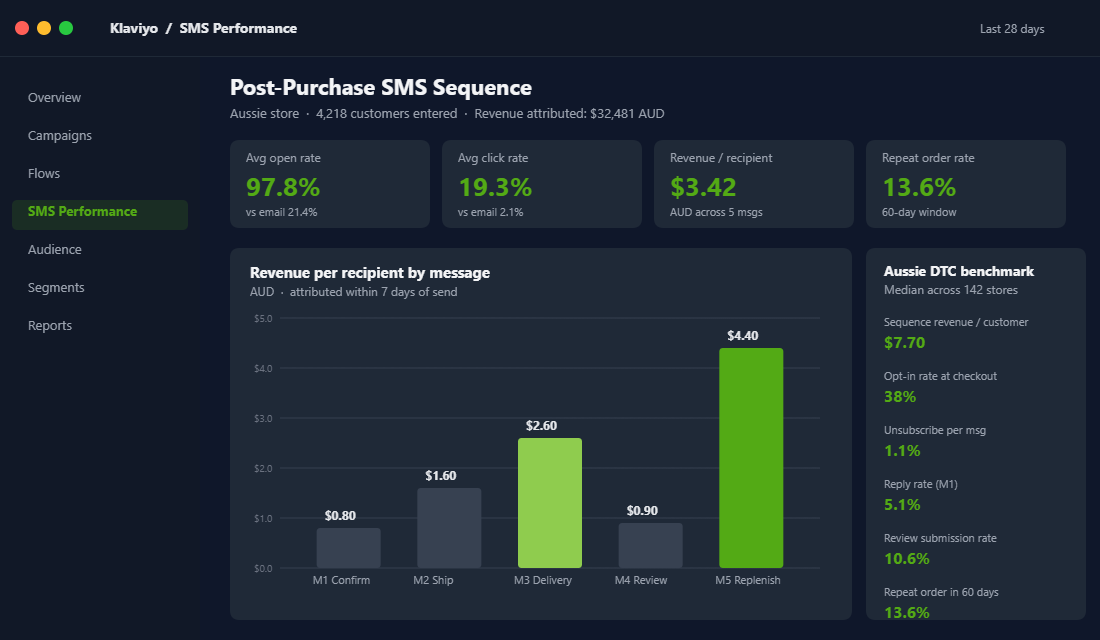
Now layer on the behaviour piece. The first 30 days after a purchase is the only window where a customer is genuinely paying attention to your brand. They opened the box. They tried the product. They are forming an opinion. The brand that shows up in that window with timely, useful messages wins the second order. The brand that goes silent loses the customer to whatever the algorithm shows them next.
This is the entire reason post-purchase email exists. SMS just does it harder, faster, and with a 4 to 5 times higher open rate. The two channels together are what beat email-only programs by 28 to 35% on total sequence revenue.
The 5-message post-purchase SMS sequence
This is the framework we run with brands doing between $40k and $500k a month on Shopify. It is built to layer on top of an existing post-purchase email sequence, not replace it. Each SMS hits a moment where email is slow or buried. The goal is to drive the second order inside the 30-day window where repeat-purchase intent is highest.
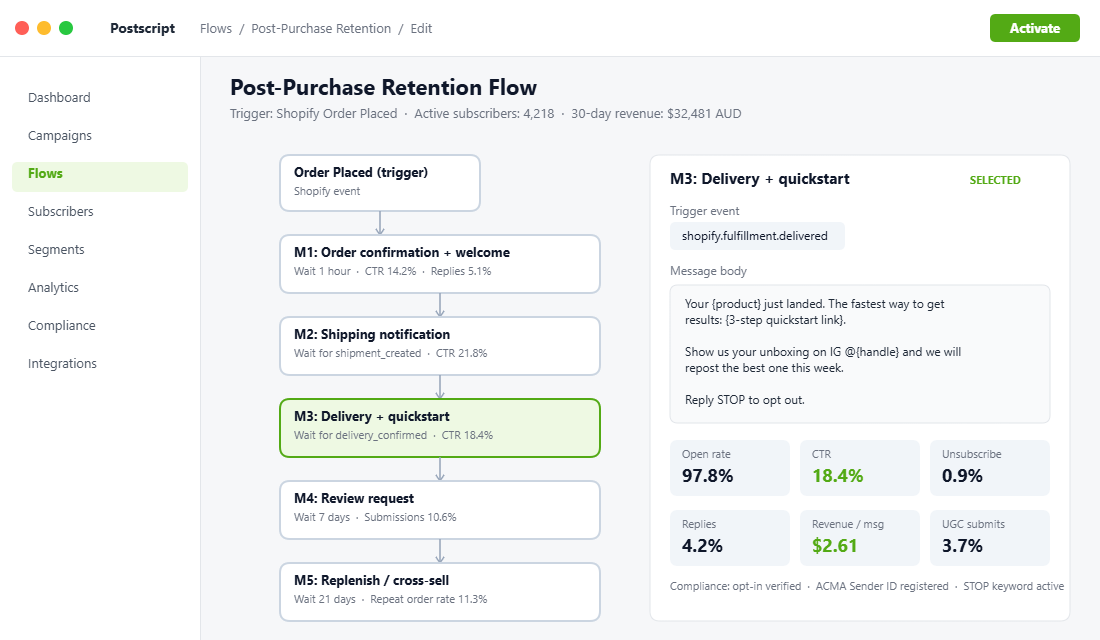
Message 1: Order confirmation and welcome (Hour 1)
The order confirmation SMS lands one hour after checkout. Not the transactional receipt Shopify already sends. A branded, human follow-up.
Template:
- “Hey {first_name}, Paul from {brand} here. Just wanted to say thanks for your first order. Your {product} is being packed now and will ship within 24 hours. If you have any questions, just reply here. Real human on this end. Reply STOP to opt out.”
The job of this message is not to sell. It is to convert the SMS opt-in from a checkbox into a relationship. Replies on this message run 4 to 8% on most accounts. Every reply is a chance to build the brand and surface objections before they become refund requests.
Message 2: Shipping notification with anticipation (when ships)
Standard tracking emails get ignored. A branded SMS the moment the parcel hits Australia Post or StarTrack lands in the customer’s hand and gets opened in under 90 seconds. The mistake most brands make is pasting the tracking number with no warmth.
Template:
- “Good news {first_name}, your {product} just left our warehouse in {city}. Track it here: {short_link}. While you wait, here are the 3 things our happiest customers do in the first week: {content_link}. Reply STOP to opt out.”
The content link points to a real educational page. A “how to get the most from your {product}” article, a video, or a quickstart guide. This is the message that starts behaviour change. The customer reads the guide, uses the product properly, and the product actually works for them. That is the foundation of a repeat purchase.
Message 3: Delivery confirmation and quickstart (day of delivery)
Delivery day is the single most under-used moment in ecommerce. The customer just opened the box. Dopamine is high. They are looking at the product. This is the moment to send the SMS that turns excitement into action.
Template:
- “Your {product} just landed. The fastest way to get results: {3-step quickstart link}. Show us your unboxing on IG @{handle} and we will repost the best one this week. Reply STOP to opt out.”
This message does three things at once. It drives first-use, which improves perceived value and reduces refunds. It seeds UGC, which feeds the top of your funnel for free. It reinforces brand identity at the peak of customer attention. Brands running this single message see a 12 to 18% click-through on the quickstart link and a 3 to 5% UGC submission rate.
Message 4: The review request (Day 7)
Review request emails sit at 10 to 15% open rate and a sub-2% submission rate. The same request over SMS lands a review submission rate of 8 to 12%, which is up to 6 times better. The trick is asking after the customer has actually used the product, not the day it arrives.
Template:
- “Hey {first_name}, you have had your {product} for a week now. 30 seconds for a quick star rating? It genuinely helps small Aussie brands like us. Tap here: {review_link}. Reply STOP to opt out.”
One tactical add. Route 5-star reviewers straight to a public review page (Judge.me, Yotpo, or Stamped). Route 3-star and below to a private feedback form that lands in your support inbox. This protects your public review average while still giving unhappy customers a clear path to be heard. The good ones go to your product page. The bad ones go to your customer service team. Both improve your business.
Message 5: Personalised replenish or cross-sell (Day 21 to 30)
The final message in the sequence is the one that earns the repeat order. Timing depends entirely on what you sell. Consumables (skincare, supplements, coffee, pet food) get a replenish SMS based on the predicted reorder date. Non-consumables get a cross-sell to the natural next product in the journey.
Replenish template:
- “Hey {first_name}, based on the {product} you bought on {purchase_date}, you are probably running low this week. Reorder in 2 taps with 10% off: {reorder_link}. Reply STOP to opt out.”
Cross-sell template:
- “You are loving your {product1}, right? Customers who bought it also rate {product2} as the perfect follow-up. Bundle and save 15% this week only: {bundle_link}. Reply STOP to opt out.”
If you have not figured out reorder timing yet, build a replenishment flow first using your average consumption data. Most brands selling consumables get the second order in the 21 to 35 day window. Hitting the right SMS at day 25 with a soft 10% nudge converts at 8 to 14%.
The Australian compliance layer you cannot skip
This is the section most international SMS guides skip. The Australian rules are stricter than US TCPA in some ways and the ACMA has been enforcing hard in 2025 and 2026. If you are sending SMS to Aussie numbers, you need to get this right or the fines will eat any revenue lift you generated.
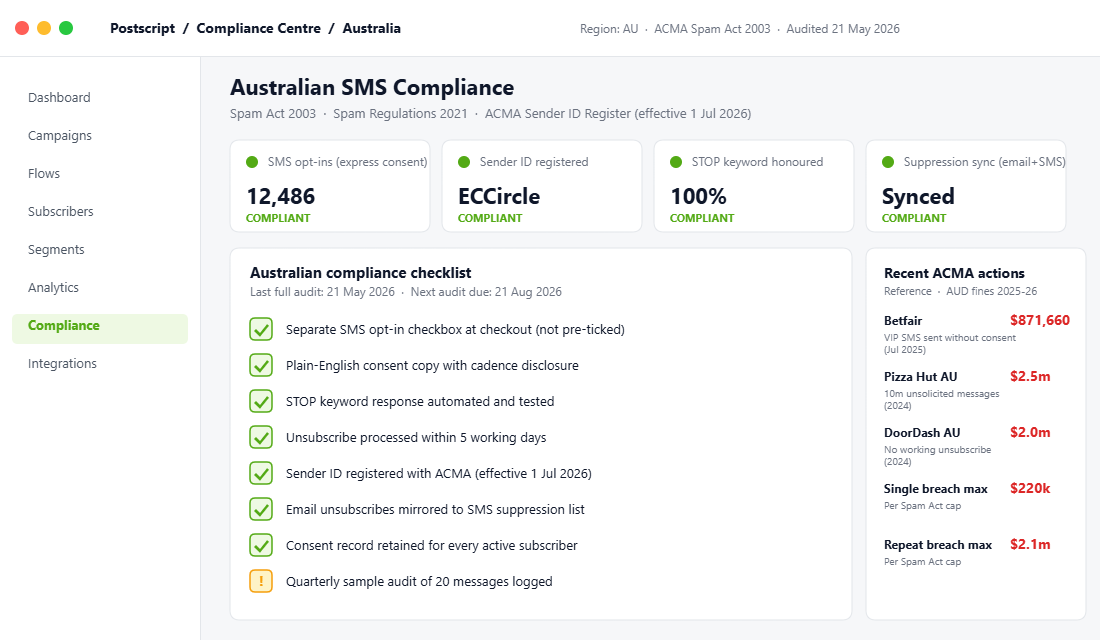
- Express consent is required for SMS. Under the Spam Act 2003 and Spam Regulations 2021, an email consent checkbox does not give you permission to send SMS. SMS opt-in must be its own checkbox, with clear language about what the customer is signing up for. Pre-ticked boxes are not consent.
- Unsubscribe must be honoured within 5 working days. “Reply STOP” is the standard, and your SMS platform should automate this. But if a customer emails you to unsubscribe, the 5-day clock starts then.
- Sender ID Register comes into force on 1 July 2026. Any business sending branded SMS (alphanumeric Sender IDs like “ECCircle” instead of a phone number) to Australian numbers must register that Sender ID with the ACMA. Register early. The Sender ID is part of your brand trust.
- Penalties are real. Up to $220,000 for a single breach. Up to $2.1 million for subsequent breaches. In July 2025, Betfair paid $871,660 after sending 140 marketing messages to VIP customers who had not consented or had opted out. VIP status does not override consent in the regulator’s view.
Practical checklist for your Shopify store:
- Separate SMS opt-in checkbox at checkout. Not pre-ticked. Plain language about the frequency.
- “Reply STOP to opt out” footer on every single SMS, transactional included.
- Sender ID registered with the ACMA before 1 July 2026.
- SMS suppression list synced with your email suppression list. If they unsubscribed from email, suppress SMS too, even though the rules are technically separate. Most brands learn this the painful way.
- Audit your SMS platform quarterly. Pull a sample of 20 sent messages and check consent records for each.
Picking the right SMS platform for your stack
Three platforms dominate Shopify SMS in Australia. The right pick depends on revenue, list size, and how integrated your email and SMS programs need to be.
- Klaviyo SMS is the default for brands already on Klaviyo for email. Shared profiles, shared segments, shared analytics. The trade-off is the SMS-specific features (flow conditions, link tracking, segmentation by SMS behaviour) are less granular than Postscript. Best for $40k to $500k per month brands who want one tool.
- Postscript is SMS-first and Shopify-native. Over 18,000 Shopify merchants run on it. The SMS flow builder, segmentation, and reporting are more powerful than Klaviyo’s. Pairs perfectly with Klaviyo for email if you want a two-tool best-of-breed stack. Best for serious SMS-led brands doing $200k per month or more.
- Attentive is the enterprise option. Custom pricing typically starts around $500 a month and scales fast. Realistic spend for a 100k to 500k SMS sender lands at $3,000 to $10,000 a month. Best for $1m per month plus brands who need dedicated strategy support.
The honest answer for most Aussie Shopify brands under $1m a month: run Klaviyo for email and SMS together for the first 6 to 12 months. Once SMS is generating 8 to 12% of total revenue, move SMS to Postscript while keeping Klaviyo for email. Plug them into each other through the native integration. That is the stack we install with most Connect members.
Setup steps: from zero to your first sequence live
Here is the order of operations to get the 5-message sequence live inside 5 working days, assuming you already have Klaviyo or Postscript connected to Shopify.
- Day 1: SMS opt-in at checkout. Add the SMS consent checkbox to your Shopify checkout (Settings, Checkout, Marketing). Add a second opt-in to your pop-up. Make the language plain English: “Yes, send me text messages about my order and exclusive offers (up to 4 per month). Reply STOP to opt out.”
- Day 2: Sender ID and compliance setup. Inside your SMS platform, set your Sender ID. Add the STOP keyword response. Sync your email suppression list to SMS. Register the Sender ID with the ACMA if you have not already.
- Day 3: Build messages 1 to 3 in the flow builder. Map the trigger (Shopify order placed), the wait times (1 hour, ships event, delivery event), and the message copy. Add merge tags for first name, product, city, and short link. Test send to your own phone before activating.
- Day 4: Build messages 4 and 5. Set the day 7 review trigger, route 5-star to public review platform and 3-star and below to private form. Set the day 21 to 30 replenish or cross-sell logic based on your average reorder window.
- Day 5: Activate and monitor. Turn the flow live on a small segment first (10% of new orders). Watch click-through rates, unsubscribe rates, and reply rates for 72 hours. If reply rate is above 3% and unsubscribe is below 2%, ramp to 100%.
Handling replies: the part of post-purchase SMS most brands switch off
Every message in the sequence above invites a reply, and a healthy post-purchase flow gets one from 8 to 15% of recipients. Most Aussie brands treat those replies as noise, route them to a no-reply number and lose the single highest-intent conversation their customer will ever start. A customer who texts back “where is my order” or “does this come in navy” is a live support ticket and a live upsell at the same time.
Set the channel up as two-way from day one. Klaviyo SMS, Postscript and Attentive all pipe replies into a shared inbox, and Gorgias and Zendesk both pull them into the same queue as email and chat. The rule we install with members is a 15-minute reply window during business hours and an automatic “got it, back to you by 9am” outside them. SMS replies answered inside 15 minutes convert to a second order at roughly twice the rate of replies answered the next day.
- Route by keyword, not by hand. Set keyword automations for the five things customers actually text: ORDER, RETURN, SIZE, STOCK and STOP. Each one triggers a canned first response with a tracking link, returns portal link or size chart, then hands off to a human only if the customer replies again. This clears 60 to 70% of inbound texts with zero staff time.
- Treat STOP as data, not just compliance. Unsubscribe rates above 2% on any single message in the sequence mean that message is mistimed or mis-targeted. Pull the message, not the flow. The sequence-level benchmark to hold is under 1% cumulative churn across all five sends.
- Answer product questions with a link, not a paragraph. A reply that says “yes, here is the navy” with a direct product link converts at 20 to 30%. A reply that describes the navy in three sentences converts at a fraction of that. The customer is on their phone, one tap from checkout, so give them the tap.
- Log every reply against the customer profile. Both Klaviyo and Gorgias write SMS conversations back to the profile, which means your loyalty tiers and win-back segments can use “replied to SMS in the last 90 days” as an engagement signal. Repliers are your warmest cohort; treat them that way.
One more habit worth building: read 20 raw replies every Friday. They tell you which product questions your PDP is failing to answer, which shipping promise you are missing, and which message in the sequence lands flat. That is the same voice-of-customer loop the broader SMS marketing playbook runs at the campaign level, and post-purchase is where it is cheapest to run because the customer has already paid you.
The compounding effect: SMS plus email beats either alone
The brands compounding fastest are the ones that stop arguing about SMS versus email and run them together. The pattern looks like this:
- Email handles depth: education, brand story, longer-form content, the second and third touch in a sequence.
- SMS handles immediacy: the moment of attention, the time-sensitive nudge, the human-feeling reply window.
- The two channels never fire at the same time. They are choreographed across the 30-day window so the customer always gets the right depth at the right moment.
The math: a strong email-only post-purchase sequence drives 8 to 12% of new customers to a repeat purchase within 60 days. Adding the 5-message SMS sequence layered on top lifts that to 11 to 16%. On a $50k per month brand with 1,000 new customers a month and a $90 AOV, that is roughly $13,500 a month in additional repeat revenue. Annualised, that is $162,000 in lifetime value the brand was leaving on the table.
Plug the SMS sequence into a tight RFM segmentation framework and the math gets better still. New customers get the 5-message flow. Lapsed customers get a different cadence. VIPs get exclusive early-access SMS instead of mass discount blasts. SMS gets sharper the longer you run it.
The post-purchase SMS scorecard
Run this scorecard once a month to make sure your sequence is working. Take the average across the last 28 days of sends.
- SMS opt-in rate at checkout: 30 to 45% is healthy. Under 20% means your opt-in copy needs work.
- Delivery rate per message: Above 96%. Below means carrier filtering. Check your Sender ID and message content.
- Click-through rate on message 2 and 3: 15 to 25%. Below 10% means your offer or content link is not compelling.
- Reply rate on message 1: 3 to 8%. This is a brand-relationship metric. Low replies mean the brand voice is not landing.
- Review submission rate on message 4: 8 to 12%. Under 5% means the timing is wrong, usually too early.
- Repeat order rate attributed to message 5: 6 to 14%. Under 4% means the timing is off or the offer is too soft.
- Unsubscribe rate per message: Under 2%. Above 3% means the cadence is too aggressive or the targeting is sloppy.
- Revenue per recipient across the full sequence: $1.80 to $4.50 for most Aussie brands. Above $5 means your sequence is best-in-class.
If any of these metrics are off, you do not need to scrap the sequence. You need to fix the specific message that is dragging the average down. SMS is one of the easiest channels to A/B test because feedback comes in inside 24 hours.
Prove it is working: the 90/10 holdout test
Platform dashboards flatter themselves. Attain and Klaviyo will both claim revenue for messages a customer barely glanced at, because last-click attribution inside an SMS tool counts any purchase within the window as SMS revenue. If you want the real number, run a holdout.
The setup takes ten minutes. Split your post-purchase flow audience 90/10 at entry: 90% get the full 5-message sequence, 10% get nothing after the transactional messages. Let it run for 60 to 90 days, then compare 60-day repeat purchase rate between the two groups.
- What good looks like: a 15 to 30% relative lift in repeat rate for the SMS group. If your base repeat rate is 20% and the SMS group sits at 24 to 26%, the flow is earning its keep.
- What a problem looks like: a lift under 5%. That usually means your messages are reaching people who would have bought anyway, and your platform dashboard has been taking credit for organic repeats.
- The money maths: multiply the incremental repeat orders by AOV and subtract message costs (roughly 8 to 12 cents per SMS in Australia). That is your true return, and it is the only number worth scaling decisions on.
Re-run the holdout once or twice a year. Flows decay as your product mix and audience shift, and a sequence that was incremental in March can be wallpaper by October.
Where to start this week
If you are reading this and you do not have a single post-purchase SMS firing, here is the minimum viable version. Build just message 1 and message 3. Order confirmation at hour 1, delivery day quickstart on delivery. That is it. Two messages. You can have it live by tomorrow lunchtime.
Run it for 30 days. Measure the click-through rate, reply rate, and repeat order rate from the segment that received the flow versus the segment that did not. The numbers will make the case for the other three messages on their own. SMS is not a channel that needs evangelising once the data is in front of you.
The brands that compound on Shopify are the ones who treat the first 30 days after a purchase like the most valuable real estate they own. Most operators rent that real estate out to discount blasts. The ones who win the next decade are the ones who build a 5-message post-purchase SMS sequence on top of a solid email program and treat every new customer like they might be a lifelong one.
Send-time, segmentation, and Aussie-specific benchmarks
The platforms and the sequence are only half the job. The Aussie brands that get post-purchase SMS to actually compound revenue dial in three things most operators ignore. Send time relative to local timezones, segmentation against repeat behaviour, and the benchmarks they use to know whether a flow is working or just sending.
Send-time rules that protect deliverability and reply rates. The Australian Spam Act does not set explicit send hours, but the ACMA expects “reasonable” practice, and most carriers throttle commercial SMS sent between 9pm and 8am local time. Anchor every SMS to the recipient’s timezone (Klaviyo and Postscript both support this), not your AEST default. Saturday morning sends (9am to 11am local) consistently outperform weekday afternoons on reply rate by 30% to 50% for non-time-sensitive messages like reviews and reorders. Time-sensitive ones (shipping, delivery) should fire immediately on event, no batching.
Segmentation that lifts the whole sequence. A flat post-purchase SMS sequence is fine at 4x ROI. A segmented one routinely hits 12 to 20x. The minimum segmentation worth running: first-time buyers versus repeat customers (different welcome and replenish copy), high-AOV versus standard (different upsell ladders), and product category (apparel needs sizing follow-up, supplements need usage instructions, electronics need setup help). Klaviyo and Postscript both let you branch a single flow on order tag, customer tag, or product collection.
Benchmarks to know if your sequence is healthy. Order confirmation SMS should hit 96%+ delivery and click rates of 8% to 12% if you include a tracking link. Review-request SMS sent on Day 7 should pull 4% to 8% review submission. Replenishment SMS on Day 21 to 30 should convert at 6% to 12% for consumables, 2% to 5% for non-consumables. If you are under those numbers, the timing or the copy is the issue, almost never the channel itself. Reply rates of 1% to 3% on any conversational SMS (like the welcome message) are healthy and worth staffing for, because replies are where the highest-LTV customers identify themselves.
Inside eCommerce Circle, post-purchase SMS is one of the core retention plays we install with every member. If you want a second set of eyes on your post-purchase sequence, let’s talk.