Here is the uncomfortable truth about your email list. The moment someone hands over their email address on your Shopify store, they are more interested in you than they will ever be again. They just clicked, they just opted in, they are sitting there with intent. And most Aussie brands waste that moment completely. They drop the new subscriber into a generic “thanks for signing up” autoresponder, or worse, into nothing at all, and then wonder why their email channel feels flat.
What’s in This Article
That first window is the single most valuable real estate you own in marketing. Welcome emails pull a 68.6% average open rate, the highest of any email type by a wide margin, and they convert at 0.94% versus 0.10% for a standard promotional send. That is a 9x difference from the exact same list. The welcome flow is not a nice-to-have. It is the highest-return sequence you will ever build, and it runs on autopilot once it is live.
This is the 6-email welcome flow we walk through with hundreds of Aussie Shopify founders. It turns a cold popup signup into a first-time buyer, builds the brand relationship that drives repeat orders, and does the selling while you sleep. Build it once, and it works on every new subscriber from now on.
Why the welcome flow outperforms everything else you send
Most founders pour their energy into campaign sends. The Tuesday newsletter, the weekend sale blast, the new-drop announcement. Campaigns matter, but they are a tax on your time and they hit people at random moments. Flows are different. They trigger off behaviour, they fire at the moment of peak intent, and they never need you to press send.
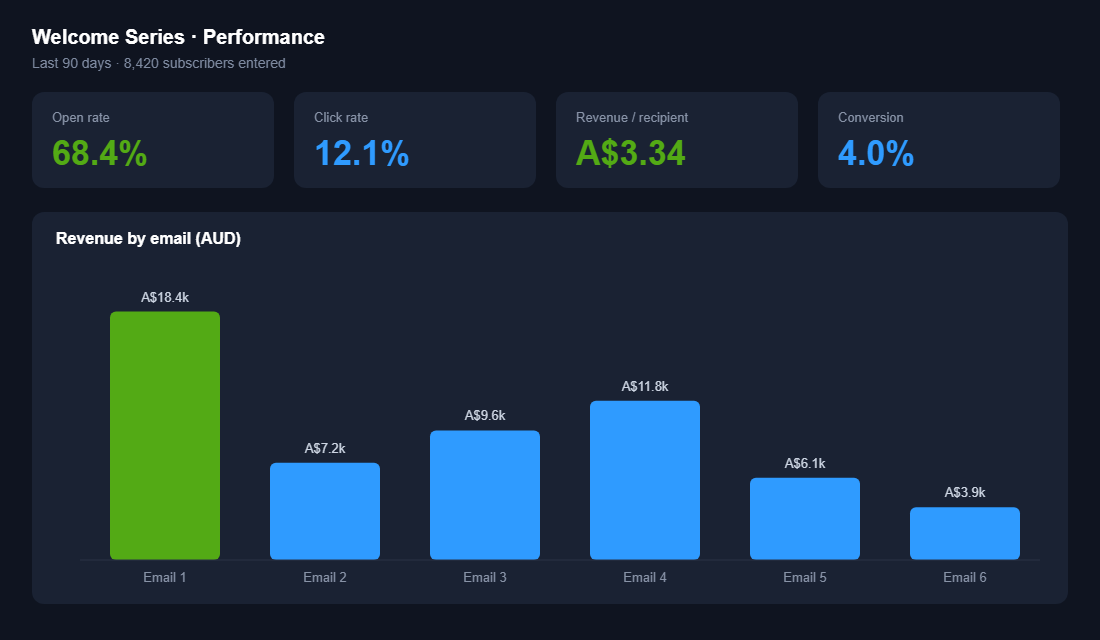
The numbers make the case on their own. A welcome flow generates roughly A$3.34 in revenue per recipient on average, compared with cents per recipient for a typical campaign. Running a series of two or more messages instead of a single welcome email lifts revenue by up to 51%. And when that first email lands instantly after signup, conversion can climb past 4%. The window closes fast, so the structure of the flow is what does the heavy lifting.
Think of the welcome flow as the front door to your whole retention engine. It is the first thing a new subscriber experiences, and it sets the tone for every email after it. Get it right and your campaigns land warmer, your abandoned cart flow catches more, and your customer lifetime value climbs across the board.
Before the flow: the popup that feeds it
A welcome flow is only as good as the signups feeding into it. If your popup is weak, the best sequence in the world has no one to talk to. The average email signup popup converts at around 2.1%, but ecommerce stores that get the offer and timing right sit at 5 to 8%, and the very best push past 10%.
Three levers move that number more than anything else:
- A real offer. Popups with a discount convert at 2.4% versus 1.7% without. A clear “15% off your first order” beats “join our newsletter” every time.
- Timing the trigger. A 6 to 10 second delay outperforms an instant popup. Let the visitor see what you sell before you ask for their email.
- Mobile-first design. Mobile-optimised popups convert at 2.2% against 1.4% for desktop-only designs. Most of your Aussie traffic is on a phone, so design for the thumb first.
One rule that saves you money: only promise the discount you can split out later. If you offer 15% to everyone, you will hand a code to people who were going to buy anyway. We set the popup to feed a list, then use a split inside the flow so existing customers never get the new-customer code. More on that below.
Email 1: Deliver the promise, instantly
The first email is the most important email your brand will ever send, and it has one job: deliver exactly what you promised in the popup. If someone signed up for 15% off, the code is the hero. No brand history, no manifesto, no five-paragraph story. They want the code, so give them the code in the first screen, above the fold, before they scroll.
Send it immediately. This is the moment of peak intent, and every minute you wait bleeds conversion. Use a unique, single-use code rather than a public one so it cannot be screenshotted into a coupon site and leaked across the internet. Add a soft expiry, something like “valid for 7 days”, to give a reason to act without feeling pushy.
Keep one clear call to action. Link straight to your bestsellers collection, not your homepage. You already know they are interested, so remove every extra decision between them and a product they can add to cart.
Email 2: Tell them who you actually are
Sent two days later, email two is your brand story. Not your company history, your reason for existing. Why did you start this? What do you stand for that the big players do not? This is where Aussie brands have a genuine edge, because most subscribers would rather back a founder with a point of view than a faceless catalogue.
Look at how the best do it. Frank Body leans hard into its cheeky, first-name brand voice from the very first email, so you know exactly who you are dealing with. Who Gives A Crap puts its donation mission front and centre, so buying toilet paper feels like doing something good. The product is almost secondary. The story is what makes you memorable in an inbox full of “20% off” subject lines.
Close this email by gently reminding them the welcome code is still live. The story earns attention. The reminder converts it.
Email 3: Borrow trust with social proof
By email three, the new subscriber likes the offer and gets the brand, but they still have one quiet question: can I trust this? This email answers it for them. Lead with proof, not claims. Real reviews, real ratings, real numbers like “rated 4.8 from 3,200 reviews” do more than any adjective you could write about yourself.
Pair the proof with your two or three bestsellers. New subscribers do not want to wade through 80 products, they want to know what everyone else buys. Show the hero products, attach the star ratings, and let the crowd make the decision easy. If you have genuinely earned it, a line like “join 40,000 Aussie customers” carries real weight here.
Email 4: The honest nudge before the code expires
This is the workhorse of the back half of the flow. Sent around day six, email four reminds the subscriber that their welcome code is about to expire. Urgency works, but only when it is true. A real expiry that you actually enforce converts. A fake countdown that resets every time they reload teaches people to ignore you.
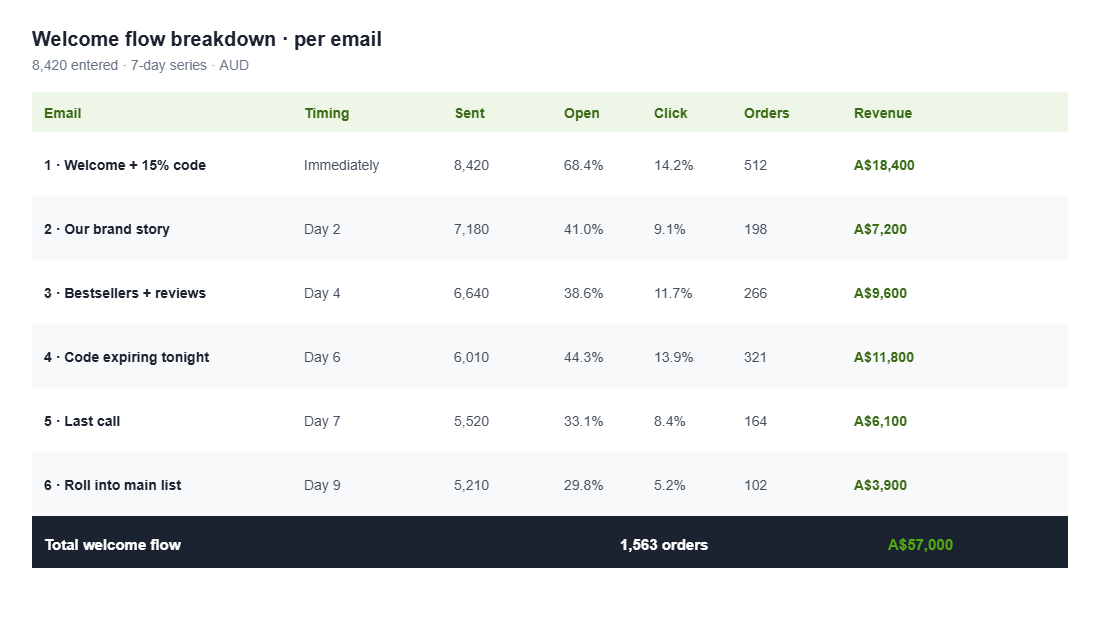
Keep it short and single-minded. One subject line about the deadline, one reminder of the offer, one button. In the breakdown below, this single email pulls more revenue than emails two and three combined, because it catches the people who liked everything but never quite got around to buying.
Emails 5 and 6: Last call, then a clean handover
Email five is your last call, sent the day after the code expires. Counterintuitively, “your discount has ended” can outperform the reminder, because loss aversion is real. Offer a small grace window or a reason to come back anyway, and you recover a slice of subscribers who were on the fence.
Email six is not really a sales email. It is the handover. By now the subscriber has either bought or not, and your job is to set expectations for what regular emails will look like and roll them cleanly into your main calendar. A simple “here is what to expect from us” message reduces unsubscribes later, because nobody feels ambushed by your next campaign.
The reason this matters: people who buy in the welcome window are your best candidates for a strong second order. If you know who they are and what they bought, your customer research and segmentation get sharper, and the next flow you build talks to them like you actually remember them.
How to build it in Klaviyo, step by step
Klaviyo is the default choice for serious Shopify brands, and the welcome flow is the first thing you should build in it. Here is the exact setup we use:
- Create the sign-up form first. Build a popup in Klaviyo, set a 6 to 10 second delay, and add a coupon block to the success screen so the offer feels instant. Point the form at a dedicated newsletter list.
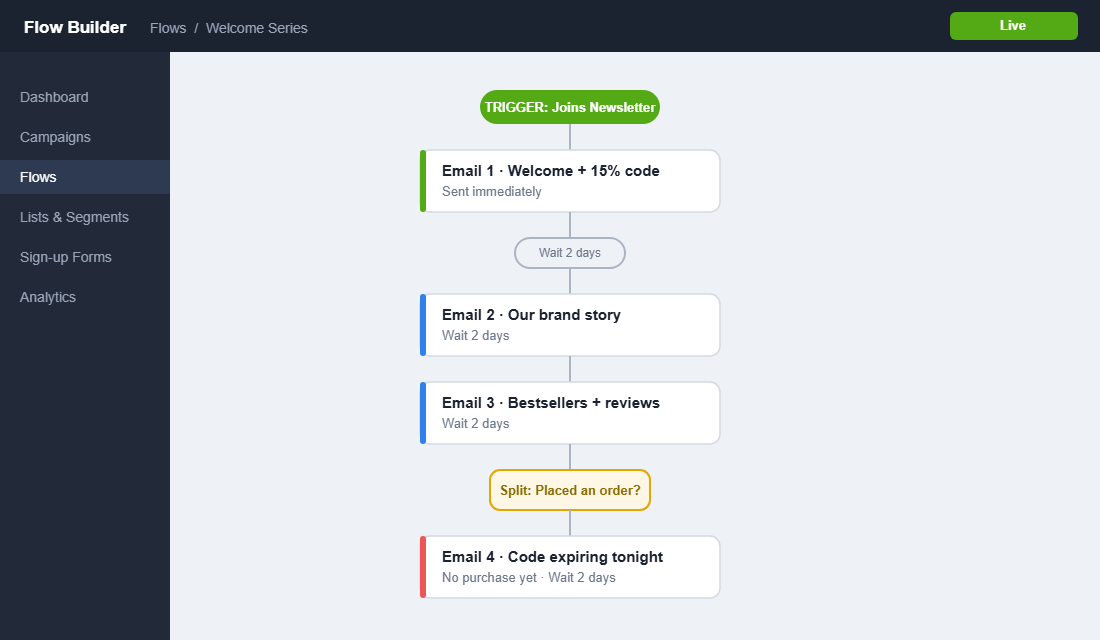
- Create the flow. Go to Flows, click Create Flow, and choose the Welcome Series template, or start from scratch for full control.
- Set the trigger. Trigger the flow off your sign-up form list, so anyone who joins enters the sequence automatically.
- Send email one immediately. No time delay before the first email. This is non-negotiable, since instant delivery is where the conversion lives.
- Add a conditional split. Insert a split on “Has Placed Order at least once over all time”. Send the discount path to people who have never bought, and a no-code path to existing customers so you never discount a sale you already had.
- Add time delays between emails. Space emails two to six by roughly two days each, keeping the whole flow inside seven to nine days.
- Use unique coupon codes. Generate single-use codes in the discount block so the offer cannot be leaked and reused.
- Turn it live and watch the first week. Check that codes apply at checkout, that the split routes correctly, and that nothing is sending twice.
One channel rule worth following: run one welcome series per channel. If you collect both email and SMS, build a separate SMS welcome triggered off the text list, because people often opt into each at different times.
The welcome flow build checklist
Save this and run it before you set your flow live:
- Popup live with a real offer, a 6 to 10 second delay, and mobile-first design.
- Email 1 sends instantly, leads with the code, links to bestsellers.
- Email 2 tells the brand story and reminds them of the offer.
- Email 3 stacks reviews and bestsellers for social proof.
- Email 4 nudges before a real expiry on day six.
- Email 5 is the honest last call after the code ends.
- Email 6 sets expectations and hands over to your main calendar.
- Purchase split stops existing customers getting the new-buyer code.
- Unique codes on, public codes off.
- Checkout tested end to end before going live.
Mistakes that quietly kill welcome flows
Most broken welcome flows are not missing, they are leaking. The sequence runs, but small errors drain the return before you ever notice. These are the ones we find most often when we audit an Aussie brand’s email setup:
- The first email is delayed. Even a one hour delay before email one quietly kills your best conversion window. Instant or nothing.
- No purchase split. Existing customers get handed the new-buyer discount, so you pay to discount sales you already had. The split pays for itself in a week.
- A public discount code. One screenshot and your “new subscriber” code is on every coupon site in the country. Single-use codes only.
- Six sales emails in a row. If every email shouts “buy now”, you train people to tune out. Two of the six should build the relationship, not push the cart.
- Set and never reviewed. Codes expire, products sell out, links break. A flow you built a year ago and never opened is probably sending people to a 404.
None of these are dramatic. That is exactly why they survive for months. Run the checklist above once a quarter and you will catch them before they cost you a season of signups.
The benchmarks to hold your flow against
Once your flow is live, you need a yardstick. Vanity opens are easy. Revenue is what counts. These are the numbers we use to judge whether a welcome flow is pulling its weight, drawn from current ecommerce email benchmarks rather than wishful thinking:
- Open rate on email one: aim for 60% or higher. Welcome emails average 68.6%, so anything under 50% points to a deliverability or subject-line problem.
- Revenue per recipient: A$3 or more across the full flow is a healthy target, with strong flows clearing it comfortably.
- Conversion rate: a well-built welcome flow converts new subscribers in the 2 to 4% range, against roughly 0.1% for a standard campaign.
- Share of email revenue: for most brands, automated flows like welcome, cart and post-purchase should out-earn one-off campaigns over time.
If your flow is short of these, do not rebuild it from scratch. Fix one thing at a time. Tighten the popup offer, make email one instant, add the split, then re-check after a few hundred new subscribers have moved through. Small fixes compound fast when every new signup runs the same gauntlet.
Why the six emails work as one system
Any single email in this flow is fine on its own. The power comes from how they stack. Email one captures the intent while it is hot. Emails two and three build the relationship and the trust that a discount alone never can. Emails four and five convert the fence-sitters with honest urgency. Email six protects the relationship for the long run. Pull any one out and the flow gets weaker, which is exactly why a multi-email series lifts revenue by up to half compared with a single welcome email.
It also compounds. Every new subscriber who buys in the welcome window enters your retention engine warm instead of cold. They are far more likely to open the next campaign, far more likely to be caught by your abandoned cart flow, and far more likely to come back for a second order. The welcome flow is not just the first sale, it is the on-ramp to every sale after it.
And it is the rare lever you build once. Set it live this week and it works on every signup for the next two years without you touching it. That is why we tell founders to build the welcome flow before they touch anything else in email. The return per hour of work is simply higher than almost anything else you can do in your store.
Inside eCommerce Circle, the welcome flow is one of the core pillars we work on with every member, because it is so often the fastest win sitting untapped in a Shopify store. If you want a second opinion on yours, let’s talk.