Most Aussie Shopify founders treat their referral program like a parking ticket. Bolt on a ReferralCandy widget, drop the link in the footer, send one half-hearted post-purchase email, then complain that “referrals don’t really work for us”.
What’s in This Article
Meanwhile, their top 10% of customers are already telling friends about them. Texting screenshots. Tagging mates in Instagram stories. Quietly building the cheapest acquisition channel in ecommerce while the brand pays Meta another $42 to win a stranger.
The job isn’t to invent demand. It’s to capture demand that already exists. The brands doing this properly are pulling 12 to 18% of revenue from referred customers, with a customer acquisition cost (CAC) that drops by 25% compared to paid social. Some sit higher. Subscription brands routinely see 20 to 40% of growth come from referrals. The math is brutal in one direction.
This is the 5-layer playbook we walk every eCommerce Circle member through when their referral channel is leaking. It assumes you already have a working store, repeat customers, and a Klaviyo account. Everything else is sequencing.
Why Referrals Quietly Beat Every Other Channel
Before the tactics, the math. If you do not believe the math, you will under-invest. And if you under-invest, you will get the same anaemic 1.2% referral revenue most stores see and conclude the channel is broken.
Three numbers to anchor on:
- Referred customers spend 25% more on their first order and stick around 37% longer than cold-traffic customers. Lifetime value runs roughly 16% higher.
- 62% of ecommerce brands now list referrals as a top three acquisition channel, up from a fringe tactic five years ago.
- Average ROI on referral spend sits near 8 to 1 across DTC. Compare that to your blended ROAS of 1.8 and the case writes itself.
The reason is trust. A friend recommendation collapses the consideration window. A shopper who lands on your product detail page (PDP) cold needs six to eight touchpoints to convert. A shopper who lands via a friend often converts in one session because the trust work is already done.
Now the structure.
Layer 1: The Trigger (Ask at Peak Emotional Loyalty)
The number one mistake Aussie founders make is asking for the referral at the wrong moment. Most ask at point of purchase, which is the worst possible time. The customer has not used the product. They cannot honestly recommend it yet. They feel the ask is transactional.
You want to trigger the ask at peak emotional loyalty. That is the moment a customer has experienced the product, felt the benefit, and is most likely to talk about it organically. The exact timing depends on the product:
- Apparel and accessories. Day 7 after delivery. The customer has worn it, washed it, and either fallen in love or moved on. Day 7 is when they show it off.
- Skincare and supplements. Day 21 to 30. The product needs time to show results. Asking before that means the customer cannot vouch for it honestly.
- Homewares and hard goods. Day 14. Enough time to unbox, set up, and live with the product.
- Subscription products. After the second box ships, not the first. The first box is curiosity. The second is commitment.
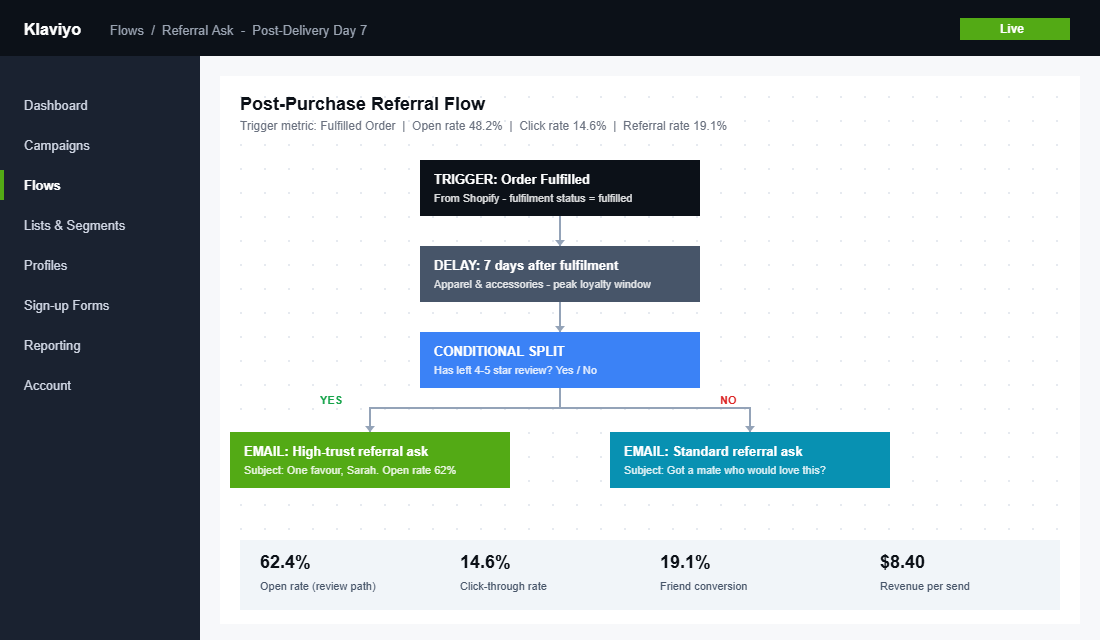
Build the trigger inside Klaviyo using the order shipped event from Shopify, then add a delay node before the referral email fires. Hook it into your post-purchase flow so it does not double up with review requests or replenishment reminders. The customer should get one ask, not three competing ones in the same week.
A second trigger worth running: post-positive-review. When a customer leaves a 4 or 5-star review on Judge.me, Yotpo, or Okendo, that is a flashing green light. Pipe that event into Klaviyo and fire a referral email within 48 hours. Conversion on this segment is typically 3 to 4 times higher than the cold post-purchase referral ask.
Layer 2: The Reward Architecture (Give-Get, Not Take-Take)
Reward design is where most programs die. Founders pick a number that sounds generous, slap it on both sides, and wonder why nobody shares.
Two rules. First, always run dual-sided rewards. Data across 2,000+ Shopify merchants shows dual-sided programs generate 2.3 times more referral shares and 1.8 times higher conversion than single-sided alternatives. 86% of working programs use give-get. There is no debate here.
Second, the friend reward matters more than the referrer reward. Friends who receive a reward convert at 15 to 22%. Friends who receive nothing convert at 8 to 12%, even when their mate is being rewarded. The “Get” side is where conversion actually happens. Most brands over-index on the referrer side and starve the friend side.
The reward maths to use:
- Average order value (AOV) under $80. Give $10 store credit, Get $10 off first order. Simple, symmetrical, doesn’t trigger an “is this real?” reaction.
- AOV $80 to $150. Give $20, Get 15% off first order (capped at $25). Percentage on the friend side feels generous; dollar amount on the referrer side feels concrete.
- AOV over $150. Give $40 credit, Get $30 off. At this price point, dollars beat percentages for both sides.
- Subscription brands. Give 1 free month, Get 50% off first month. Trial-style rewards convert harder than dollar discounts on subscription products.
One common mistake: stacking referral rewards on top of welcome discounts. If your welcome flow already gives 10% off, your referral landing page must override that, not stack. If a friend lands via referral and sees a “20% off your first order” pop-up because they have not been on the site before, your incentive math just collapsed. Lock that flow down inside your email tool by suppressing the welcome series when the source is “referral”.
Layer 3: The Share Mechanics (Make It Embarrassingly Easy)
Once the customer wants to share, your job is to remove every micron of friction. The default ReferralCandy or Smile install gives you a generic link that drops into a clipboard. That is where most programs stop. It is also why most programs flatline.
The share mechanic should hit four surfaces:
- One-tap SMS share. The customer taps a button, their default messaging app opens with a pre-written message and link. This single change typically lifts share rate by 30 to 50% in mobile-first niches like beauty and apparel.
- One-tap WhatsApp share. For brands with strong international or community customer bases (Aussie expats, multicultural niches), WhatsApp share converts at 2 to 3 times the rate of email.
- Personalised landing page. The friend doesn’t land on your homepage. They land on a page that says “Sarah thinks you’d love these. Here’s $15 to try them.” Personalisation lifts conversion 40% on referral landing pages.
- Logged-in account dashboard. The customer can see how many friends have clicked, signed up, and bought. Visibility drives repeat sharing. Most brands hide this in a footer link. Put it inside the account page top navigation.
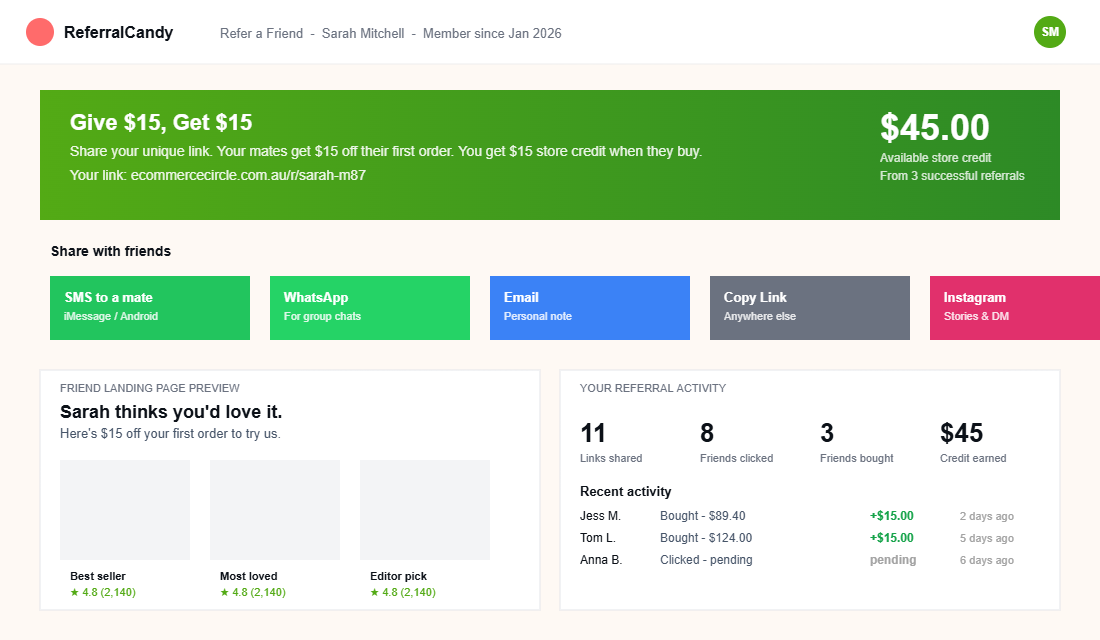
The pre-written share message matters more than founders think. Default ReferralCandy text reads like a coupon code spam. Write three versions for the customer to choose from, each tuned to the relationship:
- To a close mate. “Mate, you have to try this. I’ve been using it for a month and it’s the only one that actually works. Here’s $15 off your first one.”
- To a group chat. “Heads up, anyone who wears [category], this brand is legit. Code below gets you $15 off.”
- To a colleague. “Random recommendation, but this is the [product] I bought recently and it’s been brilliant. $15 off if you want to try.”
Bondi Sands runs a version of this through Club Bondi Rewards. Members earn 200 points for every friend they bring into the program, layered on top of their “Babes Who Bondi” private Facebook community of 22,000 customers. The community is the moat. The referral mechanic is the conversion layer on top.
Layer 4: The Friend Experience (Where Most Programs Quietly Fail)
The friend lands. The clock starts. You have about 90 seconds before the trust the referrer transferred to you evaporates into checkout friction.
Build the friend landing page as if it were a paid-traffic landing page, not an account page bolt-on. Four blocks, in this order:
- Personalised hero. “Sarah thinks you’d love [brand]. Here’s $15 to try us.” First name pulled from the referrer’s account, reward in plain language. The friend does not need to think about how to claim it.
- 3 to 5 hero products. Not the whole catalogue. The bestsellers, with a clear “this is what most people start with” framing. Decision fatigue kills referral conversion.
- Social proof bar. Star rating, review count, a single testimonial that addresses the most common objection. For apparel, sizing. For supplements, “how long until it works”. For homewares, quality.
- Reward applied automatically at checkout. Not a code to copy and paste. Automatic. Every step of manual code entry kills 15 to 20% of redemptions.
One detail most teams miss: the friend should never see a generic welcome pop-up offering 10% off when they land via a referral link. If they do, your reward stack just collided with itself and the friend now sees two competing offers. Suppress the welcome pop-up when the URL parameter indicates referral source. Most popup tools (Justuno, Privy, Klaviyo signup forms) let you exclude by UTM parameter.
Friend conversion benchmarks to anchor against:
- Landing-page-to-add-to-cart: 18 to 28%. If you are under 15%, the landing page is the problem.
- Add-to-cart-to-checkout: 55 to 70%. If you are under 50%, the checkout flow is breaking the referred-customer pricing.
- Checkout-to-purchase: 70 to 80%. Under 60% usually means the discount didn’t apply automatically.
- Overall friend conversion rate: 8 to 15% for healthy programs, 18%+ for best-in-class.
Layer 5: The Measurement Stack (The Three Numbers That Decide Everything)
You cannot improve what you cannot see. Most founders look at one number, “referral revenue”, and miss the diagnostic information underneath it. Track three numbers weekly, not monthly:
- Participation rate. The percentage of eligible customers who actually share. Healthy is 18 to 25%. Under 10% means your trigger or share mechanic is broken.
- Share-to-conversion rate. The percentage of shares that result in a friend purchase. Healthy is 8 to 15%. Under 6% means the friend landing page or reward is the problem.
- Referred customer LTV. The lifetime value of a referred customer compared to your blended LTV. Healthy is 1.2 to 1.4 times blended. Under 1.0 means your reward is attracting the wrong friends (typically discount hunters, not actual brand fits).
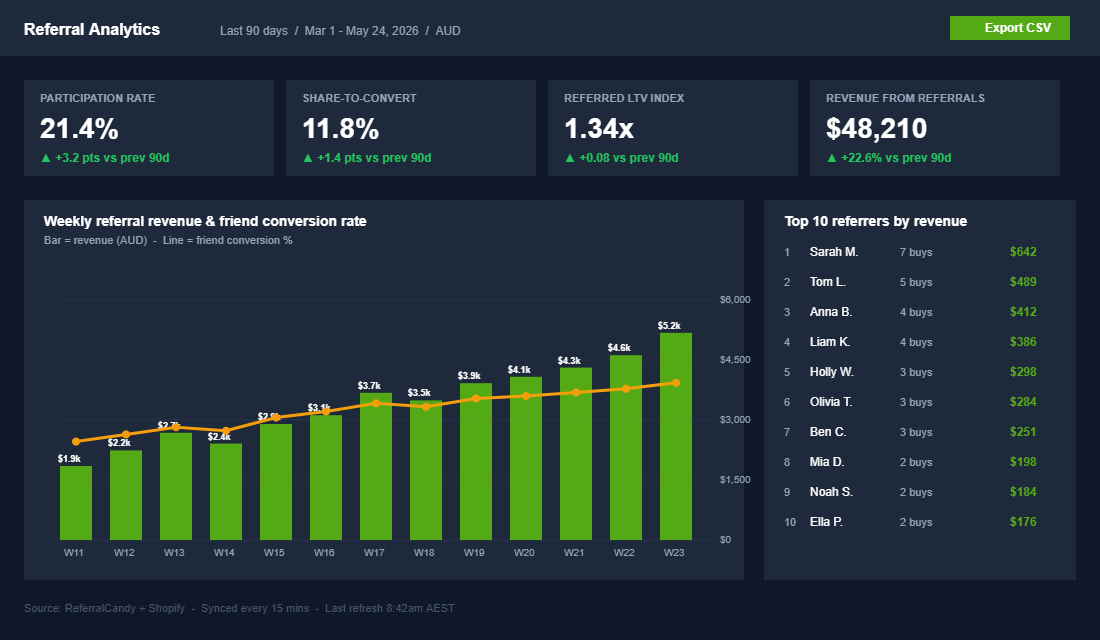
The reason LTV is critical: a high-conversion, low-LTV referral program is a leaky bucket. You acquire cheap, but the friends churn fast because they came for the discount, not the brand. The fix is usually on the reward side. Tighten the discount, lift the brand-fit messaging on the friend landing page, and watch LTV climb back into healthy range.
Tool stack to make this measurable without engineering work:
- ReferralCandy. Built for Shopify and Shopify Plus certified, 4.9 stars across 1,469+ reviews, from $29 per month. Easiest path for brands under $5M annual revenue.
- Smile.io. Best when you want loyalty plus referrals in one stack. Slightly more expensive but the dashboard pays for itself if you run both programs.
- Friendbuy or Talkable. Enterprise options. Worth the spend at $1M+ monthly revenue when A/B testing rewards becomes the bottleneck.
- Rivo. Built exclusively for Shopify and Shopify Plus. Cleanest UI of the bunch if you are starting from scratch in 2026.
The Compound Effect (Why This Channel Quietly Outgrows Paid)
Run the five layers properly for 90 days and the numbers start to bend in your favour. Run them for 12 months and the channel becomes structural.
Here is the compounding mechanic. A customer with a lifetime value of $240 generates, on average, 0.4 referrals across their lifetime in a healthy program. Each referred customer has an LTV roughly 16% higher than blended, so $278. Of those, the same 0.4 referral ratio applies. By year two, every original customer has produced roughly 0.6 referred customers worth a combined $167 in additional gross profit, with zero ad spend attached.
Now layer in the CAC effect. If your blended CAC is $48 and referred customers cost you the reward only (say $20), you have effectively halved your acquisition cost on 12 to 18% of your revenue base. That margin gets reinvested into either lower ad-floor prices, faster shipping, better product, or better packaging. All of which feed back into the referral loop.
This is how brands like Frank Body grew before paid social got expensive. It is how brands that survived the 2024 to 2025 iOS attribution mess still grow. Word-of-mouth was always the moat. The referral program just made it measurable.
The 30-Day Implementation Checklist
If you are starting from zero, run this sequence over the next 30 days. Do not skip steps.
- Days 1 to 3. Install your referral app. ReferralCandy or Smile.io for most brands under $5M.
- Days 4 to 7. Design the reward architecture. Pick give-get values based on your AOV band. Lock down stacking rules in Klaviyo and your popup tool.
- Days 8 to 14. Build the friend landing page in your Shopify theme. Personalised hero, 3 to 5 hero products, social proof bar, auto-applied reward. Test on mobile first.
- Days 15 to 21. Build the Klaviyo trigger. Order delivered + product-specific delay + referral ask email. Add the post-positive-review trigger.
- Days 22 to 25. Build the account-page dashboard. Show pending referrals, completed referrals, total earned. Update site nav to surface “Refer a Friend” prominently.
- Days 26 to 30. Set up the weekly measurement dashboard. Participation rate, share-to-conversion, referred LTV. Schedule the review meeting on your weekly operating rhythm.
Run this for 90 days before judging the channel. Referral programs have a long warm-up because the trigger fires weeks after the first purchase. Plotting performance on day 30 will give you a misleading read. Day 90 is your honest first signal.
Two related reads that pair with this playbook: the Shopify loyalty program blueprint for stacking referrals on top of a points engine, and the top 10% customer strategy for identifying the customers most likely to refer. If you also want the upstream piece, customer lifetime value is the calculation that justifies the reward maths.
The Three Mistakes That Kill Referral Programs in Month Two
Most referral programs do not fail at launch. They fail about six weeks in, when the novelty wears off and the structural flaws surface. Watch for these three.
- Set-and-forget reward fatigue. A “$10 off for you and a mate” offer that never changes becomes wallpaper. Brands that rotate their referral hook quarterly (dollar credit, free product, early access) see participation rates hold at 8 to 12% of customers, while static programs drift below 3% by month three.
- Burying the ask in one channel. If your only referral prompt lives in a post-purchase email, you are reaching maybe 35 to 45% of your buyers (that is a typical open rate, not a reach figure to be proud of). The trigger needs to appear at three or more touchpoints: the thank-you page, the parcel insert, the account dashboard, and your welcome email flow for repeat-purchase categories.
- Ignoring fraud until it eats the margin. Self-referrals and coupon-site leakage typically run at 5 to 15% of referral redemptions if unchecked. Turn on the fraud controls in ReferralCandy or Okendo from day one: same-address blocking, minimum order values, and a redemption cap per advocate. It is a ten-minute job that protects thousands in credits.
The fix for all three is the same habit: put referral metrics on the same weekly dashboard as your paid channels. The moment you review referral participation next to ROAS, the program stops being a widget and starts being a channel.
The Bottom Line
A referral program is not a footer link. It is a 5-layer system: trigger, reward, share mechanics, friend experience, measurement. Build all five and you have built a channel that compounds, lowers CAC, and lifts LTV at the same time. Build one or two and you get the same 1.2% revenue most brands settle for.
The brands hitting 12 to 18% of revenue from referrals are not lucky. They built the system. They run the weekly numbers. They treat their happiest customers as a channel, not an accident.
Inside eCommerce Circle, the referral program build is one of the core pillars we work on with every Patrons-focused member. If you want a second opinion on yours, let’s talk.