Most Aussie Shopify founders treat influencer marketing like a lottery ticket. Send a few PR boxes, wait, hope something goes viral. Six weeks later, the spreadsheet shows two posts, 14,000 vanity views, three discount-code redemptions, and a tearful conversation with the accountant about why $8,000 walked out the door for nothing.
What’s in This Article
The brands actually pulling 8 to 15% of revenue out of creator partnerships are not luckier. They are running a system. The average influencer campaign now returns $5.78 for every $1 spent, and top-performing programs return $18 to $20 per $1, but only the operators who treat this like a paid channel (with briefs, tracking links, commission structures, and a creator CRM) get anywhere near those numbers.
This is the 6-phase system we walk Aussie DTC brands through inside eCommerce Circle. It works whether you are at $50k a month dipping a toe in, or $500k a month and ready to scale a creator program into a top-three channel. No vanity metrics. No “post and pray”. Just the architecture that turns creator partnerships into a tracked, repeatable, margin-positive part of the marketing mix.
Phase 1: Pick the Right Creator Tier (The Nano vs Micro vs Macro Maths)
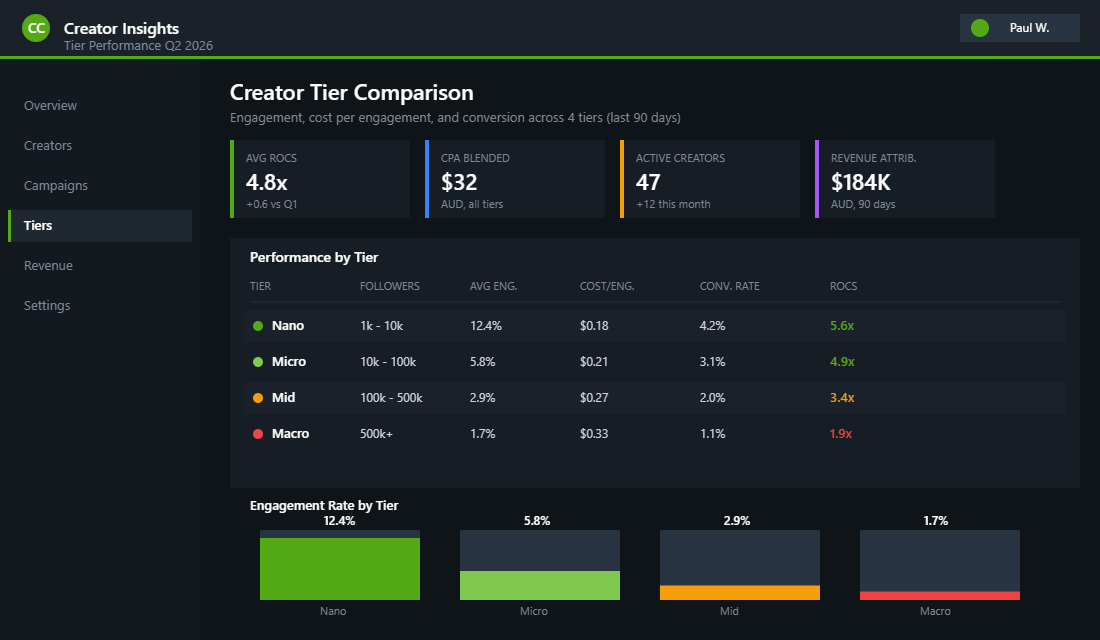
The first mistake almost every founder makes is chasing follower count. A 500k-follower creator feels prestigious. The reality is that on Instagram, macro creators (1M+) sit at 1 to 3% engagement, while micro creators (10k to 100k) hit 3 to 5%, and nano creators (1k to 10k) on TikTok regularly hit 18% engagement. The maths are brutal: a nano with 8,000 followers and a 12% engagement rate moves more product than a macro with 1.2M followers and a 1.5% rate. Every time.
Here is how to actually choose. Map your goal first, then map the tier:
- Awareness at scale. One macro placement (1M+). High cost, broad reach, weak conversion. Use sparingly, mostly for brand-equity moments like a product launch or a category-defining campaign.
- Direct response and revenue. Twenty to forty nano and micro creators running concurrently. Low cost per partnership, high engagement, traceable conversions through discount codes and Shopify Collabs links.
- Long-term trust and authority. Three to five mid-tier creators (100k to 500k) on a 6 to 12 month exclusive in your category. They become identified with the brand, like Frank Body’s coffee-scrub ambassadors did for years.
The cost-per-engagement difference is the part that breaks founders out of the “go big” mindset. Industry benchmarks put micro creators at roughly $0.20 per meaningful engagement and macro creators at $0.33. That is 65% more per real interaction through macros. For a brand running $20k a month into creators, that maths alone is the difference between 60,000 and 100,000 engaged touches.
The Australian context tightens it further. A nano creator with 5,000 to 10,000 followers in your niche typically charges AUD $50 to $300 per post. A micro creator (10k to 50k) charges AUD $200 to $1,200. You can build a 30-creator nano program for under AUD $6,000 in talent fees, plus product. That is your starting point.
Phase 2: The Creator Brief That Actually Converts
The brief is where most programs quietly die. Founders send a one-paragraph DM that says “would love for you to try our product and share if you like it”, and then act surprised when the creator posts a single Story with a $10 discount code buried at the bottom.
A brief that converts is one page. It includes a clear angle the creator will speak to, three non-negotiables (your offer, your hashtag, your tracking method), and the freedom for the creator to do the rest in their own voice. The fastest way to ruin a partnership is to write the caption for them. Their audience can smell a brand-written script in two seconds.
The template we have Aussie founders use has eight sections:
- The hook angle. One sentence on the specific problem your product solves and the story the creator can tell. Not “we make great skincare”. Instead, “the only Aussie SPF that does not pill under makeup”.
- Three audience pain points. Real quotes from your reviews and post-purchase surveys. Hand the creator the language their audience already uses.
- The offer. A discount code only valid through the creator’s link or code, ideally 15 to 20% off the first order. Higher than your usual sitewide ceiling so it feels exclusive.
- The format and deliverables. One Reel, two Stories, one carousel post, with usage rights for 6 months. Specify the channel mix up front.
- Three “must-include” beats. Product name, your handle, the tracking link or code. That is it. Do not script anything else.
- Three “do not” rules. No competitor comparisons, no clinical claims you cannot back, no “miracle” language. Keep the legal team out of the inbox.
- The timeline. Draft for review by date X, publish by date Y, dark-post permissions granted by date Z if you plan to whitelist.
- How they get paid. Flat fee, commission, or both. Pay date. Currency. Tax invoice instructions for the Aussie ones.
One operator we work with in the wellness category cut their creator-program turnaround from six weeks to nine days by templatising this brief in Notion. The creator gets a clean link, fills in their handle and rate, and the deal moves. The brief is also the document that protects you if a partnership goes sideways, because every expectation is in writing.
Phase 3: Negotiation and Deal Structure (What to Pay, What to Avoid)
Most founders either overpay (because they are intimidated by the creator’s pitch deck) or insult creators by offering “exposure” instead of cash. Both kill the program. The fix is to have a published rate card you stick to.
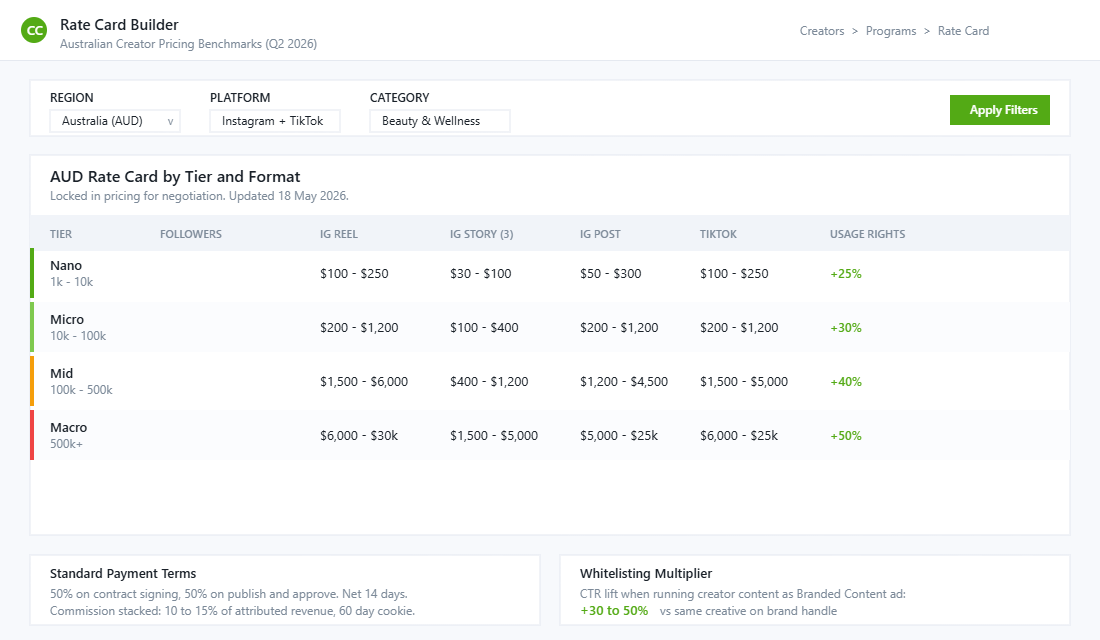
The Aussie 2026 benchmarks we use as the anchor:
- Nano (1k to 10k followers). AUD $50 to $300 per Instagram post, $30 to $100 per Story set, $100 to $250 per Reel or TikTok video. Often happy to work for product alone if the product retails over $150.
- Micro (10k to 100k followers). AUD $200 to $1,200 per Reel or TikTok, $300 to $1,500 per carousel, $100 to $400 per Story set. Plus product. Plus usage rights if you want to repurpose into paid.
- Mid-tier (100k to 500k followers). AUD $1,500 to $6,000 per Reel, often packaged as a 3-deliverable bundle. Expect a quoted fee and a contract.
- Macro (500k+). AUD $6,000 to $30,000+ per deliverable. Treat this like a small ad campaign with legal sign-off, talent contracts, and brand-safety reviews.
Layer commission on top of every deal, not instead of it. The structure that works: a smaller flat fee (say 60% of the creator’s normal rate) plus 10 to 15% commission on every sale through their code, with a 60-day cookie window. This gets you the content guaranteed, and incentivises the creator to keep promoting after the original post. Brands using this hybrid model report creators reposting their content three to four times over the first six weeks, instead of once and done.
Two negotiation rules to write on the wall. First, always ask for usage rights up front. Adding them later costs three to five times more. Six months of paid social usage rights should be 30 to 50% on top of the flat fee, not 200%. Second, do not pay the full fee before the post goes live. Standard terms are 50% on signing, 50% on publish-and-approve. Any creator who refuses split payment is a flag.
Phase 4: The Tech Stack (Shopify Collabs Is the Backbone)
Until 2023, running a creator program meant either spending $400 to $2,500 a month on a platform like GRIN, Aspire, or Klear, or stitching together spreadsheets, Bitly links, and manual PayPal payouts. Now there is a third option, and for most brands under $5M a year it is the right one: Shopify Collabs.
Collabs is built into the Shopify admin, free to install, and handles the four jobs that used to require three separate tools:
- Discovery and applications. A branded public page where creators can apply to work with you. The creator network sits on the Shopify side, so applicants self-qualify based on your category.
- Tracking links and codes. Every creator gets a unique link and discount code. Conversions flow into the Collabs dashboard with real revenue, not estimated reach.
- Product gifting. You can send gifts straight from the Collabs interface and choose which products are eligible. The creator sees a curated catalogue, not your full SKU list.
- Automatic payments. Commissions are paid out through your Shopify bill, with a 2.9% processing fee on top. No PayPal, no chasing invoices, no manual reconciliation.
The setup is genuinely under an hour. From the Shopify admin, install Collabs from the App Store, set your commission structure (start at 10 to 15% flat, then layer tiers as you scale), build a public application page with your brand colours and three application questions, then publish the link in your bio and in your post-purchase emails. Existing customers are your best first creators, which is why the application link belongs in your order-confirmation flow inside your post-purchase email stack.
For brands over $5M turnover or running 100+ creators simultaneously, the upgrade path is GRIN or Aspire. Pricing starts at AUD $600 to $2,500 a month and gets you better discovery, deeper analytics, and outreach automation. But do not start there. Earn the right to that spend by proving the channel with Collabs first.
Phase 5: The Content Calendar and Whitelisting Layer
The biggest miss in most creator programs is treating each post as a one-off. A Reel goes live, drives a small spike, and dies in 48 hours. The compounding play is to plan content like a publication and recycle it into paid media.
The calendar structure we recommend runs on a 4-week cycle:
- Week 1: Seeding. Send product to 8 to 15 nano and micro creators with no contract, only a request to tag if they post. Two to four will. Track which content performs best organically.
- Week 2: Paid partnerships. Activate 4 to 6 paid creators with the brief from Phase 2. These are the ones you commission for guaranteed content and usage rights.
- Week 3: Whitelisting. Take the top 2 performing pieces of creator content (paid or seeded), run them as dark-post ads through Meta Business Manager using the creator’s handle. This is the multiplier most founders never use.
- Week 4: Repurpose and measure. Cut creator content into Stories, Reels for your own brand handle, email banners, and PDP video. Review the month’s revenue per creator in the Collabs dashboard. Cut bottom 30%. Re-up top 30%.
Whitelisting is the part most founders skip because it sounds technical, but the lift is significant. When you run a creator’s content as a paid ad from their handle (with their permission and Meta’s Branded Content tools), click-through rates often run 30 to 50% above an equivalent brand-handle ad. Their followers see “@creatorname Paid Partnership with @yourbrand”, which carries social proof a brand-created ad cannot match. This is also where the maths on usage rights pays back fivefold within the first week of running.
The connection to your broader paid-media strategy matters here. The best creator content fuels your Meta ads landing page architecture and slots straight into your top-of-funnel rotation. That is how influencer programs stop being a side channel and start contributing 8 to 15% of total revenue.
Phase 6: Track Revenue (Not Likes) With a Real Measurement Model
You cannot scale what you cannot measure, and 60% of marketers say measuring influencer ROI is their number-one challenge. The reason is they are measuring the wrong things: impressions, reach, vanity engagement. Those are platform metrics, not business metrics.
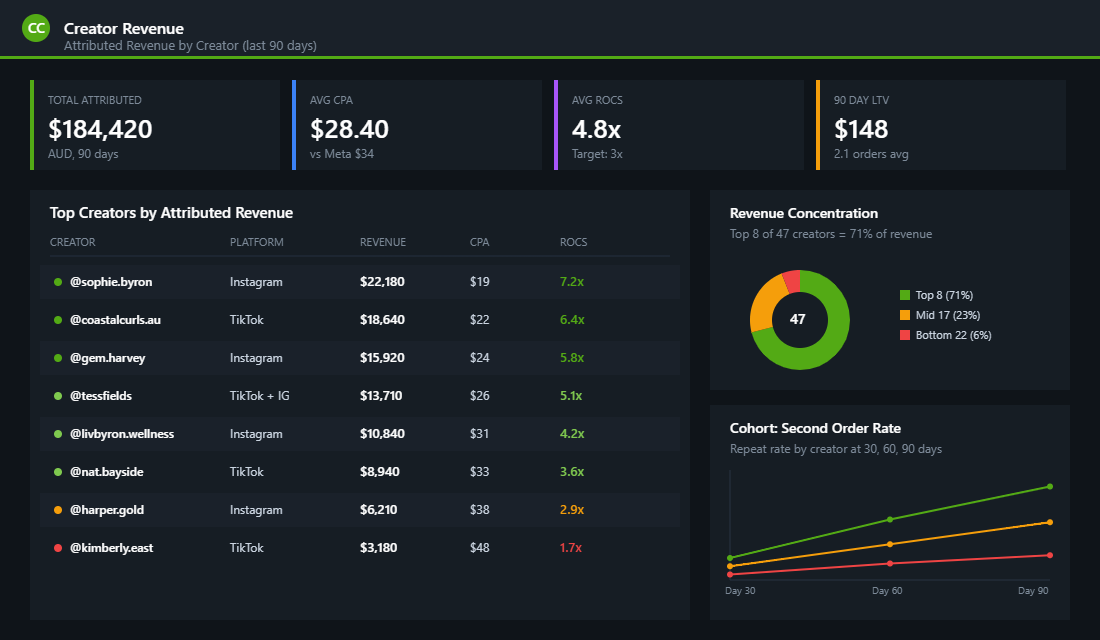
The measurement model we use has four KPIs per creator, reviewed monthly:
- Attributed revenue. Pulled from the Collabs dashboard plus discount-code redemptions in Shopify analytics. This is the floor number, often undercounting actual contribution by 20 to 30% because last-click attribution misses view-through.
- Cost per acquisition (CPA). Total spend on that creator (flat fee + product cost + commission paid) divided by new customers acquired through their code or link. Compare to your blended Meta CPA. Anything inside 1.2x of Meta CPA is healthy at scale.
- Return on creator spend (ROCS). Revenue attributed divided by total spend. Below 2x is a fail at scale. 3 to 5x is healthy. Above 5x means you have a creator-product fit and should re-up immediately on a 6-month exclusive.
- 90-day LTV by creator. Track the cohort of customers acquired through each creator and look at their second-order rate at 30, 60, and 90 days. Some creators bring high one-time buyers (low LTV), some bring repeat customers (high LTV). This is where cohort analysis earns its keep.
One Aussie skincare brand we worked with in the $2M revenue band ran 47 creator partnerships over a quarter. The Collabs dashboard showed the top 8 creators (17% of the program) drove 71% of attributed revenue. The bottom 22 creators (47% of the program) drove 6% of revenue. Reallocating the bottom-22 spend to deeper partnerships with the top 8 lifted total influencer-driven revenue 38% in the following quarter, with the same total budget.
To catch the view-through impact that last-click misses, add one post-purchase survey question to every new order: “Where did you first hear about us?” Make creators a tagged answer. Cross-check the percentage against your Collabs-attributed revenue. When the survey number is significantly higher than Collabs, you have under-credited the channel and should increase the program budget, not cut it.
When to Re-Sign, Renegotiate, or Walk Away From a Creator
Phase 6 gives you the numbers. Now you need rules for what to do with them, because the brands that win at influencer marketing aren’t the ones who find a great creator once, they’re the ones who manage a roster ruthlessly over time.
After each creator’s first cycle, sort them into three buckets based on creator-specific CAC and contribution, never follower count:
Re-sign and scale (your top 20 to 30%). These are creators whose blended CAC beats your paid-social CAC and who returned 3x or more on fee plus product. Lock them into a multi-post deal, move them onto ongoing affiliate commission so incentives stay aligned, and put paid spend behind their best-performing post. Whitelisting, or Spark Ads, is usually the single highest-return move in the entire program.
Renegotiate (the middle 40%). They drove real engagement but thin direct sales. Shift them off flat fees onto a gift-plus-commission or lower base, hand them a sharper brief, and give them one more cycle before you decide.
Cut (the bottom 30%). Big views, no measurable sales, code redemption near zero. Thank them and move on. Vanity reach is the most expensive thing you can pay for.
A practical benchmark while you judge engagement: nano creators (1k to 10k followers) often post 5 to 8% engagement, micro creators 2 to 5%, and macro creators 1 to 2%. Engaged reach converts; raw reach rarely does. And remember that the buyers a creator sends you are only profitable if they come back, so make sure your post-purchase email flow is set up to catch them. Review the roster every 90 days using Shopify Collabs for affiliate tracking (or GRIN for a larger program) and you’ll compound a small group of proven creators instead of starting from scratch every quarter.
The Compound Effect: How the Six Phases Stack
None of these phases works as a one-off. The reason 8 to 15% of revenue from creator partnerships is the realistic ceiling for a well-run program is that each phase multiplies the next. Pick the right creator tier (Phase 1), and your brief (Phase 2) lands with a creator whose audience actually buys your category. Get the deal structure right (Phase 3), and the creator has skin in the game to keep promoting beyond the first post. Put it all into Shopify Collabs (Phase 4), and every conversion is tracked without manual work.
Now layer the content calendar (Phase 5): the same creator post you paid AUD $400 for becomes a Reel on your handle, a Story sequence, a PDP video, three email banners, and a whitelisted Meta ad. One $400 production cost stretches across 15 to 20 brand touches. And the measurement model (Phase 6) tells you which creators to re-up and which to retire so the program gets sharper every month.
Frank Body built a $20M business almost entirely on this stack before any of the tools existed. They posted product samples to make-up artists and beauty micro-influencers, the #thefrankeffect hashtag took off, and within a year they were shipping to 150 countries with 350,000 Instagram followers and zero ad spend. HiSmile took the same playbook to a different scale, running up to 2,000 brand ambassadors at once plus a Conor McGregor placement that returned 5x ROAS, and grew US online sales by 374% in 12 months. Different categories, same principle: creators at scale, treated as a system, not a stunt.
Your 30-Day Influencer Launch Checklist
If you are starting from zero, here is the 30-day sprint that gets a tracked, revenue-attributed creator program live in your store. Use this checklist as the project plan.
- Day 1 to 3. Install Shopify Collabs. Set up commission structure (start at 12% flat). Build the public application page with three qualifying questions: their handle, their audience location, their content category.
- Day 4 to 7. Build the rate card and the one-page brief template. Lock the discount code naming convention (CreatorName15 is standard). Define your three “do not” rules.
- Day 8 to 14. Outreach. Manually identify 30 nano and micro creators in your category using Instagram and TikTok search. DM 20, email 10. Aim for 8 to 12 yeses. Send product to all confirmed.
- Day 15 to 21. First content goes live. Track engagement, sentiment, and click-throughs in real time. Save top-performing pieces. Request usage rights for the top 3.
- Day 22 to 26. Set up whitelisting for the top 2 pieces inside Meta Business Manager. Launch as paid ads with $50 to $100 daily budget for a 5-day test.
- Day 27 to 30. Review the Collabs dashboard. Cut the bottom 30% of creators. Re-up the top 30% on a 60-day deal. Plan month two with a sharper creator list.
That checklist is the difference between “we tried influencer marketing and it didn’t work” and “creators are now 12% of our revenue and we want to scale further”. Most founders never make the leap because they treat the first month as the whole experiment. The first 90 days is the real experiment, and the second 90 days is when the channel starts compounding.
Inside eCommerce Circle
Inside eCommerce Circle, the influencer and creator channel is one of the Promotion pillars we work on with every member running over $50k a month. Whether you are setting up Shopify Collabs for the first time or scaling a 100-creator program, the playbook above is the starting point we have refined with hundreds of Aussie Shopify founders. If you want a second opinion on yours, let’s talk.