Most Aussie founders treat price like a setting they configured once and forgot about. They will spend $8,000 a month testing ad creative, rebuild the homepage twice a year, and argue for a week about an email subject line. Meanwhile the single number that flows straight to the bottom line sits untouched in the product admin, exactly where it was 18 months ago.
What’s in This Article
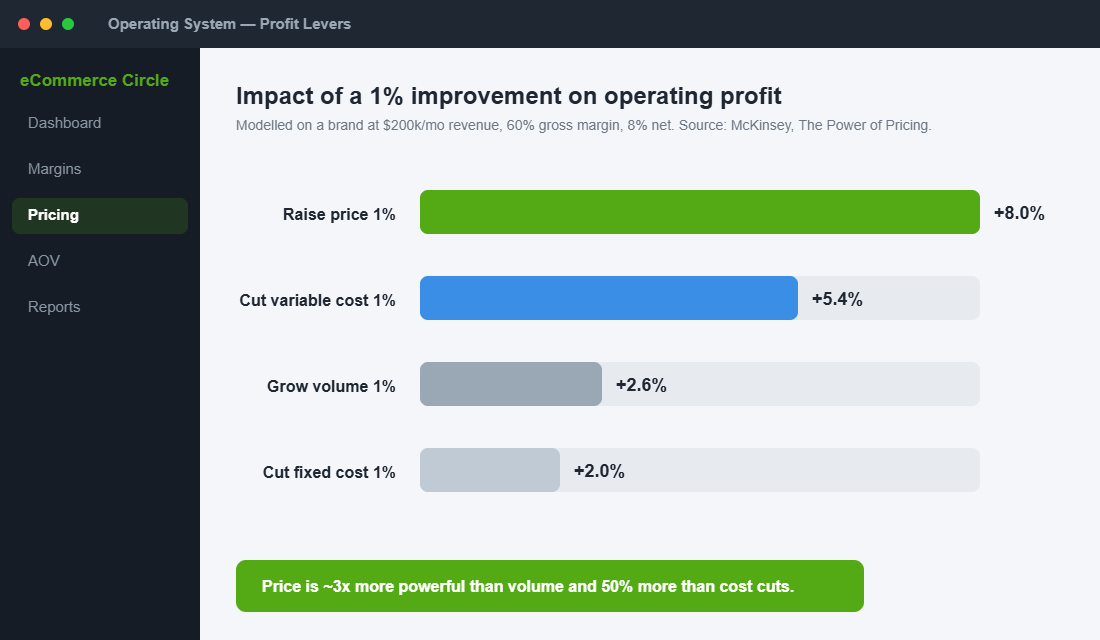
Here is the maths that should keep you up at night. McKinsey studied the S&P 1500 and found that a 1% price increase, with volume held steady, lifts operating profit by around 8%. That is nearly 50% more impact than cutting variable costs by 1%, and more than three times the impact of growing volume by 1%. You are pouring your energy into the hardest lever and ignoring the easiest one.
The timing has never been sharper either. Australian real wages are sitting roughly 4.8% below pre-pandemic levels, non-essential household spending is down 1.9% year on year, and your landed costs, freight and merchant fees have all crept up while you held the line on price. If you have not moved price in over a year, inflation has quietly handed you a pay cut. The question is not whether to raise prices. It is how to do it without watching your conversion rate fall off a cliff.
This is the playbook we run with founders inside eCommerce Circle. Five levers, in order, that let you take price up while customers stay (and often spend more).
Why Price Is the Most Powerful Lever in Your Business
Run the McKinsey number on your own store. Say you do $200k a month at a 60% gross margin and you net 8% after everything. A 1% price lift that holds volume adds about $2,000 of revenue that is almost pure profit, because none of your costs move with it. On a monthly net profit of roughly $16,000, that single percent is a 12% jump in take-home. Stretch it to a considered 5% increase and the compounding gets serious very quickly.
The reason it works is structural, not clever. DTC brands typically run gross margins between 50 and 70%, but the median DTC brand nets just 3 to 10% once ads, fulfilment, apps and overheads are paid. Your net margin is a thin sliver sitting on top of a big cost base. Price is the only lever that adds to revenue without adding a single dollar of cost underneath it. Every other growth play (more traffic, higher AOV, better conversion) carries a cost to deliver. A price rise does not.
That thin net margin is also why underpricing is so brutal. If you are netting 8% and you happen to be 10% underpriced, you are not leaving 10% on the table. You are leaving more than your entire profit on the table, every single month, and calling it normal.
The Real Reason You Are Scared to Raise Prices
Almost every founder I speak to has the same fear: “If I put prices up, customers will leave.” It feels true. It is mostly wrong, and it is worth pulling apart why.
Price is rarely the only reason people buy from you. Yes, 80% of Australian shoppers say price is a key reason they shop online. But “price matters” is not the same as “lowest price always wins”. If it were, every category would be a race to the bottom, and brands like Koala and Who Gives A Crap could not charge what they do. People happily pay more when they believe they are getting more.
The fear also assumes every customer is equally price sensitive. They are not. Your worst customers (one-time, discount-hunting, high-return) are the most price sensitive. Your best customers (repeat buyers who already love the brand) barely register a 5 to 8% move. When you refuse to raise prices to protect the bargain hunters, you are subsidising the people who will never be loyal at the expense of the ones who already are.
The last trap is the most common: testing the decision in your head instead of in your store. You imagine the worst case, talk yourself out of it, and walk away with zero data. The brands winning on price are not braver than you. They simply test, and the rest of this playbook shows you how.
Lever 1: Know Your True Contribution Margin Per SKU
You cannot price with confidence until you can answer one question for every product: what does this actually make me after the variable costs of selling it? Not gross margin. Contribution margin. They are not the same number, and the gap between them is where most founders get blindsided.
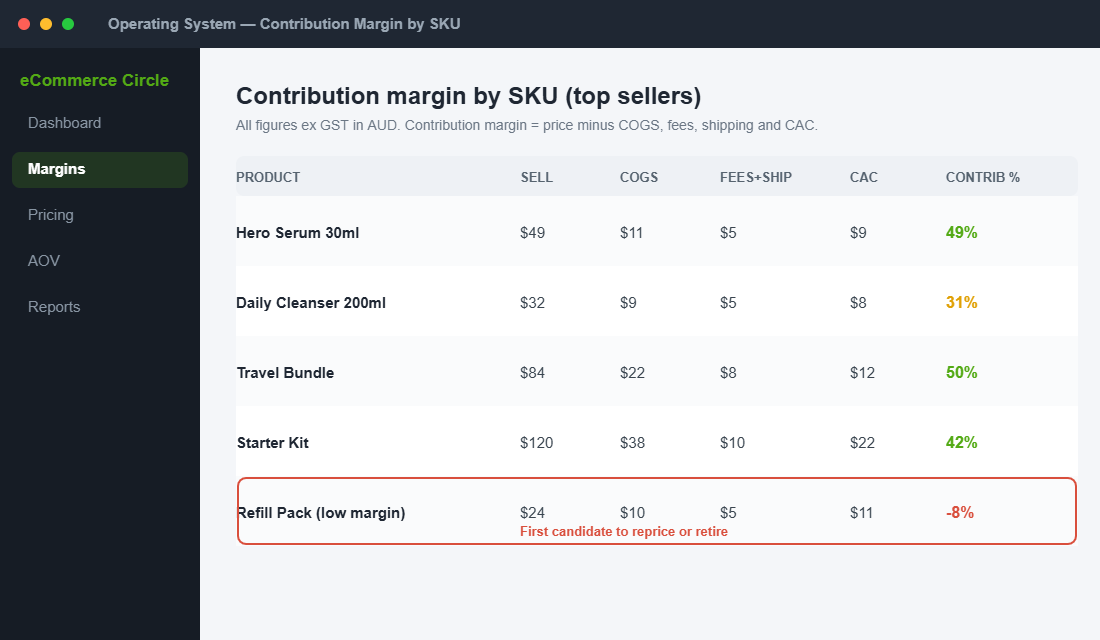
Gross margin stops at cost of goods. Contribution margin keeps going and subtracts every cost that scales with the sale: payment and merchant fees, pick and pack, the portion of freight you absorb, returns, and the marketing cost to acquire that order. That final number tells you whether a SKU is feeding the business or quietly bleeding it.
Build this for your top 20 products before you touch a single price:
- Selling price (ex GST). The real price the customer pays, GST removed.
- Landed cost of goods. Unit cost including freight-in and duties, not just the supplier invoice.
- Payment and merchant fees. Roughly 1.5 to 2.5% in AUD on most gateways.
- Pick, pack and absorbed shipping. The fulfilment cost you eat rather than charge.
- Returns. Your average return rate multiplied by the cost of handling each one.
- Allocated acquisition cost. Ad spend divided by orders, loaded onto the SKU.
What you find is uncomfortable and useful. A couple of hero products carry the whole range. Some so-called bestsellers turn out to be loss leaders once real costs are loaded in. The products with the thinnest contribution margin are your first and safest candidates for a price rise, because a small percentage move there changes the unit economics the most. If you have already trimmed your range (our SKU rationalisation playbook walks through exactly that), this is the natural next step.
Lever 2: Test the Increase Before You Commit to It
Here is the part that removes the fear entirely. You do not have to guess what a price change will do. You can run a controlled A/B test on real traffic and watch the profit number, not just the conversion rate.
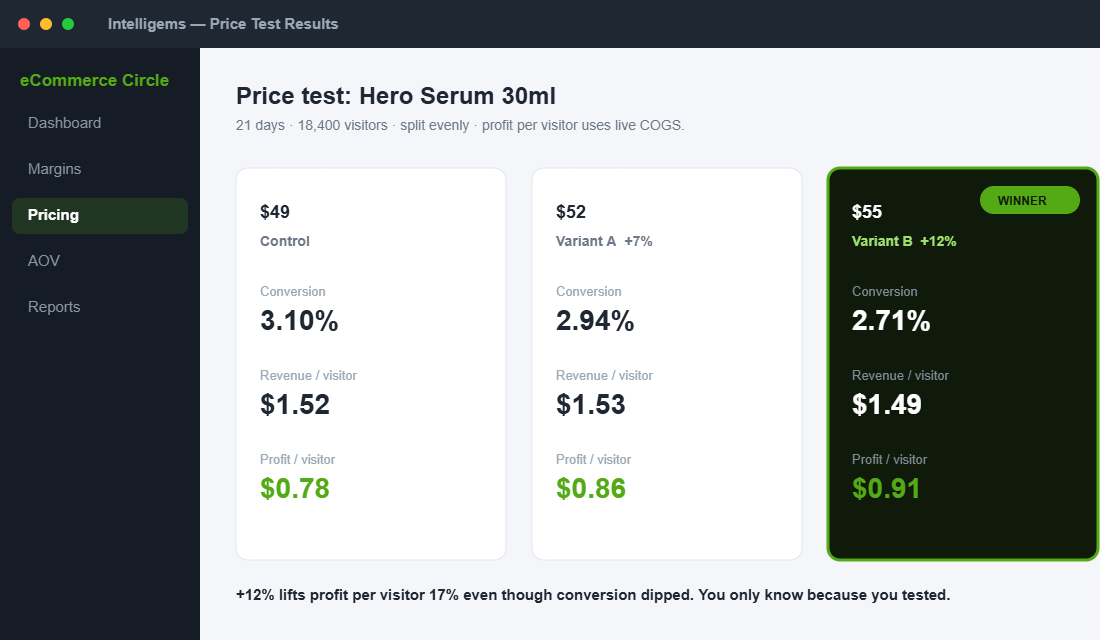
The tool we point founders to is Intelligems. Unlike theme testing apps that only measure design changes, Intelligems tests the economics of your store. It reports conversion, revenue and actual profit for each price group, calculated against your own cost of goods. That last column is the one that matters.
How to set up your first price test:
- Install and connect. Add Intelligems from the Shopify App Store and connect your store. Standard Shopify plans adjust price through Shopify Functions; Shopify Plus integrates through checkout scripts.
- Load your COGS. Enter cost of goods for the products you want to test so the profit reporting is accurate, not just revenue.
- Build the test groups. Create a price test and add two or three groups, for example current price, plus 7% and plus 12%, then set how traffic splits between them.
- Scope and launch. Choose the products or collection to include, double-check the variants, and turn it on.
- Read profit, not conversion. Let it run to a meaningful sample (often two to four weeks depending on traffic), then look at profit per visitor before anything else.
The result that surprises people: a higher price often wins on profit even when conversion dips slightly, because the extra margin per order more than covers the small drop in orders. You only know that because you ran the test. Brands using structured price testing rather than guesswork have reported revenue lifts in the 15 to 35% range simply from getting price right.
Lever 3: Raise the Floor, Not Just the Ceiling
Raising prices does not always mean changing the sticker on your hero product. Often the smarter move is to restructure the offer so the average order climbs and your cheapest item stops anchoring everyone to the lowest possible spend.
Who Gives A Crap does this beautifully. Their bundles save customers around 20% versus buying the items separately, which looks like a discount but does the opposite for the business. It pulls the average buyer up into a bigger, higher-value order they would never have assembled on their own. The “saving” is the carrot. The bigger basket is the win.
Three ways to lift the floor without a single confrontation over price:
- Add a premium tier above your bestseller. A “Luxe” or “Pro” version gives price-insensitive customers somewhere to spend, and makes your standard product look like the sensible middle choice.
- Build bundles that raise AOV while feeling generous. Pair a hero product with a high-margin add-on so the bundle price beats the sum of its parts but lifts the order.
- Quietly retire the cheapest entry SKU. If it only attracts your most price-sensitive, least loyal buyers, it is doing more harm than good.
This is where price and average order value work as a pair. If you have not tightened your AOV system yet, our average order value playbook slots in directly alongside this lever.
Lever 4: Add Value Before You Add Price
The single biggest mistake is raising the price while the experience stays identical. Customers feel that, and it reads as greed. The fix is to add a layer of perceived value just before, or alongside, the increase, so the trade feels fair rather than one-sided.
Koala is the textbook Aussie example. They sit at a premium price (a queen mattress starts around $750) and back it with a 120-night trial, up to 10 years of warranty, free delivery and genuinely easy assembly. None of those promises cost much to make, but together they strip out the risk that makes people hesitate at a higher number. The price is higher and the perceived risk is lower at the same time. That is the combination that protects conversion.
Value you can add without gutting your margin:
- Add or extend a guarantee or trial. Risk reversal is cheap to offer and powerful right at the point of decision.
- Upgrade the unboxing and post-purchase moment. Make the product feel more premium than the price tag suggests.
- Bundle in a low-cost, high-perceived-value extra. A guide, a sample, or priority support all punch above their cost.
- Sharpen the product page. Make the value obvious before the customer ever scrolls to the price.
The order matters more than the tactics. Add the value first. Let customers feel it. Then move the price. Do it the other way around and every improvement looks like an excuse.
Lever 5: Communicate Like a Founder, Not a Finance Department
When you raise prices on existing customers, how you tell them decides whether they shrug or churn. The brands that get this right do not bury it in a website footer or a quiet system update. They front it.
The format that works is a plain-text email from you, the founder. No glossy template, no marketing gloss. Your name, ideally your photo, and an honest few lines: costs have risen, you held off as long as you reasonably could, here is what is changing and when, and here is your chance to stock up at the old price before it lands. Customers who value the brand respect the honesty, and a good number buy ahead of the change, which pulls revenue forward into the month you announce it.
What to put in the letter:
- The why, in one or two honest sentences. Real cost pressure, not vague “market conditions” language.
- The exact change and the date it takes effect. No ambiguity, no fine print.
- A grace window. A few days to buy at the current price as a thank you for loyalty.
- A genuine thank you. Written like a human, not approved by a committee.
Counterintuitively, a well-handled increase can deepen loyalty rather than dent it. You have treated your customers like adults who can handle the truth. That is far rarer than a discount, and it lasts a lot longer.
The Compound Effect: Why These Levers Stack
Run one of these in isolation and you get a modest, forgettable win. Run them as a sequence and the maths starts to compound on itself.
Start with contribution margin so you know precisely which SKUs to move and by how much (Lever 1). Test the move on live traffic so you act on data, not nerves (Lever 2). Restructure the offer so the average order rises at the same moment (Lever 3). Add perceived value so the higher price feels fair (Lever 4). Then communicate the change like a founder so existing customers stay, and many buy ahead (Lever 5).
Now the numbers. A considered 7% price lift that holds volume, on a brand netting 8%, can lift net profit by 50% or more on its own. Layer a higher AOV from restructured bundles on top, shave a little discount-hunting churn off the bottom, and you have changed the trajectory of the business without spending an extra dollar on ads. This is also why price discipline quietly improves your ad maths: a healthier margin per order means you can sustain a higher marketing efficiency ratio and still profit. Our marketing efficiency ratio guide explains why that one number tells you more than ROAS ever will.
Price is not a one-time setting you configure at launch. It is a lever you should review every quarter, with the same discipline you bring to your ad accounts and your inventory.
Your Pricing Power Audit
Before your next quarter starts, run this audit. Every box you cannot tick is a marker for hidden profit you are currently leaving on the table.
- I can quote the contribution margin (not gross margin) of my top 10 SKUs from memory.
- I know which three products carry the thinnest margin and are the safest to move first.
- I have raised prices at least once in the last 12 months (if not, you are probably behind inflation).
- I have a price A/B test running or scheduled in Intelligems or a similar tool.
- I offer at least one premium tier positioned above my current bestseller.
- My bundles lift average order value and frame a clear, honest saving.
- I have added a risk reversal (trial, guarantee or warranty) in the last 12 months.
- I have a founder’s letter template ready to go for the next increase.
- Price sits on my quarterly review agenda, not in the set-and-forget pile.
Work top to bottom. The first three boxes alone will tell you more about your real profit position than another month of ad testing ever could.
The Takeaway
Underpricing feels safe because nothing visibly breaks. No customer complains that you charged too little. But it is the most expensive habit in ecommerce, and it compounds against you every month you leave it alone. The founders who pull this lever properly, with margin clarity, a real test, a stronger offer, added value and an honest message, do not lose their customers. They keep them, and they finally get paid what the work is worth.
Inside eCommerce Circle, pricing and profit is one of the core pillars we work on with every member, because it is the fastest lever most founders are too nervous to pull. If you want a second opinion on yours before you move a number, let’s talk.