Walk through the order data of almost any Aussie Shopify store doing $40k to $500k a month and you will find the same pattern. Ninety percent of orders contain one item. The founder is paying Meta $25 to $60 to acquire each of those customers, and the customer is walking out the door with a single $45 product.
What’s in This Article
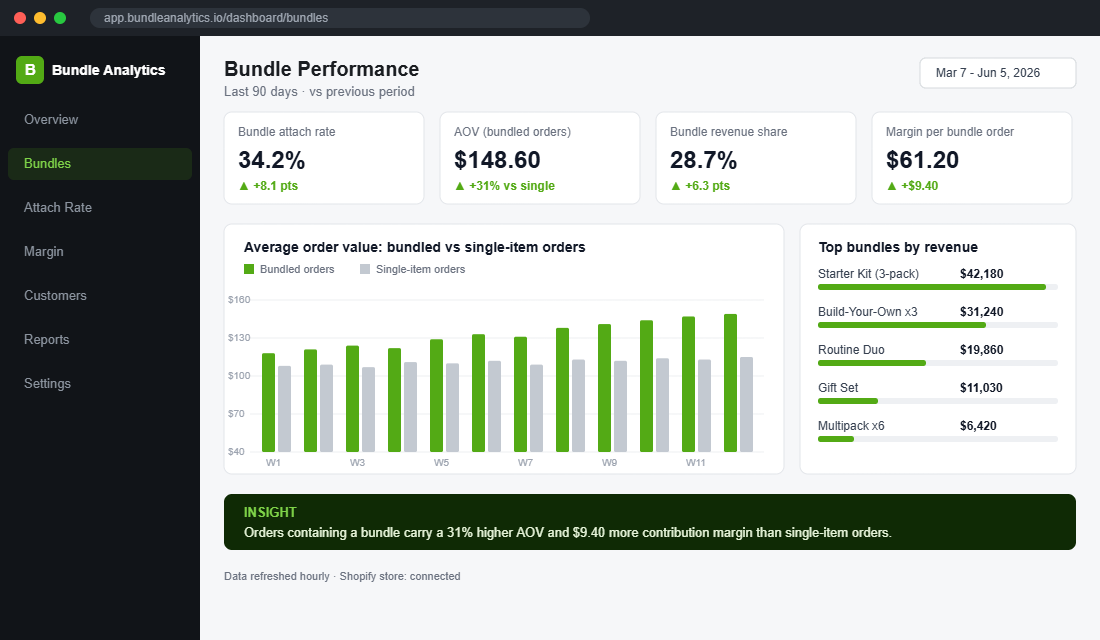
Most founders try to fix this with a discount code at checkout. That is the wrong tool. The right tool is bundling, and the difference matters: a discount gives margin away to get the same order, a bundle trades a small slice of margin to get a structurally bigger order. Shopify merchant data from 2025 shows stores that implement bundling properly lift average order value 20 to 35% within the first 90 days. McKinsey puts the profit gain from well-built bundles at around 30%.
The catch is the phrase “built properly”. A lazy bundle (two products, 25% off, no maths behind it) lifts AOV while quietly shredding contribution margin. After working with hundreds of Aussie Shopify founders inside eCommerce Circle, we have seen both versions up close. This playbook covers the five bundle types that work, the margin maths behind each one, the tools to build them, and the numbers to watch once they are live.
Bundling Is a Margin Strategy, Not a Discount Strategy
Start with why bundles work, because the mechanism dictates the design. A bundle does three jobs at once.
- It simplifies the decision. A shopper who cannot choose between your cleanser and your serum does not buy both, they buy neither. A “complete routine” kit removes the choice and answers the real question: what do I need for this to work?
- It re-anchors price. A $89 kit sitting next to $107 of summed retail prices feels like a smart buy, not a splurge. The customer compares the kit to the sum, not to their wallet.
- It spreads your fixed costs. Pick-and-pack, the shipping satchel, and most importantly the CAC you already paid: all of it is amortised across three products instead of one. That is why bundle orders carry more contribution margin even after the discount.
The proof that this compounds is sitting right here in Australia. Gold Coast oral care brand HiSmile introduced a build-your-own toothpaste bundle with more than ten flavours, and today over 80% of HiSmile orders are bundles. Average cart size has grown four times since. In the US, Hailey Bieber’s Rhode took monthly revenue from upsell kits from $948,000 to $2.53 million in six months, a 2.7x jump driven almost entirely by routine-based bundling. Industry-wide, up to 30% of ecommerce revenue now flows through bundled products.
The Bundle Maths You Need Before You Build Anything
Before you open an app or duplicate a product, sit down with a spreadsheet. Every bundle decision is a pricing decision, and pricing decisions deserve maths. Three rules keep you safe.
Rule 1: Cap the bundle discount at 10 to 20% of summed RRP. The perceived value of a bundle comes mostly from convenience and curation, not the discount. HiSmile’s flavour bundles and Frank Body’s kits sit in this band. Once you push past 20% you are training customers to never buy items individually, and you are funding the lift out of your own margin. We covered the broader logic in our discount discipline framework, and bundles follow the same law: the offer must have a reason to exist beyond “it is cheaper”.
Rule 2: Load the discount onto attach products, never the hero. Your hero SKU sells itself at full price. If the bundle is hero plus two attach products at 15% off, structure the maths so the hero contributes full margin and the attach items absorb the discount. This protects the hero’s price integrity for the day the customer comes back to buy it alone.
Rule 3: Set a contribution margin floor and check every bundle against it. For most Aussie DTC brands the floor sits around 55 to 60% after blended COGS, pick-and-pack and shipping. Calculate it per bundle: summed COGS, plus the extra packaging, plus the heavier satchel. A bundle that clears the floor goes live. A bundle that misses gets repriced, not rationalised away with “but the AOV is great”.
Bundle 1: The Starter Kit (Convert the First-Time Buyer)
The starter kit is a fixed bundle aimed at the customer who has never bought from you. It answers their actual question, which is not “which product should I buy?” but “what do I need for this to work?”. A skincare brand sells the cleanser, serum and SPF as a three-step routine. A coffee brand sells beans, a starter filter pack and a storage tin.
Design rules for the starter kit:
- Three items, no more. The kit should feel complete, not bloated. Every extra SKU adds COGS and decision friction.
- Name it for the outcome. “The Clear Skin Starter Kit” outsells “Bundle Pack A” every single time. The name should describe what the customer gets out, not what you put in.
- Price it 12 to 17% under summed RRP. Enough to be obviously better value, not enough to feel like a clearance bin.
- Make it your ad landing offer. Cold traffic converts better on a kit than a single product because the perceived value is higher at a similar price point. Your CAC stays the same while your first-order value jumps 30%+.
The starter kit also fixes a quiet profitability problem: first orders are usually your least profitable orders. If a $45 first order becomes an $89 first order, the CAC payback maths on every ad campaign changes overnight.
Bundle 2: The Routine (Cross-Category Attach)
Where the starter kit recruits new customers, the routine bundle deepens existing ones. It pairs a hero product with complementary items from other categories that genuinely work together. Melbourne’s Frank Body does this as well as anyone in the country: their best-selling Rosehip Kit pairs the dry body oil with the original coffee scrub, and their kits page is organised by routine and occasion rather than by product type.
The key word is “genuinely”. Customers smell a forced pairing instantly. The test we use with eCommerce Circle members: would a knowledgeable friend recommend these products together? If the answer is no, the bundle is a margin trap dressed up as merchandising. Check your own data first. The orders report in Shopify (Analytics, then Reports, then “Products by order”) shows you which products are already bought together organically. Your customers have been designing your routine bundles for you all along.
Bundle 3: Build-Your-Own (The HiSmile Play)
Mix-and-match is the highest-performing bundle type for brands with wide, shallow catalogues: flavours, scents, colours, variants. Instead of you guessing the combination, the customer picks any three minis, any six flavours, any four pairs, and a tiered discount rewards the bigger pick.
This is the structure behind HiSmile’s four-times cart growth, and it works because it converts variety from a decision problem into a game. The customer who cannot pick one flavour happily picks six.
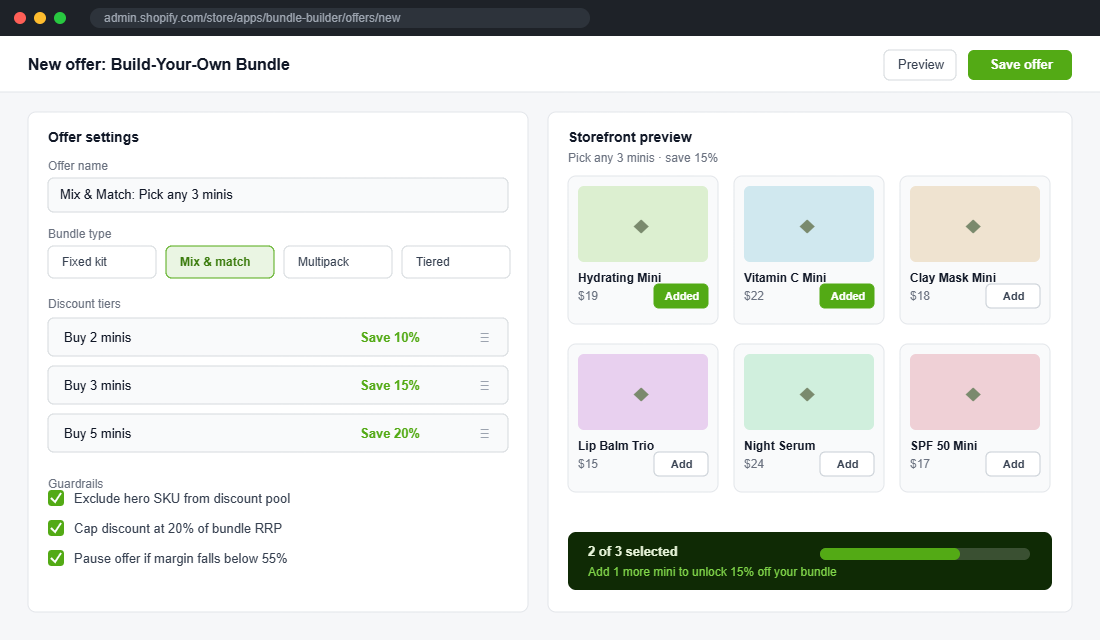
Structure the tiers so the middle option is the obvious choice: buy 2 save 10%, buy 3 save 15%, buy 5 save 20%. Most customers land on the middle tier, which should also be your margin sweet spot. And put a progress bar on the builder (“add 1 more to get 15% off”). The same psychology that drives free-shipping thresholds drives bundle completion.
Bundle 4: The Multipack (Own the Heavy User)
If you sell anything consumable (coffee, supplements, skincare, pet food, razors) the multipack is the simplest AOV lever you have. A customer who buys one bag of coffee buys again in three weeks, maybe from you, maybe from the supermarket. A customer who buys a six-pack has chosen you for the next four months.
Multipacks earn a slightly deeper discount (15 to 20%) because they do real strategic work: they lock out competitors, they smooth your demand forecasting, and they cut your shipping cost per unit dramatically. One satchel carrying six units beats six satchels carrying one. For a brand shipping nationally with Australia Post, that difference alone can fund the discount.
The multipack is also your natural bridge to subscriptions. A customer on their second six-pack is the warmest possible subscription prospect, and the pitch writes itself: same price, never run out.
Bundle 5: The Gift Set (Seasonal Margin, Not Seasonal Panic)
Gift sets are the only bundle type where you can charge a premium instead of a discount. A boxed set with a ribbon and a card solves a different problem: the buyer is not price-shopping, they are outsourcing thoughtfulness. Frank Body leans into this hard, building kits for Valentine’s Day, Christmas and baby showers.
Aussie founders should build the gift calendar around Mother’s Day, Father’s Day, Christmas and Valentine’s, with stock decisions locked 8 to 10 weeks out. Keep the discount at 0 to 10%, spend the margin on packaging the customer would photograph, and remember the gift recipient is a free customer acquisition: include a discount card addressed to them inside the box.
Run Every Bundle Through the Margin Calculator First
Here is what the pre-launch maths looks like in practice. Sum the RRP, set the bundle price, then subtract blended COGS and the real cost to pick, pack and ship the heavier parcel. What is left is contribution margin, and it has to clear your floor.
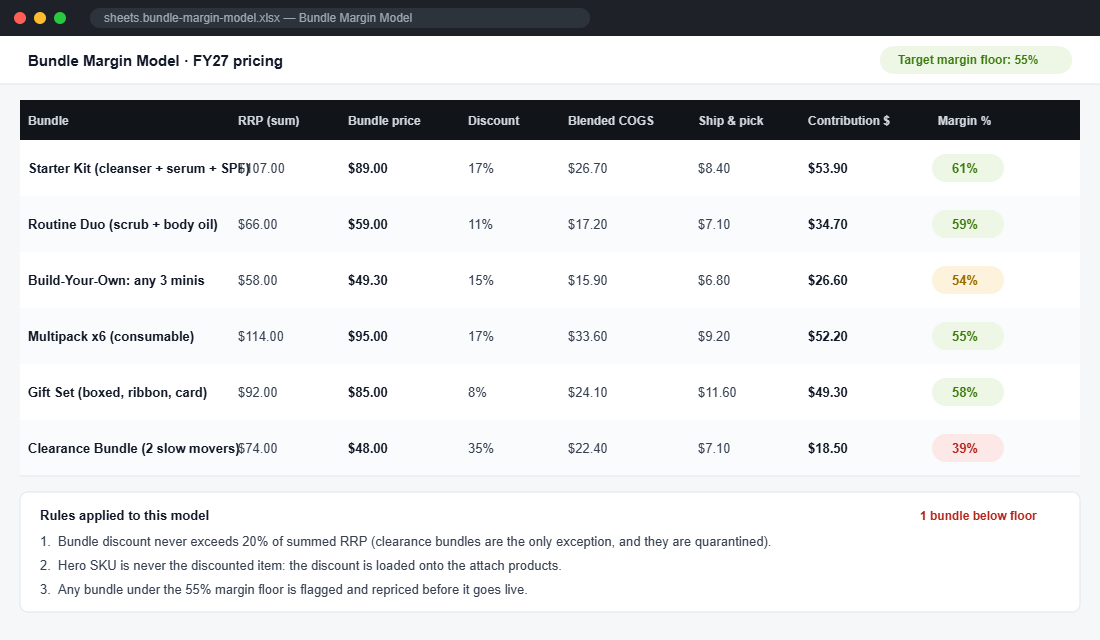
Two traps to watch. First, packaging creep: gift boxes, ribbons and inserts are real COGS and they belong in the model, not in a “marketing” line you never reconcile. Second, the clearance bundle. Pairing two slow movers at 35% off is sometimes the right call to free up cash (we walked through that logic in the SKU rationalisation playbook), but it is an inventory exit, not a growth strategy. Keep it off your homepage, out of your ads, and clearly separated from your core bundles so it cannot drag price perception down with it.
The Tool Stack: Start Native, Upgrade When You Outgrow It
Start with Shopify Bundles (free). Shopify’s native Bundles app handles fixed kits and multipacks with real-time inventory sync, which means selling a kit correctly deducts each component SKU. Setup takes about ten minutes:
- Install Shopify Bundles from the App Store (free, first-party).
- In the app, click “Create bundle”, select your component products and variants, and set the quantity of each.
- Set the bundle price (remember rule 1: 10 to 20% under summed RRP for kits, less for gift sets).
- Add bundle-specific photography, a benefit-led title and a description that explains the routine, then publish to your Online Store channel.
- Check inventory sync by placing a test order and confirming component stock levels dropped.
Move to Bundler when you want mix-and-match. Bundler is the value pick of the category: the free plan covers classic bundles and quantity breaks, and paid plans from around $13 a month add genuine mix-and-match with tiered discounts. For most stores under $100k a month it is all you need.
Move to Rebuy when bundles become your merchandising layer. At $99+ a month, Rebuy is an investment, but it adds AI-powered dynamic bundles, cart-drawer offers and post-purchase upsells that personalise to each shopper. The brands we see justify Rebuy are typically past $150k a month with a wide catalogue and a dedicated person watching the data.
Where Bundles Live on Your Store (Placement Beats Creation)
A bundle nobody sees lifts nothing. Most founders build the bundle, publish it to a collection called “Kits” and wonder why attach rate is stuck at 4%. Placement is half the program.
- Hero product page. Add a “complete the routine” module directly under the add-to-cart button on your best seller. This single placement usually drives more bundle revenue than the entire kits collection, because it catches the customer at peak intent.
- Homepage, second section. Your starter kit belongs above the fold or just below it, framed as the default way to start with your brand. New visitors should meet the kit before they meet the catalogue.
- Cart drawer. When a customer adds one component of a known pair, offer the upgrade to the bundle in the drawer (“complete the set and save 15%”). Upgrading an existing intent converts far better than interrupting with something new.
- Ad landing path. Send cold Meta and TikTok traffic to the kit page, not the single product page. Same CAC, materially higher first-order value.
- Email flows. Your post-purchase flow should pitch the routine bundle to single-item buyers, and your win-back flow should lead with the multipack. The bundle gives a lapsed customer a reason to return that a plain product page does not.
One warning on stacking: decide upfront whether bundle pricing combines with welcome codes and free-shipping thresholds, and configure the exclusions in Shopify’s discount settings. A 15% bundle saving stacked with a 10% welcome code and free shipping is how a 60% margin product quietly becomes a 38% margin order.
Measure Three Numbers, Ignore the Rest
- Bundle attach rate: the percentage of orders containing a bundle. Healthy programs sit at 20 to 35% within a quarter. HiSmile’s 80% is the ceiling, not the benchmark.
- AOV gap: bundled order AOV versus single-item AOV. You want 25%+ separation. If the gap narrows, your bundles are cannibalising multi-item orders that would have happened anyway.
- Contribution margin per order: the number that pays the bills. If attach rate and AOV climb while margin per order falls, your discounts are too deep. Reprice before you scale.
Review the three numbers monthly alongside the levers in our average order value playbook, because bundles are one of five AOV levers and they work best when the cart drawer, thresholds and upsells are pulling in the same direction.
Bundle Inventory and Fulfilment: The Part That Breaks at Scale
The maths gets all the attention, but the thing that actually takes bundles offline is stock. A three-item kit is only sellable when all three components are in stock, so the kit inherits the worst availability of any component. If your cleanser runs at 97% in-stock, your serum at 95% and your SPF at 90%, the kit is available roughly 83% of the time. That is a lot of days when your best-converting ad landing offer quietly says “sold out”.
Two ways to run it, and the choice depends on volume:
- Virtual bundles (default under about 300 bundle orders a month). Shopify Bundles and Bundler deduct component stock at order time and your 3PL picks three items into one satchel. No pre-assembly, no dead stock in kits, but pick errors rise. Ask your 3PL for their mis-pick rate; anything above 0.5% on multi-line orders means you need a pick-to-light or barcode scan step, and most Australian 3PLs will add one for a few cents a line.
- Pre-kitted SKUs (above that volume, or for gift sets). Assemble kits in advance with their own barcode and their own bin. Picking is one scan, packaging is consistent, and unboxing is better. The cost is a kitting fee of roughly $0.80 to $2.00 per kit at a 3PL, plus the risk that 400 pre-built Mother’s Day boxes sit there in June. Kit to a forecast, never to a hope.
Either way, put a safety stock rule on components that appear in bundles. A simple version: any SKU that features in a live bundle carries two extra weeks of cover versus its stand-alone forecast. And set up a back-in-stock capture on the kit page itself, because a customer who wanted the routine will not reassemble it from three product pages.
Two adjacent levers make bundles work harder once the fulfilment side is stable. Set your free shipping threshold about 10 to 15% above your starter kit price, so the kit plus one small add-on clears it; the free shipping threshold playbook walks through the calculation. And offer the multipack as a subscription from day one with a modest 5 to 10% subscribe-and-save, because the customer who just chose a six-pack is already telling you they plan to keep buying; the subscription playbook covers how to structure it without training everyone to discount.
The Compound Effect: Five Bundles, One System
Each bundle type earns its keep alone, but the real return shows up when they operate as a system across the customer lifecycle. The starter kit raises first-order value and fixes CAC payback. The routine bundle deepens the second order. Build-your-own turns your variety into a game instead of a decision tax. The multipack locks in the heavy user and bridges to subscription. The gift set recruits brand-new customers at a premium, twice a year, on a predictable calendar.
A store doing $80k a month at a $52 AOV that lifts to $65 through bundling adds roughly $240k in annualised revenue without a single extra visitor. That is the quiet power of this playbook: it monetises traffic you already paid for.
The Bundle Launch Checklist
- Pull “Products by order” in Shopify Analytics and list your top 5 organically co-purchased pairs
- Pick ONE bundle type to launch first (starter kit if acquisition is the bottleneck, multipack if retention is)
- Model the bundle: summed RRP, bundle price, blended COGS, pick-pack-ship, contribution margin
- Confirm the discount sits at 10 to 20% of summed RRP and the hero SKU carries no discount
- Confirm contribution margin clears your floor (55 to 60% for most DTC brands)
- Build it in Shopify Bundles (fixed) or Bundler (mix-and-match) with component inventory sync
- Shoot dedicated bundle photography and write an outcome-led name
- Place the bundle on your homepage, the hero product page and your ad landing path
- Set a calendar reminder for 30 days: review attach rate, AOV gap and margin per order
- Kill or reprice anything under the margin floor, then launch bundle type two
Inside eCommerce Circle, pricing and bundle architecture is one of the core pillars we work on with every member, because it is the fastest path to more profit from the traffic you already have. If you want a second opinion on your bundle maths, let’s talk.