You are paying Meta somewhere between $40 and $90 to acquire every new customer. Most of them buy once and vanish. The average repeat purchase rate across Shopify stores sits at just 28.2% in 2026, which means roughly 3 out of 4 customers you fought so hard to win never come back for a second order.
What’s in This Article
Most Aussie founders respond to this by doing one of two things. They either ignore retention entirely and keep feeding the ad machine, or they install a loyalty app on a Tuesday afternoon, leave every setting on default, and wonder six months later why nobody redeems anything.
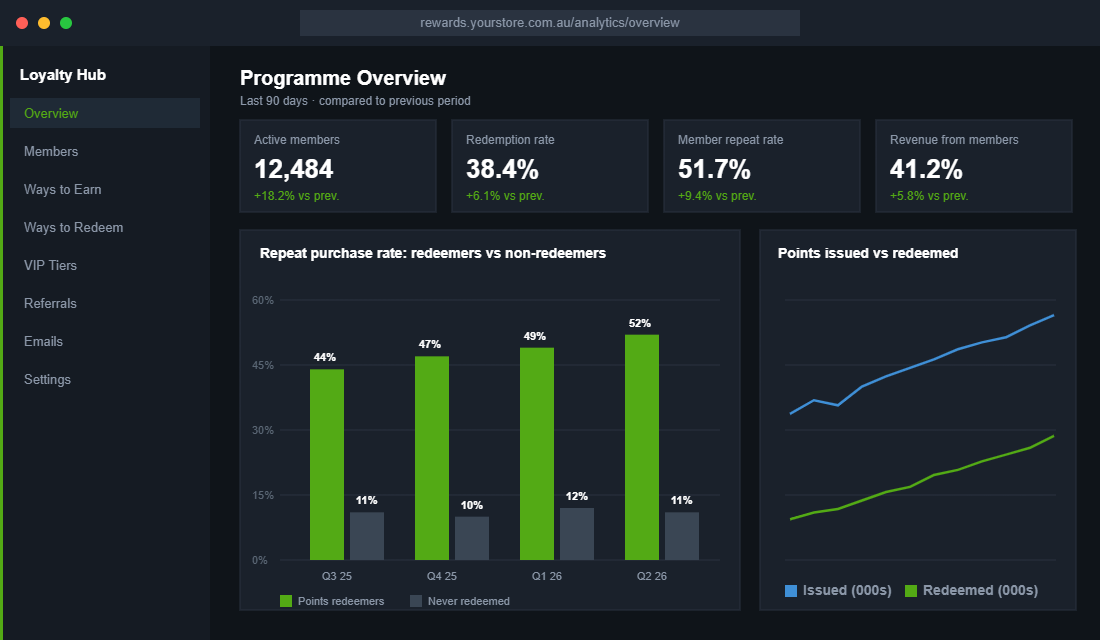
The brands getting it right play a different game. Loyalty members make 67% more purchases and generate 115% more revenue per customer than non-members. Customers who actually redeem points show a 50% repeat purchase rate, against just 10.7% for those who never redeem. That gap is the whole opportunity, and this playbook shows you the 5-part system to capture it.
Why Most Shopify Loyalty Programs Die in the Settings Menu
Here is the uncomfortable truth: a loyalty program is not an app. It is a pricing and retention strategy that happens to be delivered through an app. When you skip the strategy and just flick the switch, you get the default outcome, which is a points widget in the corner of your store that nobody opens.
Australians are arguably the most loyalty-saturated shoppers on earth. McKinsey’s Australian Consumer Loyalty Survey found 90% of Aussies belong to at least one loyalty program, averaging 4.3 memberships each. Your customer already has Woolworths Everyday Rewards, Flybuys, Qantas Frequent Flyer and Priceline Sister Club in their wallet. A vague “earn points, get rewards” pitch does not move them.
The same research found the flip side: 60% of Australians are likely to spend more or shop more often with a brand after joining a loyalty program they rate highly. Saturation is not a reason to skip loyalty. It is a reason to design yours properly. That starts with the maths.
Part 1: The Points Economy (Get the Maths Right Before You Launch)
Every loyalty program is built on one number: the reward rate. That is the percentage of customer spend you give back as reward value. Get it wrong in either direction and the program fails. Too stingy and nobody cares. Too generous and you have built a sitewide discount with extra steps.
The sweet spot for most DTC brands is a reward rate of 3 to 5%. Here is how the maths works in practice:
- Set your point value first. The cleanest structure for Aussie stores: 100 points equals $5 of reward value, so one point is worth 5 cents.
- Then set your earn rate. At 5 points per $1 spent, a customer earns 25 cents of reward value per $10 spent. That is a 5% reward rate when redeemed, and closer to 3% in practice once you account for points that expire unredeemed.
- Sanity-check it against gross margin. If your gross margin is 65%, a 5% reward rate costs you about 7.7% of gross profit on member orders. You need that back in extra order frequency, which is exactly what the data says you get.
- Never stack points with sitewide sales. Pause earning multipliers during promotions or you double-discount the same order.
One more rule from the brands that do this well: a loyalty program should deliver roughly 5 times its operating cost in incremental revenue. Track it from day one by comparing repeat rates of members against non-members in your loyalty dashboard, not by staring at total points issued.
Part 2: The Earning Architecture (Reward Behaviour, Not Just Spend)
If customers can only earn points by spending money, you have built a delayed discount, not a loyalty program. The real power move is paying points for the behaviours that compound your brand: reviews, referrals, account creation and engagement.
Think about what each behaviour is worth to you in dollars, then price it in points at a fraction of that value. A photo review on a product page lifts conversion for every future visitor. An account created before first purchase gives you a marketable email address that did not cost you a pop-up discount.
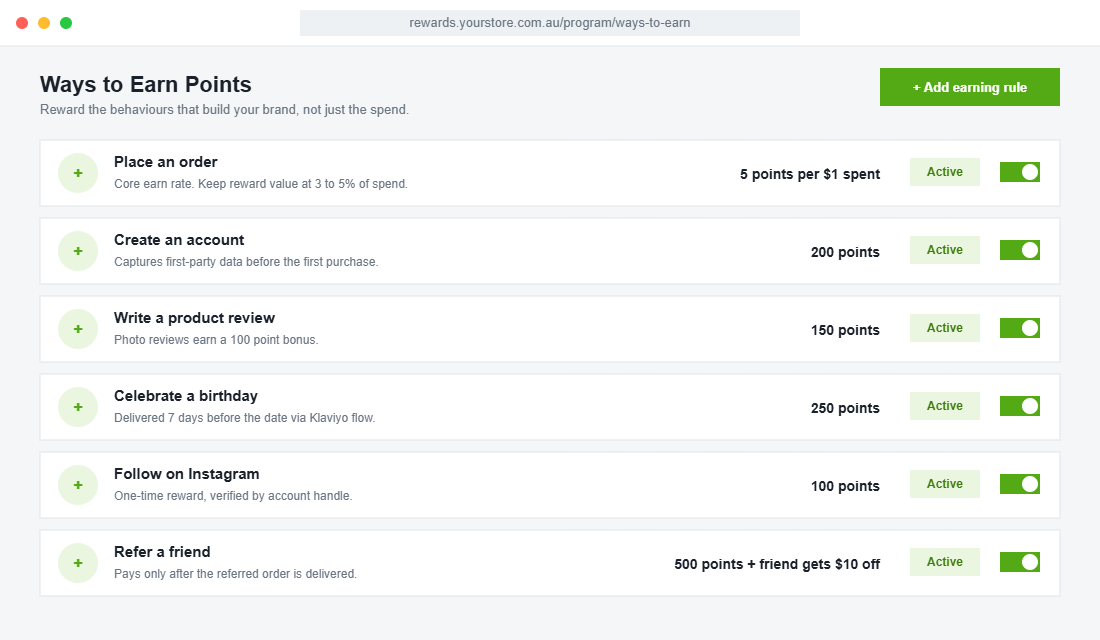
- Place an order: 5 points per $1. The core earn rate from Part 1. This is the engine.
- Create an account: 200 points. Worth $10 in reward value, and it converts guest checkouts into profiles you can market to.
- Write a review: 150 points, plus 100 bonus for a photo. Reviews with photos are conversion gold on Aussie stores where shoppers cannot touch the product.
- Birthday reward: 250 points. Trigger it 7 days before the date through your Klaviyo flow so they can shop with it, not after.
- Follow on Instagram or TikTok: 100 points. One-time rewards, small value, but they feed your retargeting audiences.
- Refer a friend: 500 points once the referred order ships. Always pay referral rewards on delivery, never at checkout, or you will pay points on refunded orders.
Referrals deserve their own system, and we covered the full structure in The Shopify Referral Program Playbook. The short version: your loyalty program is the natural home for referral rewards because your best referrers are, almost by definition, your most loyal customers.
Part 3: Redemption Design (The Metric That Actually Predicts Repeat Revenue)
Here is the counterintuitive part. Most founders treat redemptions as a cost to minimise. The data says the opposite. Smile.io’s research across thousands of stores shows customers who redeem points repeat at 50%, while members who never redeem repeat at 10.7%. Redemption is not the cost of the program. Redemption is the product.
Every redemption is a moment where the customer banks a win with your brand and immediately has a reason to come back. So your job is to engineer the first redemption as fast as possible.
- Make the first reward reachable in one order. If your AOV is $90 and you pay 5 points per $1, a customer earns 450 points on order one. Price your entry reward at 400 points ($20 value or a small freebie) so they unlock it immediately.
- Offer a reward ladder, not a wall. 400 points: free shipping or $5 off. 800 points: $10 off. 1,500 points: $20 off or a gift. 3,000 points: exclusive product.
- Include at least one non-discount reward. Free express shipping, early access to drops, or a limited product. These protect margin and feel more premium than dollars off.
- Set points to expire after 12 months of inactivity, with a 30-day warning email. Expiry emails are quietly one of the highest-converting messages in ecommerce, because nobody likes losing $15 they already own.
Redeemed points often land as store credit, and how you handle that credit matters for both margin and Australian Consumer Law. We unpacked that in The Shopify Store Credit Playbook, and the same rules apply to loyalty rewards.
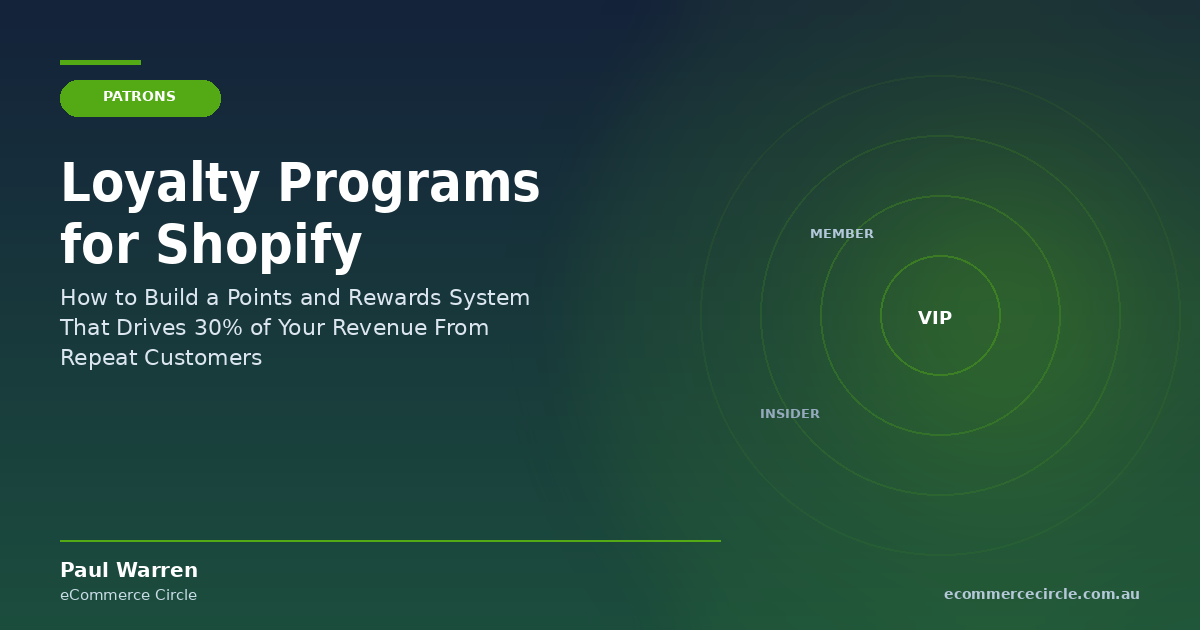
Part 4: VIP Tiers (Where the Real Money Hides)
A flat points program treats your best customer the same as someone who bought once in 2024. Tiers fix that, and the numbers are not subtle: tiered loyalty programs deliver roughly 1.8 times higher ROI than flat ones, because they concentrate rewards on the customers who actually drive revenue.
You do not need to look overseas for proof. MECCA’s Beauty Loop is the benchmark in Australian retail, with around 4.5 million members across four tiers earning quarterly sample boxes, early access and event invitations. Most of those perks are products and experiences, not discounts. That is the lesson: the higher the tier, the less the reward should look like money off.
Closer to the Shopify world, Queensland activewear brand LSKD runs points and VIP tiers through Yotpo and treats loyalty as the heart of its retention engine. The results in their published case studies are hard to argue with: a repeat purchase rate north of 80%, and one SMS campaign giving VIPs early access to a new product returned 147 times its cost. Early access costs nothing and outperforms a 20% off code.
Build your tiers on annual spend thresholds that match your customer maths:
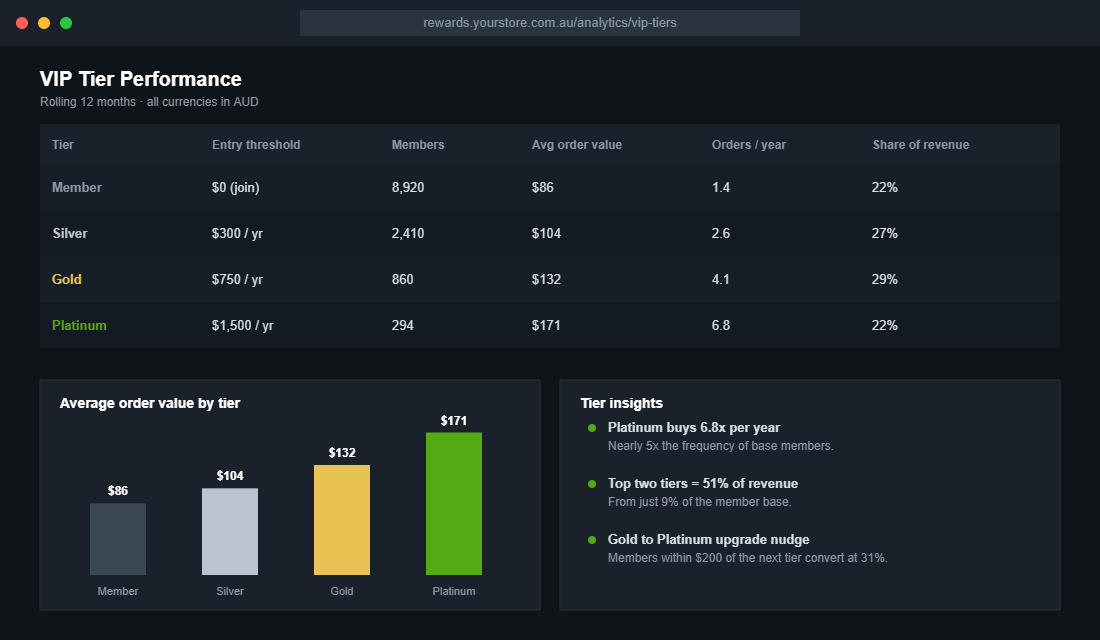
- Member (free to join). Base earn rate, birthday reward, member-only content.
- Silver at roughly 2x your AOV in annual spend. 1.25x points multiplier plus free standard shipping.
- Gold at roughly 5x AOV. 1.5x points, early access to new drops and sales, free express shipping.
- Platinum at roughly 10x AOV. 2x points, first access to limited products, an annual gift, and a direct line for support.
Then work the tier edges. Members sitting within one order of the next tier are your highest-leverage segment in the entire database. A simple “you are $40 away from Gold” email converts because the customer has already done most of the work.
Part 5: The Launch System (Email, SMS and On-Site Placement)
A loyalty program that lives only in a floating widget is invisible. The brands that get redemption rates above 30% weave the program through every customer touchpoint.
- Product pages: show points earned on this purchase right under the price. It reframes the price as an investment.
- Cart and checkout: show the points balance and the nearest reward. For logged-in members, show redeemable rewards in the cart drawer.
- Post-purchase flow: the order confirmation email should state points earned and total balance. Your thank-you page should invite guests to create an account to bank their points.
- Dedicated flows in Klaviyo: a points balance reminder every 60 days, a points expiry warning at day 335, a tier progress nudge for customers near the threshold, and a VIP welcome when someone levels up.
- Launch week: announce to your full list with founding-member bonus points, then retarget openers who did not join. Aim to enrol 30% of active customers in the first month.
And connect it to your lapsed-customer engine. Bonus points offers consistently outperform percentage discounts in reactivation campaigns because they pull the customer back into a system they already have equity in. We covered that sequence in The Shopify Win-Back Flow.
The Tool: Smile.io (Plus Two Alternatives Worth a Look)
For most Aussie stores between $40k and $500k a month, Smile.io is the right starting point. It is the most widely installed loyalty app on Shopify, it launches in an afternoon, and the free plan lets you validate the program before paying a cent. Paid plans start at USD $49 a month, which removes branding and unlocks customisation.
- Step 1: Install Smile from the Shopify App Store and connect your Klaviyo account in Settings, Integrations.
- Step 2: Set your points currency name (make it on-brand, not just “points”) and the value: 100 points equals $5.
- Step 3: Build the six earning rules from Part 2, starting with 5 points per $1 on orders.
- Step 4: Create the reward ladder from Part 3, with the entry reward priced under your average first-order points haul.
- Step 5: Switch on VIP tiers with the spend thresholds from Part 4.
- Step 6: Embed the loyalty landing page at /pages/rewards, add points display to product pages, and wire the Klaviyo flows before you announce anything.
If you are subscription-heavy, look at Rivo (from USD $49 a month, with a free tier for smaller stores) which bundles loyalty with memberships. If you are pushing past $2m a year and want deeper analytics and omnichannel features like the wallet passes LSKD uses in store, LoyaltyLion or Yotpo Loyalty are the step-up options, with pricing from around USD $159 a month.
The Five Mistakes That Quietly Kill Aussie Loyalty Programs
Before you launch, audit yourself against the failure patterns we see most often when founders bring an underperforming program into a coaching session.
- Mistake 1: Launching without a redemption target. If you do not know what a healthy redemption rate looks like (aim for 25 to 40% of issued points), you cannot tell whether the program is working or just leaking liability onto your balance sheet.
- Mistake 2: Hiding the program behind a widget. If the only place your program exists is a small launcher button in the bottom corner, your enrolment rate will stall under 10% of customers. The program needs a dedicated landing page and a place in your main navigation.
- Mistake 3: Rewarding only discounts. When every reward is dollars off, you train members to see points as a coupon machine and your premium customers tune out. Experiences and early access carry more perceived value at lower real cost.
- Mistake 4: Ignoring the accounting. Outstanding points are a real liability. Your accountant should see the points ledger at EOFY, and expiry rules keep that liability from compounding forever.
- Mistake 5: Setting and forgetting. The brands winning with loyalty review the dashboard monthly and refresh rewards quarterly. A stale rewards page tells customers the program is abandoned, and they treat it accordingly.
None of these are hard to fix. They are simply the difference between treating loyalty as a strategy you operate and an app you installed once.
The Compound Effect: Why Loyalty Is a System, Not a Widget
Look at what you have actually built when the five parts work together. The points economy makes every order plant a seed for the next one. The earning architecture turns customers into reviewers and referrers, which lowers your acquisition cost. Redemption design converts those seeds into second orders at 5 times the rate of non-redeemers.
Tiers then concentrate your generosity on the customers who matter most, and the launch system keeps the whole engine visible so it never goes stale. Each part feeds the next. A customer earns points on order one, redeems on order two, hits Silver on order three, refers a mate to bank more points, and suddenly your blended CAC is falling while everyone else’s rises.
That is the real reason loyalty programs return roughly 5 times their cost. Not because points are magic, but because every mechanism points the customer at the same action: come back.
The Loyalty Program Launch Checklist
Steal this. Work through it in order and you will be ahead of 90% of the Shopify stores in your category.
- Reward rate set between 3 and 5% of spend, checked against gross margin
- Point value fixed at 100 points equals $5, earn rate 5 points per $1
- Six earning rules live: orders, account, review, birthday, social follow, referral
- Entry reward reachable from a single average order
- Reward ladder includes at least one non-discount reward
- Points expiry at 12 months with a 30-day warning flow
- Three to four tiers with thresholds at roughly 2x, 5x and 10x AOV
- Early access and product perks at the top tiers, not bigger discounts
- Points visible on product pages, cart and order confirmation emails
- Klaviyo flows wired: balance reminder, expiry warning, tier nudge, VIP welcome
- Launch campaign with founding-member bonus points
- Dashboard reviewed monthly: redemption rate, member vs non-member repeat rate, revenue share from members
Inside eCommerce Circle, retention systems like this are one of the core pillars we work on with every member, because repeat revenue is what makes paid acquisition affordable. If you want a second opinion on your loyalty setup, let’s talk.