Here is the most expensive habit in Australian ecommerce. A shopper lands on your store, likes what they see, and hands over their email for 10% off. You fire back a one-line “thanks for subscribing, here is your code” and never speak to them again until your next campaign blast. That single email is doing maybe a tenth of the work it should.
What’s in This Article
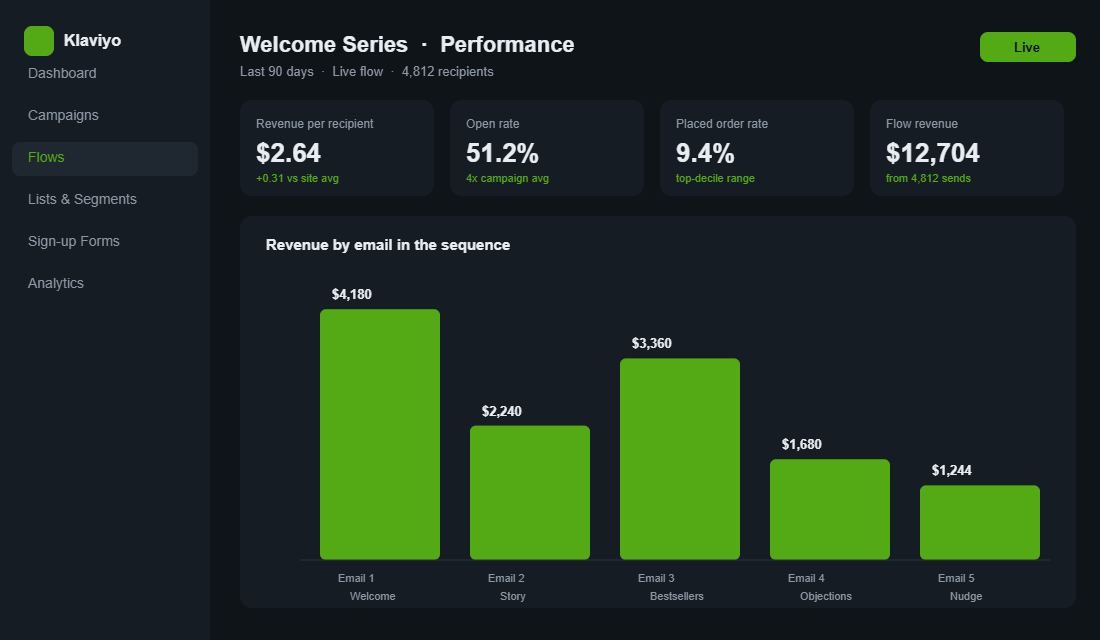
The brands quietly winning treat that first interaction as the start of a conversation, not the end of one. They run a structured welcome sequence, and the numbers are not close. The average welcome flow generates around $2.65 in revenue per recipient, and the top decile lands a placed-order rate above 10%. Even more telling: roughly 48% of all flow-driven email revenue comes from brand-new buyers, compared with just 16% from regular campaigns.
Translation: the welcome sequence is where first-time buyers are actually made. If yours is a single email with a discount code stapled to it, you are leaving the most profitable real estate in your whole marketing stack empty. This playbook is the 5-email system we walk members through, built for an Aussie audience that is sceptical, deal-hungry, and one tab away from forgetting you exist.
Why your welcome flow is the highest-ROI email you will ever build
Most founders pour their energy into campaigns: the weekly newsletter, the sale announcement, the new-drop blast. Those matter. But they are interrupting people who are busy. A welcome email is different. The person just raised their hand. They are thinking about you right now, and they will never be more interested than in the next 72 hours.
That attention shows up in the data. Welcome emails earn roughly 4 times the open rate and 5 times the click-through rate of a standard campaign, with open rates commonly landing in the 45 to 50% range (and higher for the first email). They also generate around 320% more revenue per email than a promotional send. The kicker is that a sequence beats a single email by a wide margin: multi-email welcome flows drive about 90% more orders than a one-and-done welcome message.
So the maths is simple. One welcome email captures a fraction of the intent. Five well-built emails, spaced across the window where that intent is still warm, capture far more of it. And because the flow runs automatically, you build it once and it earns for years.
Stage 0: Capture the right people, not just more people
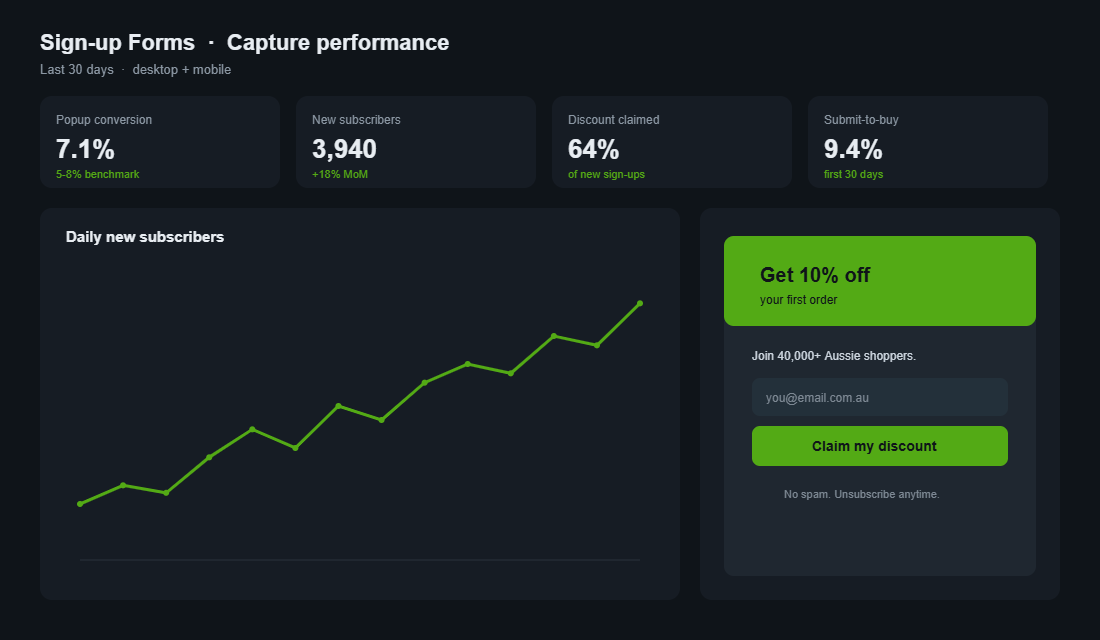
Your sequence is only as good as the list feeding it. Before you write a single email, fix the sign-up form. Ecommerce email popups convert at 5 to 8% on average, and the lever that moves that number most is the offer. A popup with no incentive converts around 5.1%; add a discount or a genuine lead magnet and you push it to 7.5% and beyond.
A few specifics that consistently lift capture rates on Aussie stores:
- Lead with one clear reward. “Get 10% off your first order” beats a vague “join our newsletter” every time. Make the value obvious in the headline.
- Test a scroll trigger, not just exit-intent. Scroll-based popups (shown after someone reads a bit) convert around 5.3% because they target engaged visitors, often outperforming the classic exit popup.
- Ask for the minimum. Email only on step one. You can collect a phone number or birthday later once trust exists.
- Point every form at one main list. Footer form, popup, checkout opt-in: all feed the same list so a single welcome flow can greet everyone consistently.
One warning. Chasing volume with a heavy discount fills your list with deal-only shoppers who never buy at full price. Capture is a quality game, not just a quantity one. If you want to layer a second channel on top, our Shopify SMS marketing playbook covers how to collect phone numbers without torching trust.
Email 1: The instant welcome (deliver the promise, fast)
This email sends immediately. No delay. The person just typed their address expecting a code, and every minute you make them wait is a minute the intent cools. Speed here is not a nice-to-have, it is the whole point.
Email 1 has one job: deliver exactly what you promised and make the next step obvious. Get the discount code front and centre, repeat it as both bold text and a button, and set a clear expiry so it has urgency later. Keep the design simple. A clean, mostly-text email often outperforms a heavily designed one because it feels personal and lands in the primary inbox.
- Subject line: confirm the reward. “Your 10% off is inside” removes all guesswork.
- Above the fold: the code, a button to shop, and a one-line welcome in your actual voice.
- One job only: resist stuffing this email with your whole catalogue. Get them to the store.
- Set the expectation: tell them what is coming next so the rest of the sequence is welcome, not a surprise.
Email 2: The brand story (why you exist)
Send this one to two days later. The discount got them in the door. The story is what makes them care enough to pay full price next time. Australian shoppers are deal-hunters by habit (8 in 10 actively hunt for the best price online), so the brands that escape the discount trap are the ones that build a reason to buy beyond the code.
Tell them why you started, what you stand for, and who the brand is for. Who Gives A Crap built a fiercely loyal Australian following on exactly this: a clear mission (donating profits to build toilets) woven through every touchpoint, paired with Klaviyo automation that grew their email list by a reported 640%. The story did the heavy lifting; the automation made sure it reached people at the right moment.
Keep it human and specific. A founder photo and a few honest sentences beat polished corporate copy. If your story is strong enough to stand alone, send people to your About page to read more. We break down how to structure that page in the Shopify About page playbook.
Email 3: Bestsellers and proof (show them what to buy)
By now they know the offer and they know the brand. Email 3 answers the next question: “okay, what should I actually get?” Do not show them everything. Show them the two or three products that convert best, and wrap each one in proof.
This is the email that often produces the second-biggest revenue spike in the whole flow, because it reaches people who liked the brand but did not buy on email 1. Make the recommendation easy:
- Feature your hero products. Lead with the items that have the most reviews and the highest conversion rate, not your newest release.
- Stack the social proof. Star ratings, review counts, and a short customer quote under each product. Real words from real buyers beat your own copy.
- Reduce the choice. Three products with a reason to pick each one converts better than a grid of twelve.
- Remind them the code still works. A small line at the bottom keeps the original incentive alive.
Email 4: Handle the objection before it kills the sale
People who have not bought by email 4 usually have a specific worry holding them back. Shipping cost. Returns. Whether the product is actually as good as the photos. Sizing. This email exists to remove those frictions one by one, before they quietly become reasons to not buy.
Treat it like a frequently-asked-questions email written for a nervous first-timer. Address the real objections directly: your shipping speed and free-shipping threshold in AUD, your returns window, your guarantee, and any risk reversal you offer. Confidence is contagious. When you answer the hard questions plainly, you signal you have nothing to hide.
- Shipping: state the cost, the free-shipping threshold, and realistic delivery times to metro and regional Australia.
- Returns and guarantee: spell out the policy in plain English. A strong guarantee removes the fear of getting it wrong.
- Quality proof: link to detailed reviews, UGC, or a press mention so the claim is not just coming from you.
- One reassuring CTA: “Still deciding? Reply to this email and we will help.” Real humans close hesitant buyers.
Email 5: The honest nudge (the code is about to expire)
The final email uses the urgency you built into email 1. The discount you gave them is about to expire, and this is their reminder. Done well, it is the single highest-converting message in many welcome flows, because it gives a fence-sitter a real reason to act today.
The word that matters here is honest. If you say the code expires tonight, it has to actually expire. Fake countdowns train your best customers to ignore you and, in Australia, misleading urgency can stray into Australian Consumer Law territory. Real deadlines work because they are real.
- Lead with the deadline: “Your 10% off expires at midnight” in the subject line and the first sentence.
- Make it one decision: the code, the expiry, and a single button. Strip everything else out.
- Add a last reassurance: one line of social proof or your guarantee to push the hesitant over the line.
- Let it close cleanly: if they still do not buy, they roll into your regular campaigns, no harm done.
The compound effect: a system, not five emails
Here is where it clicks. None of these five emails is doing the job alone. Email 1 captures the ready buyers. Email 2 converts the people who needed a reason to care. Email 3 helps the undecided choose. Email 4 removes the friction. Email 5 forces a decision while the intent is still alive. Each one mops up the buyers the previous email could not reach.
That is why a sequence drives around 90% more orders than a single welcome email. You are not sending more emails for the sake of it. You are giving five different types of buyer five different on-ramps to their first purchase. And because flow revenue skews so heavily toward new buyers, this is the most efficient first-purchase engine you can build.
The welcome flow is also the front door to the rest of your retention system. Once someone buys, they should graduate into your post-purchase flow and, eventually, your rewards program. If you have not built that next layer yet, the Shopify loyalty program playbook shows how to turn those first-time buyers into repeat customers without bleeding margin on discounts.
Set it up in Klaviyo (step by step)
Klaviyo is the default for serious Shopify brands for good reason: the flow builder is built for exactly this. Here is the setup, start to finish.
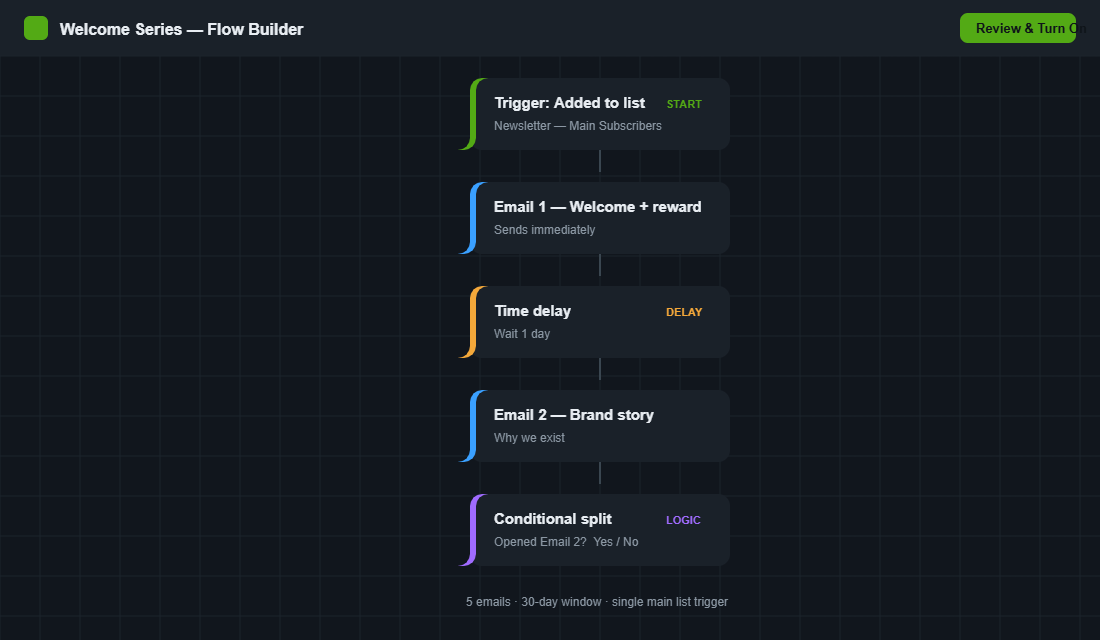
- Point every form at one main list. Send your popup, footer form, and checkout opt-in to a single “Main Subscribers” list. This keeps the trigger clean and the experience consistent.
- Create the flow. Go to Flows, click Create Flow, and choose the Welcome Series template (or start from scratch for full control).
- Set the trigger. Select “Added to list” and choose your Main Subscribers list. Click Done.
- Build email 1 with no delay. Drag in an email action, configure the content, and leave it to send immediately so the code arrives while they are still on the site.
- Add time delays between the rest. Drag a delay before emails 2 through 5. Space them across a 30-day window: roughly day 0, day 2, day 4, day 7, and day 10 to 14.
- Add a conditional split. After email 2, branch on whether they opened or clicked so engaged subscribers and quiet ones get slightly different paths.
- Review and turn it on. Send yourself test emails, check every link and the discount code, then switch the flow live.
The mistakes that quietly kill welcome flows
Most underperforming welcome flows are not broken in some dramatic way. They leak slowly through a handful of avoidable mistakes. Fix these before you obsess over copy tweaks.
- Sending only one email. The single biggest miss. A lone welcome email captures the easy buyers and abandons everyone who needed more time. Five emails earn roughly 90% more orders for the same list.
- Delaying email 1. If your first email waits an hour, the discount lands after the person has left and forgotten the tab. Send it instantly, every time.
- Leading with the catalogue instead of the offer. A welcome email that opens with twelve products and buries the code converts worse than a clean email built around one decision.
- Reusing the same list for everything. If buyers and non-buyers sit in one bucket with no exclusion, you keep nudging people who already purchased. Add a filter so anyone who buys mid-flow stops getting the “still deciding?” emails.
- Faking urgency. A countdown that resets the moment it hits zero teaches your sharpest customers that your deadlines mean nothing. Worse, misleading urgency can breach Australian Consumer Law.
How to know your flow is actually working
Set it live and then watch the right numbers, not vanity metrics. Open rate tells you the subject line works. It does not tell you the flow makes money. These are the metrics that matter.
- Revenue per recipient. The headline number. Aim for the $2.50 to $3.50 range, knowing brands with an average order value of $100 to $200 often clear $3.34. If you are well under $2, the offer or the product selection is the problem.
- Placed-order rate. What share of subscribers buy inside the flow. Around 2% is average; the top decile pushes past 10%. This is your conversion ceiling to chase.
- Revenue per email. Look at each email individually. If email 3 or email 5 is flat, that is the one to rewrite first, not the whole sequence.
- Unsubscribe rate. A small amount is healthy. A spike on a specific email means it is too pushy or too frequent. Space the delays out.
Give the flow at least a few hundred recipients before you judge it, then change one variable at a time. The most common winning change is not a new design. It is sharpening the offer in email 1 and adding stronger proof to email 3.
Your welcome sequence checklist
Print this. Build against it. If you can tick every box, your welcome flow is ahead of the vast majority of Australian Shopify stores.
- Capture: one clear reward, a scroll or exit trigger, email-only on step one, all forms feeding one list.
- Email 1 (day 0): sends instantly, code above the fold, expiry set, one CTA.
- Email 2 (day 2): the brand story, a founder photo, a reason to care beyond the discount.
- Email 3 (day 4): two or three hero products, stacked with reviews and ratings.
- Email 4 (day 7): shipping, returns, guarantee, and quality proof in plain English.
- Email 5 (day 10 to 14): honest deadline, single decision, last piece of social proof.
- System: a conditional split after email 2, and a clean handoff into your post-purchase and loyalty flows.
Build the five emails once, get the capture right, and you have a machine that turns curious browsers into first-time buyers around the clock, at roughly $2.65 for every person who joins your list. That is the difference between an email list and an asset.
Where this fits in the bigger picture
Australians spent $82.6 billion online in 2025, up 14% year on year, and 24% of all retail now happens online. The traffic is there. The question is whether your store converts the interest it already earns. A welcome sequence is the cheapest, most durable way to lift first-purchase conversion without spending another dollar on ads.
Inside eCommerce Circle, the welcome flow is one of the first systems we audit with every member, because it pays back faster than almost anything else you can build. If you want a second opinion on yours, let’s talk.