You are paying more to acquire each customer than you did a year ago, and you can see less of what they do once they land on your store. Apple’s privacy changes wiped out a big slice of your attribution. Ad costs keep climbing. Most founders respond by bolting on another tracking pixel or a new attribution app, hoping to claw back the signal they lost.
What’s in This Article
The brands pulling ahead are doing the opposite. Instead of trying to spy on customers more cleverly, they ask them directly. They build a system to collect the preferences, goals and intentions customers will happily hand over, then use that data to sell. This is zero-party data, and 88% of marketers now rank collecting and activating it as their top priority for 2026. Only 16% actually do it, according to the Supermetrics 2025 Marketing Data Report. That gap is your opening.
This playbook is the 5-step system we work through with Aussie Shopify operators: map the moments you can ask, build the quiz that does the heavy lifting, turn answers into segments, personalise the experience, and govern the whole thing so you stay on the right side of a tightening Privacy Act. Done properly, declared data becomes the one marketing asset that gets more valuable as third-party tracking gets worse.
What Zero-Party Data Actually Is (and Why It Beats the Data You Are Chasing)
Most founders lump all customer data into one bucket. The brands that win sort it into three, because the three behave very differently.
- Third-party data. Collected by someone else (ad platforms, data brokers) and rented to you. This is the data that is disappearing, and you never owned it.
- First-party data. Behaviour you observe on your own store: pages viewed, products bought, emails opened. Useful, but it is inference. You are guessing why someone did something.
- Zero-party data. Information the customer deliberately and proactively gives you. Their skin type. Their goal. Who they are buying for. Their budget. Their size. You are not guessing. They told you.
Here is the practical difference. First-party data tells you a customer viewed three protein powders and bought none. Zero-party data tells you she is training for a marathon, is dairy-free, and wants something under $60. The first leaves you guessing at a discount to win her back. The second lets you send the exact product, with the exact message, the same day. One is a clue. The other is an instruction.
Zero-party data wins on three fronts. It is accurate, because it is declared rather than inferred. It is consented, so there is no privacy landmine waiting under it. And it is yours, so no platform update can switch it off overnight. Around 73% of consumers say they will share personal data when they get clear value in return, and 48% feel more comfortable with brands that ask openly rather than tracking quietly. When you personalise off the back of that data, customers spend about 38% more on average, according to Twilio Segment research.
The timing matters in Australia specifically. The Privacy and Other Legislation Amendment Act 2024 received royal assent in December 2024. A statutory tort for serious privacy invasions has commenced, penalties for serious breaches now reach up to $50 million, and the small business exemption for businesses under $3 million turnover is on the chopping block in the next tranche of reforms. Passively hoovering up data is getting riskier. Asking for it with a clear value exchange is getting smarter.
Step 1: Map the Five Moments You Can Ask
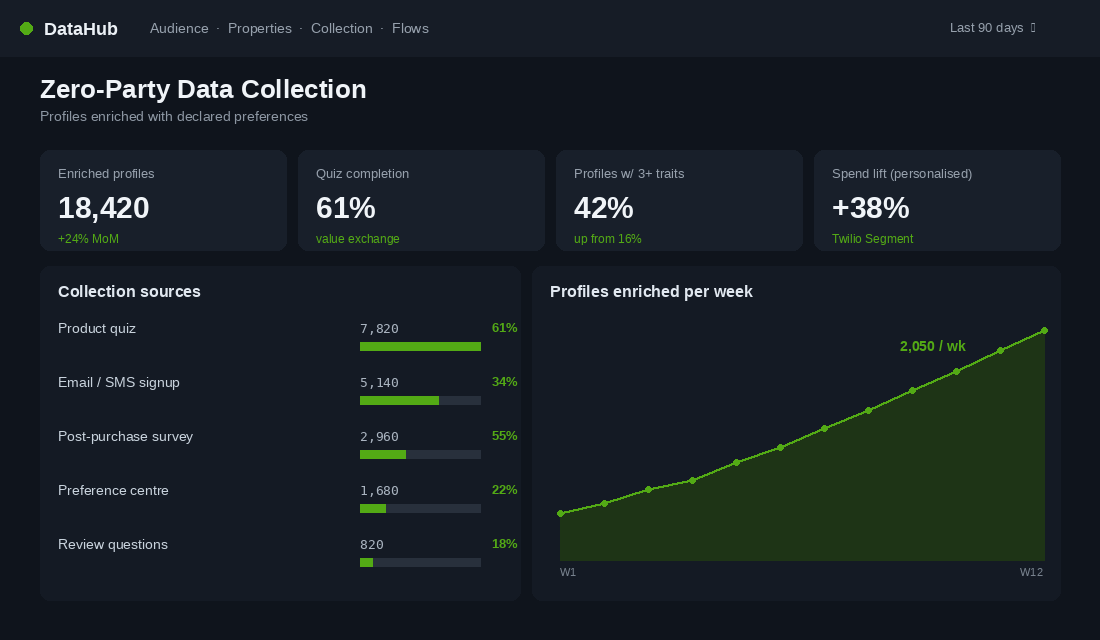
You do not collect zero-party data with one popup. You collect it across the journey, a little at a time, always in exchange for something. Map these five moments and you have a collection system, not a one-off campaign.
- The entry quiz. Top of funnel. A new visitor takes a “find your match” quiz in exchange for a tailored recommendation. This is your highest-volume collection point and the one most stores skip.
- The signup. Email and SMS capture is the moment to ask one preference question (what are you shopping for, what is your goal). One question, never ten.
- The post-purchase moment. Right after checkout, ask how they heard about you and what problem they are solving. They are warm and willing. We cover the attribution side of this in our post-purchase survey playbook.
- The preference centre. A page linked from your email footer where subscribers self-select categories, frequency and interests. It cuts unsubscribes and sharpens every send.
- Reviews and replies. Custom review questions (skin type, fit, use case) and replies to your broadcast emails are zero-party gold that most brands throw straight in the bin. Our social listening playbook covers mining the unowned version of these conversations.
One rule governs all five: never ask for data you will not use, and never ask without giving something back. Every question costs the customer a little friction. Pay for it with a recommendation, a discount, better content, or a faster path to the right product. Get the value exchange right and the data flows. Get it wrong and you train people to skip your forms.
An Aussie example of the value exchange done well: a skincare brand that asks “what is your main skin concern” at signup and immediately tailors the welcome series to that answer earns the right to ask more later. The customer gave one piece of data, got something useful back, and is now primed for the quiz, the preference centre and the review request. Trust compounds the same way revenue does.
Step 2: Build the Product Quiz That Does the Heavy Lifting
The quiz is the workhorse of the whole system. It collects the richest data, at the highest volume, with the clearest value exchange: answer five questions and I will tell you exactly what to buy. Zero-party data collection campaigns average a 61% conversion rate, and case studies from brands like Bonafide report onsite conversion lifts of up to 469% after adding quiz-led collection. Treat the headline figures as a ceiling rather than a promise, because they are vendor-reported, but the direction is real.
Our default tool recommendation is Octane AI, which starts from around AUD $50 per month and has the deepest Klaviyo integration in the quiz category. Here is the 5-step build we use:
- Install and connect. Add Octane AI from the Shopify App Store and connect your store plus your Klaviyo account before you build anything.
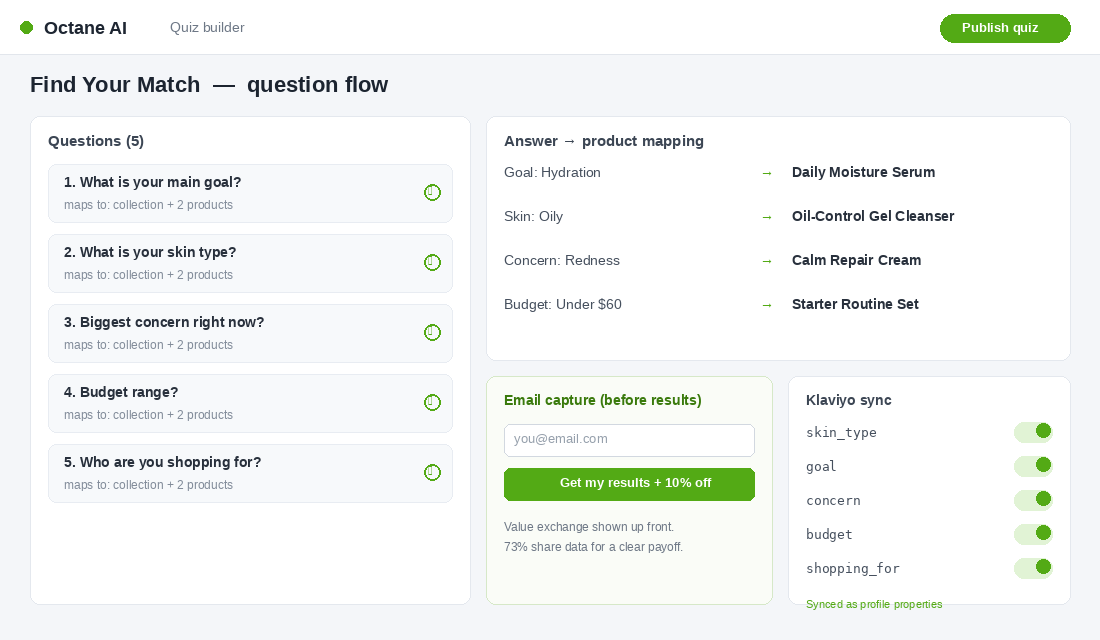
- Write 4 to 6 real questions. Set the quiz goal to recommendation, then write questions that map to how customers actually choose: goal, skin type, concern, budget, who it is for. Keep it under seven questions or completion drops.
- Map answers to products. Connect each answer path to specific products or collections so every result is genuinely tailored, not your bestseller served to everyone.
- Capture before the result. Place the email and SMS capture just before the results screen with a clear value line, such as “get your results plus 10% off your match”.
- Switch on the Klaviyo sync and publish. Turn on the sync so every answer flows through as a customer property, then publish the quiz to its own page and link it from your nav, homepage and ads.
A few design rules separate a quiz that converts from one that bores people into bouncing. Lead with the outcome, not your brand (“Find your perfect match in 60 seconds”). Use image answers over text where you can, because tapping a picture is faster than reading a paragraph on a phone, and most of your traffic is mobile. Keep a progress bar visible so people know the finish line is close. And make the results page do real work: show the recommended product, explain in one line why it fits their answers, and put a single clear add-to-cart above the fold.
One more reason to build this first: a quiz is your best paid-traffic landing page. Sending cold ad traffic to a quiz instead of a collection page gives the visitor a reason to engage and gives you data on the people who do not buy on day one. That second group is where most of your future revenue is hiding.
Step 3: Turn Answers Into Segments and Properties
Collected data that sits inside an app does nothing. The money is in activation, and activation lives in Klaviyo. Every quiz answer, signup preference and survey response should sync in as a customer property you can segment on.
- Sync answers as properties. skin_type = oily, goal = muscle gain, shopping_for = gift. Octane AI does this automatically. Data you collect by hand can be pushed through Klaviyo profile properties.
- Build segments off those properties. “Oily skin and no purchase in 30 days.” “Buying for someone else.” “Budget-conscious, browsed but did not buy.” These are segments you simply could not build from behaviour alone.
- Trigger flows on the answers. The quiz-completion flow sends the recommended product, then a two to three email education sequence written for that exact declared goal.
This is where relevance turns into revenue. 91% of consumers are more likely to shop with brands that give relevant recommendations based on their stated preferences, per Accenture research. Segmented sending off declared data is how you earn that preference instead of hoping for it. We go deep on the segment-then-send mechanics in the RFM segmentation playbook, and zero-party data makes RFM sharper because you are no longer guessing intent on top of behaviour.
Step 4: Personalise the Experience Where It Moves Revenue
Now spend the data in the places that actually shift the numbers. The aim is not personalisation for its own sake. It is putting the right product and the right message in front of the right person, every time.
- Email and SMS. Match subject lines and offers to the declared goal. A “muscle gain” subscriber and a “weight loss” subscriber should never get the same campaign.
- On-site. Show the quiz result to returning visitors, surface recommended products, and swap hero messaging by segment where your theme allows it.
- Product recommendations. Replace generic “bestsellers” blocks with “based on your answers” blocks. Relevance beats popularity nearly every time.
- Paid ads. Push consented, declared segments into Meta custom audiences so you advertise the right product to the right person and stop burning spend on bad matches.
- Product development. The aggregate of thousands of quiz answers tells you what to stock, bundle and build next. This is the highest-impact use of zero-party data, and almost nobody touches it.
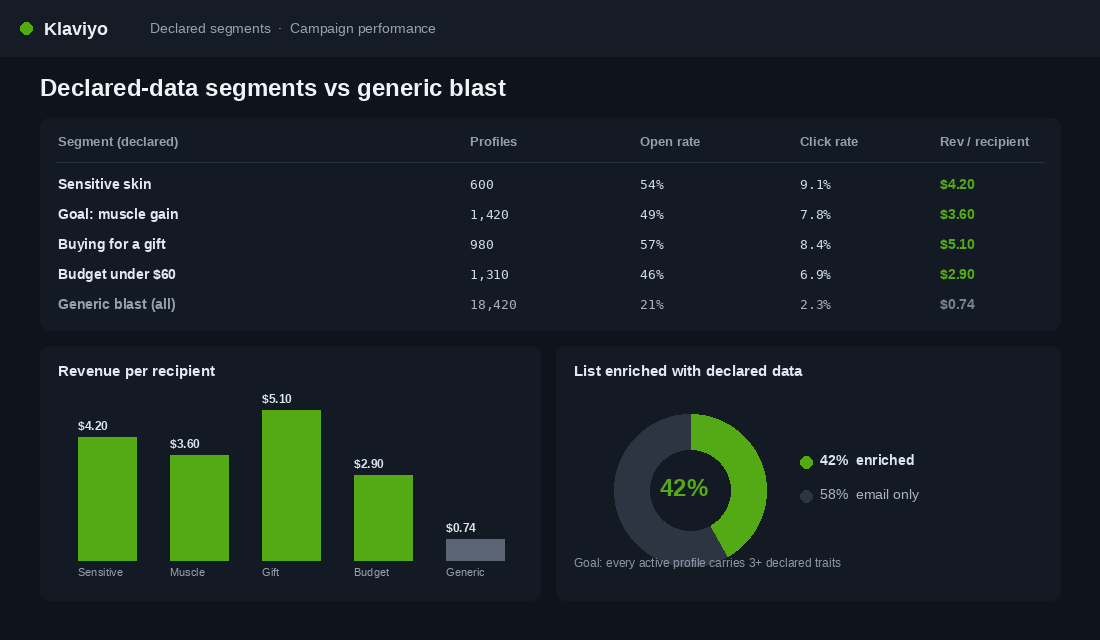
Make one campaign concrete. Say 600 quiz-takers declared “sensitive skin”. Instead of blasting your whole list a generic 15% off, you send those 600 a campaign titled around sensitive skin, featuring the three products mapped to that answer, with a short note on why. That email will out-perform the generic blast on open rate, click rate and revenue per recipient, because it reads like it was written for one person. Multiply that across every declared segment and your email channel quietly becomes your most profitable one.
The pattern looks the same at every size. AU beauty retailer Adore Beauty and the global benchmark Sephora both run preference-led programs that ask about skin type, concerns and beauty habits, then feed that into tailored recommendations and loyalty. Mecca’s Beauty Loop collects declared preferences to personalise its rewards. Ask, store, personalise, repeat. You do not need a beauty catalogue to run the same loop, you just need to know what your customers are actually trying to achieve.
Step 5: Govern It So It Stays an Asset, Not a Liability
Zero-party data is only an asset if you handle it cleanly. Get this wrong and the same data that lifts your conversion becomes a risk on your balance sheet. Five habits keep it on the right side.
- Make the value exchange explicit. Tell people what they get for answering. A clear payoff is exactly why 73% of consumers share in the first place.
- Be transparent about use. A plain-English line near the form (“we use this to recommend the right products and tailor your emails”) beats a policy buried five clicks away.
- Honour deletion. The 2024 reforms strengthened the right to request deletion. Make sure your stack can actually remove a customer profile when someone asks.
- Do not over-collect. Ask only for what you will use. Every extra field is friction for the customer and risk for you.
- Control who can see it. With penalties up to $50 million for serious breaches and the small business exemption set to be removed, treat customer data like cash in the till.
The brands that win here are not the ones sitting on the most data. They are the ones customers trust enough to keep handing it over, again and again.
The Compound Effect: Why This Becomes a Moat
Each step feeds the next. The quiz collects, Klaviyo segments, personalisation lifts conversion and spend, better results make customers more willing to share, and that richer data flows back into the quiz and the recommendations. It is a flywheel that third-party tracking can never give you, because you own every turn of it.
Put rough numbers on a two million dollar a year store. Route cold ad traffic and 30% of new visitors through a quiz, lift quiz-taker conversion even modestly, and personalise email off declared goals. A 38% personalisation spend lift applied to even a third of revenue, plus a few points of conversion on quiz traffic, comfortably adds six figures a year. The real kicker is acquisition cost. Every dollar of relevance you buy with data you already own is a dollar you do not spend re-targeting the wrong people.
Four Mistakes That Kill Zero-Party Data Programs
- Collecting and never activating. Data sitting in an app earns nothing. Wire it to Klaviyo on day one, not “later”.
- Asking without giving. A 10-field form with no payoff gets abandoned. Lead with the value, then ask.
- One and done. This is a system, not a single popup. Build collection into all five moments.
- Set and forget. Review your answers monthly. The aggregate is a product and marketing roadmap hiding in plain sight.
Your 30-Day Zero-Party Data Rollout
- Week 1. Map your five collection moments. Decide the one quiz question set that matters most to your category.
- Week 2. Build and launch the product quiz in Octane AI, wired to Klaviyo, linked from your nav and homepage.
- Week 3. Build three segments and the quiz-completion flow. Add one preference question to signup and one to your post-purchase survey.
- Week 4. Personalise one email campaign and one on-site block off declared data. Set a recurring monthly review of aggregate answers.
- Ongoing. Add a preference centre, push consented segments to your ads, and feed quiz insights into your product and buying decisions.
The founders who start now build an asset that gets stronger every month while everyone else keeps renting attention from platforms that show them less each year. The data your customers give you on purpose is the one signal nobody can take away.
Inside eCommerce Circle, turning customer data into a durable growth asset is one of the core pillars we work on with every member. If you want a second opinion on how you are collecting and using yours, let’s talk.