You can tell a lot about a Shopify business by where the founder spends their attention. Most pour almost all of it into the top of the funnel: new creative, new channels, new customers. Acquisition feels like growth because the dashboard lights up every time a fresh order lands.
What’s in This Article
Here is the uncomfortable maths. The average ecommerce store has a repeat purchase rate of around 28%, which means roughly seven in ten customers you paid good money to acquire never come back. At the same time, your top 5% of customers quietly generate about 35% of your revenue. You are funding a leaky bucket and calling it scale.
The brands that actually compound treat the second order as the real finish line, not the first. Stores sitting at a 40% repeat rate generate roughly 50% more revenue than stores stuck at 10%, off the exact same acquisition spend. This is the five-tier system we work through with members to close that gap, in the order that pays back fastest.
Track the One Number That Tells You If You Have a Business or a Treadmill
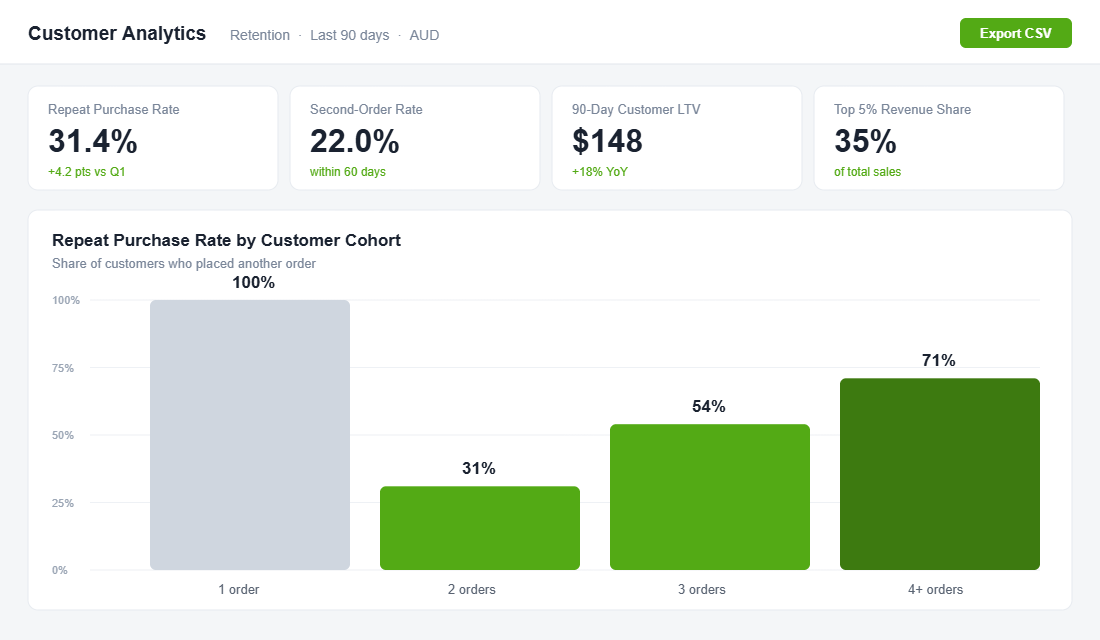
Before you fix retention, you have to measure it honestly. The number that matters is your repeat purchase rate: the percentage of customers who have placed more than one order. The formula is simple. Take customers with two or more orders, divide by total customers, multiply by 100.
What counts as good depends heavily on what you sell. Consumables like food and pet supplies routinely clear 40%, with grocery hitting north of 65%. Apparel sits around 20 to 26%. Luxury and furniture languish under 15% because nobody buys a new sofa every quarter. Benchmark yourself against your category, not against a grocery brand.
In Shopify, the raw view lives under Analytics in your customer reports, split into first-time versus returning. The problem is that the native view tells you the score without telling you why. You want to see repeat rate by cohort: of everyone who placed a first order, how many came back for a second, a third, a fourth. That curve is where the strategy hides.
Tier 1: Win the Second Order Inside 60 Days
The single most important moment in a customer’s life with your brand is the gap between order one and order two. Get a second order quickly and their lifetime value trajectory bends upward sharply. Let them drift and you are back to paying Meta to reacquire someone who already knows you.
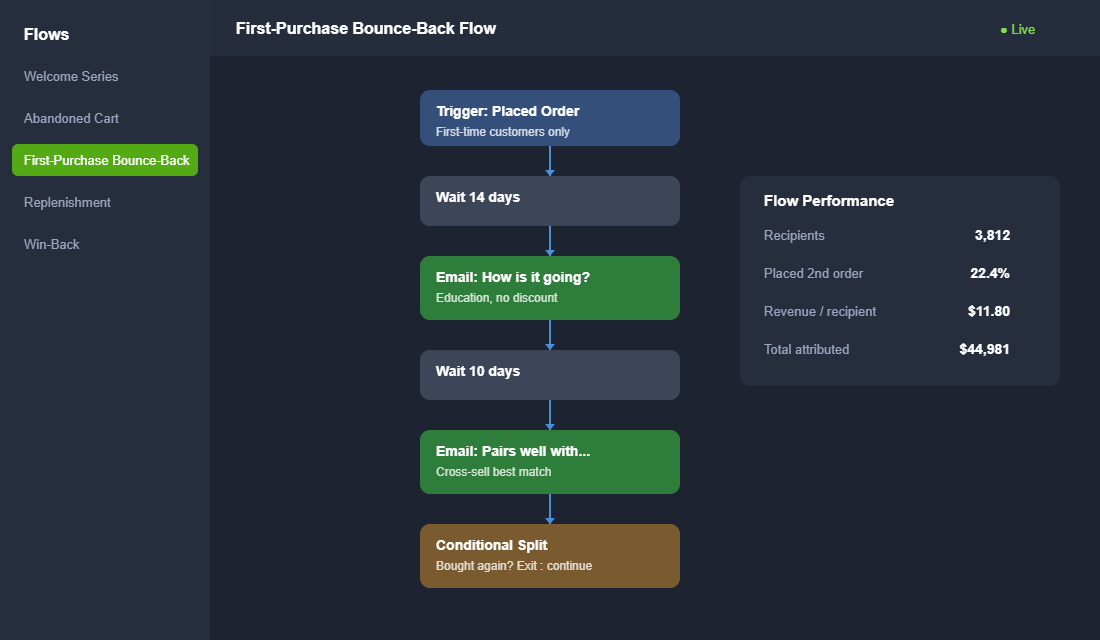
The data is clear that the faster the second purchase happens, the stronger the LTV. The window you are fighting for is under 60 days. That means a dedicated first-purchase bounce-back flow is not optional, it is the highest-use automation you own.
Build it to do three jobs in sequence:
- Educate before you sell. The first email lands 10 to 14 days after delivery with zero discount. Help them get more out of what they already bought. A customer who succeeds with order one is far more likely to place order two.
- Recommend the obvious next product. The second email cross-sells the single best companion to their first purchase. Not a catalogue. One smart suggestion based on what people who bought that product buy next.
- Make the path frictionless. Pre-build the cart, remind them of free-shipping thresholds in AUD, and remove every reason to think twice.
This flow stacks neatly on top of your acquisition emails. If you have not nailed the front end yet, our Shopify welcome email sequence playbook covers how to turn a new subscriber into that first buyer before the bounce-back even starts.
Tier 2: Build a Replenishment Engine Around Your Consumption Cycle
If you sell anything consumable, your repeat revenue is governed by one thing: how long the product lasts. A 60 day skincare serum, a four week coffee bag, a monthly supplement. The brands that win the reorder are the ones who show up right as the customer is about to run out, not a fortnight later when they have already grabbed a replacement at the supermarket.
The mistake most founders make is guessing the timing. Do not guess. Look at the actual median gap between first and second orders for each product, then trigger the replenishment reminder a few days before that gap closes. Klaviyo’s predictive analytics will estimate the next expected order date for you once it has enough order history to work with.
Split the journey by where the customer is. First-time buyers belong in the bounce-back flow from Tier 1. Customers with two or more orders move into the standard replenishment flow, where the goal quietly shifts from winning each reorder to setting up the apex tier: subscription. More on that shortly.
Tier 3: Win Back the Lapsers Before You Reach for a Discount
Some customers will go quiet no matter how good your bounce-back and replenishment flows are. That is normal. The mistake is letting them go silent, then panicking and firing off a 30% off code that trains your best people to wait for the next sale.
Timing is category specific. Beauty and supplements should trigger a win-back at 60 to 90 days of inactivity. Most general DTC sits at 90 to 120 days. Fashion can stretch to 120 to 180 days because the buying cycle is naturally longer. Set the trigger off your real average reorder gap, not a round number.
Structure the sequence so the discount is the last lever, not the first:
- Email one, no offer. A genuine check-in plus a reminder of why they bought in the first place. New arrivals, a restock, something useful.
- Email two at day seven. A modest nudge, free shipping or 10 to 15% off, framed as a welcome-back rather than a fire sale.
- Email three at day fourteen. A stronger offer or a best-seller spotlight for the genuinely price-sensitive.
- Email four at day twenty-one. A last-chance message, after which they are suppressed from win-back and moved to a low-frequency list. Protecting deliverability is protecting future revenue.
Tier 4: Turn Your Best Repeat Buyers Into Subscribers
Subscription is the apex of the repeat-purchase ladder because it converts an active decision into a default. Instead of winning the reorder every cycle, you win it once and then keep it unless the customer chooses to leave. That is a fundamentally different business to run.
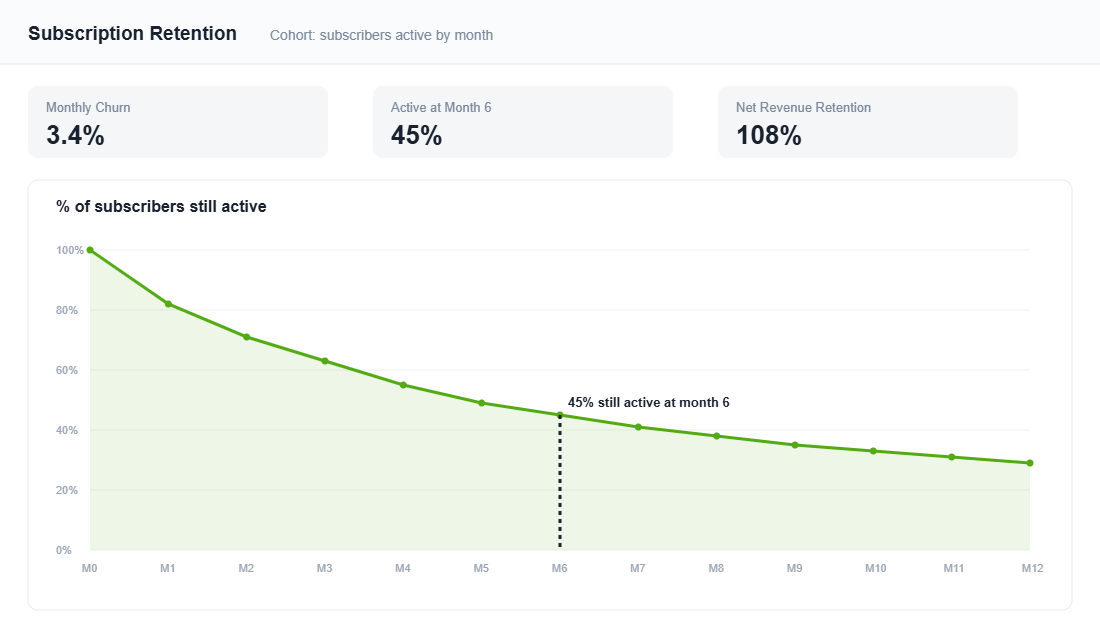
The proof is in the numbers. Best-in-class subscription programs hold monthly churn around 3.4% across both cancellations and failed payments, and cohort data shows roughly 45% of subscribers still active six months in. Chewy, the pet retailer, drives about 82% of its revenue through its Autoship subscription. Closer to home, Melbourne’s Who Gives A Crap built a category-leading brand on the simple insight that you will always run out of toilet paper, so the reorder should be automatic.
Use a purpose-built Shopify subscription app such as Recharge, Loop, or Appstle rather than bolting it on with discount codes. Then make subscribing the easy choice: a clear price advantage over one-off, flexible frequency, and one-tap skip or swap. Over a third of subscribers will skip, swap, or change frequency at some point, and the brands that make that easy are the ones that keep them. Friction on cancellation does not reduce churn, it just produces angry reviews.
Tier 5: Layer Loyalty and Referral on Top, Not Underneath
Loyalty and referral are multipliers, not foundations. A points program will not save a brand with a weak product or a broken second-order flow, but bolted onto the four tiers above it compounds beautifully. The order matters. Build the engine first, then add the accelerant.
Keep it deliberately simple. Reward the behaviours you actually want: a second purchase, a subscription sign-up, a referral that converts. Avoid the trap of giving points for everything, which just inflates your liability without changing behaviour. Referral works best pointed at your happiest cohort, your subscribers and three-plus-order customers, because they already trust you enough to put their name on the line.
One caution worth flagging: every dollar of loyalty reward and referral credit comes straight off your margin. Model it before you launch it. If you are not certain your unit economics can carry it, our Shopify pricing strategy playbook walks through finding the margin to fund retention without quietly going broke.
The Klaviyo Setup: Your First Bounce-Back Flow in an Afternoon
You do not need a six-figure tech stack to start. If you already run Klaviyo, you can stand up the Tier 1 bounce-back flow in an afternoon. Here is the exact build:
- Create a new flow triggered on the Shopify Placed Order metric.
- Add a trigger filter so only first-time buyers enter: Placed Order, equals, zero times, in the customer’s lifetime before this order. This stops existing repeat buyers getting the wrong message.
- Add a time delay of 10 to 14 days from the trigger, timed to land just after the product arrives and gets used.
- Email one: the value email. No discount. How to get the most from what they bought, plus one relevant tip.
- Add a delay of 8 to 10 days, then a conditional split: has the customer placed another order? If yes, exit the flow. If no, continue.
- Email two: the cross-sell. Recommend the single best companion product with a direct add-to-cart link.
- Switch it live and watch two numbers: the percentage who place a second order, and revenue per recipient. A healthy bounce-back flow should be pushing your second-order rate toward the low 20s and beyond.
The reason this works is that it uses what the customer has already told you. If you want to go further and personalise these flows by stated preference rather than just purchase history, our Shopify zero-party data playbook shows how to collect the declared data that makes every flow sharper.
The Compound Effect: Why the Tiers Beat Any Single Tactic
Any one of these tiers run on its own gives you a modest lift. Run together, in order, they change the shape of the business. The bounce-back wins order two. Replenishment makes order three through five feel automatic. Win-back recovers the drifters before you have to discount them. Subscription converts your best buyers into recurring revenue. Loyalty and referral turn that recurring base into a growth channel that does not touch your ad account.
That is how a brand moves from a 20% repeat rate to a 40% one, and why for mature consumable brands repeat buyers can end up driving two thirds of total revenue. The lift is not from working harder on acquisition. It is from refusing to let a customer you already paid for slip away quietly.
Here is your checklist to run this week:
- Measure. Pull your repeat purchase rate and your second-order rate by cohort. Benchmark against your category, not the average.
- Tier 1. Build or fix the first-purchase bounce-back flow. Lead with value, cross-sell second, no opening discount.
- Tier 2. Find your real median reorder gap per product and trigger replenishment a few days before it.
- Tier 3. Set a win-back at your category’s inactivity window with the discount as the last step, not the first.
- Tier 4. If you sell consumables, make subscription the easy default with flexible skip and swap.
- Tier 5. Only after the engine runs, layer loyalty and referral, and model the margin first.
The Five Numbers to Check Every Month So the Tiers Stay Honest
A retention engine drifts quietly. Flows keep sending, revenue looks fine, and nobody notices the second-order window has stretched from 44 days to 70 because a supplier delay pushed everything out.
Put these five numbers on one page and review them on the first Monday of every month. It takes twenty minutes and it is the difference between a system and a set-and-forget guess.
- Repeat purchase rate. Share of customers who bought more than once in the last 12 months. Under 15% and you are running a treadmill. 20% to 30% is a solid consumables or apparel business. Above 35% and you have a genuine moat.
- Days to second order (median, not average). One customer who reordered after 400 days will drag your average into fantasy. The median tells you when to actually send.
- Second-order rate inside 60 days. This is the single best early warning signal you have. If it falls two months running, your post-purchase flow has broken before your revenue shows it.
- Subscription churn, if you sell consumables. Healthy programs sit around 5% to 10% monthly. Above 15% you are refilling a leaking bucket and paying acquisition costs to do it.
- Contribution margin per repeat order versus first order. Repeat orders should carry meaningfully better margin because there is no ad spend attached. If they do not, your discounting is eating the whole benefit.
Klaviyo gives you most of this natively. Build a cohort report by first purchase month, then track what percentage of each cohort has bought again at 30, 60, and 90 days. Shopify’s customer reports cover repeat rate and days between orders if you are not on Klaviyo yet. For anything more granular, Lifetimely and Triple Whale both hook into Shopify and do the cohort maths for you.
Three Mistakes That Quietly Stall a Repeat Purchase Engine
Most stalled retention programs are not missing a tactic. They are running one of these three mistakes underneath everything else.
Discounting the second order by default. If every bounce-back email carries 15% off, you have trained your customers to wait for it. Test a value-led reorder email against a discount one. Plenty of Aussie brands find the value version converts within a point or two of the discount version, at full margin.
Sending on a calendar instead of a consumption cycle. A 60-serve supplement is not a 30-day product. Work out how long your product actually lasts, then send the reorder prompt at roughly 70% of that window so it lands while the customer still has some left and is not yet shopping around.
Stacking loyalty on top of a broken second order. Points programs feel productive because there is an app to install. But a loyalty program applied to a store with a 12% repeat rate is decoration. Fix Tier 1 first, then let loyalty compound something that already works.
Imagine you run a coffee brand with 2,400 customers a year and a 16% repeat rate. Moving that to 24% by fixing the second-order window alone adds roughly 190 repeat orders. At a $58 average order value and no acquisition cost attached, that is around $11,000 of near-full-margin revenue from customers you already paid for.
Inside eCommerce Circle, lifting repeat purchase rate is one of the core pillars we work on with every member, because it is the cheapest growth most stores are sitting on. If you want a second opinion on yours, let’s talk.