Here is an uncomfortable truth about your Shopify store. The single most powerful profit lever you own is the price field on your product page, and you probably set it once, in a hurry, by adding a markup to your cost and rounding to something that felt right. Then you never touched it again.
What’s in This Article
That is cost-plus pricing, and it is the default setting for most Aussie founders running between $40k and $500k a month. It feels safe because it guarantees a margin on paper. The problem is that your customer does not care what your product costs you. They care what it is worth to them. When you price off your cost, you are letting your supplier decide your profit, not your market.
This matters more in 2026 than it did two years ago. Aussie shoppers spent a record $82.6 billion online in 2025, up 14% year on year, but average basket sizes are now about $10 lower than they were in 2020. People are buying from more brands and spending less per order, and 74% of Australian consumers say cost-of-living pressure is actively limiting what they spend on non-essentials. The brands winning that environment are not the cheapest. They are the ones that price with intent. This playbook gives you the five levers to do exactly that.
Why Cost-Plus Pricing Quietly Caps Your Growth
A 1% improvement in price, with volume held flat, drops almost entirely to your bottom line. A 1% improvement in volume does not, because it drags variable costs, shipping and ad spend along with it. Price is the only lever that improves profit without costing you anything to pull. Yet it is the one most founders touch the least.
Cost-plus pricing has three hidden failures. It ignores what your competitors charge, so you either leave money on the table or price yourself out without knowing. It ignores perceived value, so a product worth $90 to your customer gets sold for $49 because your cost was $20. And it treats every customer as if they all value the product identically, which is never true.
The fix is not to randomly hike prices and hope. It is to build a pricing system that uses how people actually make decisions. The five levers below do that. They are anchoring, tiering, the left-digit effect, value-based pricing, and structured testing. Work through them in order.
Lever 1: Set the Anchor Before You Quote the Price
The first number a customer sees becomes the reference point for every number after it. This is the anchoring effect, and it is the most reliable bias in all of pricing psychology. If the first price they see is high, your actual price feels like a relief. If they see your price cold, with nothing to compare it to, it has to defend itself alone.
Koala does this on every product page. A queen Koala Luxe Mattress and Balmain Bed Base bundle sits at $3,186, with the individual total of $3,540 shown right beside it. The $3,540 is the anchor. Suddenly $3,186 is not an expense, it is a $354 saving. The strikethrough RRP is doing the persuasion before the buyer has even read the product description.
Here is how to install anchoring on your own store without lying about a fake RRP, which breaches Australian Consumer Law if the “was” price was never genuinely charged.
- Lead with your premium option. Show your highest-priced bundle or tier first, so the mid option reads as sensible rather than expensive.
- Use genuine compare-at pricing. If you genuinely sell a single unit at $39, a 3-pack at $99 can honestly show “$117 if bought separately”.
- Anchor against the alternative, not yourself. “A barista coffee a day for a month costs more than this” reframes the whole category.
- Put the anchor physically close to the price. The reference number must be visible in the same eyeline as the price you want them to accept.
Lever 2: Engineer a Decoy With Good, Better, Best
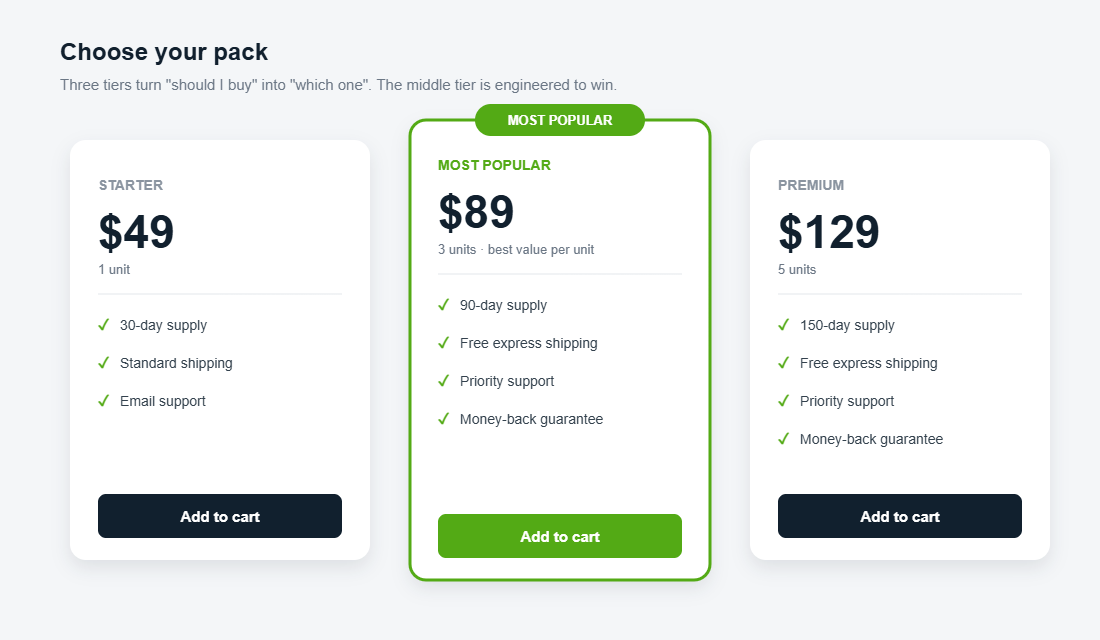
When people face a single price, they ask “is this worth it, yes or no”. When they face three options, they stop asking whether to buy and start asking which one to buy. That shift is worth more than almost any conversion tweak you can make to a product page.
The classic proof comes from behavioural economist Dan Ariely. He offered people three subscriptions to The Economist: web-only at $59, print-only at $125, and print-plus-web also at $125. The print-only option looked deliberately silly, but with it on the table, 84% chose the $125 bundle. When he removed that “useless” decoy, only 32% chose the bundle and most dropped to the cheap option. The decoy did not sell. It made the expensive option irresistible.
You can build the same structure into a Shopify store with variants or a bundle app. The goal is to make your target tier, usually the middle or upper-middle, the obvious smart choice.
- Three tiers, not five. Good, better, best. More than three causes choice paralysis and basket abandonment.
- Make the jump to “best” feel cheap. If “better” is $79 and “best” is $89 with twice the product, the $10 gap makes “best” feel like a steal.
- Name the tiers by outcome. “Starter”, “Most Popular”, “Best Value” guide the eye. Tag your target tier as the popular one.
- Anchor the page on the top tier. This connects Lever 1 and Lever 2 into one move.
If you already run bundles, you are halfway there. Our Shopify product bundling playbook covers the mechanics of building tiers that lift average order value by 20 to 35% without discounting your margin away.
Lever 3: Master the Left-Digit Effect (and Know When to Break It)
We read prices left to right, and our brain anchors on the first digit before it finishes processing the rest. $9.99 lands as “nine dollars something”, not “basically ten”. This is the left-digit effect, and the data behind it is hard to argue with. A famous MIT and University of Chicago experiment found that prices ending in 9 lifted demand by 35%. A separate 2011 analysis put the sales lift from 9-endings at around 24%.
Charm pricing works across the whole range, from a $4.99 add-on to a four-figure mattress. But it is not a law of physics, and using it on the wrong product actively hurts you. Round numbers signal quality and confidence. A luxury candle at $60 outsells the same candle at $59.95 because the round number tells the buyer this is a considered, premium purchase, not a bargain-bin clearance.
Here is the rule of thumb to apply across your catalogue.
- Use 9-endings on value and impulse buys. Consumables, accessories, anything bought on logic and price comparison.
- Use round numbers on premium and considered purchases. Hero products, gifting, anything where craft and quality justify the spend.
- Drop the cents on higher-priced items. $1,200 reads cleaner and more premium than $1,199.99.
- Keep the left digit low at psychological thresholds. $49 versus $50 matters far more than $52 versus $53, because the first digit changes.
Lever 4: Price on Value, Then Justify It
Value-based pricing means setting your price by what the outcome is worth to the customer, then earning that price with proof. This is where the real margin lives, and it is the lever cost-plus founders never reach for because they are mentally anchored to their own costs.
The mechanism is simple. The higher you price, the more justification the buyer needs, so you stack reasons until the price feels obvious. A skincare serum is not “30ml of liquid for $69”. It is “eight weeks of visibly firmer skin, dermatologist-tested, made in Australia, with a money-back guarantee”. The price did not change. The frame did.
Risk reversal is the strongest single justifier you have. When the customer carries no downside, a higher price stops being a gamble. A solid guarantee can lift conversion enough to more than pay for the occasional refund, which is exactly why we built the Shopify money-back guarantee playbook as a standalone system.
- Quantify the outcome. Translate features into the result the buyer actually wants, in their words.
- Stack proof near the price. Reviews, before-and-afters, certifications and guarantees do the heavy lifting of justification.
- Sell the cost of inaction. What does staying with the cheaper, worse option cost them over a year?
- Protect your margin upstream too. Value pricing plus tighter costs compounds. Our supplier negotiation playbook shows how to cut COGS 10 to 15% so every price rise lands twice as hard on profit.
Lever 5: Test Your Prices, Do Not Guess Them
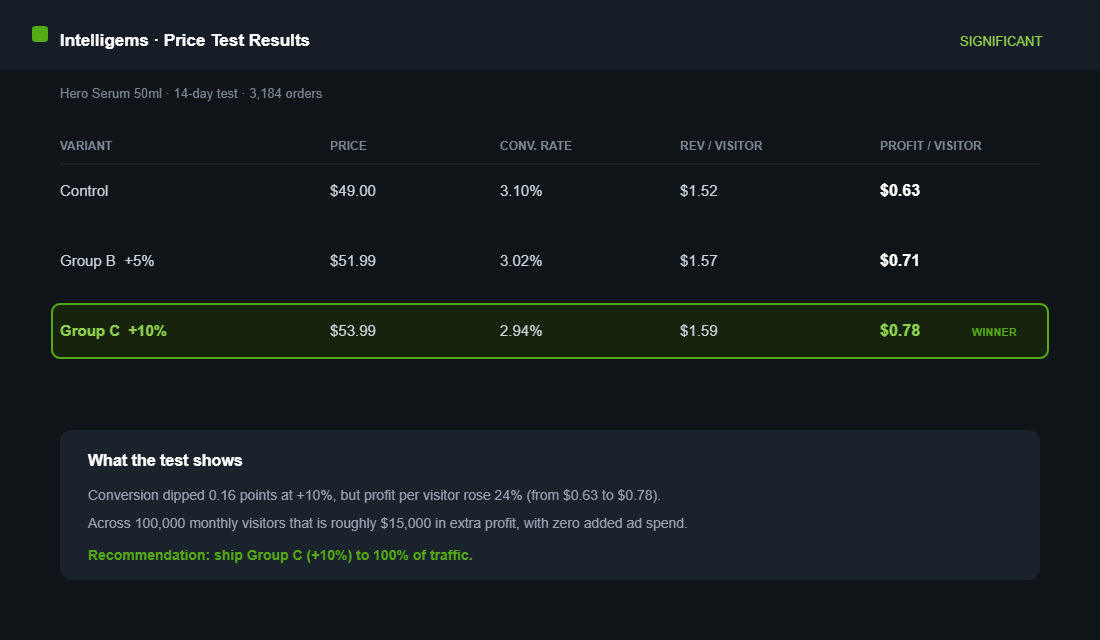
Every pricing decision in levers 1 through 4 is a hypothesis until you test it. Most founders are terrified of raising a price because they assume sales will fall off a cliff. Usually they do not. Often a 5 to 10% rise barely dents conversion and lifts profit substantially. But you only know for your store, your customers and your products, by running the test.
The tool built for this on Shopify is Intelligems. It runs true A/B price tests by splitting your live traffic into groups and showing each group a different price, then reports not just conversion and revenue but actual profit impact, which is the only number that matters. Here is how to run your first test.
- Install Intelligems from the Shopify App Store and connect it to your store. It manages prices through a Shopify Cart Transform Function, so checkout stays accurate.
- Pick one product or collection with enough traffic to reach significance, ideally a few hundred orders over the test window.
- Create a price test with two or three groups. Use Quick Fill to set the control plus a 5% and a 10% increase, or upload exact prices via CSV.
- Set traffic allocation evenly across groups and let it run until you have a clear, significant result. Do not call it early.
- Read the profit column, not the conversion column. A small conversion dip at a higher price almost always means more money in the bank.
Raising Prices on Existing Customers Without the Backlash
New visitors never saw your old price, so for them a rise is invisible. Your existing customers and email list are different. They have an anchor in their head, and a clumsy increase can feel like a betrayal. Handled well, though, a price rise can actually strengthen loyalty, because it signals confidence and gives you a reason to talk about the value you deliver.
The mistake founders make is hiding the increase and hoping nobody notices. Aussie shoppers are sharper than that, especially now, with cost-of-living pressure making everyone hyper-aware of what things cost. Transparency beats stealth every time. Tell them it is coming, tell them why, and give your best customers a window to buy at the old price.
- Give notice with a deadline. Email your list two weeks out: prices rise on a set date, lock in the current price until then. This creates urgency and goodwill in one move.
- Anchor the rise against improvements. Reformulated product, better packaging, faster shipping, an extended guarantee. Pair the increase with a genuine reason.
- Grandfather your subscribers. Hold the old price for active subscription customers for a set period. The retention payoff dwarfs the lost margin.
- Raise in steps, not leaps. Two 6% rises six months apart land softer than a single 12% jump, and let you watch the conversion data between them.
Done this way, a price rise becomes a campaign rather than an apology. The notice email often drives a spike of last-chance orders that more than covers any short-term dip, and the customers who buy through it have just reaffirmed that your product is worth it at the new price.
How the Five Levers Compound Into Real Margin
None of these levers is dramatic on its own. Together they change the economics of your whole store. Picture a product currently priced at $49 with cost-plus thinking. You anchor it against a genuine 3-pack so the single feels reasonable. You add a good-better-best structure that nudges buyers to the $89 tier. You set the value tier on logic and the premium tier on a clean round number. You justify the price with reviews and a guarantee. Then you test a rise from $49 to $54 and find conversion holds.
Each move is a few percent. Stacked, they can lift your average selling price and margin by double digits while your traffic and ad spend stay exactly the same. That is the compounding nature of price. It flows straight to contribution margin, which funds more inventory, more ads and more room to breathe in a market where 74% of shoppers are watching every dollar.
The brands that survive a value-seeking market are not the ones racing competitors to the bottom. With free shipping a deciding factor for 53% of Aussie shoppers and discounts critical for more than half, the temptation to compete on price alone is strong. Resist it. Price with intent, justify with value, and let your competitors train their customers to only buy on sale.
Passing Through Cost Increases Without Torching Trust
Every lever above assumes your costs hold still. They don’t. Freight rates move, the AUD moves, your supplier’s raw material moves, and most Aussie founders absorb all of it silently until the margin report gets ugly enough to force a panicked 20% rise.
The fix is cadence, not courage. Review landed cost quarterly against your price list — a 30-minute calendar block, four times a year. When cost of goods moves more than 5% on any SKU, you act. Small and regular beats large and infrequent every time, because a 4% rise passes unnoticed while a 20% rise generates emails.
Three rules that keep the pass-through clean:
- Never raise price and cut spec in the same quarter. Customers forgive one. Doing both at once reads as a bait-and-switch and it shows up in your reviews within a fortnight.
- Move the hero SKU last. Your best-selling product is the one customers price-check. Raise the long tail first, watch conversion rate for two weeks, then move the hero once you’ve confirmed elasticity is where you thought it was.
- Give subscribers notice and a window. Thirty days’ notice with the option to lock the old price for one more cycle. You’ll lose a handful. You’ll keep the ones who were going to churn loudly and tell everyone why.
Watch two numbers after any rise: conversion rate and units per order, tracked for a full 14 days against the prior 14. A conversion drop under 5% on a 10% price rise is a straightforward win — you’re up on contribution margin even with fewer orders. A drop over 15% means you moved past what the current positioning supports, and the answer is to strengthen the value story, not to quietly roll the price back.
The Discounting Habit That Undoes All Five Levers
You can execute every lever in this playbook perfectly and still end the year on the same margin you started, because of a sitewide 20% off code that runs eleven times a year.
Run the maths on your own store. On a product with a 60% gross margin, a 20% discount doesn’t cost you 20% of profit — it costs you a third of your gross margin on every unit. To break even on contribution you need roughly a 50% lift in units sold. Most sitewide promos deliver nowhere near that; they mostly pull forward demand from customers who were going to buy at full price next week anyway.
Three changes that recover margin without killing volume:
- Cap sitewide sales at three a year. Black Friday, EOFY, and one seasonal clear-out. Everything else becomes a targeted offer to a defined segment, not a banner on your homepage.
- Replace percentage-off with threshold offers. “Free shipping over $120” or “spend $150, get the travel size” protects your unit margin and lifts average order value instead of shrinking it.
- Audit your discount codes quarterly. Most Shopify stores have twenty to fifty live codes they’ve forgotten about, several of them stacking. Pull the discount report in Shopify Analytics, look at total discount as a percentage of gross sales, and kill anything that isn’t tied to a live campaign. If that number is above 12%, you have a leak, not a promotion strategy.
Pricing discipline is mostly the discipline of saying no to the easy revenue. The 20% code always works this week. It’s what it does to your margin over twelve months, and to what customers believe your product is worth, that costs you.
Your Pricing Audit Checklist
Run this on your three best-selling products this week. It takes about an hour and almost always surfaces money you are already leaving behind.
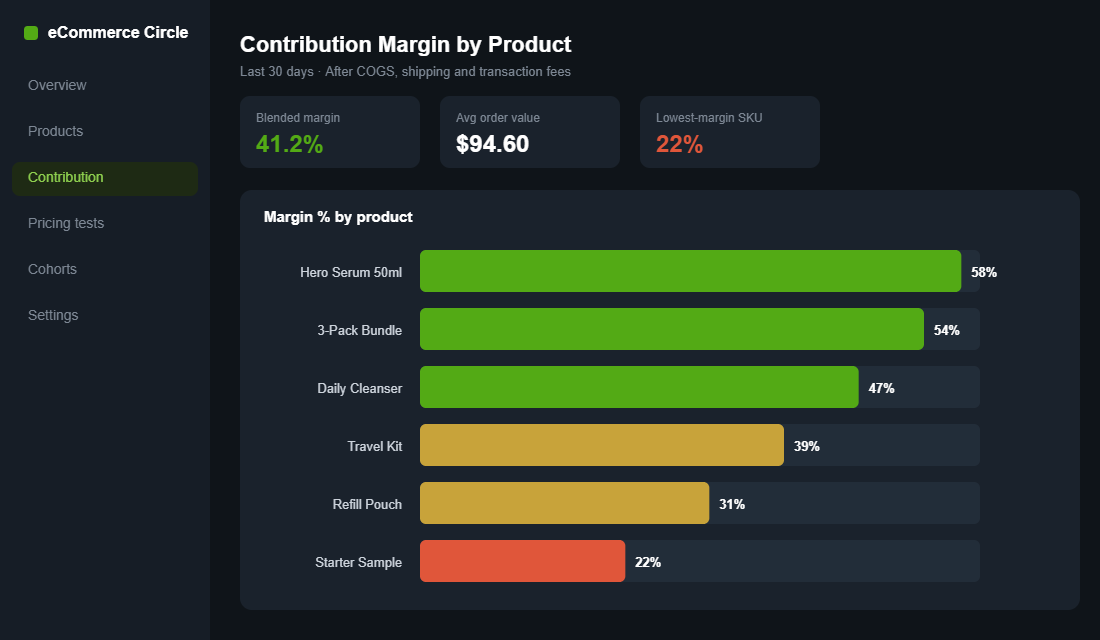
- Margin check. Do you know the true contribution margin of each product after COGS, shipping and transaction fees? If not, start here.
- Anchor check. Is there a genuine, higher reference price visible next to the price you want accepted?
- Tier check. Does the customer choose between options, or just yes or no? Build three tiers if not.
- Digit check. Is each price using a 9-ending for value items and a round number for premium items, on purpose?
- Value check. Is your strongest proof, including a guarantee, sitting right beside the price?
- Test check. When did you last A/B test a price rise? If the answer is never, that is your single biggest opportunity.
Inside eCommerce Circle, pricing is one of the core pillars we work on with every member, because it is the fastest path to profit that does not require spending another dollar on traffic. If you want a second opinion on yours, let’s talk.