Most Aussie Shopify founders try to grow the wrong number. They pour budget into the top of the funnel, chasing more traffic and more first orders, while the cheapest profit in the whole store sits untouched: the size of the basket that is already sitting at checkout.
What’s in This Article
Acquiring a new customer in 2026 is more expensive than it has been in years. Yet the average cart in plenty of AU stores still holds a single item. You have already paid to get that person to the cart. Selling them one product and waving them out the door is the most expensive habit in ecommerce.
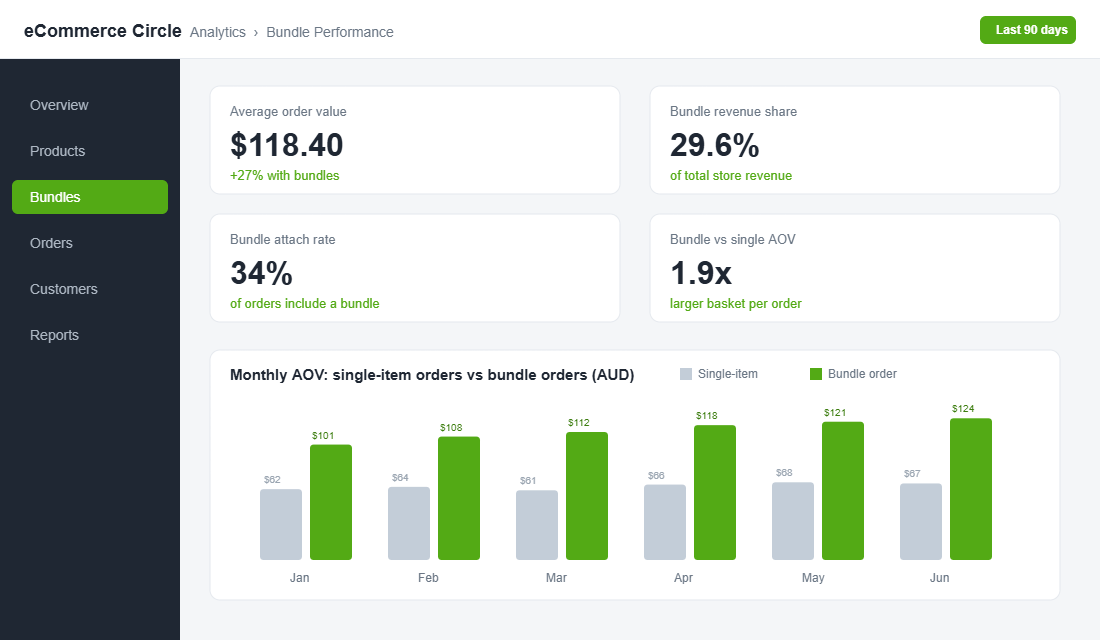
Bundles fix that without spending another dollar on ads. Done with intent, product bundling lifts average order value by 20 to 35% (McKinsey, 2025), and in some categories up to 30% of total ecommerce revenue now comes from bundled products. This playbook gives you the five bundle types that actually work, the pricing psychology behind them, and exactly how to build them on Shopify.
Why Bundles Beat Blanket Discounts
When sales feel flat, the reflex is to discount. Knock 20% off the store, run a code, hope volume makes up the difference. The problem is that a blanket discount trains customers to wait, and it strips margin off every order, including the ones that would have paid full price anyway.
A bundle does the opposite. It grows the order instead of shrinking the price per item. You can offer a genuine saving on the bundle while still walking away with more dollars and often more margin per transaction, because the customer is buying three or four things instead of one. McKinsey puts the typical impact at a 20% sales increase and a 30% profit gain for brands that bundle with discipline.
The retention upside is the part most founders miss. Customers who buy a bundle show roughly 2.7x higher lifetime value than single-item buyers, because a bundle gets more of your product into their routine on day one. Before you build a single bundle, get clear on your real per-order economics in our Shopify Contribution Margin Playbook, so the saving you offer never quietly turns the order into a loss.
The Five Bundle Types (and When Each One Wins)
There is no single “bundle”. There are five distinct structures, and each one solves a different problem. Pick the wrong one and the offer falls flat. Pick the right one and it does the heavy lifting for you.
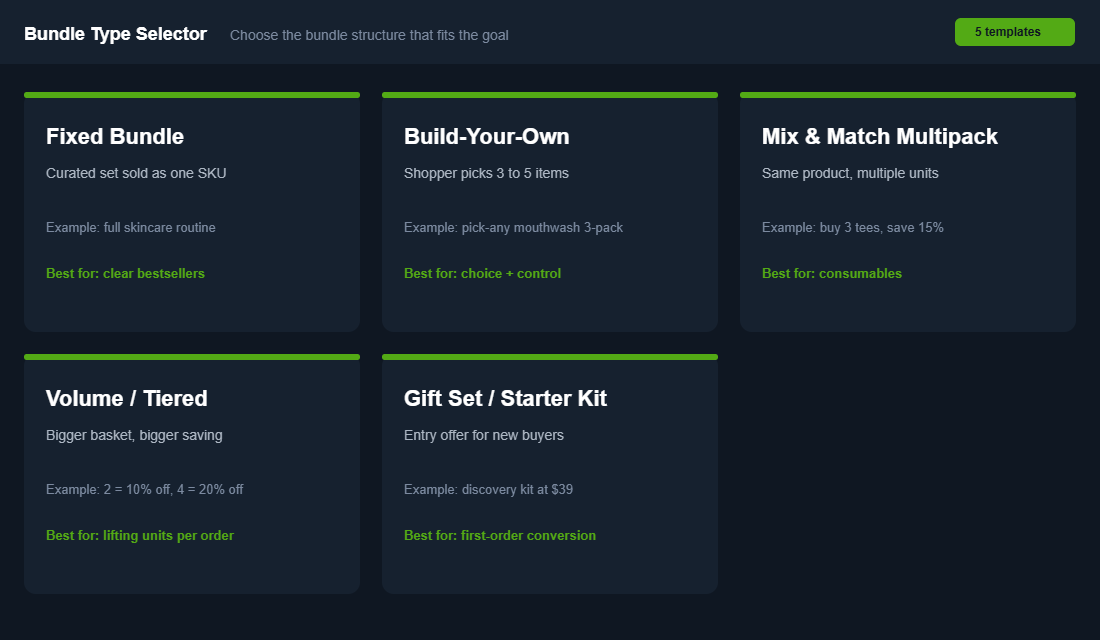
- Fixed bundle. A curated set sold as one product, like a full skincare routine or a starter kit of your three bestsellers. Best when you already know which products go together and you want a clean, one-click offer.
- Build-your-own (BYOB). The shopper chooses three to five items from a set. This is how Hismile sells. Best when choice and control matter, and when you have enough range to make the picking fun.
- Mix and match multipack. The same product in multiple units, like a three-pack of tees or a six-pack of a consumable. Best for anything people reorder, where buying ahead is the natural move.
- Volume or tiered bundle. The saving scales with the basket: two for 10% off, four for 20% off. Best for lifting units per order and pushing customers up to the next tier.
- Gift set or discovery kit. A lower-priced entry offer for new buyers, like a discovery kit at $39. Best as a first-order conversion tool that gets your range into a new customer’s hands.
Hismile is the AU case study worth studying. The teeth-whitening brand sells a build-your-own flavour pack and curated sets, and the result is striking: more than 80% of orders are bundles, and the strategy lifted their average cart size to roughly four times a single-product order. That is not a gimmick. That is the bundle becoming the default way people buy.
The Pricing Psychology That Makes a Bundle Feel Like a Steal
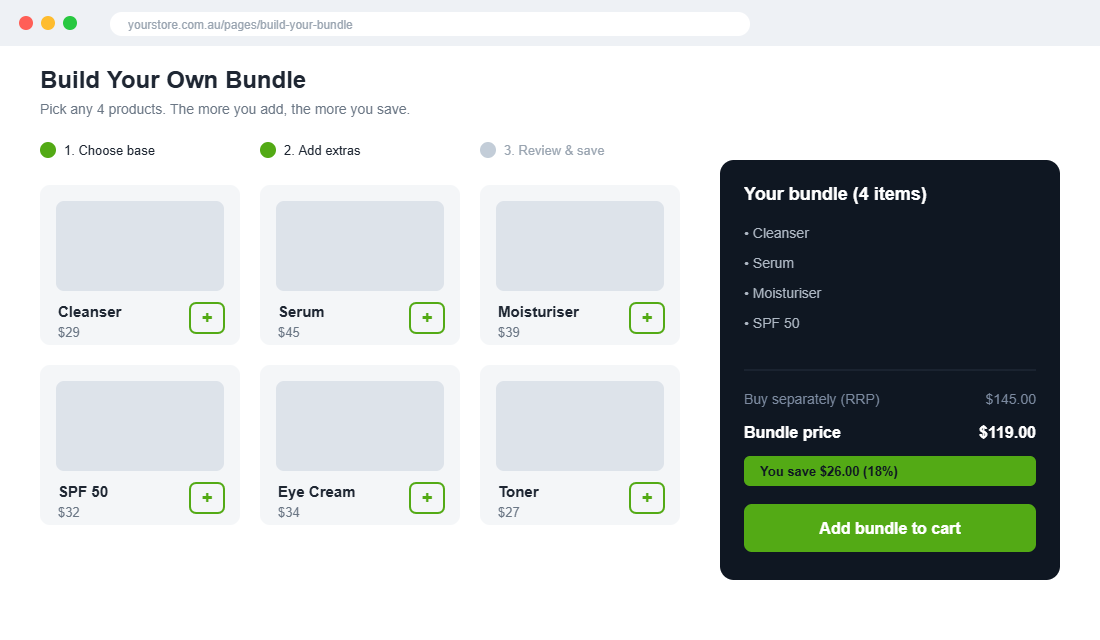
A bundle only works if the customer instantly sees the value. The single most important move is price anchoring: show the recommended retail price of the items bought separately, then show the bundle price underneath it. The saving has to be visible at a glance, not buried in the fine print.
The decoy effect is the other lever. When you put a “good, better, best” set of options in front of someone, the middle or top tier suddenly looks like the smart choice. The classic proof is The Economist, where adding a third subscription option pushed the combo plan’s selection rate from 32% to 84%. On a Shopify store, that looks like a single product, a two-pack, and a four-pack, with the four-pack framed as the obvious value.
Be careful with the size of the discount. The goal is to make the bundle feel generous, not to give away margin you cannot afford. A 10 to 20% saving on the bundle is usually plenty when the value is anchored well. Bundling is also the cleanest way to move slow stock: pair a slow-moving item with a bestseller so it leaves the warehouse without a clearance markdown that teaches customers your full price is fiction.
How to Build Bundles on Shopify (Native App vs Fast Bundle)
Shopify shipped a free native Bundles app in 2023, and for most founders it is the right place to start. It handles fixed bundles and multipacks cleanly, tracks component inventory so your stock counts stay accurate, and adds no monthly cost. If you want a curated set or a simple multipack, build it there first.
The native app has limits. It struggles with products that force a variant choice (pick a colour or size before adding to cart), and it does not do build-your-own, tiered volume pricing, or complex discount logic. When you need those, reach for a dedicated app. Fast Bundle covers mix and match, BOGO, buy-X-get-Y, gift-with-purchase, and a full build-your-own builder. BYOB and MBC Bundle Builder are strong if a guided “build a box” flow is the whole point of the offer.
- Step 1. Install the native Shopify Bundles app from the App Store and open it from the admin sidebar.
- Step 2. Create a bundle, give it a clear name (for example “Complete Routine Kit”), and add the component products.
- Step 3. Set the bundle price below the combined RRP, and write the saving into the product description so it is impossible to miss.
- Step 4. Add lifestyle imagery that shows all the items together, so the value reads in a single glance.
- Step 5. For a build-your-own or tiered offer, install Fast Bundle or BYOB instead and create a dedicated bundle page.
The build-your-own format earns its setup time. Around 72% of bundle-builder sessions end with items added to cart, because the act of choosing makes the customer feel ownership of the basket before they have paid for it.
Where to Put Bundles So People Actually See Them
A great bundle hidden on a forgotten page earns nothing. Placement is half the job. The product page is the first home: a “Frequently bought together” or “Complete the set” block directly under the add-to-cart button catches people at peak intent. Nielsen found that complementary bundle messaging on the product page lifted sales velocity by 11%.
Give bundles their own collection in the main navigation, labelled “Bundles & Sets” or “Save with Kits”, so deal-seekers can find them on purpose. Surface them in the cart drawer as a last-second upgrade, and pair the bundle with a threshold so the two offers reinforce each other. Our Shopify Free Shipping Threshold Playbook shows how to set that number so the bundle nudges the customer over the line instead of leaving cents on the table.
Do not stop at checkout. The moment after the card is charged is the lowest-friction sale you will ever make, and a one-click bundle add-on there converts without touching your conversion rate. We break down exactly how in the Shopify Post-Purchase Upsell Playbook.
The One Number That Tells You a Bundle Is Working
Track bundle attach rate: the share of orders that include a bundle. If it sits in the single digits, your bundles are buried or the value is not landing. Good stores push it past 30%, and category leaders like Hismile take it past 80%. Attach rate tells you whether the offer is doing its job.
Then watch two supporting numbers. Bundle AOV against single-item AOV tells you how much bigger a bundled basket really is, and blended contribution per order tells you whether the saving is still leaving you with healthy dollars after the discount. A bundle that lifts AOV but quietly kills your per-order contribution is not a win, it is a slow leak. Check both every month, not just the headline revenue.
The Compound Effect: Bundles as a System
One bundle on one product page is a tactic. Bundles running across the whole store are a system, and the pieces compound. The product page bundle lifts AOV at the point of highest intent. The cart and threshold bundle catch the people who almost left one item short. The post-purchase bundle adds margin after the sale is locked. The starter kit pulls in new customers at a price they will say yes to.
Stack those and the maths gets interesting. A 25% lift in AOV on the same traffic, the same ad spend, and the same conversion rate flows almost entirely to the bottom line, because you have already paid the acquisition cost. That is why the brands quietly winning in AU are not the ones with the biggest ad budgets. They are the ones squeezing more out of every order they were already going to get.
Your Bundle Build Checklist
Run any new bundle through this before it goes live:
- Goal first. Are you lifting AOV, clearing slow stock, or converting new buyers? Pick the bundle type that matches.
- Logical fit. The items must genuinely belong together. A random pairing reads as a clearance dump.
- Anchor the price. Show RRP, bundle price, and the saving in both dollars and percent.
- Protect the margin. Keep the discount in the 10 to 20% range and confirm contribution per order still works.
- Place it where intent is high. Product page, cart, post-purchase, and a dedicated bundles collection.
- Name it like an offer. “Complete Routine Kit” beats “Bundle 1” every time.
- Measure attach rate. Review it monthly alongside bundle AOV and blended contribution.
Inside eCommerce Circle, building a profitable bundle system is one of the core pillars we work on with every member, because it is the fastest way to grow profit without growing the ad budget. If you want a second opinion on yours, let’s talk.