Most Aussie Shopify stores treat the gift card like a fire extinguisher. It is bolted to the wall, never looked at, and only grabbed in an emergency when a customer wants a refund and you would rather keep the cash. It lives in a footer link nobody clicks, with a stock-photo image and a $50 default, and it quietly does about 1% of revenue. Meanwhile the Australian gift card market is worth roughly AUD 10.9 billion in 2025 and growing close to 10% a year. You are leaving a whole revenue line sitting in the corner.
What’s in This Article
Here is the part most founders miss. A gift card is not a discount, and it is not a refund tool. It is the only product you sell that brings a brand-new customer to your store, paid for by someone who already loves you, with the cash landing in your account weeks before you ship a thing. Around 35% of Gen Z and millennials say they have discovered a new brand through a gift card. That is customer acquisition you are being paid to do, with zero ad spend.
This is the 5-part system we use inside eCommerce Circle to turn gift cards from a checkout afterthought into a measurable channel: how you position them, the digital gifting experience, the recipient-to-customer conversion, the cash and breakage economics, and the seasonal calendar that does the heavy lifting. Real numbers throughout, built for an Aussie operator, with a checklist at the end you can run this week.
Why a Gift Card Is a Growth Lever, Not a Checkbox
Start with the size of the prize. The Australian gift card and incentive market sat at about AUD 10.9 billion in 2025 and is forecast to reach AUD 27 billion by 2034. Online channels already capture 61.75% of that spend, which means the shift is happening on screens, exactly where your store lives. Globally the category is over 1.1 trillion US dollars, and digital gift cards now make up roughly 57% of sales while growing more than 20% a year. This is not a fading novelty. It is one of the fastest-moving lines in retail.
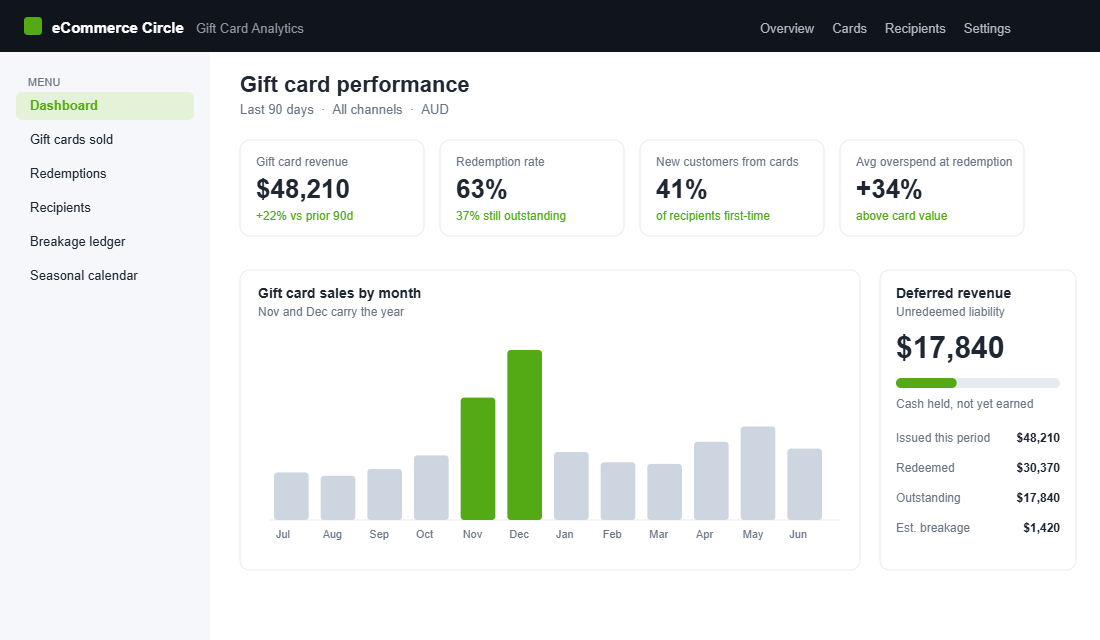
Now the three reasons it matters for your store specifically. First, acquisition. The person who redeems the card is usually not your customer yet, they are your customer’s friend, partner or parent. Second, cash flow. You collect the money today and deliver the product later, so a gift card is an interest-free advance from your own audience. Third, basket size. When recipients redeem, they spend more. In Australia, 47% of gift card users spend an average of 36% above the card’s face value, and global data puts that figure at 75% of recipients spending over the card value. Sephora has reported gift card recipients spending 71% more than the card was worth.
There is even a fourth quiet benefit: breakage. Some cards never get fully redeemed. In the US, 43% of adults hold unused gift cards worth around 23 billion dollars collectively. A slice of that becomes margin you keep without shipping anything. None of this shows up if the gift card is hidden. It only shows up when you treat it like a product and measure it like one.
Part 1: Position the Gift Card as a Product, Not a Fallback
The single biggest mistake is treating the gift card as a setting rather than a product. If yours is one link in the footer, it will perform like one link in the footer. The fix is to merchandise it the way you would merchandise a hero SKU.
- Give it a real landing page. Not the bare Shopify card page. A page with lifestyle imagery, a short story about who the gift is for, the denominations, and a line that handles the obvious objection (“never expires, redeem online or in store”).
- Put it in the main navigation. Add a “Gifts” menu item, with the gift card and your most giftable bundles underneath. People in gift mode shop differently. Make it easy for them to find the gift section without digging.
- Anchor the denominations. Offer $25, $50, $100, $150 and a custom amount. Set your default to a value slightly above your average order value so the recipient is nudged to add a little of their own money at redemption.
- Sell the use-case, not the card. Copy like “Not sure of their size or shade? Let them choose” removes the risk that stops people buying gifts in the first place.
Two Australian brands do this well. T2 runs a dedicated digital gift card with chosen amounts, a personal message, and clear copy that it can be redeemed in store or online. Frank Body sells an e-gift card front and centre as a product, not a buried setting. In both cases the gift card looks like something you would happily give, which is the whole point.
Part 2: Nail the Digital Gifting Experience
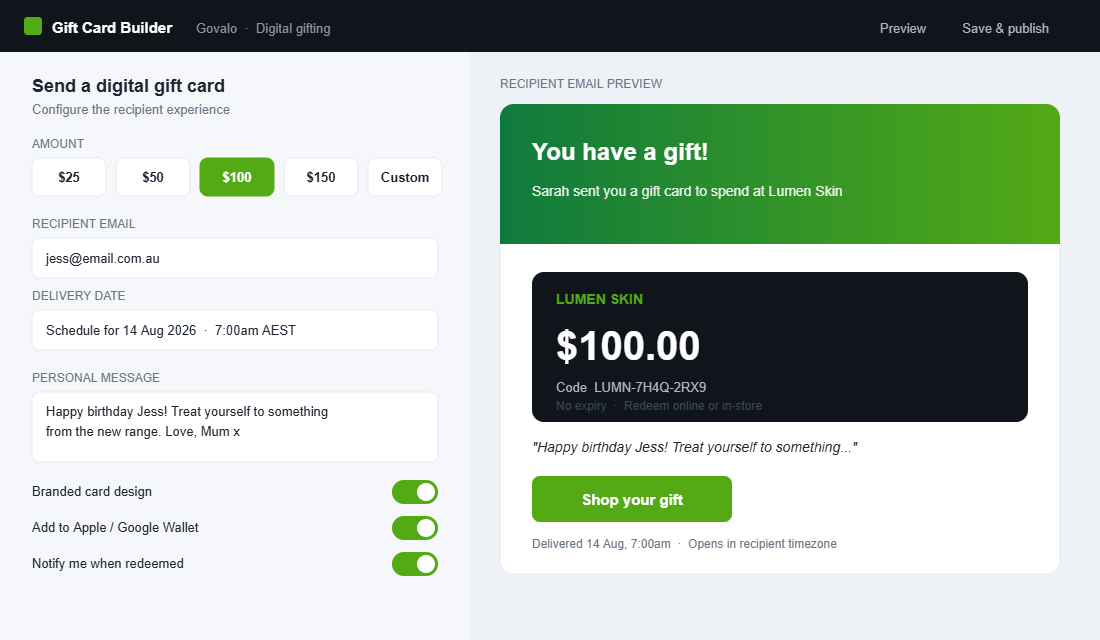
Digital is now the majority of gift card sales, and the reason is convenience. A gift card you can send to someone’s inbox at 11pm on the night before their birthday beats anything you can post. But the default Shopify experience is bare. It emails a code to the buyer, and that is roughly it. To capture the digital opportunity you need to control three things: who it goes to, when it arrives, and what it feels like.
- Send it straight to the recipient. Let the buyer enter the recipient’s email so the gift lands with the right person, not in the buyer’s inbox to be forwarded and forgotten.
- Schedule the delivery. Scheduled send is the feature that turns a panic purchase into a planned one. The card arrives on the morning of the birthday, in the recipient’s timezone, not three weeks early.
- Add a personal message and your branding. A gift card that opens with “Happy birthday Jess, love Mum” and your logo feels like a gift. A raw code feels like an admin email.
The Tool Stack: How to Set It Up
You do not need a big budget to start. Shopify includes gift cards natively. Here is the order we recommend.
- Step 1, turn on native gift cards. In your Shopify admin go to Products, then Gift cards, and create your denominations. Gift card products are free on every Shopify plan and use the same checkout you already trust.
- Step 2, build the landing page. Create a dedicated page, add it to your “Gifts” menu, and feature your denominations with real imagery and benefit copy.
- Step 3, add an experience layer when you are ready. An app like Govalo (a Shopify Plus certified gifting app) adds recipient delivery, scheduled send, gift messages and custom designs. Rise.ai is the alternative if you want gift cards plus store credit and SMS delivery working together for loyalty and refunds.
- Step 4, switch on redemption notifications. Get notified when a card is redeemed so you can track the recipient cohort, then watch the new-customer share in your reports.
Start with native, prove the demand, then add the experience layer once gift cards are doing real volume. Do not buy the app before you have built the landing page.
Part 3: Engineer the Recipient-to-Customer Conversion
This is the part that separates a gift card line item from a growth channel. The recipient arrives holding store credit and almost no context. They do not know your range, your bestsellers, or where to start. Most stores drop them on a generic homepage and hope. That is where the value leaks.
Design the redemption journey on purpose. When a recipient clicks through, send them to a short “welcome, you have a gift” page that does three jobs: points them at your hero product and bestsellers so they do not have to think, shows the value sitting in their account, and captures their email so they become a contact you can market to. If your free shipping threshold sits just above your average card value, you have a built-in nudge to spend a little extra, which is exactly the 36% overspend the data predicts.
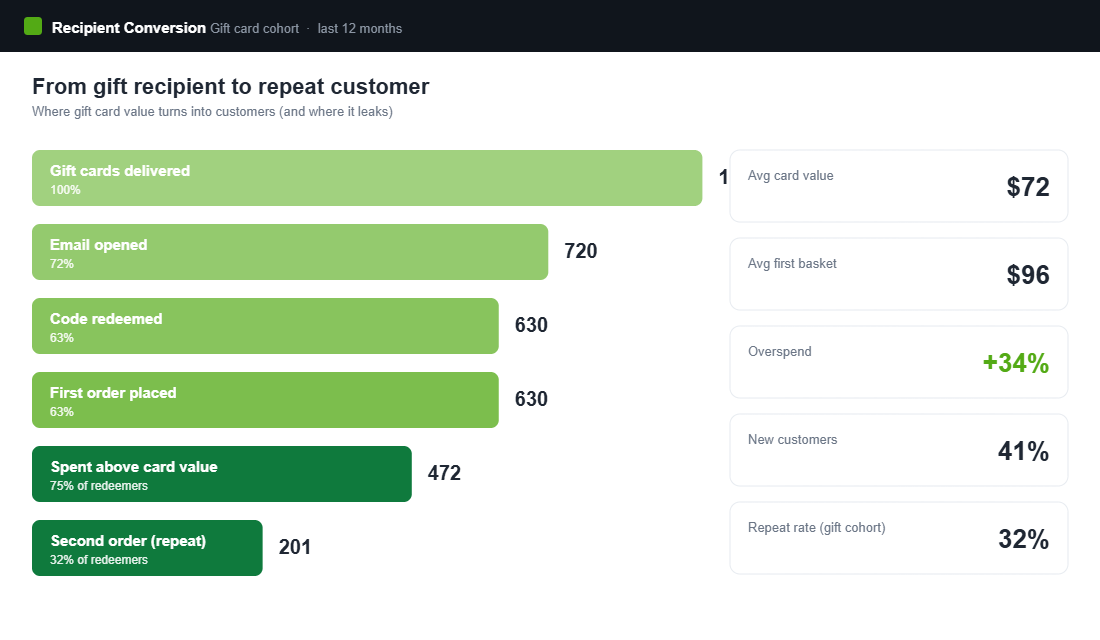
The real prize is the second order. A recipient who redeems, has a good first experience, and then comes back on their own money has become a customer at a negative acquisition cost. That is why the gift card cohort belongs in your retention thinking. For the full system on turning a first purchase into a repeat one, work through our Shopify Repeat Purchase Playbook, and make sure the parcel that follows does its job using the Unboxing Experience Playbook. A gift that arrives beautifully is a recipient who remembers your name.
Part 4: Get the Cash-Flow and Breakage Economics Right
Gift cards are unusual on your books, and getting this wrong is how founders fool themselves. When you sell a gift card you have not earned revenue yet. You are holding the customer’s money against a future order. In accounting terms that is deferred revenue, a liability, not profit. The cash is real and you can use it, but do not spend it as margin until the card is redeemed and the product ships.
- Treat the float as a loan from your fans. Outstanding gift card value funds inventory and ad spend, but it is owed back in product. Keep enough working capital to honour every card.
- Recognise breakage carefully. A portion of cards is never redeemed, and that value eventually becomes income. Australian GST and revenue-recognition rules around gift cards have specific timing, so set your breakage policy with your accountant rather than guessing.
- Remember the margin lands at redemption. A gift card sale carries almost no cost of goods at the point of sale. The cost arrives when the recipient orders. To know whether the redeemed order is actually profitable, run the numbers through our Contribution Margin Playbook so a generous gift card promo does not quietly sell product at a loss.
One trap to avoid. When you issue gift cards in place of cash refunds, that is a smart retention move, but do not book it as new sales. It is retained revenue, not fresh demand. Keep the two streams separate in your reporting or your growth picture will lie to you.
Part 5: Run the Seasonal Gifting Calendar
Gift card demand is wildly seasonal, and that is good news because it makes the channel plannable. Roughly 30% of annual gift card sales happen in December and another 20% in November, so half the year’s volume lands in two months. If you only think about gift cards in late December, you have already missed most of it.
- Own the last-minute window. This is the Aussie operator’s secret weapon. Once your physical postage cutoff passes around 20 to 22 December, the e-gift card is the only gift left that arrives on time. Promote it hard on the 22nd, 23rd and 24th with a “still need a gift? delivered instantly” message. That is pure incremental revenue.
- Map the whole year. Christmas and Black Friday are the peaks, but Mother’s Day, Father’s Day and Valentine’s Day are reliable smaller spikes, and birthdays run all year round. Build a simple calendar so a gifting email goes out before each one.
- Open a corporate and bulk lane. Corporate buyers make up about 53% of the Australian gift card market. A simple “buying for your team or clients?” option, even just an email enquiry form, opens a high-value channel most DTC stores ignore entirely.
Pair the calendar with the EOFY and BFCM motions you already run, and the gift card stops being a December afterthought and becomes a planned line you forecast like any other.
The Compound Effect: Five Parts, One Channel
Run these parts on their own and you get small wins. Run them together and they multiply. A properly merchandised gift card (Part 1) gets bought more often. A great digital gifting experience (Part 2) means it actually reaches a new person. A designed redemption journey (Part 3) converts that recipient into a first-time customer who overspends. Clean economics (Part 4) mean you keep the cash float and the breakage without fooling yourself on profit. And a seasonal calendar (Part 5) stacks all of it into the two months that matter most.
The end state is a channel that acquires new customers at a negative cost, hands you an interest-free cash float to fund inventory, and lifts basket size at redemption. That is three growth levers from one product you are probably already ignoring. The brands winning here are not spending more. They simply stopped treating the gift card like a fire extinguisher.
Gift Card Benchmarks: What Good Looks Like for an Aussie Store
Before you run the audit below, calibrate your expectations. Most Shopify stores that treat the gift card as a footer link sit at roughly 1% of revenue. Stores that run the five parts in this playbook consistently reach 2-4%, and gifting-heavy categories like beauty, candles and homewares can push past 5% in Q4. Here is the scoreboard to measure yourself against.
- Recipient overspend: 20-60% above card value. A $100 card typically produces a $120 to $160 first order. That overspend lands at full margin, because the recipient chose you rather than being acquired through paid media.
- Redemption curve: around 80% of cards are used within 12 months, with a heavy spike in the first 90 days. Cards still unredeemed at the six-month mark deserve a gentle reminder email, which is one of the highest-ROI flows you can build in Klaviyo.
- Breakage: plan for 10-15%, but never bank on it. Remember Australian law requires a minimum three-year expiry on gift cards sold to consumers, so treat unredeemed balances as deferred revenue with a long tail, not free money.
- Seasonality: 35-40% of annual gift card volume lands in the six weeks before Christmas. If your December gifting push is not planned by October, you are giving that spike to Myer and The Iconic.
- Recipient-to-repeat conversion: 25-35%. A quarter to a third of gift card redeemers should place a second, self-funded order within six months if your post-redemption flow is working. Below 15% means you are treating redeemers like the end of a transaction instead of the start of a customer.
Imagine you run a Sydney candle brand doing $2M a year. Moving gift cards from 1% to 3% of revenue is $40K of incremental sales, roughly half of it from brand-new customers you paid nothing to acquire, all collected upfront before you shipped a single unit. There is no ad campaign on your Meta account with economics that look like that.
Your Gift Card Audit: 10 Checks to Run This Week
- 1. Landing page. Does your gift card have a real page with imagery and benefit copy, not just the bare Shopify card screen?
- 2. Navigation. Is there a “Gifts” item in your main menu that a buyer in gift mode can find in one click?
- 3. Denominations. Do you offer a sensible ladder ($25, $50, $100, $150, custom) with a default just above your average order value?
- 4. Recipient delivery. Can the buyer send the card straight to the recipient’s email?
- 5. Scheduled send. Can they choose the delivery date so it lands on the day, not weeks early?
- 6. Personalisation. Does the card carry a personal message and your branding?
- 7. Redemption page. Do recipients land on a welcome page that points them at bestsellers and captures their email?
- 8. Overspend nudge. Does your free shipping threshold sit just above your average card value?
- 9. Accounting. Are gift card sales tracked as deferred revenue, with a breakage policy set with your accountant?
- 10. Calendar. Do you have planned gifting pushes for BFCM, the last-minute December window, Mother’s and Father’s Day, plus a corporate lane?
Score yourself out of ten. Most stores we audit land between two and four. Every box you tick is revenue you were leaving on the table.
Inside eCommerce Circle, turning quiet assets like the gift card into measurable channels is one of the core pillars we work on with every member. If you want a second opinion on yours, let’s talk.