Every growing Shopify store hits the same wall. Sales are up, the P&L says you made money, and yet the bank account is empty because next season’s stock order just swallowed everything. You are not going broke. You are growing broke.
What’s in This Article
You are not imagining the squeeze either. Nearly 80% of Australian SMEs reported significant cash flow strain over the past year, according to joint research from CommBank and UNSW. For DTC founders the pressure is sharper than for almost any other business type, because inventory is the hungriest line on the balance sheet. You pay your supplier months before a single customer pays you.
Most founders respond in one of two ways. They starve growth by ordering less stock than demand justifies, then lose their best weeks to stockouts. Or they grab the first cash advance offer that appears in their Shopify admin without doing the maths, and spend the next six months wondering why every good sales day feels strangely thin.
The founders who scale past $1m, $3m and $5m do neither. They treat inventory funding as a system: they know their exact gap, they know the true annualised cost of every dollar they borrow, and they only borrow against stock that has already proven it sells. This playbook walks through that system in five parts.
Part 1: Work Out Your Real Funding Gap (Before You Shop for Money)
The biggest funding mistake is not the interest rate. It is borrowing the wrong amount. Borrow too little and you stock out mid-season anyway, which means you paid fees for nothing. Borrow too much and you pay for money you did not need while it sits on a shelf as inventory you cannot move any faster.
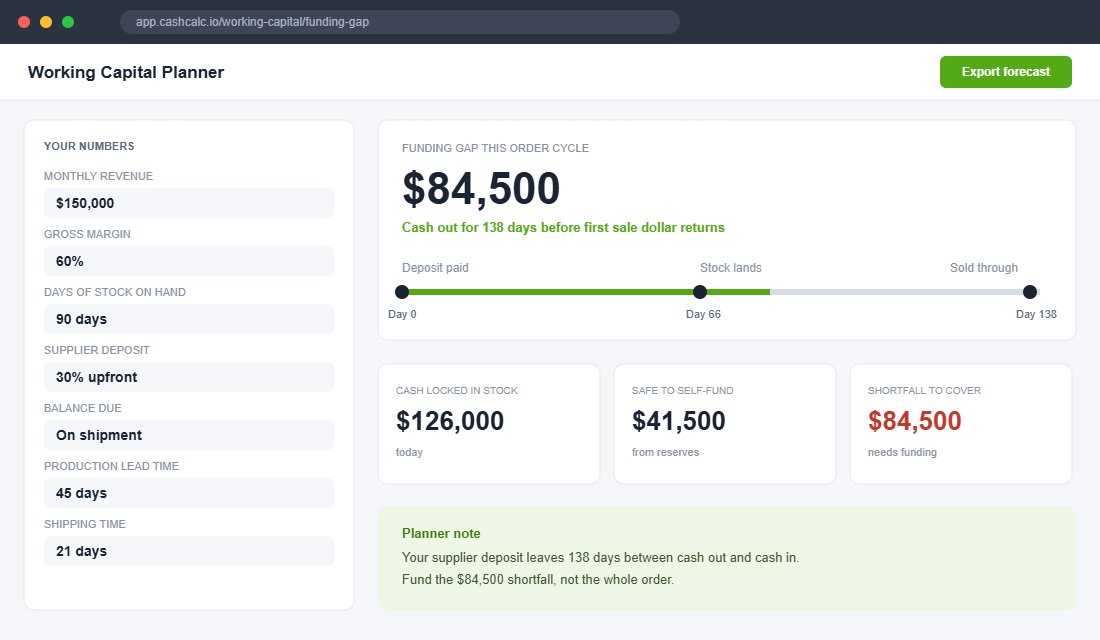
Your funding gap comes from your cash conversion cycle: the number of days between paying your supplier and getting cash back from customers. For a typical Aussie brand importing stock, the timeline looks like this:
- Day 0. You pay a 30% deposit to secure the production run.
- Day 45. Production finishes and the 70% balance is due.
- Day 66. Stock lands at your 3PL after roughly three weeks on the water, plus freight, duties and GST at the border.
- Day 66 to 138. The stock sells through over ten weeks.
That is 138 days where cash mostly flows one direction: out. On a $65,000 landed order, for a store doing $150,000 a month at a 60% gross margin, peak cash exposure often sits around $84,000 once you layer in freight timing and the GST you pay at import before claiming it back on your next BAS.
So before you talk to any lender, sit down with your last three orders and calculate three numbers:
- Peak exposure. Deposit, balance, freight and duties, mapped week by week against when they actually leave your account.
- Safe self-funding. The cash you can commit while keeping at least eight weeks of operating expenses untouched. Not “whatever is in the account”. Untouchable buffer first, funding second.
- The gap. The difference between the two. Fund the gap, not the whole order.
If you have never mapped this properly, start with our cash conversion cycle playbook before borrowing anything. Shortening the cycle is cheaper than funding it. Every day you cut off the cycle is a day you do not pay to borrow.
Part 2: Know the Menu: The Five Ways to Fund Stock, Ranked by Cost
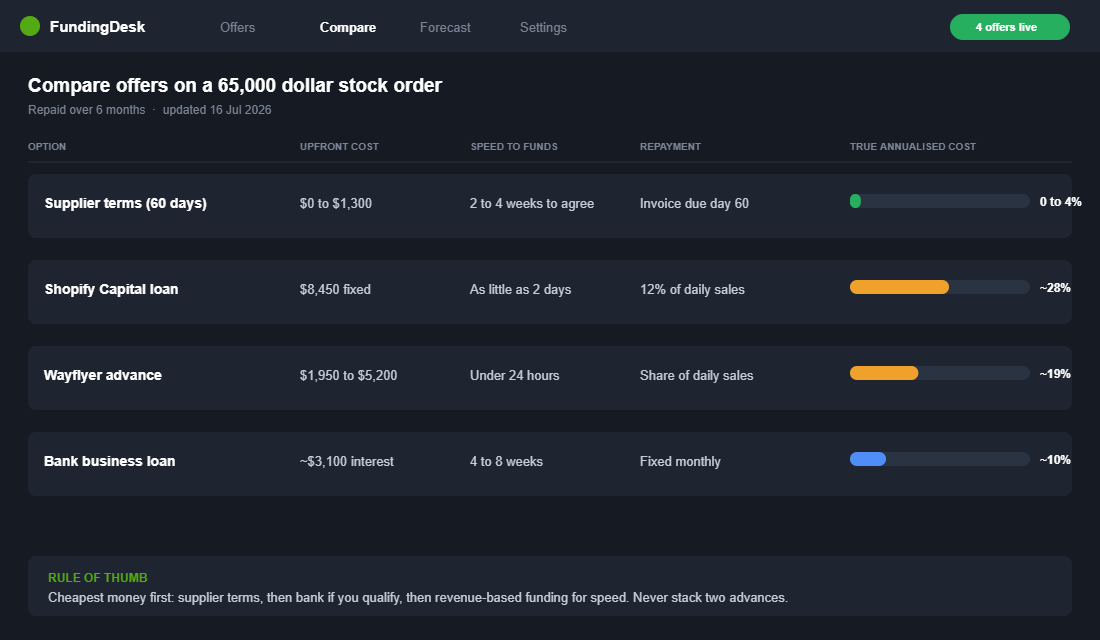
Australian founders have more funding options than at any point in the last decade. New lending to Australian SMEs jumped from $122.5 billion in 2023 to $153.7 billion in 2024 according to the OECD, and a growing share of it is unsecured lending built for businesses like yours. That is good news and a trap at the same time, because easy money makes it easy to skip the comparison. Here is the menu, ranked roughly cheapest to most expensive.
1. Supplier payment terms (the free option almost nobody asks for)
Moving from 30% deposit and 70% on shipment to 30% deposit and 70% at 60 days after shipment can wipe out most of your funding gap at no cost. Suppliers say yes far more often than founders expect once you have three or four clean orders behind you, because your repeat business is worth more to them than the timing of one invoice. Worst case, they price 1 to 2% into the unit cost, which is still the cheapest money on this list.
2. Bank loans and overdrafts (cheapest borrowed dollar, slowest to arrive)
Headline rates are the lowest on the menu, and the RBA noted through late 2025 that credit became both cheaper and more available for small businesses, including lending not secured by property. The catch is everything else: four to eight weeks of process, real paperwork, and often a personal guarantee or property security. If you have two or more years of clean financials and the patience, price this option every time.
3. Shopify Capital (fastest to check, built into your admin)
Available to eligible Australian merchants on the Finance page of the Shopify admin. You receive a lump sum in as little as two business days in exchange for a fixed borrowing cost, and repay through a fixed percentage of daily sales, typically in the 10 to 17% range. Australian loans run to a maximum 18-month term with minimum payment milestones each six months. There is no compounding interest and repayments flex with revenue: slow week, smaller repayment.
4. Revenue-based financing (Wayflyer and friends)
Wayflyer funds ecommerce brands from $5,000 up to $20 million for a fixed fee of roughly 2 to 8% of the advance. It connects directly to your Shopify and ad account data, offers usually come back within a day, and funds can land within 24 hours of approval. Repayment is a share of daily sales that scales down when revenue slows. Wayflyer runs a Sydney team and has funded Aussie brands including Stax, King Kong Apparel and Craft Club. Globally it has deployed more than $3.5 billion across 6,000+ businesses, so this category is no longer the experimental corner of the market it was five years ago.
5. Personal cash and credit cards (technically an option, usually a trap)
The CommBank research found 27% of SME owners used personal savings or skipped their own salary to keep the business running. Nearly every founder does it once. The problem is when it becomes the funding strategy: personal credit card rates are worse than almost everything above, and a business that only works when the founder works for free is not yet a business. Do it once in a pinch, then build the system so you never do it twice.
Part 3: Do the True-Cost Maths (a Factor Rate Is Not an Interest Rate)
Here is where good founders get quietly burned. Cash advance products quote a factor rate or a fixed fee, not an interest rate, and the difference matters enormously.
Say you take $50,000 at a 1.13 factor rate, which sits inside the typical 1.10 to 1.17 range for merchant cash advances. You repay $56,500. That $6,500 is 13% of the advance, so it feels like a 13% loan. It is not. If your sales repay it in six months, you paid 13% for half a year of money, which annualises to roughly 26%. Repay faster and the effective annual cost climbs higher, not lower, because the fee is fixed no matter how quickly it comes out of your sales. A fixed fee rewards slow repayment; an interest rate rewards fast repayment. Most founders have that instinct exactly backwards.
But the annualised rate still is not the real decision number. The comparison that matters is cost of capital versus the contribution the funded stock generates:
- Funding cost on the order: $6,500 on the $50,000 you borrowed.
- Contribution the stock earns: if that $50,000 of inventory retails for $125,000 and your contribution margin after COGS, shipping and marketing is 25%, the order throws off $31,250.
- Verdict: pay $6,500 to unlock $31,250 you otherwise could not have stocked. That is a good trade, nearly five times covered.
Run the same maths on a slow mover contributing 10% and the trade collapses. Which gives you the rule that anchors this entire playbook: borrowed money is for proven winners, not hopeful bets.
Three questions to ask before signing anything: What is the total dollar cost, not the rate? What is the effective annual cost if I repay in four, six and nine months? And does the contribution on this specific stock clear that cost at least three times over?
Part 4: Match the Money to the Stock (the Decision Framework)
Not all inventory deserves funding, and different stock suits different money. Here is the framework, category by category.
Fund aggressively: proven hero SKUs. Twelve or more months of sales history, consistent sell-through, forecastable demand. This is exactly what revenue-based funding was built for, and it is where speed genuinely beats squeezing out the last percentage point of cost. A hero SKU that stocks out for three weeks in peak season costs you far more in lost contribution and lost ad efficiency than the funding fee ever will.
Fund carefully: seasonal buys. BFCM and Christmas stock has a hard sell-by date, so fund it only when the forecast is built on last year’s actuals plus this year’s run rate, and structure the money so repayment finishes with the season, not months after it. Timing matters more than founders think: if the stock needs to be on the water in September, the funding conversation happens in August. Rushing this decision in October is how brands end up taking whatever offer is fastest instead of whatever offer is best.
Fund with supplier terms only: steady replenishment. Predictable, boring, repeat orders of consistent movers are exactly what suppliers will finance with extended terms, because they can see the pattern too. Save your borrowing capacity for the growth bets that need it.
Do not fund: new launches and slow movers. A launch is a hypothesis. Fund hypotheses from cash flow and keep the first order small until it proves out. And never borrow to buy more of something that is not selling: that is how dead stock becomes dead stock plus fees. If the back room already holds slow movers, clear them for cash first with our dead stock playbook. Freeing $20,000 of trapped cash out of duds is better than borrowing $20,000 at any price.
The quality of your forecast decides how much of this framework you can actually use. If your reorder decisions still run on gut feel, tighten them with our inventory forecasting playbook before taking on repayments that depend on the forecast being right.
Part 5: Repayment Discipline: Protect Your Cash While You Pay It Down
The advance lands, the stock is ordered, everyone relaxes. Then the remittance drag starts. A 12% daily remittance means every $1,000 day is really an $880 day for the next several months. Founders who never modelled that find themselves short at the next ad spend cycle or the next supplier deposit, and that is when the real trap springs: a second advance to cover the hole the first one made. Stacked advances are how a 20% effective cost quietly becomes 45%, and they are the single most common way funding goes wrong for DTC brands.
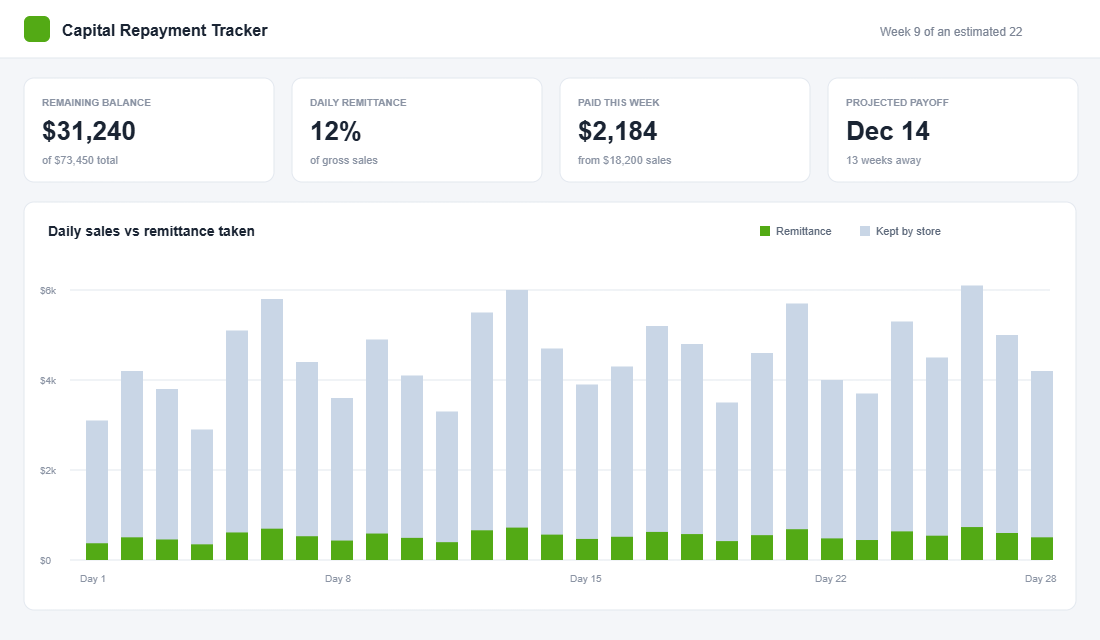
The guardrails that keep repayment boring, which is exactly what repayment should be:
- Model the remittance into your 13-week cash forecast the day you accept. Projected weekly sales times remittance percentage, taken off the top of every single week.
- One advance at a time. No stacking, ever. If you are tempted to stack, the first advance was too big or the stock it bought is not selling. Fix that problem instead.
- Watch the minimum payment milestones. Australian Shopify Capital loans require minimum repayment amounts within each six-month period of the 18-month term. A soft quarter can turn a comfortable daily remittance into a forced top-up payment, so check the milestones against your seasonal dips before accepting.
- Never renew by default. Lenders offer a fresh advance the moment you are mostly repaid, and the refresh offer always feels like a compliment. Re-run the Part 3 maths from scratch every time, as if this were the first dollar you ever borrowed.
- Review three numbers every Monday. Balance remaining, remittance taken last week, weeks to payoff. Two minutes. When payoff lands, the remittance percentage becomes your margin again; plan what that cash does next before it arrives.
What It Looks Like When It Works
Sydney womenswear label She Street grew to around $2 million a year fully self-funded, then stalled. Small-batch buying meant every unit cost more than it needed to, and thin margins meant there was never enough spare cash to order bigger. Inventory funding through Wayflyer let the brand buy in larger, cheaper production runs. Profit margin moved from 11% to 21% in about a year, with turnover tracking toward $4 million. The money did not create the demand. It unlocked buying power the demand had already earned.
Craft Club, the Sydney craft kit brand founded by Nakisah Williams, grew roughly 300% in the twelve months after taking funding, using the capital to keep hero kits in stock through demand spikes instead of donating those sales to stockouts.
The aggregate numbers back the pattern too: Shopify reports that merchants who took Shopify Capital funding averaged 36% higher sales over the following six months compared to their peers. Money applied to proven stock at the right time compounds. Money applied to hope does not.
Tool Spotlight: Check Your Shopify Capital Position in 10 Minutes
Shopify Capital is the fastest option to check, so start there to establish a baseline offer even if you end up choosing supplier terms or a bank. The setup:
- Open Finance in your Shopify admin. Eligibility is automatic, based on your sales history and store performance, so there is no application form. If you are eligible, offers appear on the Finance page.
- Read the three numbers on any offer: the loan amount, the fixed cost of funds, and the daily remittance percentage.
- Convert to true cost. Divide the cost of funds by the loan amount, then annualise it against a realistic payoff timeline from your current daily sales.
- Model the remittance into your 13-week cash forecast and check the six-month minimum payment milestones against your seasonal dips before you tap accept.
- If you accept, funds typically land within two business days. Put the projected payoff date in your calendar and start the Monday three-number review.
Then get a Wayflyer quote as the comparison (connect Shopify plus your ad accounts; offers usually come back within a day), and if the amount is large or you hold property security, price a bank facility as well. An hour of comparison shopping routinely saves four figures.
The Inventory Funding Checklist
Run every line before you accept any money:
- Funding gap calculated from peak exposure minus safe reserves, not guessed
- Cash conversion cycle mapped, with every shortening lever pulled first
- Supplier terms renegotiated before borrowing (always ask for the free option first)
- Total dollar cost known for every offer, annualised at 4, 6 and 9-month payoff speeds
- Stock being funded is proven, with contribution at least three times the funding cost
- Remittance modelled into the 13-week cash forecast
- No existing advance outstanding, and none planned on top
- Minimum payment milestones checked against seasonal dips
- Payoff date in the calendar with a weekly three-number review
- Renewal decision pre-committed: re-run the maths, never auto-renew
The Compound Effect
Each part of this system strengthens the others. A mapped cash conversion cycle shrinks the gap you need to fund. Renegotiated supplier terms shrink it again, so any advance you do take is smaller and cheaper. Funding only proven stock means contribution comfortably clears the funding cost, which keeps repayments painless, which protects your record and pricing for the next round. Within two or three cycles, funded orders are building the reserves that let you self-fund a bigger share of every order after that.
That is the actual goal. Funding is not a lifestyle. It is a bridge to a balance sheet that no longer needs it, and the founders who get this right borrow less every year while ordering more.
This article is general information, not financial advice. Run any funding decision past your accountant before you sign.
Inside eCommerce Circle, funding and cash flow decisions like these sit at the heart of the Profit pillar we work on with every member. If you want a second opinion on your numbers before you sign anything, let’s talk.