There is one marketing moment in your entire business that you have already paid for, the customer is guaranteed to experience, and they are emotionally primed to enjoy. It is the moment they open the box. And most Aussie brands hand them a beige satchel with an invoice stuffed inside.
What’s in This Article
Think about the asymmetry. You spent $40 to acquire the customer, discounted to win the sale, and paid Australia Post to deliver it. Then at the one point where their attention is total and their excitement is peaking, you say nothing. No brand, no thought, no reason to come back. That is the most wasted touchpoint in ecommerce.
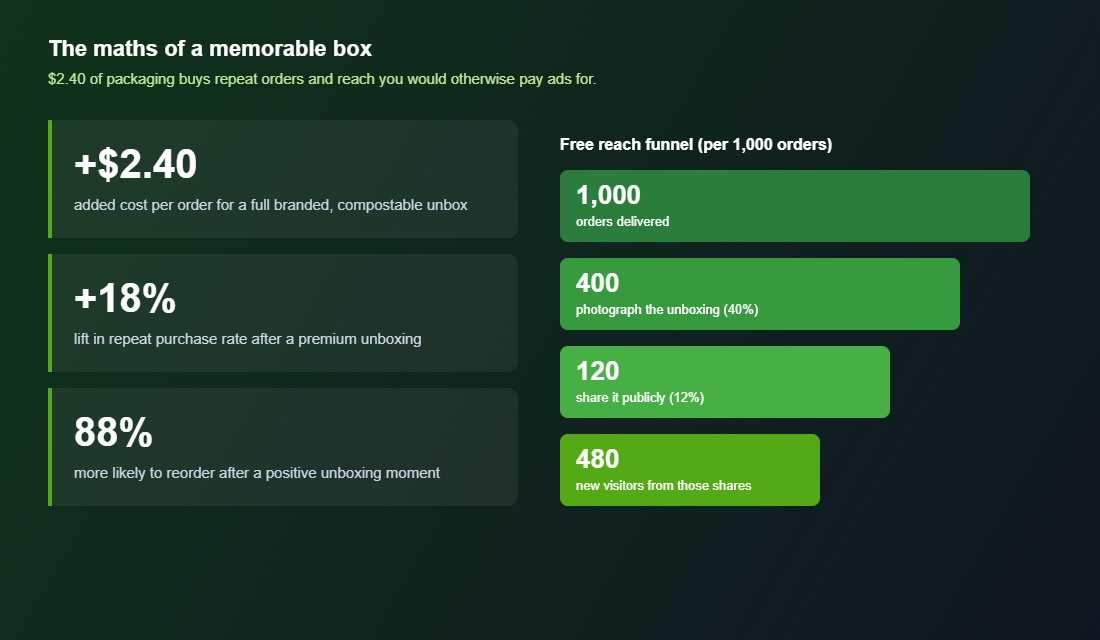
The brands that get this right treat the box as a retention and word-of-mouth channel, not a packing cost. The numbers back them: 88% of shoppers are more likely to reorder after a positive unboxing experience, and 52% will repurchase specifically because of premium packaging. This playbook breaks the unboxing moment into five engineered layers, shows you the economics, and hands you a checklist to build it this month.
Your Box Is a Retention Channel, Not a Line Item
Most founders file packaging under “cost of fulfilment” and optimise it down to the cheapest mailer that survives the courier. That is a category error. Packaging is the only piece of marketing your customer physically holds, in their home, at the exact moment they decided you were worth buying from.
The behavioural data is hard to argue with. Around 41% of consumers say branded packaging makes them more likely to order again, 45% actively prefer buying from retailers with premium packaging because they associate it with quality, and 40% will share an unboxing on social media. That last number is the one most stores sleep on: four in ten customers are willing to become your unpaid media channel if you give them something worth filming.
And the appetite for that content is enormous. YouTube unboxing videos pull in more than 4.8 billion views a year, and custom branded packaging lifts unboxing video shares by up to 3x versus a plain brown box. That is organic reach you would otherwise buy through Meta, earned for the price of a printed mailer.
Here is the kicker. Only about 56% of ecommerce brands use branded packaging at all, and just 36% include any insert or sample. The bar is on the floor. A considered unboxing experience is one of the few places left where a small Aussie brand can out-class a much bigger competitor for a couple of dollars an order.
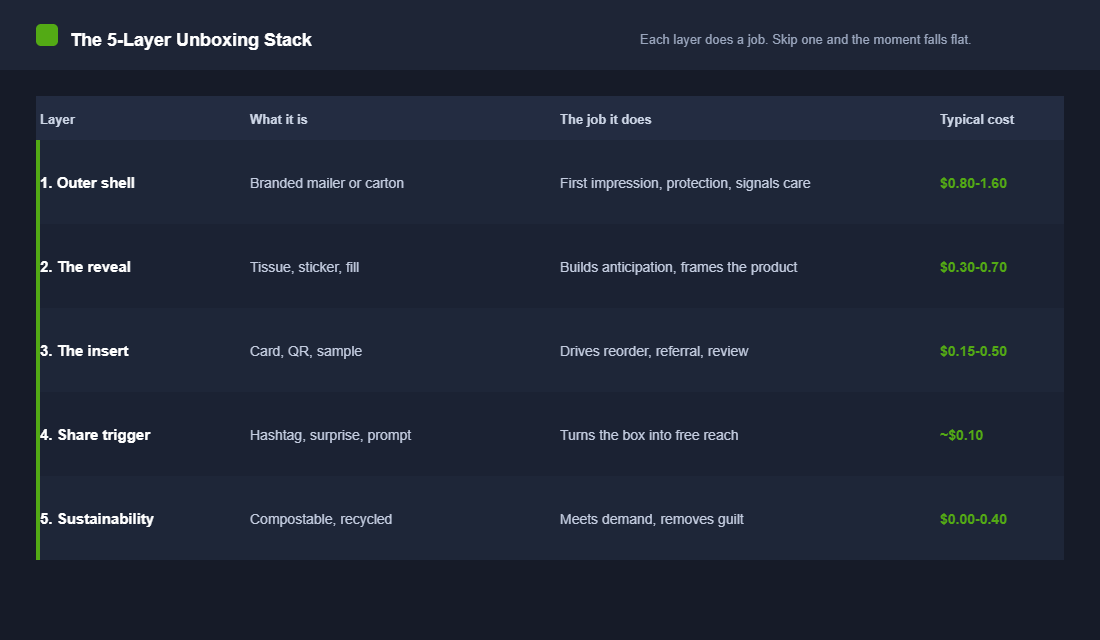
Layer 1: The Outer Shell (You Get One First Impression)
The outer shell is the mailer or carton the customer sees on the doorstep. Its job is three-fold: protect the product, survive the Australia Post network, and signal in the first half-second that this brand cares. A scuffed, unbranded satchel says “commodity” before the customer has even opened it.

You do not need a rigid box for everything. Match the shell to the product: a branded recycled mailer for soft or robust goods, a printed carton for fragile or premium items, a rigid box only where the product value justifies it. The mistake is defaulting to plain because “no one sees the outside anyway”. They do, and so does everyone in their building.
Keep it tight on cost. A branded recycled mailer runs roughly $0.80 to $1.60 in Australian quantities, a rounding error against your customer acquisition cost. Print the logo, use a brand colour on the inside flap for a hit of personality when it opens, and make sure the size fits the product so it does not arrive rattling in a half-empty box.
- Right-size it. A snug fit protects the product, cuts void fill, and reads as deliberate rather than wasteful.
- Brand the inside, not just the outside. A printed interior or coloured flap turns the open into a moment.
- Pick a finish that survives the network. Matte laminates and kraft hide scuffs better than gloss across a multi-day domestic journey.
Layer 2: The Reveal (Choreograph What Happens Inside)
The reveal is everything between lifting the lid and touching the product: the tissue, the sticker, the way the items are arranged. This is where anticipation gets built or killed. A product loose in a sea of plastic fill feels cheap. The same product wrapped in branded tissue, sealed with a logo sticker, feels like a gift.
Choreograph it deliberately. The customer should uncover the product in a sequence, not have it fall out. Branded tissue wrapped around the item and held with a sticker creates a tiny pause, a one-second beat of “what is this” before the reveal. That beat is what makes the moment filmable and memorable. It costs roughly $0.30 to $0.70 per order in tissue, a sticker, and paper fill.
People do not film a product falling out of a satchel. They film a moment that was clearly designed for them. The reveal is where you earn the share.
Aussie brands have built whole identities on this layer. Frank Body leaned on its instantly recognisable look and a cheeky printed voice so the unboxing felt like a personality, not a parcel. Go-To Skincare uses playful copy and on-brand colour so opening the box feels like the brand talking to you. Neither is expensive. Both are unmistakable. That recognisability is what turns a one-time buyer into someone who recognises your box on a friend’s feed.
Layer 3: The Insert That Actually Does a Job
Most inserts are wasted. A generic “thanks for your order” card does nothing. A great insert has a single, specific job: drive the next action. With only 36% of brands including any insert at all, this is the cheapest competitive edge in the whole playbook, at roughly $0.15 to $0.50 a card.
Pick one job per insert and make the call to action unmissable, ideally with a QR code so the customer can act from their phone while the box is still open:
- Reorder. A QR to reorder consumables in two taps, or to start a subscription, captured while the product is literally in their hand.
- Referral. A “give a mate $15, get $15” card turns the unboxing into the trigger for your referral program. Pair this with the system in our referral program playbook.
- Review or UGC. A QR that opens a photo review, timed to land when satisfaction is highest. This feeds directly into a reviews collection engine.
- Education. A “how to get the most out of this” card that reduces returns and increases the chance the product actually works for them.
One insert, one job. If you try to do all four on a single card, the customer does none of them. Rotate the job based on what the business needs most this quarter: more reviews, more referrals, or more repeat orders.
Layer 4: Engineer the Share (Free Reach Hiding in Plain Sight)
Layer 4 is the one almost everyone skips, and it is where the compounding lives. A beautiful box that nobody photographs is a private pleasure. A box engineered to be shared becomes a tiny, recurring acquisition channel that runs on every order you ship.
Sharing rarely happens by accident. You prompt it. Give the customer a reason and an easy path: a printed hashtag, a handle to tag, a small unexpected extra (a sample, a handwritten-style note, a sticker) that creates the “oh, that is nice” reaction people screenshot. Around 40% of shoppers will share if the packaging feels unique, so the job is simply to be worth sharing and to ask.
The maths is quietly powerful. If 1,000 orders go out and 12% of recipients share the unboxing publicly, that is 120 pieces of organic content pointing at your brand, every cycle, for roughly ten cents of prompt per order. Those shares pull new visitors back to your store at a blended cost well below your paid CAC. It is the closest thing to free traffic that scales with your order volume.
Make sharing effortless. The handle and hashtag go somewhere the customer cannot miss, the prompt is specific (“tag us, we repost our favourites”), and you actually repost the best ones. Featuring a customer is the single cheapest loyalty gesture you have, and it trains the rest of your base to do the same.
Layer 5: Sustainability Without the Greenwash
Sustainability is no longer a nice-to-have for the Australian shopper, it is a purchase factor. Around 67% of online shoppers under 40 now treat sustainable packaging as a factor in who they buy from, and 61% name it the top thing they consider about ecommerce’s environmental impact. Get this layer wrong and the premium unboxing you built actually works against you.
The win here is that sustainable and premium are no longer a trade-off. Recycled and recyclable mailers, compostable satchels, paper tape and paper void fill, soy-based inks, and a clear note telling the customer how to dispose of it all read as more premium, not less. The “how to recycle this” line on the insert is both a genuine service and a quiet signal that you have thought about it.
Who Gives A Crap built an entire brand on this principle, wrapping products in colourful paper and leaning into a plastic-free, purpose-led story that customers actively share. You do not need their scale to borrow the logic: choose materials your customer can feel good about, then tell them plainly what to do with the packaging. Avoid vague “eco” claims with nothing behind them. Specific beats virtuous, and Australian consumers are quick to spot the difference.
The Economics: What It Costs and When Premium Pays
Add the five layers and a full branded, compostable unboxing lands around $2.00 to $3.00 per order in Australian quantities, call it $2.40 for the typical mid-range brand. The instinct is to see that as a cost. The right way to see it is as the cheapest retention spend on your P&L.
Run it against the return. If a premium unboxing lifts your repeat purchase rate by even a slice of the 52% who say it makes them reorder, the second purchase pays for the packaging on dozens of future orders. Layer in the 12% who share and the new visitors that brings, and the box is doing the work of both a retention email and a small ad budget, for the price of a coffee split across three orders.
Be disciplined about where you spend. The full premium treatment makes sense for considered, giftable, or repeat-purchase products where the relationship has real lifetime value. For thin-margin commodity items, dial it back to a branded mailer and a single smart insert. The point is not to gold-plate every parcel. It is to match the experience to the customer’s value, the same way you would with your best customers in our top 10% customer strategy.
How to source custom packaging with noissue
You do not need a warehouse or a five-figure print run to start. noissue, a packaging platform with strong Australian and New Zealand roots, lets small brands order custom, compostable packaging at low minimums. Setup takes an afternoon:
- Create an account and pick a product. Start with custom tissue and a logo sticker, the two highest-impact, lowest-cost items.
- Upload your logo and set colours. Use the online designer to apply your brand to tissue, mailers or stickers and preview before you commit.
- Choose compostable or recycled stock. Select materials that match your Layer 5 promise, then note the disposal instruction for your insert.
- Order at a low MOQ to test. Run a small first batch, ship it, and watch your share rate and repeat rate before scaling the order.
- Add the insert separately. Print thank-you and QR cards through a local printer (VistaPrint or an Aussie printer) so you can update the offer each quarter without reordering everything.
Pair the physical side with a review or UGC app like Okendo or Loox so the QR on your insert flows straight into captured photo reviews. That closes the loop between the box and the content it generates.
The Compound Effect: Where the Box Pays Off
Any single layer is nice. The system is what compounds. Picture the sequence running on every order: the branded shell signals care on the doorstep, the reveal earns a photo, the insert drives a reorder or referral, the share trigger turns that photo into reach, and the sustainability layer makes the whole thing feel good enough to talk about.
Now stack it across a year. A premium unboxing nudges repeat rate up 18%, turns 12% of orders into public content, and lifts post-delivery sentiment. Each of those feeds the others: more repeat orders mean more boxes shipped, more boxes mean more shares, more shares mean more new customers receiving the same experience. It is a flywheel that spins faster the more you ship, and it costs the same couple of dollars whether you have 100 orders a month or 10,000.
That is why unboxing sits under the Patrons pillar, not fulfilment. It is not about getting the parcel there. It is about turning the person who opens it into someone who orders again and brings a friend. The box is the cheapest, most overlooked loyalty tool you own.
Your 6-Point Unboxing Checklist
Before you reorder a single mailer, run your current experience through these six checks. Tick all six and your box is engineered, not accidental:
- Branded outer shell, right-sized. Logo on the mailer or carton, snug fit, finish that survives the courier.
- A choreographed reveal. Tissue plus sticker so the product is uncovered, not dumped. One designed second of anticipation.
- One insert with one job. Reorder, referral, review or education, with a QR so the customer can act on the spot.
- An explicit share trigger. Handle, hashtag and a specific prompt the customer cannot miss, plus a habit of reposting the best.
- Sustainable materials with a disposal note. Recycled or compostable stock and a clear “how to recycle this” line. No vague eco claims.
- Costed and matched to value. Know your per-order packaging cost and spend more on high-lifetime-value products, less on thin-margin ones.
Work top to bottom. Most brands already have Layers 1 and 5 half-sorted and are leaking the entire opportunity on Layers 3 and 4, the insert and the share. Those two are the cheapest to add and the fastest to pay back.
The Bottom Line
The unboxing moment is a marketing channel you have already paid for. Every order is a guaranteed, undivided moment of attention in the customer’s home, and most brands fill it with a beige satchel and an invoice. That is the opportunity.
Engineer the five layers, spend the couple of dollars where lifetime value justifies it, and the box stops being a cost and starts being a flywheel: more repeat orders, more shares, more new customers, all running on the parcels you were already shipping.
Inside eCommerce Circle, the unboxing experience is one of the retention levers we work on with every member under the Patrons pillar. If you want a second opinion on yours, let’s talk.