Here is a number most Aussie Shopify founders never calculate: the exact order value below which giving away shipping turns the sale into a loss. They offer free shipping over $50 because a competitor does, or because $50 feels generous, and they never go back to check the maths. Meanwhile freight quietly eats 7 to 9% of revenue and nobody can see it on the dashboard.
What’s in This Article
You already know free shipping moves the needle. Extra costs at checkout, shipping and taxes and surprise fees, are the single biggest reason carts get abandoned. Baymard puts it at 48% of abandonments. In Australia, 56% of online shoppers rank free shipping as their top delivery preference, and 60% say it is one of the most important factors when they choose where to buy. The demand is not in question.
The mistake is treating the threshold as a marketing slogan instead of a profit lever. Set it too low and you subsidise orders that were always going to convert. Set it too high and nobody reaches it, so it does nothing. Set it right, about 20 to 30% above your average order value, and 58% of shoppers will add an item to qualify, lifting AOV by roughly 30%. That is the whole game. This playbook shows you how to find your number.
Free shipping is never free. It is a line on your P&L
The phrase “free shipping” is the most successful piece of misdirection in retail. The customer pays nothing extra. You pay all of it. The only question is whether you have priced for it or whether it is silently bleeding your margin.
Australian freight is not getting cheaper. Australia Post lifted parcel prices by an average of 4.95% in 2025, and a flat-rate satchel still starts around $12.50 before packaging. Yes, MyPost Business can save you up to 40% once your volume bands kick in, but even discounted, a typical apparel or beauty parcel lands somewhere between $8 and $13 to your door. When you “give away” shipping on a $35 order at 60% gross margin, you have $21 of margin and you have just handed $10 of it to Australia Post. You kept $11. One return wipes the whole order out.
This is a Platform and Profit problem at the same time, which is exactly why it gets ignored. The marketing side wants the free shipping promise on the homepage. The finance side never gets asked. Your job as the operator is to sit in the middle and set a threshold that keeps the promise on the page while protecting the contribution margin underneath it.
Step 1: Find your true blended cost per order
You cannot set a threshold until you know what an average order actually costs you to ship. Not the cheapest satchel. The blended number across every parcel you send.
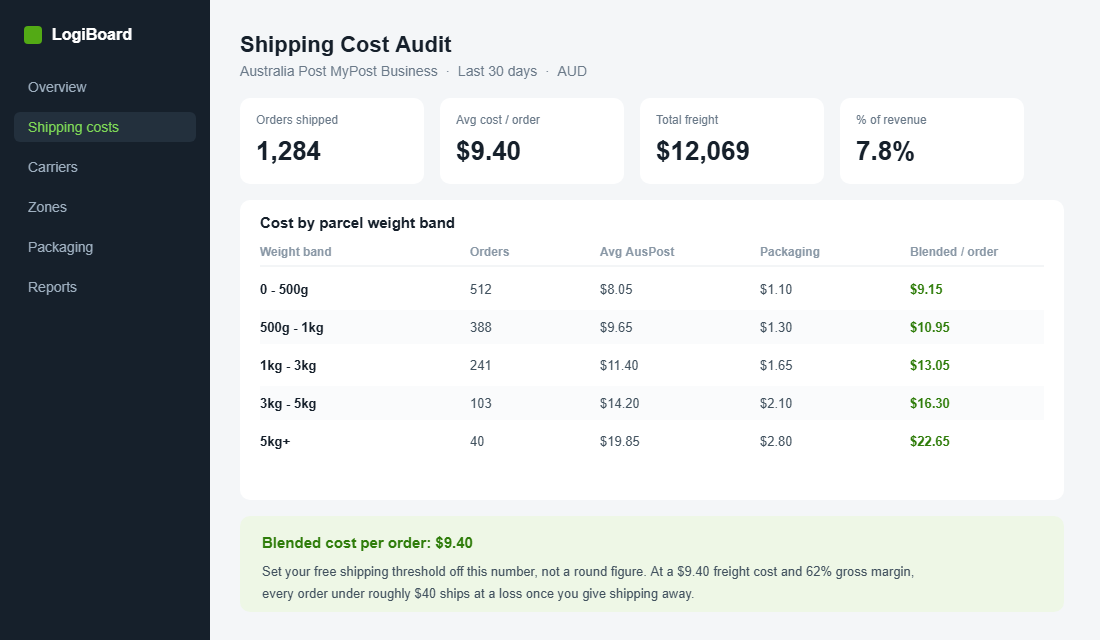
Pull your last 30 days of orders and work out the real cost per parcel, including the bits founders forget:
- Carrier cost by weight band. Group orders into bands (under 500g, 500g to 1kg, 1kg to 3kg, and so on) and apply your actual MyPost Business rate for each.
- Packaging. Mailer or box, tissue, sticker, thank-you card. For most beauty and apparel brands this is $1 to $3 a parcel and it is real money.
- Handling and pick-pack. If a 3PL fulfils you, add their per-order fee. If you do it in-house, value your time honestly.
- Returns freight. If you offer free returns, spread that cost across all orders so the blended number tells the truth.
For the store in the dashboard above, that blend lands at $9.40 a parcel. That single figure is the foundation for everything that follows. If you do nothing else from this article, calculate this number. The brands that struggle with shipping economics are almost always the ones who never knew it. This is the same blind spot we cover in the contribution margin playbook: you cannot manage a cost you have never measured.
Step 2: Set the threshold off your AOV, not a round number
Here is where almost everyone gets it wrong. They pick $50 or $75 because it is tidy. The right threshold has nothing to do with round numbers and everything to do with your current average order value.
The rule that holds up across thousands of stores: set your free shipping threshold 20 to 30% above your current AOV. High enough that customers have to add something to reach it, low enough that reaching it with one more item feels achievable rather than absurd. If your AOV is $78, a threshold around $100 is the sweet spot. Push it to $125 and the lift per order is bigger, but far fewer people bother, so total revenue can actually fall.
For context, the median conditional free shipping threshold in the market sat at $64 in 2025, up 23% from $52 in 2019, and 43% of retailers have raised theirs to cope with rising freight. The direction of travel is up. Do not anchor to an old $50 number set when satchels were cheaper. Model it.
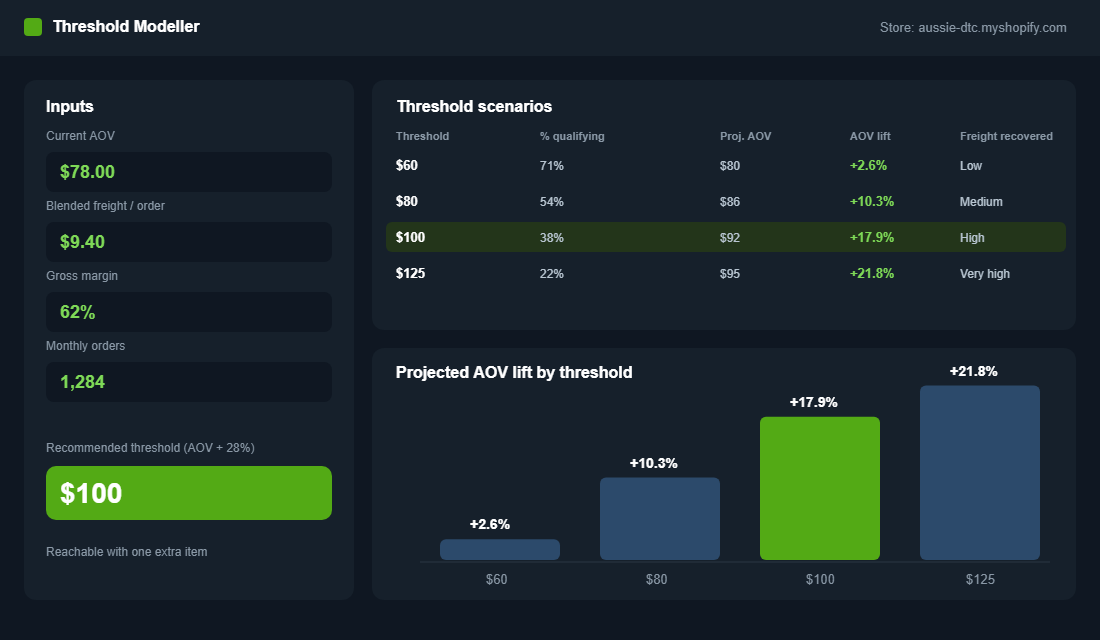
Build the simple model above in a spreadsheet. For each candidate threshold, estimate the share of orders that already clear it, the share that will add an item to reach it, and the resulting blended AOV. The threshold that produces the most total contribution wins. It is usually the one sitting around AOV plus 25 to 30%, not the highest one on the list.
Step 3: Make the threshold impossible to miss with a progress bar
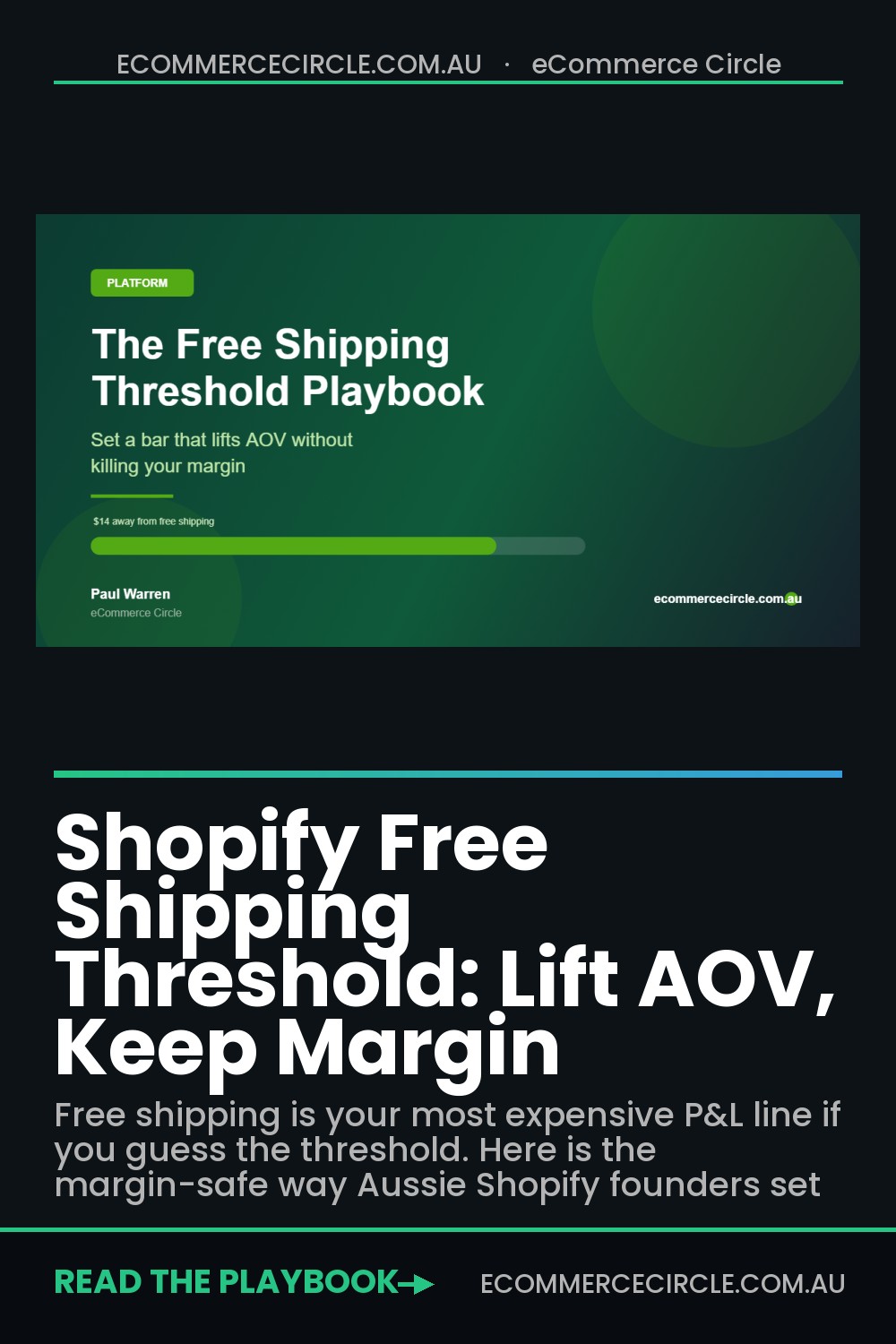
A threshold the customer cannot see does nothing. The lift comes from the nudge: a live progress bar that says “you are $14.00 away from free shipping” and updates as items go in the cart. That little bar is one of the highest-ROI things you can add to a Shopify store this week.
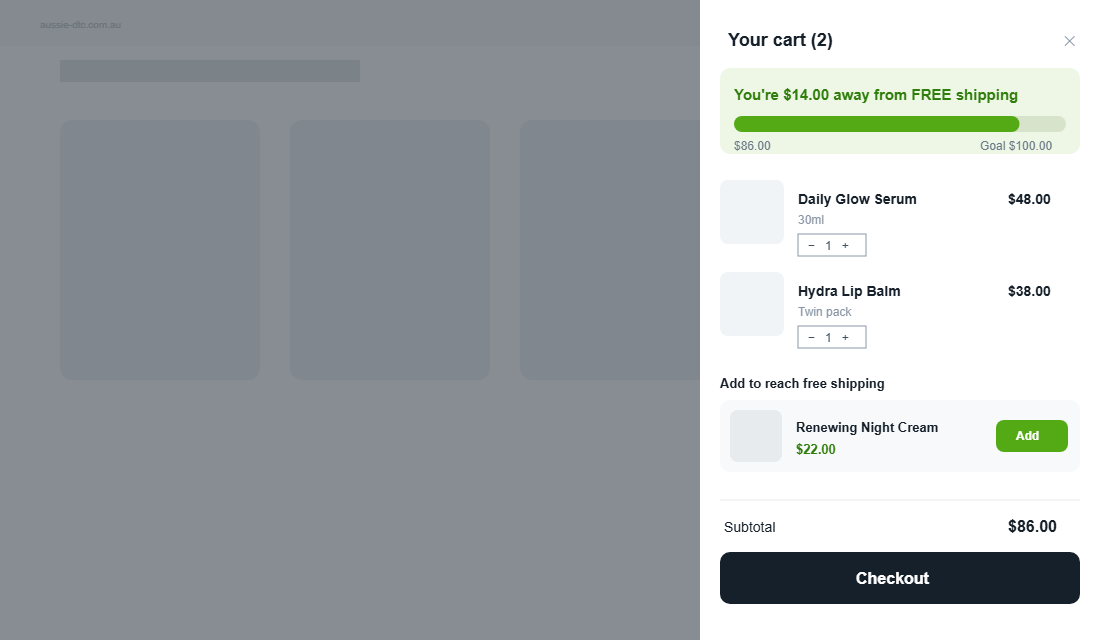
The best place for it is the slide-out cart, because that is the moment of highest intent. If your cart drawer is still a plain list, fix that first. We walk through it in the slide cart playbook. Then add the bar. Here is the setup with Hextom: Free Shipping Bar, one of the most widely used free options on the Shopify App Store:
- Install the app from the Shopify App Store and open it inside your admin.
- Create a new bar and choose the progressive goal type so the message counts down as the cart fills, rather than a static banner.
- Set your goal amount to the threshold you modelled in Step 2 (for example $100) and write two messages: the “you are $X away” state and the “free shipping is on us” celebration state.
- Target Australia only using the geo-location rules, so overseas visitors who pay for shipping never see an offer you do not extend to them.
- Place it in the cart and as a sticky bar on product pages, then match the colours to your theme using brand green for the filled state.
If you want the bar plus one-tap upsells inside the same drawer, Upcart bundles the progress bar, reward tiers and in-cart cross-sells together, which is the combination that does the heavy lifting on AOV. Whichever you choose, the rule is the same: show the gap, then make closing it a single tap with a relevant, on-brand add-on.
Step 4: Protect the margin you are about to give away
A threshold lifts AOV, but it can still leak profit if you are not careful about which orders qualify. Three guardrails keep it honest.
- Exclude heavy and bulky items. A $100 order of three light beauty products costs $9 to ship. A $100 order of a single heavy item can cost $25. Use Shopify shipping profiles to carve out the heavy SKUs so they are not swept into the free shipping promise.
- Check the threshold beats your variable cost. At your threshold, the gross margin on the order must comfortably cover the blended freight plus payment fees. If $100 at 62% margin gives you $62 and freight is $9.40, you are fine. If a category runs at 35% margin, model it separately.
- Do not free-ship the discount stackers. If a customer is already on a 30% code, free shipping on top can push the order underwater. Either lift the threshold for discounted carts or exclude the deepest codes.
Two Australian brands show the strategy at opposite ends. THE ICONIC built its model around free standard shipping over a set spend, training a generation of Aussie shoppers to add one more item to qualify. Who Gives A Crap takes the other route: it sells in bulk packs, so the minimum order is effectively a built-in threshold and almost every order clears the freight cost by design. Both protect margin. Neither gives shipping away on a $20 order.
Step 5: Treat the threshold as a test, not a tattoo
This is the Performance half of the job. Your first threshold is a hypothesis. The data tells you whether it was right, and your AOV will drift over time as your range and pricing change, so the number is not set once.
Watch three numbers for 30 days after you launch or move a threshold:
- Average order value. The headline. A healthy threshold lifts blended AOV by 8 to 18% within the first few weeks.
- Share of orders qualifying. If almost everyone clears it, the threshold is too low and you are leaving lift on the table. If almost nobody does, it is too high and the bar is just decoration. Aim for a meaningful chunk reaching it with one added item.
- Checkout abandonment. Shipping surprise is the number one abandonment trigger, so a visible threshold should reduce it. If abandonment climbs, your threshold may feel out of reach. Pair this with the abandoned cart recovery playbook to catch the ones who still slip.
Move the threshold in $5 increments, never wild jumps, and give each change at least two weeks before you judge it. Small, measured moves let you find the peak of the curve without spooking your repeat buyers.
Three threshold mistakes that quietly cost you orders
Once the threshold is live, a handful of avoidable errors show up again and again in store audits. Each one is easy to fix once you know to look for it.
- Hiding the threshold until checkout. If the first time a shopper learns about free shipping is the final review step, you have created the exact surprise that drives the 48% abandonment, not removed it. The threshold has to live in the cart drawer and on product pages, not buried in a shipping policy page nobody reads.
- One threshold for the whole world. A $100 bar that works beautifully for an Australian customer is meaningless to a shopper in the United States paying $30 international freight. Use geo rules so each market sees a threshold that reflects its real shipping cost, or no offer at all.
- Never moving it after launch. Founders set $50 in year one and still run it three years later, after AOV has climbed to $80 and freight has risen 15%. The threshold that protected margin then is bleeding it now. Diarise a review every quarter and after any major pricing change.
None of these are exotic. They are the difference between a threshold that runs on autopilot and one that slowly drifts out of step with your economics. Five minutes a quarter keeps it honest.
The compound effect: where the threshold quietly pays for everything
On its own, a free shipping threshold is a nice AOV bump. The reason it deserves a spot in your core operating system is what it compounds into.
Start with the order. A shopper sitting at $86 sees a $14 gap, adds a $22 night cream to clear it, and your AOV on that order jumps 26%. Now run that across a few hundred orders a month and the maths gets serious. On 1,284 monthly orders, lifting blended AOV from $78 to $92 is roughly $18,000 of extra revenue a month, and because the added items carry full product margin, most of it drops to contribution.
Then it keeps giving. The extra item the customer added is a second product in their hands, a second chance to fall in love with the brand, which feeds repeat purchase rate and lifetime value. The visible threshold cuts the shipping-shock abandonment that was costing you conversions at checkout. And the freight you recover funds the free shipping promise that pulls customers in from the homepage in the first place. Acquisition, conversion, AOV and retention all touched by one well-set number.
That is the difference between a tactic and a lever. A tactic helps once. A lever, set correctly, keeps paying every single order for as long as the store runs.
The Free Shipping Threshold Framework
Work through this once and you will have a margin-safe threshold backed by your own numbers, not a competitor’s guess:
- 1. Measure. Calculate your blended cost per order: carrier rate by weight band, plus packaging, plus handling, plus a share of returns freight.
- 2. Anchor. Pull your current AOV from Shopify analytics. This is the number the threshold is built on.
- 3. Model. Test thresholds at AOV plus 20%, plus 30% and plus 40%. Estimate qualifying orders and blended AOV for each. Pick the one with the most total contribution.
- 4. Margin-check. Confirm the gross margin at your chosen threshold comfortably covers freight and fees. Carve out heavy SKUs and deep-discount carts.
- 5. Show it. Add a progressive free shipping bar to the slide cart, geo-targeted to Australia, with a one-tap add-on that closes the gap.
- 6. Measure again. Track AOV, share of orders qualifying and checkout abandonment for 30 days. Adjust in $5 steps.
Six steps, one afternoon, and a number you can defend. Most stores never do step one. Doing all six is how you turn the most expensive line on your P&L into one of the most profitable nudges in your cart.
Set the number, then leave it alone for two weeks
Free shipping is not a yes or no decision. It is a threshold decision, and the threshold is a profit lever you control. Guess it and you either subsidise orders that did not need help or set a bar nobody clears. Model it off your real freight cost and your real AOV, make it visible in the cart, and watch the same shipping promise that was bleeding margin start funding itself.
Inside eCommerce Circle, getting the free shipping threshold right is one of the first Platform and Profit wins we work on with every member, because it pays for itself in weeks and touches the whole funnel. If you want a second opinion on yours, let’s talk.