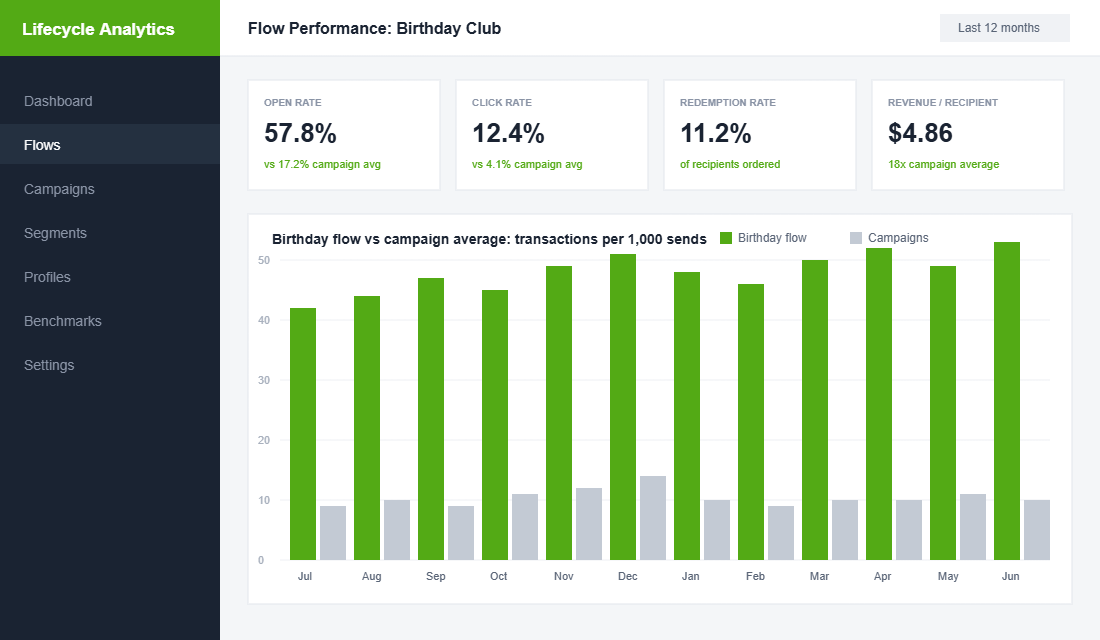
There is one email your store could send that opens at triple the rate of anything else in your account, transacts at nearly five times your promotional average, and lands on a day when your customer is already primed to treat themselves. Most Aussie Shopify stores never send it.
What’s in This Article
The birthday email is the closest thing lifecycle marketing has to a sure bet. Experian’s research puts birthday sends at 481% more transactions and 342% more revenue per email than standard promotional campaigns. Not 20% better. Not 50% better. Nearly five times the transactions, from an email that takes an afternoon to build and then runs on autopilot for years.
The catch, and the reason most founders never cash this in, is that you cannot send a birthday email without a birthday. The whole channel lives or dies on a single field most stores never ask for. This playbook covers the 5-part system we work through with eCommerce Circle members: capture the date, build the flow, get the offer economics right, wrap a club around it, and expand it into dates you already own.
Why One Date Outperforms Your Entire Campaign Calendar
Before building anything, understand why this works so absurdly well, because the mechanics tell you how to run it properly.
- Attention is pre-booked. Experian clocked birthday email open rates at 56.2% against 16.8% for mass promotions. Your subject line barely matters. The day does the work.
- Permission to self-gift. Your customer spends all year buying for the household and the kids. On their birthday, spending on themselves is socially sanctioned. You are not creating demand, you are catching it.
- Reciprocity, done honestly. A genuine gift (not a grudging 10% off) triggers the oldest loop in retail: you gave me something, I feel good about you, I buy. Experian’s data shows birthday emails pulling 179% higher unique click rates than promotional sends.
- Flows beat campaigns on every metric that matters. Klaviyo’s benchmark data shows automated flows generating around 41% of total email revenue from just 5.3% of sends. The birthday flow is the purest example of the species: perfectly timed, perfectly personal, zero ongoing effort.
One email, sent to a few dozen people a day, quietly compounding. For a store with 20,000 profiles and birthdays captured on even a third of them, that is roughly 6,600 highest-intent sends a year that you are currently not making.
Part 1: Capture the Date Without Being Weird About It
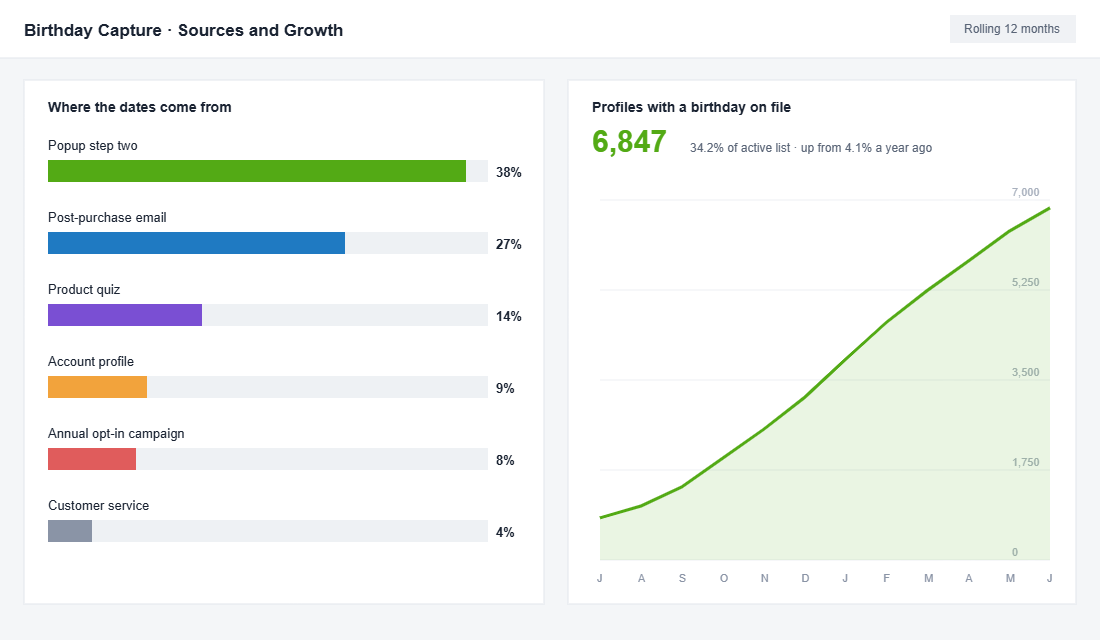
The birthday flow has one hard dependency: the date itself. Nobody fills in an optional birthday field for fun, so you need to engineer the ask. Four capture points, stacked, will get you from zero to 30%+ of profiles carrying a birthday within a year.
- The popup, second step. Never ask for the birthday up front; every extra field on step one kills your capture rate. Take the email first, then make the birthday the optional second step with the reason attached: “Want a gift on your birthday? Tell us when it is.” If you have not rebuilt your capture stack lately, start with the email popup playbook and add this as step two.
- The post-purchase moment. The thank-you page and the first post-purchase email are your highest-goodwill touchpoints. A single line (“add your birthday, we like an excuse to spoil people”) converts far better there than in any newsletter.
- The account and quiz. If you run a product quiz or customer accounts, add the field with the same promise. Every answer is zero-party data your competitors do not have, which is the exact discipline covered in the zero-party data playbook.
- The birthday campaign, once a year. Run one dedicated campaign to your list: “We give birthday gifts now. Want in?” A single send like this can double your captured dates in a week, because you are asking everyone at once with a clear reason.
Two rules on the ask. Only request day and month; the year adds friction and you do not need it to send a gift. And say what the date buys them. “For your birthday treat” converts. A bare date field reads as data harvesting, because it is.
Part 2: Build the Flow in Klaviyo (An Afternoon, Start to Finish)
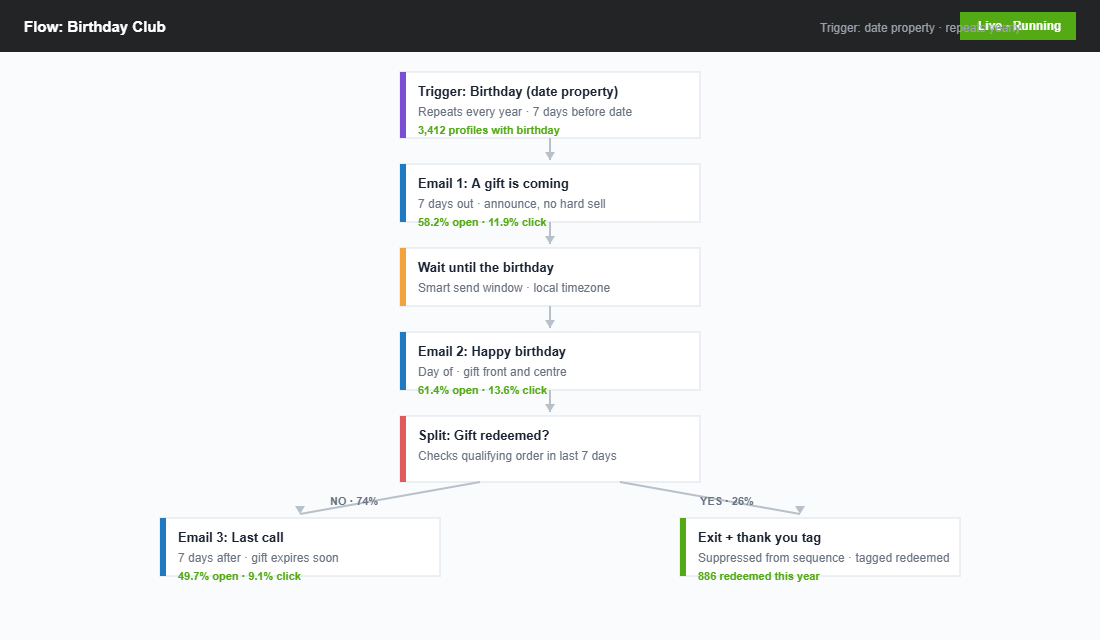
Klaviyo handles birthdays natively through date-property triggers, so there is nothing to install and nothing custom to build. Here is the setup, step by step.
- Step 1: Create the property. Standardise on a single profile property called Birthday, stored as a date. Map every capture point (popup, quiz, account, campaign form) to that one property so nothing fragments.
- Step 2: Create the flow. In Klaviyo, create a new flow with a date-property trigger on Birthday, set to repeat every year. This is the switch that makes it evergreen.
- Step 3: Offset the first email. Set the first send to 7 days before the date. Early enough to beat the birthday-week noise and allow shipping time, close enough to feel personal.
- Step 4: Build the three sends. Email one, 7 days out: announce the gift, no hard sell. Email two, on the day: happy birthday, gift front and centre, one clear button. Email three, 7 days after: last call before the gift expires. Suppress anyone who has already redeemed.
- Step 5: Set the guardrails. Add profile filters so heavy recent purchasers are not pushed a discount they do not need, and exclude anyone in an active win-back or replenishment sequence that would collide with it.
Expect the flow to sit among the best performers in your account within a quarter. Klaviyo’s own benchmarks put flow revenue per recipient at roughly 18 times campaign sends, and birthday flows routinely top even that table because the timing is perfect by definition.
Part 3: Get the Offer Economics Right
The difference between a birthday flow that prints money and one that quietly erodes margin is the offer construction. The default move (15% off everything) is the weakest option on the table.
- A gift beats a discount. A percentage off is marketing. A named thing is a present. “A free mini candle with your order” or “a 20 dollar birthday credit” lands emotionally in a way 15% never will, and a credit denominated in dollars protects your pricing architecture from permanent discount training.
- Price the gift on landed cost, not retail. A gift-with-purchase that retails at 25 dollars might cost you 6. Attached to a 90 dollar qualifying order, that is a 7% cost of offer on the acquisition of your highest-converting send of the year. Run the same maths on your credit option and pick the cheaper path to the same feeling.
- Set a qualifying floor just above AOV. Gift with orders over a threshold sitting 10 to 20% above your average order value, and the birthday email lifts basket size while it converts.
- Give it a window. Fourteen days of validity creates a clean deadline for email three and stops birthday credits haunting your books all year.
The Australian benchmark here is MECCA’s Beauty Loop. The birthday gift is a curated, genuinely desirable product, members must have their birthday loaded on their profile ahead of time to receive it, and the entire beauty-obsessed country knows about it. The gift is the loyalty program’s front door. Note the mechanic doing the heavy lifting: no discount anywhere in sight.
At the other end of the basket, Boost Juice’s Vibe Club gives every member a free drink, redeemable in a window from two days before to two days after their birthday. Simple, cheap at cost, and it drags a customer into the store during their highest-spend week of the year. Both brands are running the same play at different price points, and both have made the birthday perk the single most famous feature of their program.
Part 4: Build a Birthday Club, Not Just an Email
One email is the entry level. The brands that own this moment treat the birthday as a small event, and the upgrade path costs almost nothing.
- Name it. “The [Brand] Birthday Club” costs nothing and reframes a flow into a membership. People join clubs. Nobody joins a flow.
- Add SMS on the day. If you have SMS consent, a short “happy birthday, your gift is waiting” text on the morning of converts brilliantly alongside the email, because it is the one day a brand text feels warm instead of salesy.
- Tier it for VIPs. Your top 5% of customers get a better gift, a handwritten note, or early access to something new. If you run points, stack a birthday multiplier on top; it slots straight into the structure from the loyalty program playbook.
- Let the team in on it. For stores doing lower volume, a personal note from the founder on the day (“no ask, just happy birthday from all of us”) is the kind of thing that ends up screenshotted on Instagram.
The point of the club framing is compounding word of mouth. MECCA’s birthday gift gets talked about at brunch tables every weekend. Yours does not need to be famous nationally. It needs to be famous among your customers’ friends.
Part 5: Expand Into Dates You Already Own
Once the birthday flow is live, you are sitting on a template that works for any personal date. The best part: the next ones need no capture step at all, because Shopify already knows them.
- The customer anniversary. One year since the first order is a date every profile in your account already carries. “A year ago you took a chance on us” plus a small credit is a retention email that feels like a relationship, and it needs zero data collection.
- The product birthday. For consumables and refillables, the anniversary doubles as a perfectly-timed replenishment nudge. “Your first candle turns one. Time for a new one?”
- Someone else’s birthday. Ask subscribers for a partner’s or best friend’s date at capture (“want a reminder before your partner’s birthday?”) and you have built a gifting reminder flow that sells your product as the solution to a problem every Australian forgets annually.
- Pet birthdays. If you are in the pet niche, this is not a joke, it is your best flow. Pet owners celebrate harder for the dog than for themselves, and the photos end up tagged on social.
Each of these runs on the identical Klaviyo mechanics from Part 2: one date property, one repeating trigger, three emails. Build the birthday flow once and you can clone the entire system in an hour per date.
The Guardrails: Privacy, Tone and Honesty
Three things keep this channel clean. First, collect the minimum: day and month, clearly explained, used for exactly what you promised. Birthdays are personal information under Australian privacy law, so store them properly and never trade them around; the goodwill you are building is the entire asset.
Second, watch the tone. One email that says happy birthday and hands over a gift reads as generous. Four emails wringing the moment for revenue read as exactly what they are. Cap the sequence at three and suppress aggressively once redeemed.
Third, never fake it. No “birthday-ish” sends to people whose date you do not have, and no fake gift framing around an offer everyone gets anyway. Customers compare notes, and a caught fake burns trust at the precise moment you were trying to build it.
Measurement: The Numbers That Tell You It Is Working
The birthday flow is easy to launch and easier to forget, so put four numbers on your monthly dashboard and review them alongside your other flows. Each one diagnoses a different part of the system.
- Capture rate. The percentage of active profiles carrying a birthday. Under 10% after six months means your ask is buried or unexplained; go back to Part 1. Past 30% and the flow’s annual revenue roughly triples on its own, because volume is the multiplier every other metric rides on.
- Open and click rates against your account average. If your birthday email is not opening at least double your campaign average, something is structurally wrong: check the subject line actually references the birthday and that the send is landing in the right week. Experian’s 56.2% open benchmark is the standard to chase.
- Redemption rate on the offer. Between 8 and 15% of recipients placing a qualifying order is a healthy range for most DTC stores. Below that, the gift is not desirable enough or the qualifying floor is set too high above your AOV. Above 20%, congratulations, but check the margin maths still holds at that volume.
- Revenue per recipient against your welcome flow. The welcome flow is usually the strongest automation in a Shopify account, which makes it the honest yardstick. A well-built birthday flow should sit in the same league on a per-recipient basis, and it often wins outright because the timing cannot be beaten.
One quarterly habit ties it together: pull the birthday cohort’s repeat rate and compare it with customers acquired the same month who received no birthday touch. That gap is the true return on the flow, and it is the number that justifies upgrading the gift for VIPs rather than quietly shrinking it at the first budget review.
How the Five Parts Compound
Run the system end to end and the loop feeds itself. The capture stack turns anonymous subscribers into profiles with dates. The flow converts each date into your highest-performing send of that customer’s year. The offer economics make every redemption profitable instead of margin-negative. The club framing gets the gift talked about, which fills the top of the funnel with warm referrals. And the expansion dates multiply the whole machine across anniversaries, partners and pets without another popup field in sight.
Hundreds of Aussie Shopify founders we work with obsess over the next acquisition channel while a five-times-transaction-rate email sits unbuilt in their Klaviyo account. This one is not crowded, it does not fatigue like an ad creative, and it gets stronger every month as captured dates accumulate.
How to Collect Birthdays Without Wrecking Your Signup Rate
The birthday flow only works if you actually have the date. Most stores kill their own flow at this step by bolting a birthday field onto the main signup form, which typically drops form completion by 20 to 30% for the sake of one extra field.
Collect it after the relationship exists, not before. Here are the four placements that work, roughly in order of volume.
- The post-signup thank you page. Someone has already joined your list, so the friction cost is zero. A single line (“Tell us your birthday and we will send you something on the day”) typically captures 25 to 40% of new subscribers.
- A dedicated birthday capture email sent as step three or four of your welcome sequence. Open rates on welcome emails run around 50 to 60%, well above the 25 to 35% you see on campaigns, so this is prime real estate.
- The account or preference centre. Add birth month and day to the profile fields customers can edit. Low volume but very high intent, and it doubles as a re-permission touchpoint.
- Post-purchase, on the order confirmation page. The customer is already in a good mood. Keep it to month and day only, never the year, which both reduces hesitation and keeps you clear of collecting more personal information than you need.
Ask for day and month only. Requesting a birth year reads as data harvesting, adds a privacy obligation you do not want under the Australian Privacy Act, and gains you nothing operationally. In Klaviyo, store it as a date property so the flow can trigger on the date-based anniversary rather than a text string.
The Five Numbers That Tell You If Your Birthday Flow Is Actually Working
A birthday flow that looks busy is not the same as one that earns. Check these five metrics 60 days after launch, then quarterly.
- Birthday capture rate. The share of your active list with a valid birthday on file. Under 15% and the flow simply cannot move the needle, no matter how good the creative is. Above 35% and it becomes a genuine revenue line.
- Open rate against your flow baseline. Birthday emails should sit well above your other flows, commonly in the 45 to 60% range. If yours is tracking near campaign averages, your subject line is not signalling that the email is personal.
- Revenue per recipient. This is the number that matters. A healthy birthday flow generates several dollars per recipient, comfortably ahead of a standard promotional campaign, because intent and timing are both working in your favour.
- Discount dependency. Track what share of birthday orders used the code versus bought at full price. If close to 100% redeem, your offer is doing all the work and you are training customers to wait for it. Test a gift with purchase or early access instead of a percentage off.
- Downstream repeat rate. Compare the 90-day repeat purchase rate of customers who received a birthday email against those who did not. This is where the real return sits, because the flow is a retention mechanism first and a promotion second.
Give the flow a full quarter before you judge it. Birthdays are spread across twelve months, so a 30-day read only ever samples about a twelfth of your list. Once it is running, the natural next builds are a win-back flow for lapsed customers and proper customer segmentation so the birthday offer itself can flex by spend tier. If you want the whole thing running without manual intervention, the Shopify Flow automation playbook shows how to wire the triggers together.
The 30-Day Birthday Flow Launch Checklist
Work through this in order. Nothing here needs a developer.
- Week 1: Create the Birthday date property in Klaviyo. Add the optional birthday step to your popup and map every capture point to the single property. Day and month only.
- Week 2: Design the offer. Pick gift, credit or tiered gift-with-purchase, price it on landed cost, set the qualifying floor 10 to 20% above AOV and a 14-day window.
- Week 3: Build the flow: date trigger repeating yearly, first email at 7 days out, day-of email, last-call email, redemption suppression and purchase-collision filters.
- Week 4: Send the one-off “we do birthday gifts now” campaign to your full list and add the ask to your post-purchase email. Watch capture rate weekly.
- Day 30: Review opens, clicks, redemption rate and revenue per recipient against your welcome flow. Then clone the structure for the customer anniversary.
Inside eCommerce Circle, Patrons (retention and the systems that bring customers back) is one of the core pillars we work on with every member, and the birthday flow is one of the fastest wins in it. If you want a second opinion on yours, let’s talk.