Most Aussie Shopify stores collect reviews by accident. A star widget sits at the bottom of the product page, an automated email fires at the wrong time, and whatever trickles in is left to gather dust. Meanwhile the single cheapest lever you have for lifting conversion is running at maybe 10% of its potential.
What’s in This Article
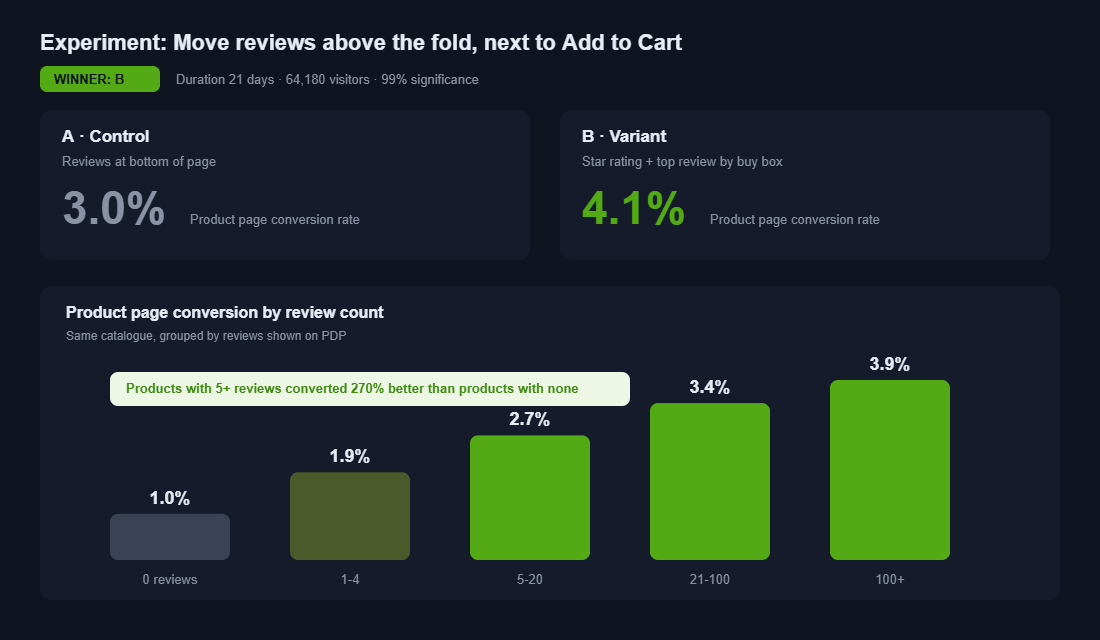
Here is what the data says you are leaving on the table. Products with five or more reviews convert 270% better than products with none. On higher-priced items over $100, just five reviews increases the likelihood of purchase by 380%. And roughly 98% of shoppers read reviews before they buy, especially from a brand they have not tried before.
Reviews are not a nice-to-have you bolt on once. They are a system: how you collect them, where you show them, and what you do with them after. This is the five-part reviews playbook we run with hundreds of Aussie Shopify founders inside eCommerce Circle, built to turn customer trust into repeat revenue without spending an extra dollar on ads.
Part 1: Reviews Are the Cheapest Conversion Lever You Own
Ad costs keep climbing. Your product page does not. Every improvement you make to social proof works on 100% of your traffic, forever, at no ongoing cost. That is what makes reviews the highest-return work most stores ignore.
The numbers make the case on their own:
- 98% of shoppers read reviews before buying, and the average person reads about 10 reviews before they trust a business.
- 76% check the star rating first when sizing up a product or a store, often before they read a single word.
- Five or more reviews lift conversion 270%, and 380% on items over $100 where the perceived risk is higher.
- Photo and video reviews convert harder than text. Shoppers who engage with visual review content convert up to 144% more often and generate 162% higher revenue per visitor.
Look at your own funnel and you will usually find the same story. Products with a wall of reviews carry the store. Products with none sit dead, no matter how good they are. The gap is not the product. It is the proof.
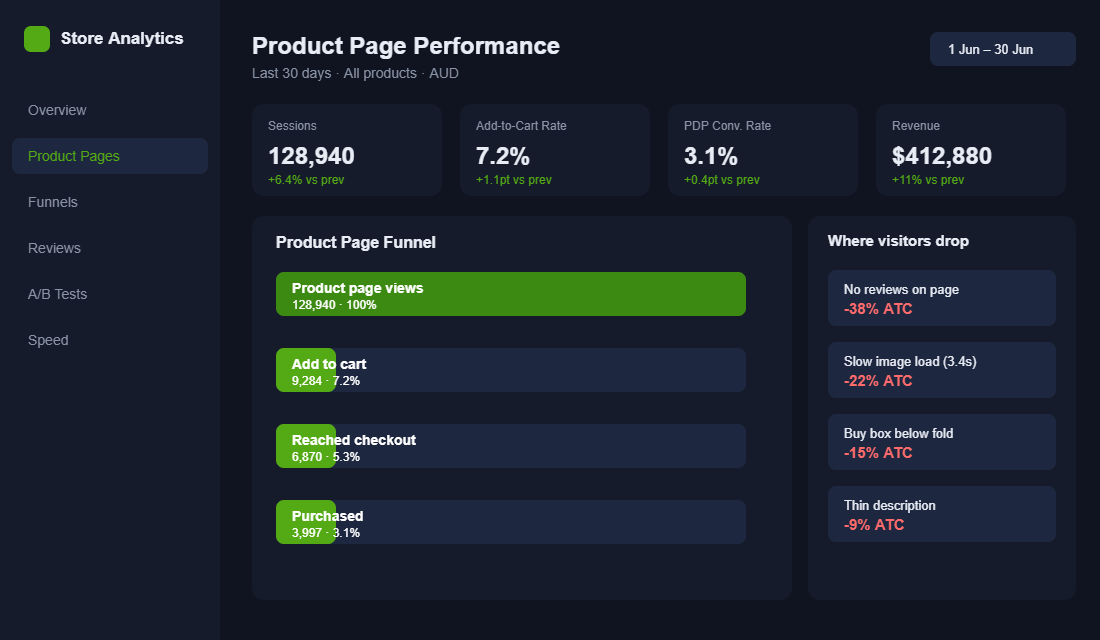
Reviews are also where your product page earns its trust. You can nail the photography and the copy, but without proof next to the button, a first-time buyer still hesitates. Fix the proof and the whole page starts pulling its weight.
Part 2: Collect Reviews on Autopilot (Not by Chance)
The stores drowning in reviews are not lucky. They ask, at the right moment, every single time, without a human lifting a finger. If you are still hoping customers wander back to leave feedback, you will always be short.
The tool: Judge.me. It is the review app we point most Aussie founders to because it is fast, affordable and does not slow the page down. Setup takes about 20 minutes:
- Install Judge.me from the Shopify App Store and connect it to your theme in one click.
- Turn on automatic review-request emails, timed to land a few days after estimated delivery, not the moment the order ships.
- Enable photo and video reviews so real customer images start stacking up on every product.
- Add a small incentive, like entry into a monthly voucher draw, to lift response rates without paying for every review.
- Import any reviews you already have from email, your old platform, or a spreadsheet so no product launches showing zero.
Timing is the lever most people get wrong. Ask before the product has arrived and you get silence or a complaint about shipping. Ask three to five days after delivery, once the customer has actually used it, and your response rate climbs. For consumable products, a second nudge near the reorder point does double duty as a review request and a repeat-purchase prompt.
Set a target and track it. A healthy automated flow converts somewhere between 5% and 15% of delivered orders into reviews, depending on your category and how well you ask. If you are sitting under 3%, the problem is almost always timing or a clunky, multi-step review form rather than unwilling customers. Make the ask short, mobile-first and specific, and the numbers move fast.
Do not rely on email alone. A polite SMS review request a week after delivery often outperforms email for physical products, because it lands where your customer already is. Add a QR code on the packaging insert too, so the happiest moment, unboxing, has a one-tap path to leaving a photo review.
Push hard for photos. Visual reviews are worth chasing because shoppers see customer photos as roughly 2.5 times more authentic than anything the brand produces. A one-line prompt (“add a photo and go in the draw”) is often all it takes. Those images then feed straight into the UGC engine you use across ads and social.
Choose a Review App You Will Not Have to Escape From
Part 2 points you at Judge.me, and for most Aussie stores that stays the right call. But the app you pick sets the ceiling on what your reviews can do for the next three years, so buy with your eyes open.
Price is the easy part of the decision. The harder part is what you lose on the day you want to move.
| App | Rough cost (AUD/month) | Best fit | Watch out for |
|---|---|---|---|
| Judge.me | Free, then about $22 | Most Aussie stores under 2,000 orders a month | Default widget styling is plain and needs theme work |
| Loox | About $20 to $95 by order volume | Photo and video-first brands, referrals built in | Thin on attribute ratings and review syndication |
| Okendo | From about $45, past $200 as you scale | Attribute ratings (fit, sizing, skin type), quizzes, deep Klaviyo integration | Cost climbs fast with order volume |
| Stamped | About $35 to $150 | Stores wanting reviews and loyalty in one app | Two jobs in one app means neither is best in class |
| Yotpo | Free tier, paid from about $120 | Bigger catalogues wanting SMS, loyalty and reviews as a suite | Annual contracts, and over-specced for a $50K a month store |
| Junip | Free, then about $30 to $150 | Fast, clean widgets and strong request response rates | Smaller ecosystem and fewer third-party integrations |
Pricing moves with your monthly order count, not your revenue, so check the current numbers in the Shopify App Store before you commit.
Imagine you run a 90-SKU activewear brand doing $80K AUD a month on the free Judge.me plan. Your top complaint theme is sizing, and returns are eating roughly 12% of revenue.
That is the case for moving to Okendo or Stamped, because attribute ratings let buyers say “runs small, size up” in a structured field that shows on the page. If that shaves even 2 points off your return rate, the extra $50 a month pays for itself ten times over. Without that problem, the upgrade is just a nicer widget.
Migration is where founders get burned. Text and star ratings export cleanly as CSV, but photos, videos, verified-buyer badges and original review dates often do not survive the trip.
Protect your star counts with four steps:
- Export before you cancel. Once the plan lapses, some apps lock the export. Pull the full CSV plus a media archive while the subscription is still live.
- Match on product handle, not SKU. SKUs get renamed. Handles rarely do, and a bad match dumps hundreds of reviews onto the wrong product or nowhere at all.
- Preserve original review dates. If they all import as today, your entire catalogue looks like it was reviewed in one suspicious burst.
- Re-link Google Merchant Center afterwards. Your product review feed points at the old app. Expect star ratings in Shopping listings to disappear for two to four weeks while the new feed is verified.
Run the migration on a Tuesday, not a Friday, and check your five top-selling product pages within the hour. A broken widget on your hero product for a weekend costs more than the app ever will.
Part 3: Display Reviews Where the Decision Actually Happens
Collecting reviews is only half the job. The classic mistake is dumping them in a tab at the very bottom of the product page, a thousand pixels below the button. By the time someone scrolls that far, most have already decided. Bring the proof to the decision, not the other way round.
Put social proof in four places:
- Next to the price. The star rating and review count belong right beside the price, above the fold, so 76% of shoppers who check ratings first see it instantly.
- One quote near the button. Surface a single strong review just above or below Add to Cart. It answers the last objection at the moment of decision.
- Photos in the gallery. Mix customer photos into the image gallery. They convert harder than studio shots because they are believable.
- Star ratings on collection cards. Show ratings on category and collection pages so proof starts working before the shopper even lands on the product.
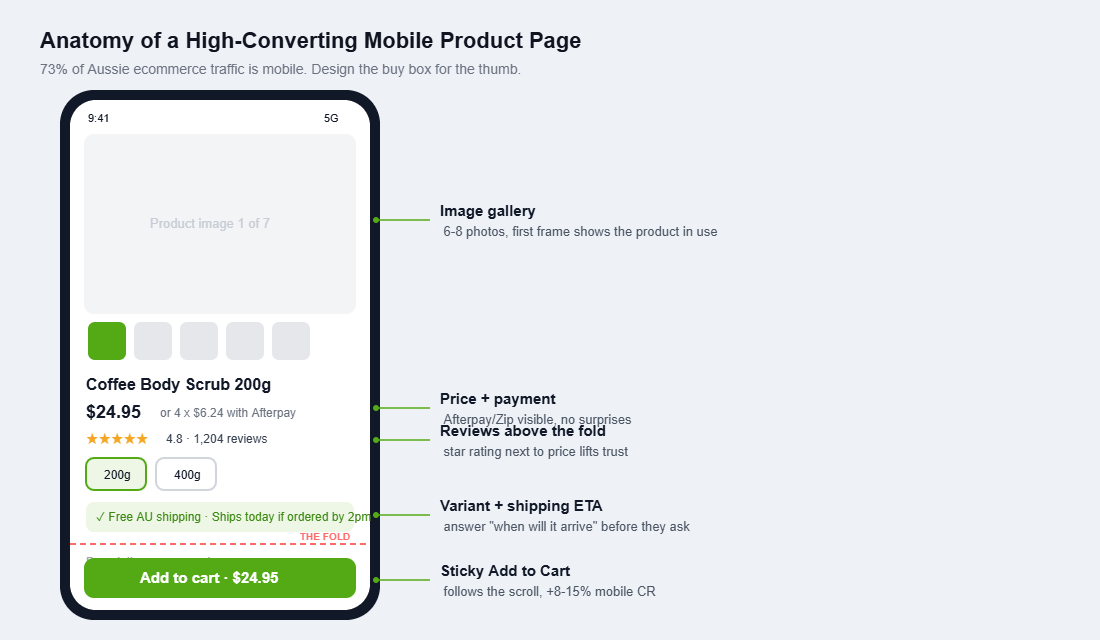
The impact of placement alone is easy to underestimate. In the test below, moving the star rating above the fold and surfacing a top review next to the button lifted product page conversion from 3.0% to 4.1% in 21 days. Same reviews, same product, different position.
Who Gives A Crap, the Aussie B Corp that has raised millions for sanitation projects, does this well. Their product pages pair blunt, funny benefit copy with a visible rating and customer count, so personality and proof land in the same glance. You never doubt that thousands of people buy their toilet paper, because the page shows you.
Part 4: Turn Reviews Into Free Traffic and Sharper Ads
Reviews are not just an on-page asset. Handled well, they earn you cheaper traffic and make every ad work harder. Most stores never squeeze this second layer of value out of the feedback they already have.
- Star ratings in Google. Add review schema so those gold stars show up in search results. They lift click-through rate because your listing stands out against plain blue links. This ties straight into the Shopify SEO playbook, and most review apps output the markup for you.
- Real language for your copy. The phrases customers use in reviews are the exact words your next customer is searching for. Mine them for product page headlines, ad hooks and email subject lines.
- Review-led ad creative. A five-star quote over a customer photo is one of the highest-performing ad formats going, because it is proof and creative in one. It is believable in a way a polished brand ad is not.
- Objection-crushing FAQs. The questions that show up again and again in reviews are the objections costing you sales. Answer them on the page before they are asked.
One review can end up working in four places at once: on the product page, in search results, in a Meta ad, and in an email. That is the compounding return that makes a review worth far more than the single sale it came from.
Freshness matters as much as volume here. A shopper trusts a product with 40 reviews from the last three months far more than one with 300 reviews that stop dead a year ago, because recent feedback signals the product is still good and the brand is still shipping. A steady drip of new reviews keeps your search stars, your ad proof and your page all current, which is exactly why the collection engine in Part 2 has to run continuously rather than in one-off bursts.
Make Your Reviews Findable by Google and AI Answer Engines
Star ratings in search are only the first layer. Your reviews are also the richest source of specific, buyer-written language on your entire site, and that is exactly what search engines and AI assistants are hunting for.
Get the schema right first, because most stores quietly break it. Google will only show product ratings for reviews that are visible on the same page, so never mark up an aggregate rating that a shopper cannot scroll to and read.
Three schema rules worth checking today:
- One source of markup per page. If your theme outputs Product schema and Judge.me outputs it too, you get duplicate aggregateRating and Google may ignore both. Run your top product through the Rich Results Test and confirm there is exactly one.
- Feed Google Merchant Center separately. Organic stars and Shopping stars are two different systems. Merchant Center needs a product review feed, and you generally need at least 50 reviews across the catalogue before ratings show at all.
- Do not mark up your own testimonials. Reviews you wrote about yourself, on your own site, are self-serving and against Google’s guidelines. That includes the “what our customers say” slider on your homepage.
Now the newer opportunity. When an Aussie shopper asks ChatGPT or Gemini for the best merino base layer for a Tassie winter, the model builds its answer from pages carrying specific, attribute-level language.
Brand copy is generic by nature. Review copy is not, because customers write things like “wore it for three days on the Overland Track and it did not stink”. That sentence is the kind of detail an answer engine quotes and a marketer never writes.
So engineer your review form to produce it. Replace the blank “write your review” box with two prompts: what did you buy this for, and how did it compare to what you expected. Response quality jumps, and so does the usable word count per review.
Then get that language onto more than the product page. Pull the three strongest review quotes onto each collection page, use Shopify Search & Discovery to add a rating filter so highly reviewed products surface first, and make sure your review widget renders as real text rather than a script that only fires on scroll.
If your reviews only load after a user interaction, crawlers and AI agents never see a word of them, and you have built a trust asset invisible to the systems now recommending products. Reviews are one layer of the broader trust signals framework, and the layers only pay off when they are actually rendered on the page.
Part 5: Respond, Then Mine Them for Gold
The last part is where almost everyone quits. They collect and display reviews, then ignore them. That is a mistake in two directions: you miss a trust signal, and you miss the single best source of product feedback you will ever get.
Respond to reviews, especially the critical ones. 88% of consumers are more likely to buy from a company that replies to all its reviews, positive and negative, and 45% are more likely to support a business when they see it has responded to negative feedback. A calm, helpful reply to a one-star review often sells the next reader better than a wall of five-stars, because it shows how you handle things when they go wrong.
Then mine the patterns. Set aside 30 minutes a month to read every new review and tag the themes:
- Repeated complaints point to a product, sizing or packaging fix that will quietly lift conversion and cut returns.
- Repeated praise tells you the real benefit to lead with in your copy and ads, which is often not the one you assumed.
- Recurring questions are objections to add to your FAQ and product descriptions.
- Unexpected use cases are new angles for content, bundles and audiences you had not considered.
Your reviews are a free, always-on customer research panel. Most founders are sitting on a goldmine of product and marketing insight and never open the door.
Three Review Mistakes That Quietly Cost You Sales
Before you chase more reviews, kill the errors that make the ones you already have work against you. These three show up on the majority of Aussie Shopify stores we audit, and each one caps the return on all the collection effort you are putting in.
- Hiding or filtering out the negatives. A perfect five-star average reads as fake, and shoppers know it. A product sitting at 4.6 with a handful of honest three-star reviews converts better than a suspicious 5.0. The mix is the proof. Do not scrub it.
- Letting reviews sit at zero on new products. A fresh product with no reviews is the hardest thing in your store to sell, because it carries all the risk and none of the proof. Seed new launches by importing feedback, running a small sampling group, or bundling them with a proven hero product until reviews build.
- Treating every product the same. Your best sellers deserve dozens of reviews and rich photo content. A product you sell twice a month does not need the same push. Concentrate your collection effort where the revenue actually is, not evenly across the catalogue.
There is a fourth trap worth naming: fake or bought reviews. Beyond the legal risk under Australian Consumer Law, shoppers are good at spotting them, and a page of generic five-star one-liners does more harm than an honest, imperfect set. Real beats polished every time.
Frank Body, the Melbourne coffee-scrub brand that has sold over 35 million products since 2013, is the reference for doing this right. Their pages are stacked with real customer photos and unfiltered feedback, not a curated highlight reel. The product is shown on real skin, mid-mess, with reviews to match. You believe it works before you have read a single line of brand copy, and that belief is what the whole system is built to create.
Where should you start this week? Do not rebuild all five parts at once. Pull up your best-selling product, run it against the audit at the end of this article, and fix the lowest-scoring item first.
For most stores that is either collection timing or placement, and both are same-day fixes that pay off immediately. Measure for a week, then move to the next gap.
Keep Your Reviews on the Right Side of the ACCC
Fake reviews are not just bad marketing in Australia. They are a breach of the Australian Consumer Law, and the ACCC has been publicly sharpening its focus on manipulated ratings and paid testimonials.
The exposure is real. Misleading or deceptive conduct carries maximum corporate penalties of up to $50 million, three times the benefit obtained, or 30% of adjusted turnover for the breach period, whichever is greater.
Meriton Property Services learned this the expensive way, copping a $3 million penalty for stopping unhappy guests from receiving review invitations. Note what they were punished for: not writing fake reviews, just quietly preventing the bad ones from being written.
That practice is called review gating, and plenty of Shopify stores do it without realising. If your flow asks “how happy are you?” and only sends the review link to people who answer 4 or 5, you are gating.
Here is what a compliant review program looks like on an Aussie store:
- Every delivered order gets the same ask. No sentiment screen in front of the review link. If you want to catch unhappy customers first, do it with a separate service email, not by filtering who gets invited.
- Incentives are unconditional and disclosed. A voucher draw for all reviewers is fine. A discount only for five-star reviews is not, and apps like Judge.me and Okendo can flag incentivised reviews with a badge automatically.
- Gifted product gets labelled. If you seeded stock to a creator or a sampling group, the review must disclose that material connection. “Free product provided” is enough.
- You do not delete reviews you simply dislike. Remove abuse, spam and anything that breaches privacy. Leave the honest three-star ones alone and reply instead.
- Claims in reviews are your claims too. If a customer writes that your supplement cured their eczema and you publish it on the page, you can wear that therapeutic claim. Moderate for it.
None of this costs you conversions. An honest 4.6 with real criticism visible outperforms a scrubbed 5.0, so compliance and performance point the same direction here.
When something critical lands, acknowledge it, own the specific issue and state the fix publicly. Our negative review playbook gives you the reply structure, and the discipline of using it keeps you well clear of the temptation to gate.
How the Five Parts Compound
None of these steps is dramatic on its own. Together they build a flywheel. You collect more reviews, which lifts conversion, which creates more customers, which creates more reviews.
Display them well and each one works harder. Repurpose them and each one works in four places. Respond to them and you deepen trust while learning what to fix next.
Run the numbers. If proof takes a product from a 3% conversion rate to 4.1%, that is more than a third more sales on the same traffic, with no extra ad spend. Do that across your top 20 products and you have grown revenue by fixing a system you were already half-running.
The flywheel also lowers your cost of acquisition over time. Better proof lifts conversion, which means every dollar of ad spend buys more customers, which produces more reviews, which lifts conversion again. Stores that treat reviews as a system quietly pull ahead of competitors still buying their way to growth, because they are compounding trust while everyone else is only renting attention.
Your 12-Point Reviews Audit
Open your best-selling product on your phone and score it. One point per item. Under 9 out of 12 and your reviews are working part-time.
- Automatic review requests fire 3 to 5 days after delivery
- Photo and video reviews are enabled and being collected
- A small incentive is nudging response rates
- Existing reviews were imported so no product shows zero
- Star rating and count sit next to the price, above the fold
- One strong review appears near the Add to Cart button
- Customer photos are mixed into the gallery
- Star ratings show on collection and category cards
- Review schema is live so stars show in Google
- At least one review-led ad creative is running
- Every negative review gets a calm, public reply
- Reviews are read and themed at least once a month
The Bottom Line
Reviews are the cheapest, most durable conversion lever you own, and most stores run them at a fraction of their potential. Collect them on autopilot, show them where the decision happens, turn them into traffic and ads, and mine them for what to fix next. Score yours against the 12-point audit and fix the lowest number first.
Inside eCommerce Circle, reviews and social proof are one of the core pillars we work on with every member, because they move revenue faster than almost anything else. If you want a second opinion on yours, let’s talk.