Every dollar of paid traffic you buy disappears the moment you stop spending. Meta CPMs keep climbing, Google Ads auctions get more crowded every quarter, and yet most Aussie Shopify founders keep renting 100% of their traffic while their competitors quietly build an asset that compounds.
What’s in This Article
Organic search still drives around 43% of all ecommerce traffic, more than any other single source. It converts at roughly 2.8% on average, ahead of social and most paid channels outside branded search. And industry analysis puts SEO’s return around 317%, with a break-even point of about 9 months.
Then there is the elephant in the SERP. AI Overviews now appear on close to half of all Google searches, and when they show up, click rates on traditional listings fall hard. Most founders read that as “SEO is dying”. The sharper read: the queries that buy things behave very differently from the queries that ask things, and the brands that structure their stores properly are collecting more qualified traffic than ever while everyone else panics. This playbook shows you how to be in the first group.
Why SEO Still Pays in the AI Search Era
Let’s deal with the fear first, because it is half legitimate. Ahrefs found the top organic position loses about 58% of its expected clicks when an AI Overview sits above it. Seer Interactive measured organic click rates dropping from 1.76% to 0.61% on queries with AI Overviews present. Those are real losses, mostly on informational queries.
Here is what the doom headlines skip:
- Buying queries still send clicks. Product and shopping searches behave differently from informational ones. Someone searching “linen sheets australia” is shown stores, not essays. Your collection pages are competing in a SERP that AI summaries have disrupted far less.
- Citations are the new position one. Brands cited inside an AI Overview earn around 35% more organic clicks than brands that are not. Being the source the machine quotes is now a rankable outcome, and it favours exactly the kind of structured, genuinely useful content this playbook builds.
- Organic still books revenue. Organic search drives roughly 23.6% of online orders. Nobody’s Meta account does that for free.
One documented Shopify case study saw a fashion brand go from zero to 120,000 monthly organic visitors in 14 months, converting non-brand organic traffic at 2.6%. That did not come from tricks. It came from structure, which is where we start.
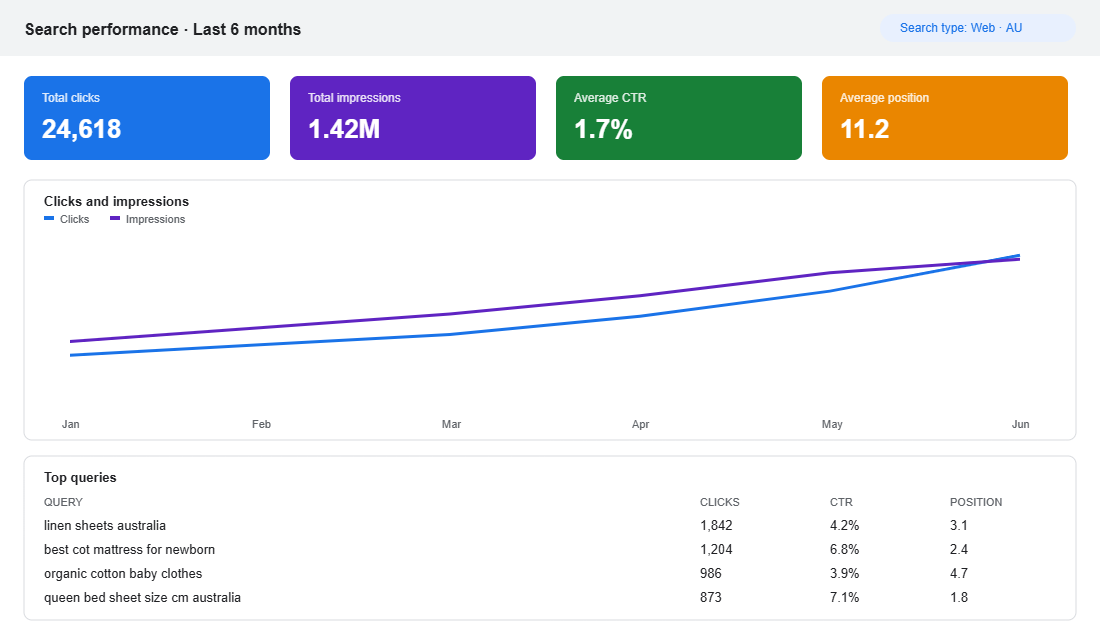
One more reframe before the system. SEO in 2026 is no longer just about ranking a blue link. The same structured, trustworthy store that wins Google positions is what AI shopping assistants pull from when a customer asks them what to buy. Product schema, clear category pages, real reviews, and consistent business details are how you become recommendable to machines as well as findable by them. Every hour in this playbook pays into both outcomes at once.
Part 1: Fix the Foundations Shopify Ships With
Shopify is a solid SEO platform out of the box, but it has quirks, and most stores never fix them. Before you write a word of content, spend a week here.
- Kill duplicate product URLs. Shopify creates two paths to every product: the clean /products/ URL and a /collections/name/products/ version. Shopify canonicalises these for you, but check your theme actually links to the canonical version internally so you are not splitting signals.
- Get your speed sorted. Site speed is a confirmed ranking input and a conversion lever twice over. Most Shopify stores are dragged down by app bloat, not their theme. Our Shopify site speed playbook walks the whole cleanup.
- Make navigation crawlable and logical. Google discovers your pages the same way customers do: through menus and internal links. A flat, keyword-sensible menu structure beats a clever one. The navigation playbook covers the architecture.
- Check your structured data. Product schema (price, availability, reviews) is what wins you rich results and helps AI systems understand your catalogue. Most modern themes include it; verify with Google’s Rich Results Test rather than assuming.
- Tidy indexation. Tag pages, search results pages, and thin variant pages should not be in Google’s index. One store we reviewed had 4 times more junk pages indexed than real ones, diluting everything.
None of this is glamorous. All of it determines whether the next four parts work at all.
Part 2: Map Every Keyword to the Right Page Type
The single most common Shopify SEO mistake: targeting buying keywords with blog posts and information keywords with collection pages. Google has already decided what type of page wins each query. Your job is to match, not argue.
The mapping is simple:
- Collection pages take the money keywords. “Womens linen pyjamas australia”, “mens running shorts”, “ceramic dinner sets”. Plural, category-level, commercial intent. These are your highest-value targets by a wide margin.
- Product pages take the specific searches. Model names, exact product types, long-tail variants. They win when someone knows almost exactly what they want.
- Blog posts take the questions. “Bamboo vs cotton pyjamas”, “what doona weight for melbourne winter”. These queries face the most AI Overview pressure, which changes how you write them (more in Part 4), but they still build the topical authority your money pages ride on.
- Utility pages take the support queries. Size guides, care instructions, shipping questions. Unsexy, high-trust, and they quietly rank for years.
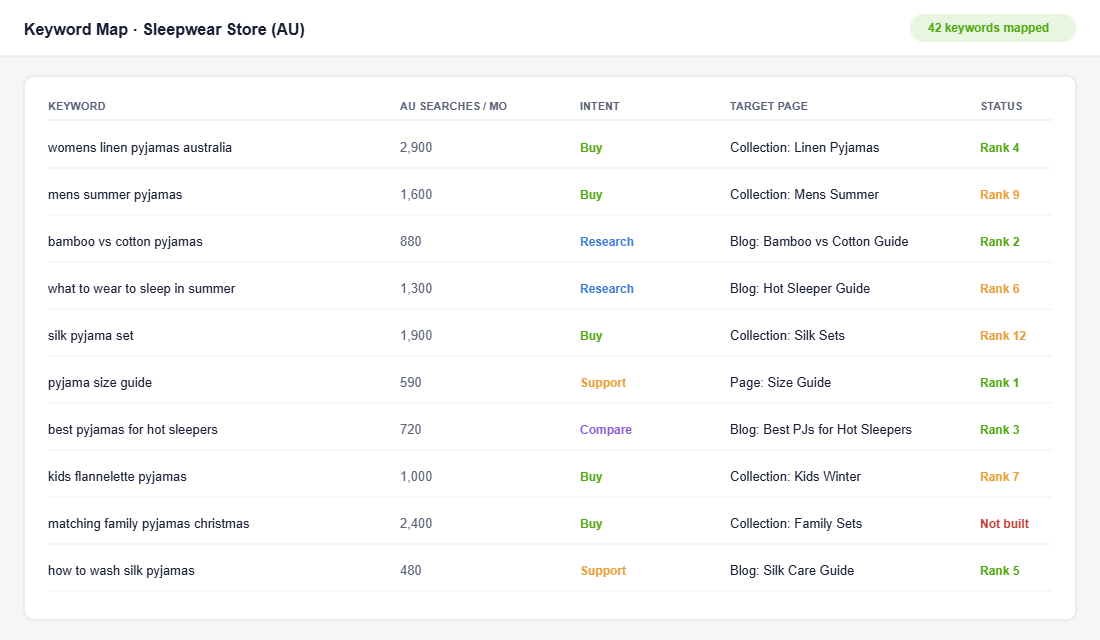
Build the map in a spreadsheet: keyword, monthly Australian searches, intent, target page, current rank. Free data from Google Keyword Planner and Search Console gets you most of the way; a tool like Ahrefs or Semrush speeds it up. Two Australian notes: check the “australia” modifier versions of your head terms (they often convert better and rank easier), and use Australian spelling in your copy because your customers search the way they spell.
The map instantly shows you gaps. A high-volume buying keyword with no matching collection is not an SEO problem, it is a merchandising decision waiting to be made. Matching family pyjamas at Christmas is a collection you build in August, not a blog post you write in December.
Part 3: Treat Collection Pages as Your Money Pages
If organic revenue is the goal, collection pages are where it lands. A ranking collection page collects buying-intent traffic every single day and sends it straight into your product grid. Yet most Shopify collections are a title and a wall of products, which gives Google almost nothing to rank.
The upgrade list:
- One collection per money keyword, with the keyword in the title, H1, URL handle, and meta description. Not stuffed, just present.
- 150 to 300 words of genuinely useful intro copy above or below the grid: who the range suits, what it is made from, how to choose. Written for a shopper, readable by a crawler.
- An FAQ block answering the 3 to 5 real questions buyers ask about the category. This is also your best shot at being the source an AI Overview cites for category questions.
- Internal links to sibling collections and the pillar guide (Part 4), so authority flows sideways and down.
We went deep on this page type in the Shopify collection page playbook, including layout and conversion details. For SEO purposes, the headline is: your collections are landing pages for Google’s highest-value shoppers. Resource them like it.
Want proof this works at scale? Look at how Bellroy structures category and product pages for search terms like slim wallets, or how Koala built its early growth on owning mattress-related searches in Australia against far bigger ad budgets. Different categories, same pattern: the money pages are built to rank, not just to display.
Part 4: Build a Content Engine That Feeds Your Money Pages
Blog content in 2026 has one strategic job: build the topical authority that makes your collections rank, and catch the researchers who become buyers. The structure that does this is hub and spoke.
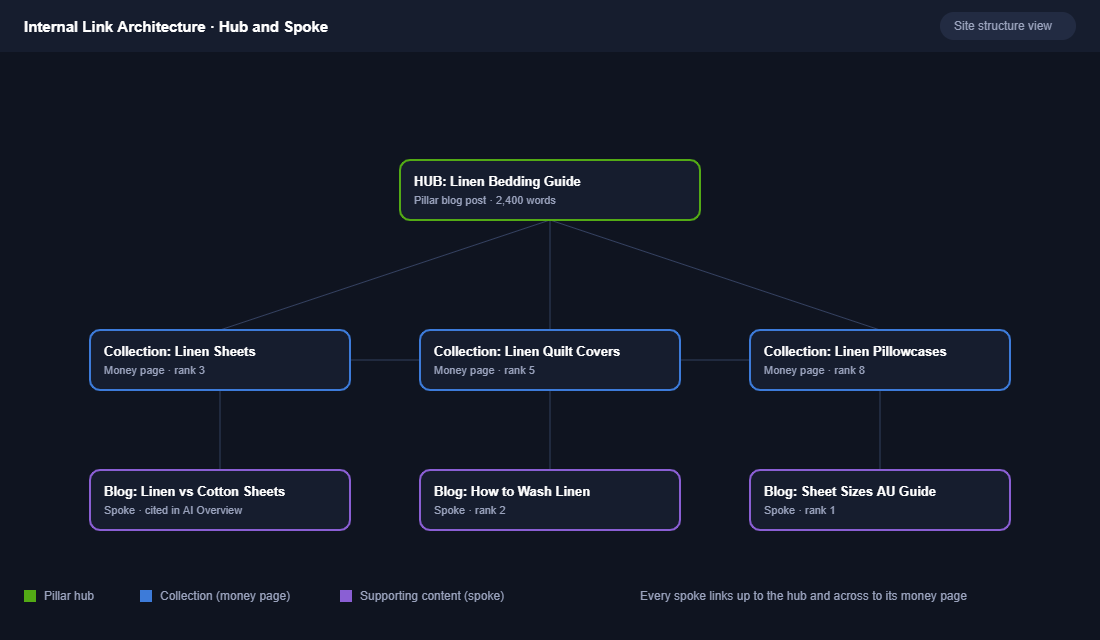
The hub is a genuinely comprehensive pillar guide for each core category: “The Complete Guide to Linen Bedding” at 2,000-plus words. The spokes are focused posts answering one question each: linen versus cotton, how to wash linen, Australian sheet sizes explained. Every spoke links up to the hub and across to the relevant collection. The hub links down to every spoke and out to the money pages.
Now the AI Overview adjustment. Since summaries answer the surface question, your content earns its click by being the source and by offering what a summary cannot:
- Answer first, then deepen. Put a clear, quotable 2 to 3 sentence answer directly under each heading. That is what gets cited, and cited brands earn about 35% more clicks.
- Add what machines cannot generate: your own product photography, real measurements, testing notes, Australian-specific advice (climate, sizing, shipping). First-hand experience is the moat.
- Convert the visit you do get. Every post carries links to relevant collections and an email capture. A researcher who joins your list is worth more than three anonymous pageviews.
Cadence matters less than coverage. Two good spokes a month, mapped against Part 2’s keyword list, beats a daily blog of filler.
Part 5: Earn Authority Signals Google Can Verify
Content and structure get you into the game. Authority decides the close ones. For an Australian DTC brand, the realistic authority levers are:
- Digital PR beats link buying. A data story, a founder comment for a journalist, a product in a “best of” roundup from an Australian publication is worth more than fifty directory links. Pitch seasonally: gift guides in October, EOFY stories in May.
- Supplier, stockist, and community links. If your products are stocked anywhere, made with someone’s materials, or support a local club or cause, there is a legitimate link waiting to be asked for.
- Reviews as trust infrastructure. Review volume and ratings feed your rich results and your credibility with AI systems deciding which sources to trust. Keep the collection engine running.
- Consistency of entity details. Same business name, same details, across your site, socials, Google Business Profile, and marketplaces. Boring, and it matters more each year as search systems reconcile who you are.
Measure It With Search Console (Free, 20 Minutes)
You do not need an expensive stack to run this playbook. Google Search Console is free and it is the source of truth. Set it up properly:
- Verify your domain at search.google.com/search-console using the DNS record option, so you capture every subdomain and protocol in one property.
- Submit your sitemap. Shopify generates it automatically at yourstore.com/sitemap.xml. Paste that into Sitemaps and submit.
- Check the Pages report for indexation problems: junk pages indexed, real pages excluded, canonical conflicts.
- Build a non-brand view. In Performance, filter queries to exclude your brand name. This is your real SEO scoreboard; brand traffic was coming anyway.
- Review monthly, not daily. Track non-brand clicks, your keyword map’s target rankings, and organic revenue in Shopify analytics. Judge the program on quarters, remembering the typical break-even is around 9 months.
The Mistakes That Keep Good Stores Invisible
After reviewing hundreds of Aussie Shopify stores, the same five SEO mistakes show up on almost every audit. Check yourself against each one honestly.
- Chasing volume over intent. Founders see 40,000 monthly searches for a broad term and ignore the 900-search buying keyword their collection could actually win. The smaller keyword pays for stock. The bigger one pays for nothing if you never crack page one.
- Rewriting the homepage every quarter and touching nothing else. Your homepage ranks for your brand name regardless. The compounding gains live in collections and content, which is exactly where nobody spends time.
- Deleting and recreating products and collections. Every delete throws away accumulated authority and creates a broken link. Merge, redirect, or repurpose instead. If you must remove a page, set a redirect to its closest sibling.
- Copying supplier descriptions. If forty stores carry your product with identical copy, Google has no reason to pick you. Rewriting your top 20 product descriptions in your own voice, with real details, is a weekend job with a years-long payoff.
- Quitting at month four. The break-even data says 9 months. Most stores abandon SEO right before the curve bends, then conclude it never works, then go back to renting every visitor.
The Australian Edge Most Stores Waste
Competing in the .com.au SERP gives you structural advantages over global players, if you actually use them.
Write for the local buyer. Australians search with local vocabulary: doona not duvet, thongs not flip flops, esky not cooler. Your copy should use the words your customers type, and your size guides should lead with Australian sizing and centimetres. Global competitors will not do this, and it shows in the SERP.
Make your Australian-ness explicit. Shipping times from a Melbourne warehouse, AUD pricing with GST included, local returns, and an ABN in the footer are all trust signals for both shoppers and search systems ranking results for Australian queries. A dedicated shipping page that answers “how long does delivery take within Australia” in plain language regularly outranks global giants for exactly the anxious pre-purchase searches that decide orders.
And lean into seasonal inversion. Northern-hemisphere content calendars run backwards for us. Their winter content peaks in December; your winter buying keywords peak in May and June with a fraction of the competition. Plan your content drops on the Australian calendar and you will routinely publish into open space.
How the Five Parts Compound
Clean foundations mean everything you build gets crawled, understood, and credited. The keyword map means every page you create has a defined job. Optimised collections turn rankings into revenue. The content engine builds the authority that lifts those collections, and catches tomorrow’s buyers while they research. External authority signals then tip the competitive queries your way, and Search Console tells you where to push next.
Paid traffic scales linearly with spend. This system compounds: the guide you publish in July is still sending buyers to your linen sheets collection in three years. That is the whole argument for doing the unglamorous work now, while your competitors are still refreshing their ROAS dashboards.
Structured Data: The SEO Job Your Shopify Theme Half-Finished
Almost every Shopify theme ships some structured data. Almost none of them ship it completely, and the gaps are exactly the fields that produce the rich results people actually click.
Start by finding out what you have. Run three of your product URLs through Google’s Rich Results Test and open the Enhancements reports in Search Console. You are looking for two things: errors that block a rich result entirely, and warnings for recommended fields you have left empty.
- Product schema: name, image, description, sku, brand, offers with price and priceCurrency set to AUD, and availability. The one most themes miss is aggregateRating, because it lives in your reviews app rather than the theme. Star ratings in the search result are worth having, so connect it.
- Shipping and returns in the offer: Google now surfaces delivery cost and return window directly in the shopping result. For an Aussie store competing against overseas sellers, “free delivery, 30 day returns” showing in the SERP is a genuine differentiator.
- BreadcrumbList: replaces the ugly URL string with a readable path. Cheap to add, and it lifts click-through on deep collection pages.
- Organization schema on your homepage: legal name, logo, sameAs links to your social profiles, and contact details. This is what search engines and AI assistants use to work out that your brand is a real entity rather than a dropshipper.
- FAQPage on collection and guide pages: use it where you genuinely answer questions, not as a keyword dump. Misused FAQ markup gets ignored at best and manually actioned at worst.
If your theme’s markup is incomplete, apps like Schema Plus or JSON-LD for SEO handle it for around AUD $20 to $30 a month, or a developer can patch the theme’s product template in an hour or two. Validate after every theme update, because theme updates quietly break schema more often than anything else on this list. The same discipline applies to the collection pages doing your heaviest ranking work.
The Pages You Should Never Let Google Index
Shopify generates a lot of URLs you never asked for, and every one of them competes with the pages you actually want ranking. This is the fastest technical win available to most stores, and it takes an afternoon.
Open the Pages report in Search Console and sort by indexed URLs. On a store with 300 products you might reasonably expect 400 to 600 indexed pages. If you are seeing 4,000, you have a crawl budget problem and Google is spending its time on junk instead of your money pages.
- Filtered and sorted collection URLs: anything with ?sort_by= or ?filter. These create near-infinite duplicate variations. Canonical them to the clean collection URL.
- The /collections/all path: a duplicate of your catalogue that competes with your real collections.
- Product URLs nested inside collections: Shopify can serve the same product at /products/x and /collections/y/products/x. Make sure the canonical always points at the clean /products/ URL.
- Tag pages: almost always thin duplicates. Noindex them unless you have deliberately built them into your keyword map.
- Search results, cart, account and checkout: zero search value, and they should never appear in the index.
- Empty or one-product collections: either merge them or noindex them. A collection page with a single product is a thin page by any definition.
Do the cleanup, resubmit your sitemap, then give it four to six weeks. What you typically see is not a ranking drop but a consolidation: fewer indexed pages, and the ones that remain climbing because authority is no longer spread across duplicates. Once the index is clean, the fixes in the product page SEO checklist and a consistent content engine compound far faster.
Your 90-Day SEO Sprint
- Days 1 to 14, foundations: Search Console verified, sitemap submitted, indexation cleaned, speed audit done, schema verified.
- Days 15 to 30, the map: keyword map built for every collection plus your top 20 question queries, gaps flagged as build decisions.
- Days 31 to 60, money pages: top 10 collections upgraded with titles, intro copy, FAQs, and internal links.
- Days 61 to 90, the engine: first pillar hub published, first 4 spokes live, each linking to its money page. One digital PR pitch sent.
- Day 90, review: non-brand clicks versus day 1, target keyword movement, and the next quarter’s build list.
The Benchmarks That Tell You SEO Is Working (And When to Worry)
SEO is the channel founders quit six weeks before it starts paying. The reason is almost always that nobody agreed up front what progress looks like. Here are the numbers to hold it to.
- Impressions move first, clicks follow. Expect impression growth in Search Console within 4 to 8 weeks of publishing or fixing a page. Clicks typically lag by another 4 to 12 weeks. If impressions are flat after two months, the problem is relevance or indexation, not patience.
- Click-through rate by position. Position 1 averages roughly 27% CTR, position 3 around 11%, and position 10 about 2.5%. That is why moving a page from 8 to 4 is worth far more than moving one from 40 to 25.
- Organic conversion rate. Non-brand organic traffic usually converts at 0.5% to 2% on Aussie DTC stores. Brand organic converts at 3% to 8%. If you report them together, brand traffic hides the fact that your non-brand pages are not earning.
- Indexation ratio. Pages indexed divided by pages submitted in your sitemap. Below 70% means Google is actively choosing not to index a third of your site, and you should find out why before publishing anything new.
- Time to first ranking. A new collection page on an established domain typically enters the top 100 within 2 to 4 weeks and finds its real position by month three.
Set a review date at 90 days and another at 180. Judging SEO monthly produces panic decisions and a lot of half-finished content.
The Internal Link Audit You Can Run in Twenty Minutes
Internal linking is the highest-return SEO work most stores never do, because it needs no new content and no outreach. You are just telling Google which of your pages matter.
Crawl your site with Screaming Frog, which is free up to 500 URLs and covers most Shopify catalogues. Export the internal links report and sort by inlink count. You are looking for two things: money pages with fewer than three internal links pointing at them, and blog posts with zero links pointing out to a collection or product page.
The rule of thumb is that every commercial page should have at least three to five internal links from relevant content, and every blog post should link to at least two commercial pages using descriptive anchor text. Not “click here”. Not “read more”. The words someone would actually search. Your collection pages are usually the biggest winners here, because they are the pages with commercial intent and the pages Shopify themes link to least.
Do this once a quarter and it takes twenty minutes. Skip it for a year and you end up with a catalogue of orphan pages Google has quietly stopped caring about.
What Actually Changes When AI Overviews Take the Top of the Page
The practical shift is that informational queries increasingly get answered on the results page, so the traffic that survives is the traffic with intent behind it. Transactional and comparison queries, the ones with “buy”, “best”, “vs”, “near me” or a product spec attached, still send clicks.
Three things follow from that. Weight your keyword mapping toward commercial intent rather than top-of-funnel volume. Make sure your product and collection markup is clean, because AI answers pull from structured data and citations far more readily than from prose. And build the assets AI cannot synthesise: your own test results, your own photography, your own customer numbers, your own opinion. Generic advice is the first thing to get absorbed and the last thing to get cited.
Inside eCommerce Circle, owned traffic is one of the core Promotion levers we work on with every member, precisely because it is the channel no ad platform can reprice overnight. If you want a second set of eyes on where your store’s organic opportunity actually sits, let’s talk.