You did $58k in sales last month. You should feel unstoppable. Instead you were on the warehouse floor at 9pm assembling orders, and at 11pm you were still tapping out “hi, so sorry, your parcel is on its way” replies on your phone in bed. The business grew. Your life did not.
What’s in This Article
Here is the trap almost every Aussie Shopify founder falls into. You tell yourself you will hire help “once things settle down” or “once we can afford it”. So you keep personally doing tasks worth about $8 an hour while the $500-an-hour work (better offers, product strategy, supplier deals) never gets touched. The store plateaus, and you quietly blame the market.
The data is brutal on this. Gallup studied 143 Inc. 500 CEOs and found the founders with strong delegation habits posted an average three-year growth rate of 1,751%, a full 112 percentage points ahead of the low delegators, and pulled 33% more revenue. Yet only one in four founders delegate well. Meanwhile the average small business owner burns around 16 hours every week on admin. This playbook is how you get those hours back by hiring, vetting and onboarding a virtual assistant properly, not just tossing tasks over a fence and hoping.
The Real Reason You Are Still Doing $8 Tasks
It is not money. A capable virtual assistant costs less than most founders spend on takeaway and rideshares in a month. The real reason is that handing work off feels slower than doing it yourself. “It is quicker if I just do it” is true for exactly one week, then it costs you every week after that forever.
There is also a control reflex. You built this thing from nothing, so trusting a stranger with your customer inbox or your Shopify admin feels risky. Fair. The fix is not to avoid hiring. The fix is a hiring system that filters hard, tests before it trusts, and manages with numbers instead of hope.
Think about what your hourly rate actually needs to be. If you want a business that pays you $250k a year and runs on a 40-hour week, your time is worth roughly $120 an hour. Every hour you spend uploading products, chasing tracking numbers or scheduling Instagram is an hour billed at $120 to do $8 work. You are the most expensive junior staffer your store has ever had.
Why Aussie Founders Have an Unfair Advantage Hiring Offshore
Most founders picture a VA as a random freelancer in a different hemisphere who logs on while you sleep. For Australian stores, the geography is far kinder than that. The Philippines runs just two hours behind AEST, so a Manila-based VA working 9 to 5 their time overlaps almost your entire working day. Real-time replies, not next-day ping pong.
The cost gap is the other half of the advantage. A skilled Filipino ecommerce VA typically runs between AUD 5 and AUD 12 an hour, or roughly AUD 1,200 to AUD 3,600 a month for a full-timer, according to current Philippines VA rate guides. A local Australian admin doing the same tasks lands closer to AUD 35 an hour once you add super and on-costs. Same output, a quarter of the price, and you free a full-timer rather than renting a few scattered hours.
The Philippines also has a deep, English-fluent talent pool that already knows the tools you run. Shopify, Klaviyo, Gorgias, Canva and Meta Ads Manager are standard skills there, not exotic ones. You are not training someone from scratch. You are hiring someone who has already run a store like yours for another founder.
Decide What to Hand Off First (Before You Hire Anyone)
The single biggest mistake is hiring a VA and then figuring out what they will do. You end up paying someone to sit idle while you scramble to invent tasks, and within a month you decide “VAs do not work”. The order is reversed. You define the role first, then hire to it.
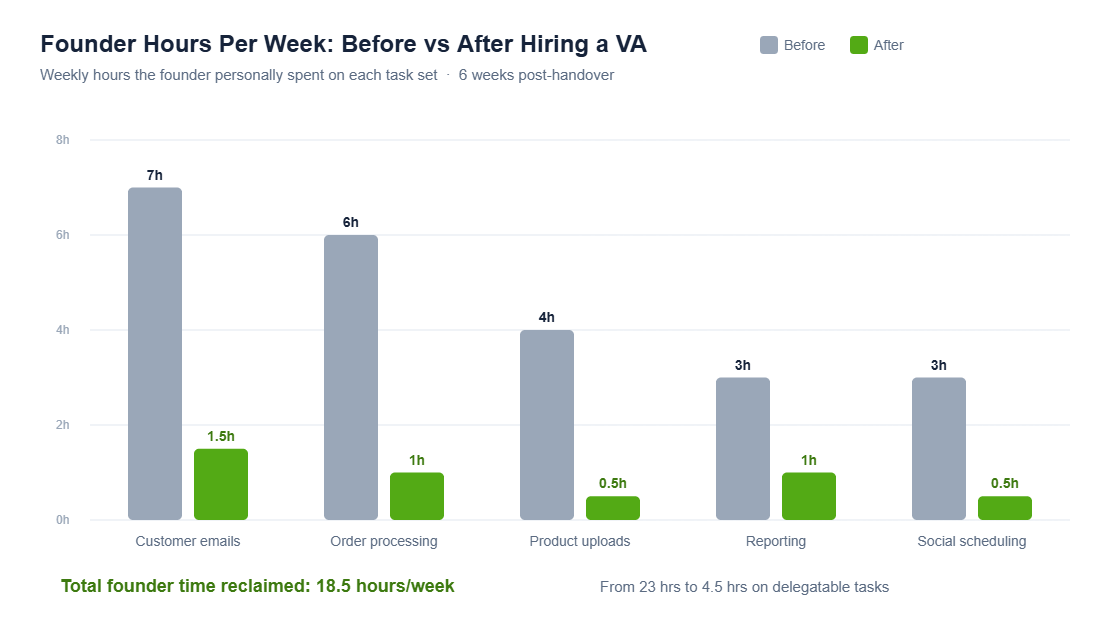
Spend one week tracking every task you touch. Beside each, write the value: is this $8 work or $120 work? The $8 pile is your VA’s job description. For most stores that first list looks like this:
- Customer support. Answering “where is my order”, processing returns and refunds, handling sizing and product questions in Gorgias or your Shopify inbox.
- Order and fulfilment admin. Checking orders flagged for fraud, fixing address errors, chasing tracking with the courier, updating customers.
- Product and content operations. Uploading new products, writing baseline descriptions, resizing images in Canva, building collections.
- Reporting and scheduling. Pulling a weekly sales snapshot, scheduling social posts, loading email campaigns into Klaviyo.
If you have already read our First Hire Playbook, this is the practical layer beneath it: not just which role to hire, but the exact task list that role owns from day one. Pair it with the Delegation Playbook to decide what stays with you. Customer support is almost always the right first handover, because it is high-volume, low-judgement and directly protects revenue.
Where to Actually Find a Great VA
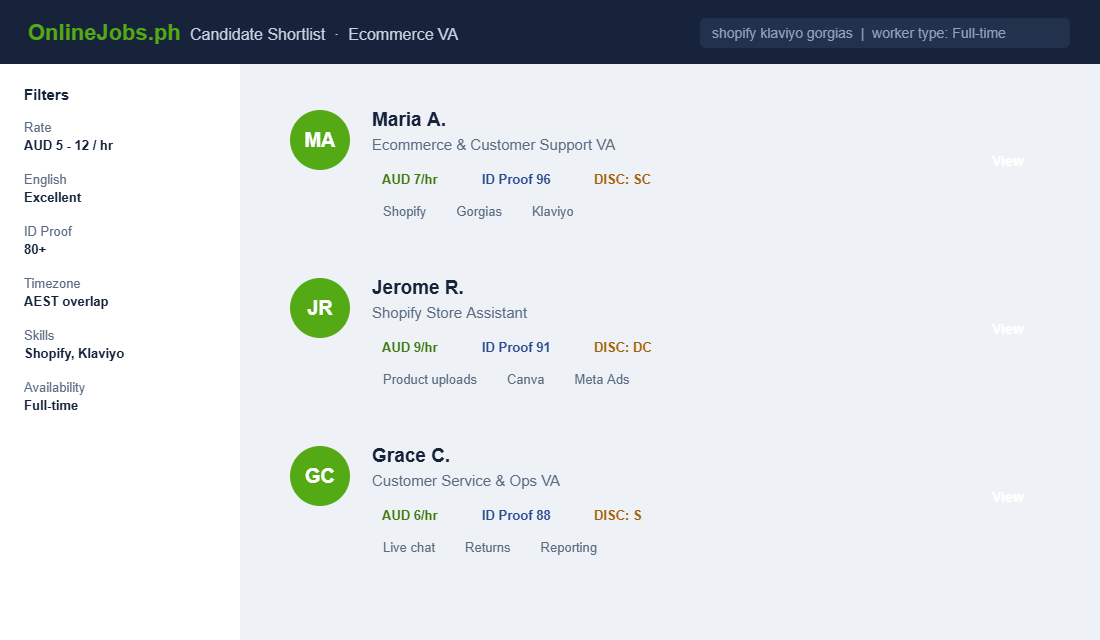
Skip the expensive done-for-you agencies for your first hire. They mark up the same talent you can reach directly. The best-known direct marketplace is OnlineJobs.ph, which lists more than 5 million Filipino worker profiles and where employers commonly get applicants within 24 hours of posting. You hire and pay the person directly, with no per-hour middleman cut.
Here is the setup, step by step:
- Create an employer account and take the paid plan for one month. It is around AUD 100 and it opens up direct messaging and worker contact details. Cancel after you hire. This one cost pays for itself in the first week of reclaimed time.
- Post a job, do not just search. Posting lets the right people self-select toward you. Set worker type to full-time and salary in a clear range so you only attract people in your budget.
- Filter by ID Proof score and English rating. Prioritise profiles with an ID Proof of 80-plus and excellent written English. This screens out the low-effort applicants instantly.
- Set up Timeproof or a simple time tracker so hours are visible from day one, and plan to pay via Wise or Payoneer, which are the cleanest ways to send AUD to the Philippines.
Post your role on a Monday morning your time. You will typically have a healthy stack of applicants by Tuesday and can start shortlisting the same week.
The Job Post That Filters Out 90% of Applicants
Your job post is a filter, not a brochure. A generic “seeking hardworking VA” ad attracts hundreds of copy-paste applications you have to wade through. A specific ad repels the wrong people and pulls the right ones. Name the tools. Name the tasks. Name the store type.
Then plant a screening instruction inside the post. A simple one works best: ask applicants to start their reply with a specific word, or to answer one question, like “what is the first thing you would check when a customer says their order has not arrived?”. Anyone who ignores the instruction has not read the post, and you delete them without a second thought. This single trick cuts your review pile by more than half in minutes.
Keep the post honest about the work. If it is customer support and product uploads, say so. Overselling the role as “growth marketing” to attract talent just means your new hire is disappointed and gone in a month. The goal is the right person who wants exactly this job, not the most impressive person who wanted a different one.
The Paid Test Task (Never Hire Off an Interview Alone)
Interviews measure how well someone interviews. They tell you almost nothing about whether the person can actually clear a support queue or upload a product without breaking your theme. So do not hire off a chat. Hire off work.
Shortlist your top three or four applicants and pay each of them for a small, real test task. Something like: “Here are five sample customer emails, draft replies in our brand tone” or “here is a product with images and specs, create the Shopify listing”. Pay them their hourly rate for it. It costs you maybe AUD 30 per candidate and it is the most valuable AUD 90 you will spend all quarter.
Watch three things. Quality of the actual output. How closely they followed the brief. And how they communicate when something is unclear, do they guess silently or ask a sharp question? The person who asks the smart clarifying question is usually your hire. Speed matters less than judgement, because speed comes with reps and judgement mostly does not.
Onboard Properly in the First Two Weeks
A VA fails or flies based on their first fortnight. Drop someone into your store with no structure and they will either freeze or improvise in ways you do not want. The antidote is boring and effective: record everything once, so you never explain it twice.
Use Loom to screen-record yourself doing each core task at normal speed while narrating. Processing a return. Uploading a product. Replying to the three most common customer questions. Ten to fifteen short videos covers most of the role. Drop them into a simple Google Doc or Notion page and you have an instant training library. This is the raw material for the systems in our SOP Playbook, and your VA can turn your Looms into written SOPs as one of their first tasks, which doubles as a comprehension test.
Structure the ramp. Week one is shadowing and small supervised tasks. Week two they own a slice of the real workload with you reviewing everything. By week three or four they should be running their task list independently while you check outputs, not steps. Do a quick daily 10-minute check-in for the first fortnight, then taper to weekly.
Manage With a Weekly Scorecard, Not Vibes
“How is the VA going?” answered by gut feel is how good hires quietly drift and bad ones hide. Replace the vibe with a one-page weekly scorecard. Five to eight numbers that show, at a glance, whether the role is being done to standard.
For a support-and-ops VA that scorecard tracks things like tickets resolved, average first-response time, orders processed on time, products uploaded, and reviews requested. Set a target for each, record the actual weekly, and mark it green or amber. Ten minutes on a Friday tells you everything.
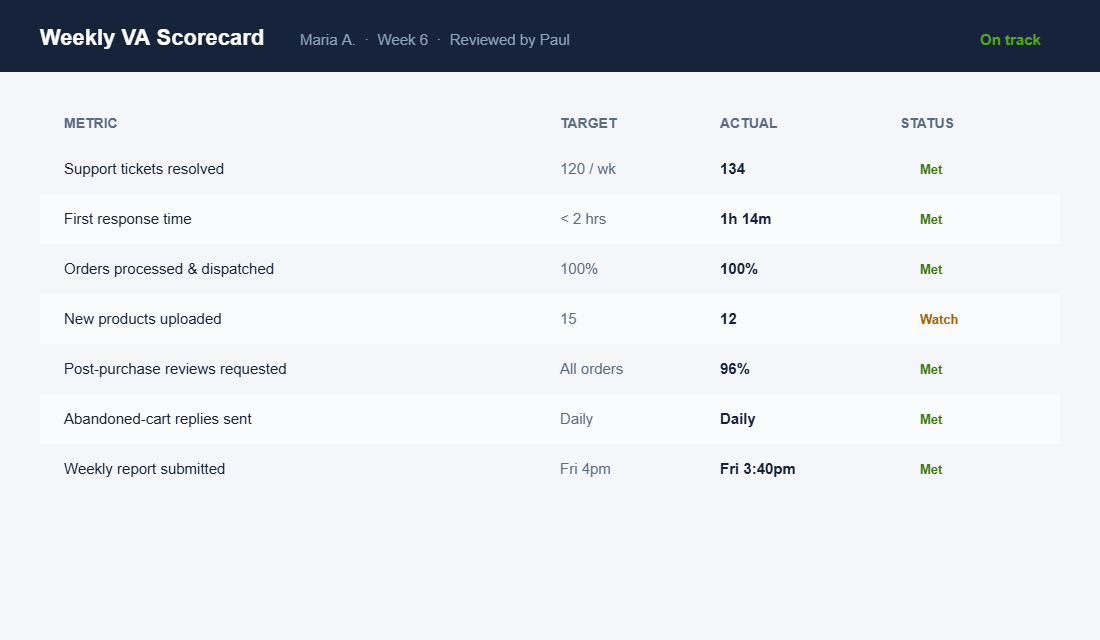
The scorecard does three jobs at once. It shows you the role is handled so you can actually let go. It gives your VA a clear definition of a great week, which most remote workers never get and quietly crave. And it surfaces problems while they are small, an amber cell in week three is a coaching chat, not a crisis in week ten.
Four Ways Founders Break the VA Relationship
Most VA hires that fail do not fail because the person was wrong. They fail because the founder made one of the same four mistakes. Knowing them ahead of time is half the battle.
- Vague instructions, then frustration. “Just handle the inbox” is not a brief. Your VA cannot read your mind on refund limits or tone. Give decision rules: refund without asking under $50, escalate anything over, always reply within two hours. Clarity up front prevents the resentment that builds when someone guesses wrong.
- No feedback for three weeks, then a blow-up. Silence reads as approval. If you let small errors slide because you feel awkward correcting someone, they compound until you are quietly furious over things the VA never knew were wrong. Short, specific, weekly feedback keeps the relationship healthy.
- Underpaying to save $2 an hour. Hiring the cheapest applicant to save AUD 2 an hour is a false economy. You churn through hires, retrain constantly, and lose far more in lost time than you ever saved. Pay a fair rate for the skill and keep good people for years.
- Dumping tasks without owning outcomes. Handing over work is not the same as handing over responsibility. Assign the outcome, not just the task list, so your VA owns “the support queue is clear by 5pm” rather than “reply to emails”. Ownership is what lets you finally stop checking.
Treat your VA like the professional teammate they are, not a task-dumping ground, and a great one will stay with you for years. Retention is its own advantage, because an experienced VA who knows your store, your customers and your suppliers is worth several new ones.
Hand Over the Keys Without Handing Over the Business
Here is the step almost every founder skips in week one, usually because they are in a hurry to get value out of the hire. They send the VA their own Shopify login. Sometimes their Klaviyo password. Occasionally the bank feed. It feels efficient for about four months, right up until the day the relationship ends or a laptop gets compromised, and then it is the most expensive shortcut in the business.
Set access up properly on day one and it takes 40 minutes. Retrofitting it after something goes wrong takes a fortnight.
- Individual staff accounts, never shared logins. Shopify lets you create a staff account with granular permissions. Give your VA their own, tied to their own email, so every action is attributable and revoking access is one click rather than a password reset cascade across nine tools.
- Least privilege, always. A VA doing customer service needs Orders and Customers. They do not need Finances, Apps, or Settings. A VA doing product uploads needs Products. They do not need the payout screen. Start narrow and widen on request, because the reverse conversation is awkward and rarely happens.
- Share credentials through a password manager, not a message. 1Password and Bitwarden both have shared vaults with per-item access. Passwords sent over Slack, WhatsApp or email live forever in a chat history you do not control.
- Two-factor on their account too, using an authenticator app. Your VA’s account is a door into your store. Treat it with the same standard as your own, and avoid SMS-based codes where the number sits on an overseas carrier you cannot verify.
- Never hand over the owner account, the domain registrar, or the payment processor. These three are the business. If a VA needs something inside them, you do it on a screenshare.
- Write the offboarding checklist before you need it. One document listing every tool the VA can reach, so that closing access takes ten minutes on a Friday rather than a nagging six-week suspicion that you forgot one.
Diarise a quarterly access review. Fifteen minutes, once a quarter, opening every tool and confirming the permission list still matches who actually works here. Permissions accumulate silently, and a store with three former contractors still holding live access is exactly the single point of failure the disaster recovery playbook is written to eliminate.
The 90-Day Progression Plan: From Task Doer to Function Owner
The founders who get 15 hours a week back are not the ones who found a better VA. They are the ones who kept promoting the role. A VA who is still executing the same six tasks in month nine that they were handed in week two is a VA you have capped, and capped roles are the ones that get bored and leave.
Days 1 to 30: execute to a script. Narrow, highly documented, high-frequency work. Order tracking enquiries, product uploads, review requests, inbox triage against a decision tree you wrote. Success is measured on accuracy and turnaround, nothing else. Every task they complete becomes a loom video or a written SOP, which means month one is quietly building your operations manual as a by-product. The SOP guide covers how to capture those properly instead of ending up with 40 unlabelled videos.
Days 31 to 60: own the outcome, not the task. Shift the framing from “reply to support tickets” to “keep first response time under 4 hours and CSAT above 90%”. You stop assigning work and start reviewing a number. This is the transition most founders never make, and it is the one that actually buys the hours back, because you are no longer the queue that work flows through.
Days 61 to 90: improve the system. Ask them to bring one process improvement a fortnight. They see the friction you stopped noticing eighteen months ago, and a VA who has answered 900 tickets knows exactly which product page is causing them. Give them a small budget of hours to fix things rather than only to do things.
Pay should follow the progression, not lag it by a year. A 10 to 15% increase at the six-month mark for someone who has moved from executing to owning is cheap against the cost of rehiring and retraining, which realistically runs 40 to 60 hours of your own time. Structure the review the same way you would for any other team member, using the framework in the performance review playbook, and lean on the 30-60-90 onboarding framework to set the first three months up before day one rather than during it.
The Compound Effect: What 15 Hours a Week Actually Buys You
Fifteen hours does not sound life-changing until you compound it. That is roughly 65 hours a month, or about 780 hours a year, an entire extra working quarter handed back to you. The question is what you point that time at.
If you pour it back into $8 tasks, nothing changes and you have just moved the busywork around. The founders who win redeploy every reclaimed hour into the $120 work only they can do: sharpening offers, negotiating better supplier terms, building the email flows that lift lifetime value, planning the next product line. That is exactly the pattern behind Gallup’s delegation number. The growth did not come from working more hours. It came from spending the same hours on higher-value work.
There is a compounding people effect too. Your first great VA becomes the person who helps you hire and train the second. You build the muscle of hiring, onboarding and managing remotely, and that muscle is what turns a founder-dependent store into a business that runs whether or not you are packing boxes tonight.
Your VA Hiring Checklist
Run this in order. Do not skip the test task, and do not hire before you have defined the role.
- Track your week. Log every task and tag it $8 or $120. The $8 pile is the role.
- Write the role, then the ad. Name the tools, tasks and store type. Plant a screening instruction to filter non-readers.
- Post on OnlineJobs.ph Monday morning. Full-time, clear AUD range, filter for ID Proof 80-plus and excellent English.
- Pay for a real test task. Shortlist three or four, pay each for a genuine sample of the work, hire on output and judgement.
- Onboard with Loom. Record 10 to 15 task videos, have the VA convert them to SOPs, ramp over two weeks from shadow to owner.
- Manage with a scorecard. Five to eight weekly numbers with targets, reviewed every Friday. Green, amber, coach.
- Redeploy your hours into $120 work. Protect the reclaimed time. That is the entire point.
Inside eCommerce Circle, buying back founder time and building a team that runs the store without you is one of the core pillars we work on with every member. If you want a second opinion on what to hand off first and who to hire, let’s talk.