Most Aussie Shopify founders treat their factory like the electricity company. You get a quote, you accept the quote, you pay the invoice, and you move on. The number on the line item feels fixed. It feels like a law of physics.
What’s in This Article
It is not. It is a starting position.
The factory that quoted you $4.20 a unit has a target margin built in. They have softer tiers at 2x and 5x your current volume. They have payment terms they will move on, packaging costs they will absorb, and freight clauses they wrote knowing they would never be challenged. The brands hitting 65 to 70% gross margin in 2026 are not buying better products than you. They are running a smarter supplier game.
Here is the maths that should hurt: the median DTC gross margin in 2026 is 57% across public SEC filings, with the bottom quartile sitting at just 46%. A 5% landed cost reduction on a product with 35% COGS adds 1.75 percentage points directly to your gross margin line. On a $2M brand, that is $35,000 a year, dropping straight to contribution. No new ads. No new SKUs. No new staff. Just a different conversation with the people you are already paying.
The catch is that most founders try to negotiate the wrong lever. They go straight at unit price, lose the relationship, and walk away with a 2% concession that the factory makes back on the next freight invoice. The Aussie operators we work with at eCommerce Circle pull five levers in sequence. Done properly, the compound effect is an 8 to 15% reduction in true landed cost across the year, without a single phone call going sideways.
This is the playbook.
Why Supplier Negotiation Is the Highest-Return Hour of Your Month
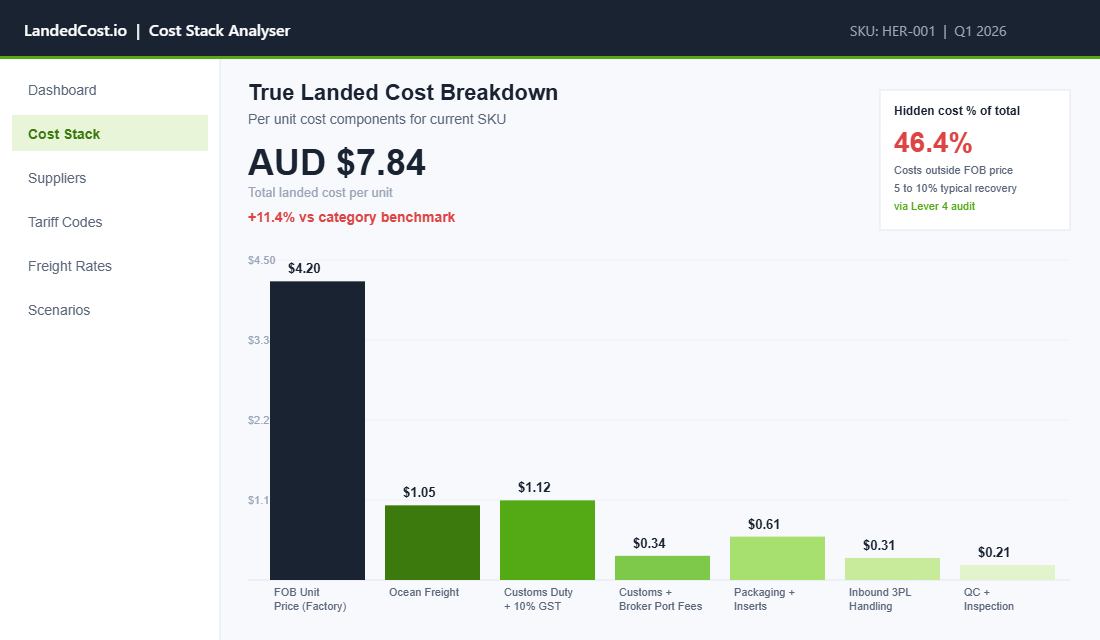
Before we get into the five levers, let me reset what we are actually negotiating. Most founders think the conversation is about price. It is not. It is about the entire cost-of-goods stack, plus the cash-flow timing around it.
The components that sit inside your true landed cost:
- Factory unit price (the FOB number on the quote)
- Freight and insurance (ocean, air, inland)
- Duties and GST (10% GST on landed value into Australia)
- Customs brokerage and port charges
- Inbound handling and 3PL receiving fees
- Packaging and inserts (often quoted separately)
- QC and inspection (third-party or factory self-cert)
- Sample and tooling costs
- Payment terms (deposit timing, balance, credit)
A founder we worked with last year was certain his factory had given him their best price. He had ground them down on unit cost three quarters in a row. Margin had moved by 1.4 points. When we walked through the rest of the stack, we found packaging that was being cross-charged at 22% above market, freight he was paying in full while a competitor on the same vessel was on collect terms, and a deposit structure that was eating six weeks of cash flow every quarter. Total saving across the stack: 11.4% on true landed cost. The factory never had to drop their FOB number further.
That is what good supplier negotiation looks like in 2026. You stop hammering the one lever you can see and start working the four you cannot.
The other piece most founders ignore is DPO, days payable outstanding. The median DPO for public DTC and CPG brands is 36 days. Leading brands sit at 60 to 70 days. A 10-day improvement in DPO is functionally identical, from a cash perspective, to a 10-day improvement in days inventory outstanding. But DPO is almost always the cheaper one to negotiate. You are not paying for warehouse space or marking down stock. You are just asking your factory to wait longer for money you were going to send them anyway.
If you want the full picture of how COGS feeds margin, our Shopify Contribution Margin Audit walks through where most Aussie founders are leaving $30K to $100K of hidden profit on the table every year. The supplier conversation is one of the biggest levers inside that audit.
Lever 1: The Tiered Volume Quote (Not a Price Cut)
Almost every Aussie founder asks the wrong opening question. They ask “can you do better on the unit price?”. The factory says no, or maybe drops 1 to 2% to feel like they gave you something, and you both move on.
The right opening question is: “What does your tiering look like at 2x and 5x my current order?”
This works for three reasons. First, it does not threaten the relationship. You are not asking them to lose money. You are asking them what the menu looks like at higher volumes. Second, it reveals their cost structure. The drop from 1x to 5x volume tells you exactly where their break-even sits. Third, it sets up a future move. Even if you cannot place a 5x order today, you now know what the unit looks like at scale, and you have anchored their willingness to discount.
Most suppliers offer tiered pricing at 2x and 5x minimum order quantities, but only if you ask. The discount typically lands between 4 and 12% depending on category, with consumables and apparel at the higher end and electronics or technical goods at the lower end.
The Aussie founders we coach run this play in three steps:
- Ask for the full tier table in writing. Get the unit price at 1x, 2x, 3x, and 5x your current MOQ. This is data you keep on file for every supplier.
- Calculate the breakeven SKU velocity. If a 2x order saves you 6% per unit but adds three months of stock-on-hand, your inventory carrying cost (which runs 20 to 30% of inventory value annually in DTC) probably wipes out the saving. Run the maths before you commit.
- Lock the tier on a written commitment, not a single PO. This is the big move. If you can credibly forecast 2x volume over the next 12 months, ask for the 2x unit price now, paid against the next four POs. Suppliers say yes to this far more often than founders expect.
The reason this works is risk shifting. The supplier is not giving you a discount today. They are pricing in volume they have predictability on. From their seat, a written 12-month commitment is more valuable than a single bigger order, because it lets them plan capacity. Research shows that a written commitment for 3 to 5 recurring orders can reduce MOQ by 25 to 40% on its own, which means the tier-locking play also opens up smaller order sizes for SKU variants you are still testing.
Lever 2: The Payment Terms Move (Pull Your DPO From 14 to 45 Days)
This is the single most under-used lever in Aussie DTC, and it is also the cheapest concession a factory can give you. Most founders pay 30% deposit on order, 70% on delivery, balance due before bill of lading release. Some pay 50/50. A handful are still paying 100% upfront because the factory pushed them there in year one and they never renegotiated.
The benchmark you want to hit is Net 30 from bill of lading on the balance, with a deposit of 20 to 30%.
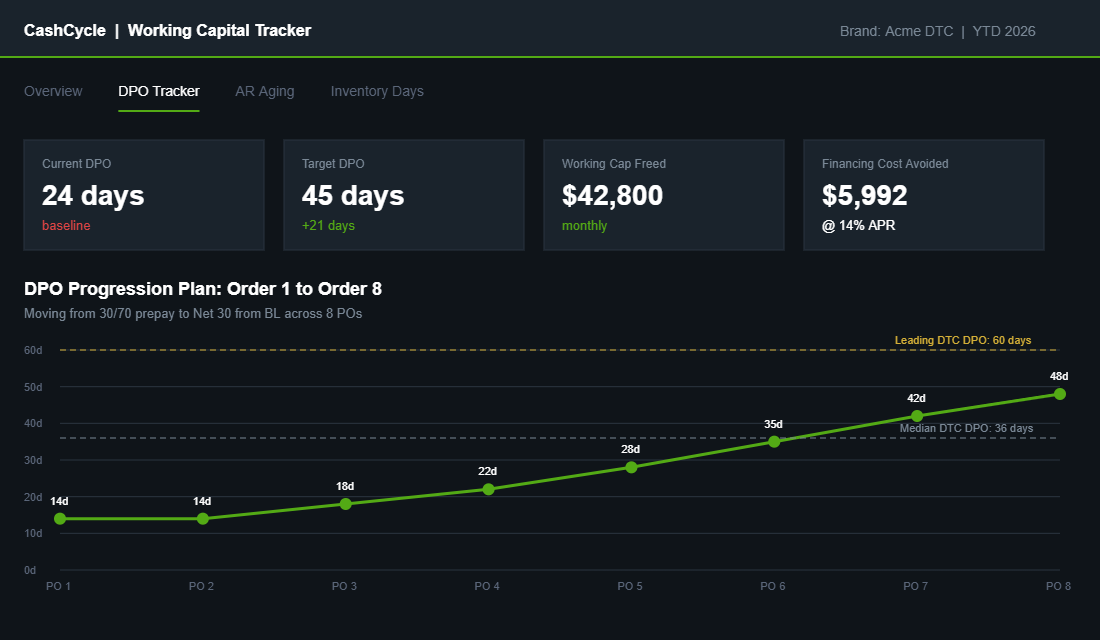
The cash impact is enormous. If you order $80,000 of stock with 30/70 payment up front, you have $80,000 out the door before a single unit is sold. If you move to 20/80 with the 80% on Net 30 from BL, you keep $64,000 in your account for an extra six to eight weeks. Across four orders a year, that is roughly $250K of working capital you are not asking the bank or Wayflyer to lend you at 14 to 18% APR. The arithmetic, in 2026 interest-rate terms, is the same as buying back $35K to $45K of margin a year.
Here is the catch. You cannot ask for Net 30 on the first order. Suppliers will not extend terms to a brand they have not shipped with at least three times. The sequence we coach is:
- Order 1 to 3: standard 30/70, but log every payment as cleared funds on day of invoice, not day of due date. You are building a payment history file. Ask the factory to sign a simple receipt of clean payment after each PO.
- Order 4 to 6: ask for 20/80 with the balance moved to “Net 14 from BL”. You are signalling intent without scaring the factory.
- Order 7+: push to Net 30 or Net 45 from BL. By this point you have a three-shipment track record. If the factory still says no, you have the data to take the conversation to a second supplier (more on that under Lever 5).
Public DTC brands that improve DPO from a sub-25-day baseline typically gain 8 to 15 days inside the first two quarters of running this play. At median, those brands are now at 36 days. Leading brands sit at 60 to 70 days, and they got there by negotiating exactly this lever.
One framing that works disarmingly well with Asian factories: position the request as a banking constraint, not a margin grab. “Our Australian bank requires a 30-day payment buffer on import goods to release additional working capital. Can we move the balance to Net 30 from BL on this PO?” You are giving them a face-saving “yes”. They are not giving in to negotiation pressure, they are accommodating a banking requirement. Founders we coach have moved DPO 20+ days in a single conversation using this exact language.
Lever 3: The MOQ Flexibility Trade
The third lever is the one that hurts cash flow the most when you get it wrong. MOQs that are too high turn your store into a warehouse. MOQs that are too low push your unit cost up. The win is moving the supplier off their stated MOQ without losing the unit price, or paying a small unit price premium to halve your cash exposure on stock.
Three plays inside this lever:
The bundle MOQ play. Most suppliers will let you bundle multiple SKUs to hit total quantity, while you get the per-SKU variety. If the stated MOQ is 1,000 units but you only need 400 of SKU A, 400 of SKU B, and 200 of SKU C, the factory will often run all three on a single production line as one combined PO. You need to ask. The default answer in the quote will always be the higher per-SKU MOQ.
The mold-fee swap. For custom products, offer to pay the tooling or mold cost separately. This covers the supplier’s fixed cost, which is the real reason they set the MOQ in the first place, and lets you order in smaller quantities. The mold fee can sometimes be credited back against future orders once cumulative volume hits a defined threshold, usually 5,000 to 10,000 units. The Aussie founder we worked with on a custom bottle SKU used this exact play to drop her first PO from 5,000 units to 750.
The written commitment trade. This is the most powerful and the most overlooked. Provide the supplier with a signed commitment for 3 to 5 recurring orders over 12 months at a forecast quantity. In exchange, ask for either lower MOQ on individual POs (typical: 25 to 40% reduction) or unit pricing held at the higher tier you have committed to.
Who Gives a Crap built their supply structure on this principle. The Aussie unicorn locks ~85% of its supply via long-term contracts with manufacturers in China and SE Asia, mainly Sichuan Province, which gives them stable pricing on a volatile pulp market and gives the factory predictable capacity planning. The pricing benefit is structural, not transactional.
The trap to avoid: do not ask for low MOQ AND low unit price AND extended payment terms on the same call. You will get a polite no on all three. Pick the lever that matters most for your stage. If you are pre-product-market-fit, prioritise MOQ flexibility. If you are scaling, prioritise unit price and payment terms.
Lever 4: The Invisible Cost Audit (Where Most of the Margin Hides)
This is the lever that has the biggest impact and the lowest awareness. Founders get fixated on the FOB price and ignore the fact that freight, duties, packaging, QC, and handling typically add 18 to 32% on top of that number to get to true landed cost. Most operators only track the factory invoice. They miss the fact that “invisible” costs can add 5 to 10% on top of quoted FOB pricing.
Here is the audit you should run on every supplier, every quarter:
Freight. Compare your current freight cost per cubic metre against the live rate on Freightos or a quote from Flexport, Shopify’s preferred freight forwarding partner. If your factory or freight forwarder is charging more than 12 to 18% above the live marketplace rate, you have an immediate concession on the table. The conversation is not adversarial. It is “we are using Freightos as our benchmark. Can you match within 8%, or do we need to move volume to a different forwarder?”
Duties and tariff codes. A surprising number of Aussie importers get their tariff codes wrong, which means either overpaying duty or risking ABF audit penalties. A licensed customs broker review of your top 10 SKU tariff codes will often find one or two miscoded items where the duty rate is 5 to 10% lower than what you are paying. This is one of the highest ROI hours you will spend all year.
Packaging cross-charges. Factories almost always quote inserts, polybags, and custom boxes at a markup. Get a separate quote from a packaging-only supplier and benchmark. Where the factory is more than 20% above market, ask them to match. If they refuse, switch to a separate packaging supplier and have the factory pack-out the product on arrival of the materials.
QC and inspection. If you are paying for factory self-cert and getting defect rates above 1.5%, the cost of switching to a third-party inspection at $300 to $500 per visit is almost always positive. Companies like AsiaInspection and QIMA price per inspection and you can lock 95% AQL standards. Defect rates dropping from 4% to 0.8% on a $80K order is a $2,500+ recovery on the back of a $400 inspection bill.
Sample fees. Every supplier will tell you sample fees are non-refundable. Most will refund them against the first production PO. Ask. The cost of asking is one polite email.
When you stack these five sub-levers, you typically find 3 to 7% of true landed cost that was hiding in plain sight. None of it requires the factory to drop their unit price. Most of it is fixing your own ignorance of what good looks like.
For founders running the full supply chain audit, our Shopify Supplier Risk Playbook covers the diversification side: how to make sure no single supplier is more than 40% of your supply, and how to audit them annually for financial, geographic, and quality risk.
Lever 5: The Relationship Capital Account
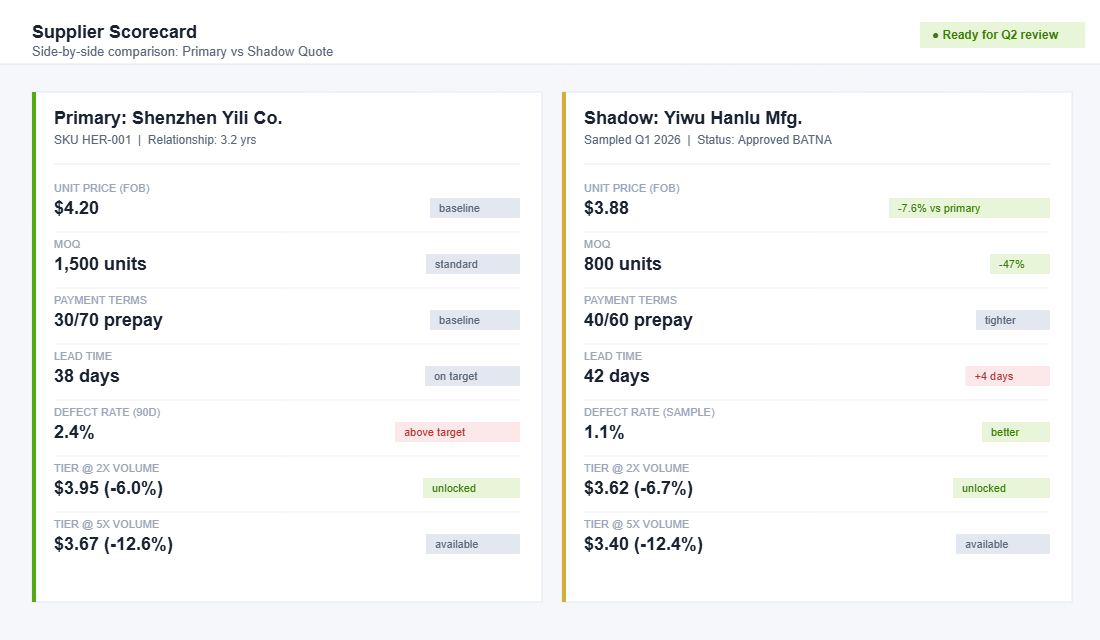
The fifth lever is the one that compounds across years, and it is the one most Aussie founders forget exists. You are not negotiating a single PO. You are running a relationship that you want to be cheaper and more flexible in year three than it was in year one.
Three moves inside this lever:
The visit. Going to the factory in person, once a year, is worth more than 20 emails. Suppliers price relationships with people they have met higher than relationships with people they have not. The trip cost (typically AUD $3,000 to $5,000 for a week in Shenzhen or Yiwu) pays for itself many times over in better terms, better priority on your POs, and earlier access to capacity in peak periods.
The second supplier. Always have a credible alternative. Not necessarily in production, but quoted and sampled, with a BATNA price you can reference. BATNA, or best alternative to a negotiated agreement, is the single most powerful tool you have in any commercial conversation. When your primary factory knows you have a second factory at 8% lower cost on similar quality, your unit price magically becomes more flexible at renewal. The Aussie founders we coach maintain a “shadow quote” file: a second supplier on every major SKU, sampled and benchmarked at least every 12 months.
The forecast share. Most factories work blind. They get POs when you place them and have no visibility into your demand. Sharing a rolling 12-week forecast, even if it is non-binding, dramatically changes how they treat you. They reserve capacity for you. They give you first call when raw material prices drop. They tell you 4 weeks ahead of time when their costs are going up. Forecast-sharing is the single biggest signal you can send that you are a partner, not a transaction.
Frank Body, the Aussie skincare brand that scaled to global, manufactures domestically (Australia and the US) rather than in China, partly because the proximity allows for the kind of forecast-sharing and relationship management that is hard to maintain at 8,000km distance. That is a strategic call worth thinking about as you scale. Domestic manufacturing typically costs 15 to 25% more per unit but reduces your CCC by 30 to 60 days and removes geopolitical and freight risk.
The Compound Effect: How the 5 Levers Stack
The reason this playbook works is because the levers compound. Each one looks small on its own. Stacked properly, they reset your entire cost structure.
Here is what a 12-month execution looks like for an Aussie brand at $1.5M revenue:
- Lever 1 (tiered volume): 4% reduction on unit cost via 2x tier commitment = $24,000 saving on a $600K COGS base
- Lever 2 (payment terms): 25 days of additional DPO = $40,000 of working capital freed = $5,600 in financing cost avoided at 14% APR
- Lever 3 (MOQ flexibility): 30% lower MOQ on test SKUs = $35,000 less in dead-stock risk across the year
- Lever 4 (invisible cost audit): 5% reduction on landed cost via freight, duty, and packaging = $40,000 saving
- Lever 5 (relationship capital): access to factory’s surplus capacity at 6% discount during slow months = $15,000 saving on opportunistic POs
Total impact: roughly $120,000 in cost reduction and cash-flow improvement, on a brand doing $1.5M revenue. That is 8% of revenue, or roughly 14% of COGS. It compounds because Lever 2 funds Lever 1, Lever 4 funds Lever 5, and the whole thing improves your contribution margin without touching ads, products, or staff.
Most Aussie founders are leaving 80% of this on the table because they only negotiate Lever 1. The five-lever stack is what separates the brands hitting top-quartile 64% gross margin from the median 57%.
The Pre-Negotiation Checklist (Run This Before Every Call)
Before any supplier conversation, run this 8-point check. The founders we coach who use it consistently get 2 to 3x the concessions of founders who wing it.
- Know your numbers. Current unit cost, current MOQ, current payment terms, current freight cost per CBM, current defect rate. Write them down.
- Know the benchmark. Live Freightos rate, comparable supplier quotes, Australian customs duty rate for your HS codes. Write them down.
- Know your BATNA. Have a sampled, quoted second supplier ready to name. Not a threat, just a fact.
- Define the single biggest ask. One ask per call. Tiered volume, or payment terms, or MOQ, or freight. Never three.
- Calculate the cash impact. Know exactly what a 1% reduction or 10-day extension is worth to you.
- Write the email first. Draft the request as a written follow-up before the call. If you cannot write it cleanly, the call will not go well.
- Anchor the framing. “Banking requirement”, “12-month forecast commitment”, “category benchmark”. Use the language that gives the factory a face-saving yes.
- Plan the close. Decide what you will accept, what you will counter, and where you will walk. Negotiation without a walk-away is a wish list.
Run this before every quarterly supplier call. The compound effect over four calls a year is the difference between a brand that scales and a brand that runs out of cash at $2M.
Where to Start This Week
Pick one supplier. Probably your biggest by spend. Run the invisible cost audit (Lever 4) on that single relationship. Compare your freight rate against a live Freightos quote, compare your packaging cost against a packaging-only supplier, and run your top 5 tariff codes past a licensed customs broker. Do this in the next two weeks.
You will almost certainly find 3 to 7% of landed cost that you can reclaim without a single hard conversation. That sets up the relationship capital for the harder asks (payment terms, MOQ, tier locking) in the next quarter.
Supplier negotiation is not about being aggressive. It is about being prepared. The factories you are working with negotiate every day. They have data. You need data too. The five-lever playbook is the operating system that gives you the data and the sequence to use it.
Inside eCommerce Circle, supplier negotiation is one of the core pillars we work on with every member who is over $1M revenue. If you want a second opinion on your supplier stack, let’s talk.