Here is the cruel irony of ecommerce growth: the faster your Shopify store grows, the more likely you are to run out of cash. It sounds counterintuitive — more sales should mean more money, right? But the timing mismatch between when you pay for inventory and when you receive payment for sales creates a cash flow gap that has killed more promising ecommerce businesses than any competitor ever could.
What’s in This Article
You order $20,000 worth of inventory in January. The supplier wants payment in 14 days. The stock arrives in March. It sells over March and April. But Shopify pays you in 2-3 day cycles. Meanwhile, you need to order more inventory to avoid stockouts. Plus you are paying for ads, staff, apps, and rent. Suddenly your bank account is empty despite record revenue months.
This cash flow crunch is the single most common growth barrier for Shopify stores doing $20K-100K per month. Revenue looks great. Profit looks decent. But the bank account tells a different story. Here is how to manage the cash cycle so your growth does not bankrupt you.
Understanding the Cash Conversion Cycle
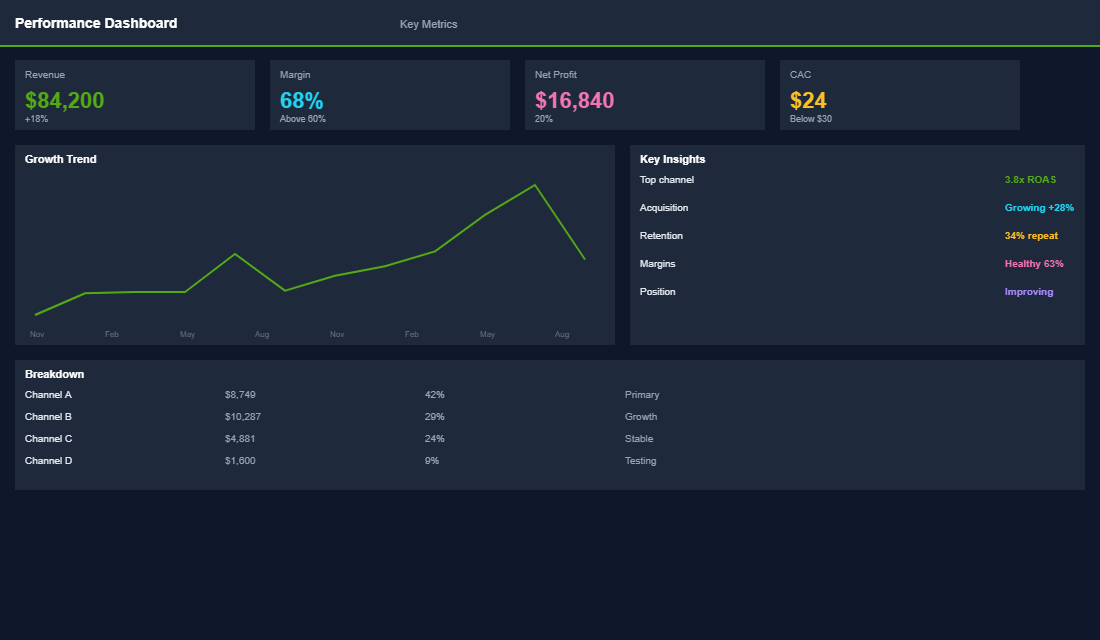
The Cash Conversion Cycle (CCC) is the number of days between when you pay for inventory and when you receive cash from selling it. For most Shopify stores, this cycle is 40-90 days. That means for every dollar of inventory you buy, you are waiting 40-90 days to get that dollar back — plus a profit margin.
The CCC has three components. Days Inventory Outstanding (DIO) is how long stock sits in your warehouse before selling — typically 30-60 days. Days Sales Outstanding (DSO) is how long after a sale you receive the cash — for Shopify, this is just 2-3 days. Days Payable Outstanding (DPO) is how long you can delay paying your suppliers — typically 0-30 days depending on your terms.
Your CCC = DIO + DSO – DPO. If your inventory sits for 45 days, Shopify pays in 3 days, and your supplier gives you 14-day terms, your CCC is 45 + 3 – 14 = 34 days. Every dollar of inventory ties up cash for 34 days before returning to your bank account. The goal is to reduce this number through faster inventory turnover, quicker payment collection, and longer supplier terms.
The 12-Week Cash Flow Forecast: Your Early Warning System
A cash flow forecast is the most important financial tool for a growing Shopify store — more important than your P&L, more important than your balance sheet. It shows you exactly when cash problems will hit, giving you time to act before they become crises.
Build a simple 12-week rolling forecast in a spreadsheet. For each week, list your expected cash inflows (Shopify payouts, other revenue) and your expected cash outflows (inventory orders, ad spend, payroll, rent, apps, GST payments, supplier invoices). The running balance tells you whether you will have enough cash to cover expenses in any given week.
Update this forecast weekly with actual numbers and revised projections. The accuracy improves dramatically after 4-6 weeks as you calibrate your estimates against reality. The most important thing the forecast reveals is cash troughs — the weeks where your balance dips lowest. These are the danger points where many stores get caught.
Pay special attention to the weeks when large inventory orders, tax payments, and seasonal ad spend increases overlap. These convergence points create the deepest cash troughs and are where most cash flow crises occur.
Seven Tactics to Improve Cash Flow Without Slowing Growth
- Negotiate supplier payment terms. If you are paying suppliers upfront or on 7-day terms, negotiate for 30-day terms. Many suppliers will agree, especially if you have a consistent order history and pay on time. Moving from 7-day to 30-day terms effectively gives you 23 extra days of float on every inventory order — a massive cash flow improvement.
- Reduce inventory days. Carry less stock by ordering more frequently in smaller quantities. Yes, you may pay slightly more per unit, but the cash flow benefit often outweighs the cost increase. Aim for 30-40 days of inventory coverage rather than 60-90 days.
- Use pre-orders for new products. Launch new products with pre-orders before you have stock. Customers pay now, you use their money to fund the production run. This eliminates cash risk on new products and validates demand before you invest in inventory.
- Implement deposits for custom or high-value orders. If you sell custom, made-to-order, or high-value products, require a 50% deposit at order and 50% before shipping. This funds production before you have delivered the product.
- Time your ad spend to your cash cycle. Do not launch a major ad campaign the same week a large inventory payment is due. Stagger your big cash outflows so they do not all hit in the same week. Use your 12-week forecast to plan campaign timing around cash availability.
- Set up a business line of credit before you need it. Apply for a business credit line or overdraft facility when your financials look strong — not when you are desperate. Having a $20-50K line of credit available as a safety net gives you breathing room during cash flow troughs. You may never use it, but knowing it is there reduces stress and prevents panic decisions.
- Separate your cash into buckets. Open separate bank accounts for: operating expenses, tax obligations (set aside 25-30% of profit for GST and income tax), inventory investment, and an emergency reserve. This prevents you from accidentally spending tax money on inventory or dipping into your emergency fund for routine expenses.
The Inventory Investment Trap
The biggest cash flow risk for growing Shopify stores is over-investing in inventory. It feels responsible to stock up — you do not want to run out of your bestseller. But every dollar in inventory is a dollar you cannot spend on marketing, operations, or that tax bill coming in 6 weeks.
Follow the rule: never invest your last dollar in inventory. Maintain a cash reserve of at least 1.5x your monthly operating expenses before committing to large inventory orders. If your monthly expenses are $35K, you need at least $52K in the bank before placing a $20K inventory order.
Cap your total inventory investment at 40% of your quarterly revenue. If you are doing $60K per month ($180K per quarter), your total inventory value should not exceed $72K. Beyond that threshold, you are over-invested in stock relative to your sales velocity, and your cash is trapped.
For seasonal inventory purchases (like BFCM stock), start saving 3-4 months before the order is placed. Set aside a fixed amount each week into your inventory account so the large payment does not hit as a cash flow shock. Treat seasonal inventory like a planned expense, not a surprise.
The Compound Effect of Cash Flow Mastery
When you manage cash flow proactively, you remove the constraint that limits most growing stores. You can invest in inventory when opportunities arise instead of scrambling when you run out. You can increase ad spend during peak periods because you have the cash to fund it. You can negotiate better supplier terms because you are a reliable, on-time payer. And you can sleep at night knowing that a slow sales week will not trigger a cash crisis.
One eCommerce Circle member was doing $65K/month in revenue but constantly running out of cash. After implementing the 12-week forecast, negotiating 30-day supplier terms, reducing inventory days from 58 to 36, and establishing cash buckets, they improved their cash position by $28K within 3 months — on the same revenue. The business went from stressful to stable, and they were finally able to invest in growth with confidence.
The Cash Flow Metrics for Your Weekly Dashboard
You cannot manage what you never look at. Every Monday, four numbers deserve five minutes of your attention: cash on hand, cash runway in weeks, inventory value at cost, and accounts payable due in the next 30 days. Together they answer the only question that matters: can I cover my commitments and still fund growth?
Add one derived number: free cash after commitments. Take your closing bank balance, subtract supplier payments, ad spend, wages and tax set-asides due in the next four weeks. If that number trends down three weeks running, act immediately, because a cash crunch announces itself weeks before it lands. Our guide to the 7 financial metrics most Shopify owners ignore pairs well here, and knowing your true contribution margin per order tells you whether growth is feeding cash flow or eating it.
Tools That Make Cash Flow Visible
Most Aussie Shopify stores run Xero, and Xero alone is enough to start: reconcile weekly, keep a separate tax savings account, and sweep 25 to 30% of profit into it every month so BAS and income tax never ambush you. When you want forward visibility, Float or Fathom plug into Xero and turn your actuals into a rolling 12-week forecast for less than $100 AUD a month.
If software feels like overkill, a spreadsheet does the job. Thirteen columns, one per week, with expected cash in and cash out. The tool matters far less than the habit. Stores that forecast weekly catch shortfalls 6 to 8 weeks early, which is enough time to negotiate supplier terms, run a stock clearance or trim ad spend. Stores that do not forecast find out when a payment bounces.
Imagine you run a candle brand doing $60K AUD a month. Your Christmas stock order of $45K is due to your supplier in August, ad spend ramps in October, but the revenue does not land until November and December. On paper you are profitable all year. In the bank, August to October is a desert. That three-month gap is where profitable Aussie stores die, and it is exactly what a 13-week forecast makes visible in July, while you still have options: a smaller first order, a deposit split, or a pre-sale to fund the stock with customer cash instead of yours.
Your Next 30 Days
Week one, calculate your cash conversion cycle and your free cash after commitments. Week two, build the 13-week spreadsheet and book a supplier terms conversation, because moving even one key supplier from deposit-up-front to net 30 can release thousands in working capital. Week three, audit your inventory: anything that has not sold in 90 days goes into a clearance plan, using the approach in our inventory forecasting playbook. Week four, set your weekly dashboard reminder and run your first Monday review.
Do that for one quarter and you will know your position weeks ahead instead of finding out at the bank. If you are heading into June, our EOFY profit reset is the natural next step.
The Cash Timing Map: Where Money Actually Leaves a Shopify Store Each Month
Most founders know their monthly costs. Very few know the exact day each one hits, and that gap is where cash crunches are born. A store can be profitable on paper and still bounce a supplier payment because $18k of ad spend and a $32k BAS both landed in the same week that Shopify’s payout was delayed by a public holiday.
Build a timing map once and update it quarterly. Put every outflow on a calendar by day, not by month. For a typical Aussie Shopify store doing $100k a month it looks like this:
- Money in. Shopify Payments pays out on a rolling schedule, usually two to three business days after the sale in Australia. Afterpay and Zip settle on their own cycles, often weekly, less their 4 to 6% fee. Amazon, if you sell there, holds funds for 14 days. So $100k of “sales” in a month is closer to $90k of cash, and roughly a week of it is always still in transit.
- Ad spend. Meta and Google bill in thresholds and monthly cycles. If you are on a credit card, the cash leaves 30 to 55 days after the spend, which feels great until the card statement lands in a slow week. Note the statement date, not the spend date.
- Stock. Deposits of 30% at order, balance of 70% before shipping, then 6 to 10 weeks of sea freight before you can sell any of it. That means a $50k purchase order is $50k out the door up to three months before the first dollar comes back. Mark both payment dates and the expected sell-through start date.
- BAS and super. Quarterly BAS is due on the 28th of the month after the quarter (later if lodged through a BAS agent), and it is usually the single largest bill you pay. Super guarantee is due quarterly too, and moves to payday super from July 2026. Put a standing weekly transfer of 10 to 12% of gross sales into a separate tax account so these are never a surprise.
- The small stuff that adds up. Shopify plan, apps, 3PL invoices, Klaviyo, and freight accounts typically total 6 to 9% of revenue for a store this size and most bill in the first five days of the month, right when the previous month’s ad card is also due.
Once the map exists, the fixes are obvious. Move your ad card statement date away from BAS week. Ask your 3PL to bill on the 15th instead of the 1st. Negotiate a 40/60 split with your supplier instead of 30/70, or a 30-day balance payment after shipping rather than before. None of these change your profit by a cent, but each one flattens a spike, and the store with no spikes never has to stop growing to survive a bad week.
Two systems make this automatic. The Profit First account structure splits every payout into operating, tax, stock and profit accounts the day it lands, so the BAS money is physically somewhere else before you can spend it. And if you are past $1.5m a year and still doing this in a spreadsheet at midnight, it is time to read the bookkeeper vs fractional CFO roadmap and hand the forecasting to someone who does it weekly. Seasonal stores should also overlay their demand seasonality curve on the map, because the stock payments for your biggest quarter always land in your quietest one.
Cash flow and financial management is the Profit pillar inside the eCommerce Circle. We help members build cash flow forecasts, optimise their cash conversion cycles, and make financial decisions that support sustainable growth. If your bank account is not reflecting your revenue, let’s talk. If you want to see which of the 10 P’s is capping your orders right now, take the free More Orders Scorecard. It takes two minutes and tells you exactly where to start.