Most Aussie Shopify founders run their stores like a fishing trawler. Every month they cast nets full of paid ads into the same ocean, hoping the same fish swim back. The water gets more crowded, the bait gets more expensive, and the catch gets smaller. Then they wonder why margin keeps shrinking even when revenue grows.
What’s in This Article
The brands quietly winning right now are doing something different. They have built a recurring revenue layer underneath the trawler. Subscribers replenish on autopilot. Cash flow is forecastable a quarter out. Customer lifetime value is two to three times what a one-off buyer is worth. And paid ads stop being a treadmill, because every new customer is more valuable than the last.
If you sell anything consumable, refillable, or replenishable, subscriptions are not a “nice to have” feature you add when you have time. They are the single biggest lever you can pull on profit, and most Shopify stores in Australia still have not pulled it. This article is the playbook for adding subscriptions properly, the financial case for why it works, and how to price the offer so it lifts your LTV without quietly destroying your margins.
Why Subscriptions Are a Profit Story, Not Just a Retention Story
When most operators think about subscriptions, they think about retention. Keeping a customer longer. That is true, but it dramatically undersells the financial impact. The real story is what subscriptions do to your unit economics across the entire business.
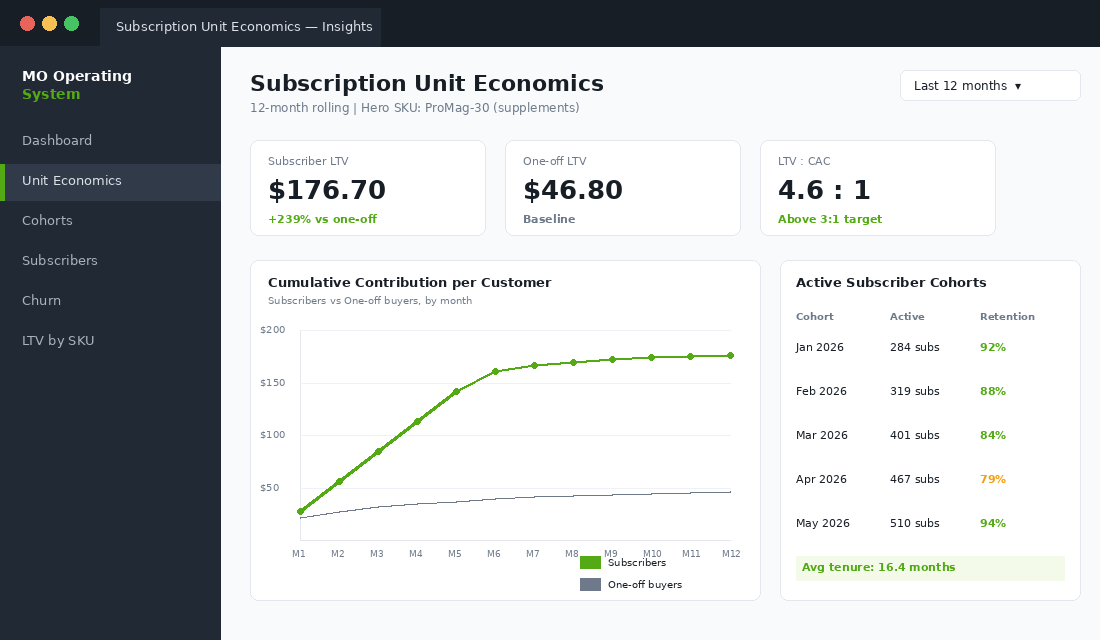
Shopify merchants who add subscriptions are seeing average order values 2 to 3x higher over the customer lifetime than their one-off counterparts, and that compounds in five different places at once.
- Higher LTV. A subscriber on a 30-day cadence with a 6-month average tenure delivers 5 to 6 orders before they churn. A one-off buyer delivers 1 to 1.4. Same product, same margin, three times the contribution.
- Lower CAC payback. When LTV climbs, the maths on what you can pay for a click changes overnight. You stop being out-bid by competitors and start out-spending them on purpose.
- Forecastable cash flow. Inventory planning gets easier when you know roughly how many units ship each month. So does payroll, so does ad spend.
- Lower marketing dependency. Every recurring order is a sale that did not need a Meta ad to trigger it. That is pure margin you keep.
- Higher business valuation. If you ever sell, recurring revenue trades at a 2 to 4x multiple of one-off revenue. A $3M subscription business sells for what a $7M-$9M transactional business does.
That last point is the one nobody talks about. The Aussie brands that get acquired in the next five years will not be the ones with the loudest brand. They will be the ones with the highest percentage of revenue on subscription. Who Gives A Crap is the textbook example. They built a recurring toilet paper business that made them effectively recession-proof, and the data they own about their subscriber base is more valuable than the SKUs themselves.
The First Question: Does Your Product Actually Belong on Subscription?
Not every product earns the right to recur. Adding a subscribe-and-save toggle on a one-off purchase product is one of the fastest ways to confuse buyers, tank conversion, and end up with a churn problem on a sub-base that should never have existed.
Run your catalogue through this filter before you do anything else.
- Replenishable. Does a customer use it up? Coffee, vitamins, dog food, skincare, toilet paper, pet treats, supplements, candles. If yes, the subscription writes itself.
- Predictable cadence. Can you reasonably predict how often someone runs out? A 30g protein scoop with 30 servings = 30 days. A 1L oil that lasts 60 days = 60 days. If consumption is wildly variable, the cadence breaks.
- High enough AOV. The unit economics need to support a discount. Below $25 AOV, a 10% discount usually erodes more margin than the LTV uplift recovers.
- Sticky brand. Will the customer actually want this brand again, or were they price-shopping? If your reviews are average and your repeat rate is below 15%, the subscription will leak.
- Operationally ready. Can your 3PL or warehouse handle subscription pick-and-pack on a date-specific cadence without losing the plot?
Stores selling durables (furniture, kitchenware, electronics, clothing) usually fail the first two filters and should not chase subscription as a primary lever. They have other plays. Lyka, the Aussie fresh dog food brand, passes all five with flying colours. Replenishable. Highly predictable cadence. AOV well above $100 per shipment. Brand-loyal customer base. Cold chain logistics they have already built. Their subscription model is the business, not an add-on.
If your product passes four or five of those filters, keep reading. If it passes two or fewer, your retention play lives somewhere else. Look at loyalty programs or post-purchase upsell sequences instead.
The Pricing Model That Actually Works (And the One That Always Loses)
The fastest way to torch your margin is to copy the discount your competitor offers without doing the maths on your own contribution. The second fastest way is to build a complicated tiered model that confuses buyers and tanks conversion at the cart.
The pattern that wins for consumables is simple, predictable, and sits on a 10 to 15% subscriber discount. Here is why that range, not 5%, not 25%.
- 5% discount. Not enough to overcome the hesitation cost of “locking in” recurring billing. Conversion lift is minimal. Subscriber take rate stays at 8 to 12% of new customers.
- 10 to 15% discount. The sweet spot. Take rate climbs to 25 to 40% of new customers. Margin impact is recoverable on the second order. Cancel-and-rejoin behaviour stays low.
- 20 to 25% discount. Take rate climbs another few points, but you are now training customers that the “real” price is the discounted one. Worse, you cannot afford to acquire customers who will only ever pay 75% of MSRP.
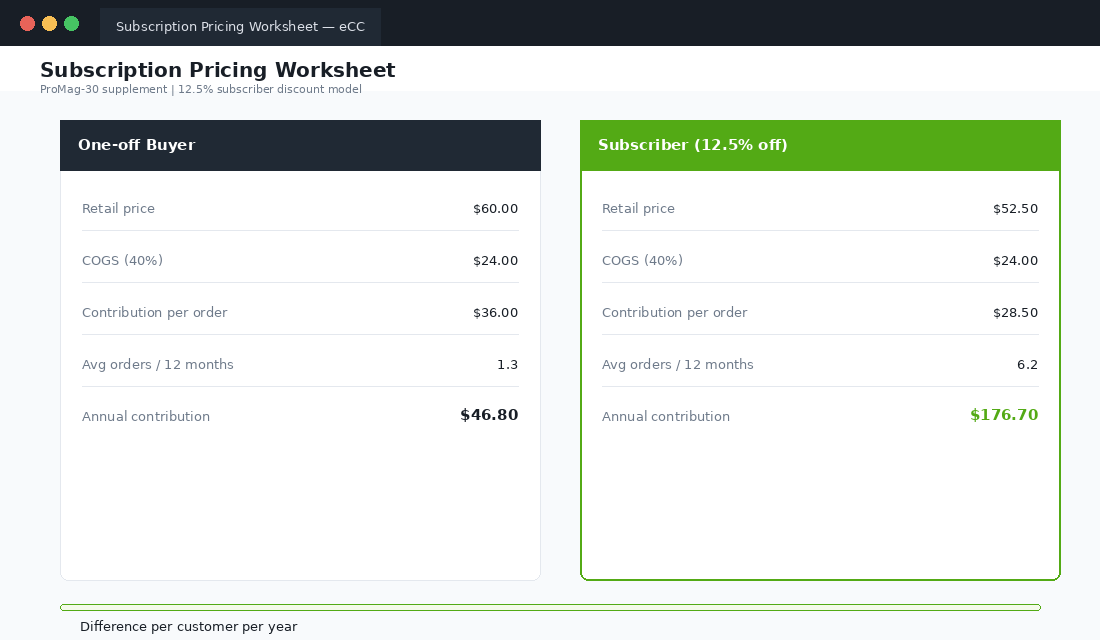
A worked example. You sell a $60 RRP supplement bottle with a 60% gross margin. COGS is $24. On a one-off purchase, contribution per order is $36 before shipping and pick-pack. Now offer a 12.5% subscriber discount: customer pays $52.50, you keep $28.50 in contribution per order. You are losing $7.50 per order in absolute contribution.
But here is the maths that founders skip. A one-off buyer in this category orders 1.3 times on average across 12 months. Total annual contribution = $46.80. A subscriber orders 6.2 times on average across 12 months. Total annual contribution = $176.70. You traded $7.50 per order for an additional $129.90 per customer per year. That is the trade. The discount is not a margin loss, it is a financing fee on a much bigger contribution stream.
If your gross margin is below 50%, the maths does not work as cleanly. You can run a subscription, but the discount has to drop to 5 to 8%, and you make up the LTV lift through cadence frequency and bundle expansion rather than discount-driven take rate. If your gross margin is below 35%, do not add a subscriber discount at all. Build the offer around perks (free shipping, early access, members-only flavours) instead.
The 4 Offer Variants That Work on Shopify (And When to Use Each)
“Subscription” is not one offer. It is four very different offers depending on how you structure it, and the one you pick determines who subscribes, how long they stay, and what you can charge.
- Subscribe-and-Save. The simplest. Same product, same SKU, recurring at a discount. Best for: established hero SKUs with strong repeat data. Take rate: 25 to 40% of buyers if positioned well on the PDP.
- Subscription Box. Curated assortment that ships on cadence. Best for: brands with discovery in their DNA (beauty, snacks, wine). Take rate: smaller pool but higher AOV and tenure.
- Replenishment Plan. Customer picks the size and cadence. No discount, no commitment, but the convenience is the offer. Best for: premium brands where discounting damages positioning.
- Membership-Style Subscription. Flat monthly fee gives subscribers free shipping, member pricing, early drops, and exclusive products. Best for: brands with depth across the catalogue and a community angle.
For most Aussie Shopify stores selling consumables, the right starting point is straight Subscribe-and-Save on the hero SKU. Get the maths right on one product, prove the LTV lift in real numbers, then expand to the catalogue. Founders who try to launch a curated box or a membership tier on day one usually end up with a complicated build, low take rate, and no clean read on whether the model works.
The 3 Subscription Apps Every Shopify Brand Should Compare
The Shopify subscription app market has consolidated to three serious players in 2026. Picking the wrong one early is expensive: data migration between platforms is messy, customer-facing portals look completely different, and the cost differences add up at scale.
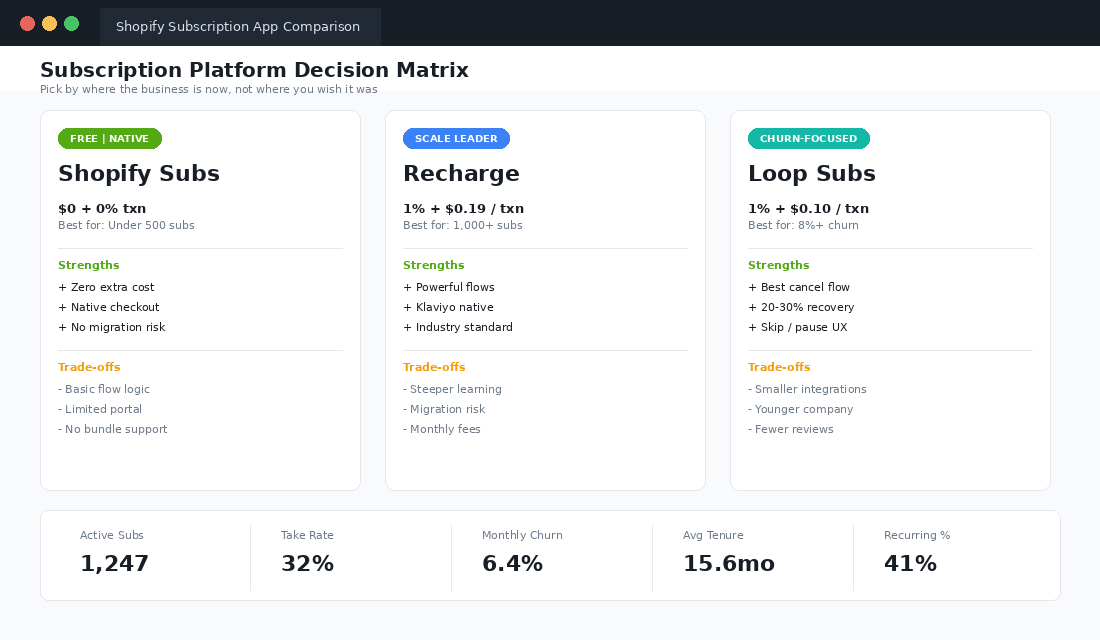
Shopify Subscriptions (native). Free. Built in. Works on Shopify checkout natively, no custom flow, no extra transaction fee. Limitations: lighter on dunning logic, fewer customer portal customisation options, no advanced bundle or flow logic. The right starting point if you have under 500 active subs and a single subscription SKU. We use it as the default for any new brand piloting subscriptions before they have proven the model.
Recharge. The category leader for brands at scale. Charges 1% + $0.19 per transaction on the Pro plan, plus monthly platform fees. Powerful flow builder, deep integrations with Klaviyo, Postscript, Gorgias. Best for brands above 1,000 active subs running multiple subscription products and complex retention flows. The customer portal is what most established Aussie subscription brands have settled on.
Loop Subscriptions. The newer player, built specifically around churn reduction. Their cancel flow is the best in the market: it intercepts cancels with personalised offers (skip an order, swap product, pause for 30 days, downgrade cadence) and recovers 20 to 30% of cancels that would have otherwise walked. Worth the switch if your monthly churn is above 8% and you have not yet found your retention floor.
The setup pattern that works for most brands launching from scratch:
- Install Shopify Subscriptions (native) and ship a Subscribe-and-Save offer on your hero SKU only.
- Run for 90 days minimum. Track take rate, churn rate, LTV by cohort, and revenue contribution.
- If take rate is above 20% and you cross 300 active subs, evaluate Recharge. Migrate before you cross 1,000 subs (the migration gets exponentially harder past that).
- If churn climbs above 8% per month at any stage, layer Loop’s cancel flow on top regardless of which platform you are on.
The Churn Number That Decides Whether the Whole Model Works
Subscriber LTV is mathematically just AOV times tenure. AOV is mostly fixed. Tenure is set by churn rate. So churn is the variable that decides whether your subscription business is a quietly compounding asset or a leaky bucket.
The benchmarks worth knowing as an Aussie operator:
- 5 to 7% monthly churn. Healthy for ecommerce DTC subscription. Average tenure of 14 to 20 months. This is the target.
- 7 to 10% monthly churn. Industry average. Workable but no moat. Tenure 10 to 14 months.
- Over 10% monthly churn. The model is leaking. Average tenure under 10 months. You will not earn back CAC at scale.
- 40% of subscribers churn within 90 days. This is the universal pattern. Whatever your monthly number, the first 90 days do most of the damage.
That 90-day stat is the most actionable insight in the whole article. It means your subscription retention strategy is not really about month 6 or month 12. It is about the first 3 cycles. Win those, and the back end takes care of itself.
The early-cycle moves that work:
- Welcome sequence with usage education. Show them how to actually use what they bought. The number one cancel reason in cycle one is “didn’t use it enough”.
- Cadence flexibility on cycle two. Trigger an email or SMS 5 days before the second ship date asking if the cadence still works. Sounds counterintuitive but moving someone from 30 days to 45 days saves a cancel.
- Surprise upgrade in cycle three. A free sample, a thank you note, a member-only product drop. Costs you under $5, signals “this is a real relationship”.
- Cancel flow that offers options. The single highest-impact retention move. A 4-step cancel flow (Skip, Pause, Swap, Downgrade) recovers 20 to 30% of cancel attempts. Loop is built for this; you can also run it natively on Recharge.
How to Position the Subscription on the Product Page (Conversion Maths)
Most Shopify stores bolt a subscription option onto the PDP and call it done. The result: 4 to 8% take rate, and a confused first-time visitor who does not understand why there are two prices.
The brands hitting 25 to 40% take rate position the subscription as the default. The hierarchy on the PDP looks like this:
- Subscribe option pre-selected. The radio toggle defaults to the subscription, with the discount visible and the cancellation policy visible alongside it.
- One-time purchase as the secondary option. Visible, easy to select, but not the default.
- Anchor the saving. “Save $7.50 per order. Cancel anytime in 60 seconds.”
- Address the lock-in fear. Right under the toggle. “No commitment. Skip, pause, or cancel from your account in one click.” This single sentence lifts take rate by 5 to 10 points in tested PDPs.
- Show the cadence options. “Ship every 30 / 60 / 90 days.” Default to the most common cycle for your product, but show the others.
Pair this with the right page copy elsewhere. Add a homepage callout for the subscription program. Build an email sequence that introduces the subscription option to repeat customers who have not yet subscribed. Push subscriber-only perks (early access, member pricing on adjacent SKUs) to make the membership feel like a real club, not a billing arrangement.
The 90-Day Subscription Launch Plan
If you are starting from zero, here is the plan we walk Aussie Shopify operators through. It assumes a single hero SKU on Subscribe-and-Save, native Shopify Subscriptions, and a goal of 200 active subscribers by day 90.
- Days 1-14: Build. Pick the hero SKU. Lock the discount at 12.5%. Install Shopify Subscriptions. Build the PDP with the subscribe-as-default layout. Write the cancellation copy. Run the cancel flow as a manual workflow before you automate it.
- Days 15-30: Soft launch to existing buyers. Email your repeat customer list with a “we are launching subscription” announcement. Offer them an extra 5% off their first 3 cycles to seed the base. Aim for 50 active subs.
- Days 31-60: Push to traffic. Make the subscription the default option on the hero SKU PDP for 100% of traffic. Add a homepage callout. Set up a Klaviyo welcome flow specifically for new subscribers (different from your standard welcome). Aim for 120 active subs.
- Days 61-90: Optimise the cancel flow. Look at every cancel from the first 60 days. Categorise the reasons. Build a Skip/Pause/Swap flow into your cancel page. Track recovery rate. Aim for 200 active subs and under 8% monthly churn.
- Day 91: Review and decide. If take rate is over 20% and churn is under 8%, double down: add a second subscription SKU, expand the cadence options, evaluate Recharge migration. If take rate is under 15%, the offer is wrong: revisit pricing, positioning, or product fit before scaling.
The 90-day window is non-negotiable. You need 90 days to see meaningful churn data, take rate stability, and cohort behaviour. Anything shorter and you are reading noise.
The Failed Payment Problem: Where a Third of Your Churn Actually Comes From
Here is the number that surprises most founders when they finally look at it. Somewhere between 25% and 40% of subscription cancellations are not decisions at all. Nobody clicked cancel. A card expired, a bank flagged the transaction, or the customer got a new card after a fraud alert and never updated it.
That is involuntary churn, and it behaves completely differently to the voluntary kind. Voluntary churn means your offer, product or cadence is wrong. Involuntary churn means your billing plumbing is wrong. One needs a strategy conversation. The other needs an afternoon.
Run this benchmark on your own account before you touch anything else. A healthy Shopify subscription program recovers 65% to 75% of failed payments within 21 days. If you are recovering under 50%, you are quietly handing back revenue you already earned, every single month.
The Dunning Sequence That Actually Recovers Money
Most subscription apps ship with a default retry schedule that nobody ever edits. The defaults are conservative because they are built for the average merchant across every vertical. You are not the average merchant. Set it yourself.
- Attempt 1, day 0. Immediate retry. Roughly 20% of declines clear on the spot because the original failure was a temporary bank hold.
- Attempt 2, day 3. Time it for after most Aussie pay cycles land. Thursday and Friday retries clear noticeably better than Monday ones.
- Attempt 3, day 7. Pair this one with an email that does not read like a debt collection notice. Subject line: “Quick fix needed for your next delivery.”
- Attempt 4, day 14. Final automated attempt, plus an SMS with a one-tap card update link. SMS at this stage recovers roughly double what a fourth email does.
- Day 21. Move the subscriber to a paused state, not a cancelled one. Paused subscribers reactivate at around 15%. Cancelled ones almost never do.
Two settings do most of the heavy lifting and both are usually switched off by default. The first is account updater, which lets your payment gateway automatically pull the new card number when a customer’s bank reissues it. Shopify Payments supports this on recurring transactions and it alone can cut involuntary churn by 20% to 30% with zero customer contact. The second is a self-service card update link that does not require the customer to log in. Every login wall between a willing customer and a working card costs you subscribers.
If you are running Recharge, the retry logic sits under Settings then Dunning Management. Skio and Loop Subscriptions both expose the same controls with slightly friendlier defaults. Whichever app you chose, put a calendar reminder in for the first Monday of each quarter to check that your recovery rate has not drifted.
The Cohort Report That Tells You If the Model Is Working
Blended subscriber numbers lie to you, and they lie in a specific, predictable direction. When you are adding subscribers each month, new joiners mask the churn happening underneath them. Your total subscriber count goes up and to the right while your month-six retention quietly falls off a cliff. You will not see it until growth slows, and by then you have built a cost base on a number that was never real.
The fix is a monthly join cohort. Group every subscriber by the month they signed up, then track what percentage of that specific group is still active at month 1, 3, 6 and 12. You are looking for one thing: is your March cohort retaining better than your January cohort at the same age? If yes, the changes you are making are working. If the curves sit on top of each other, you are busy but not improving.
Rough Australian DTC benchmarks to measure yourself against, assuming a monthly replenishment product:
- Month 1 retention: 85%+. Below this and your onboarding or first-delivery experience is broken.
- Month 3 retention: 60% to 70%. This is the make-or-break window. Most cancellations cluster around delivery two and three.
- Month 6 retention: 45% to 55%. Anyone still here at six months is very likely a two-year customer.
- Month 12 retention: 30% to 40%. At this level, subscriber LTV typically runs 3x to 4x your one-time buyer LTV.
You can build this in a spreadsheet in about an hour by exporting subscriber contracts with their created date and status. If you would rather not, Lifetimely and Peel both produce subscription cohort views natively, and Recharge’s own analytics tab covers the basics. The tool matters far less than the habit of looking at it monthly. For the full method, our Shopify cohort analysis playbook walks through the same structure for one-time buyers, and the 5-signal churn health score shows you how to flag at-risk subscribers before they leave rather than after.
One practical note on interpreting the curve. A cliff at month three usually means an offer or cadence problem, because the customer has now received enough product to know whether the frequency suits them. A steady, gentle decline across all months usually means a product or perceived-value problem. The shape tells you which conversation to have.
The Compound Effect: How Subscriptions Change the Whole Business
Once a subscription program is humming, every other lever in your business shifts.
- Paid acquisition gets cheaper. A higher LTV means you can pay more per click and still hit a 3:1 LTV:CAC ratio. You start winning auctions you used to lose.
- Inventory planning gets sharper. A 30-day forecastable shipment volume removes most of the seasonal forecasting risk. Stockouts drop. Working capital trapped in safety stock drops.
- Email becomes a real channel. Subscribers open at 2 to 3x the rate of one-off buyers. Your list value compounds.
- BFCM stops being everything. When 30 to 50% of revenue is recurring, a single discount weekend is no longer the difference between a great year and an average one.
- Cash becomes predictable. You can invest in inventory, hires, and creative with a much clearer view of what is coming in the door.
This is why the brands quietly winning the next five years in Australian ecommerce are the ones who built the subscription layer before they needed it. Lyka, Who Gives A Crap, Pet Circle. Same playbook, different categories. The difference is they treated subscriptions as a unit economics decision, not a marketing campaign.
If you want to read the financial discipline metric that pairs perfectly with this, our piece on CAC payback period covers the other side of the equation. And if your contribution maths is fuzzy before you start, fix that first with our contribution margin guide for Shopify stores.
Your Subscription Readiness Checklist
Before you ship a single subscription offer, run your business through this 10-point checklist. If you cannot answer yes to at least 8 of 10, the launch will struggle.
- Product fit: The hero SKU is genuinely consumable or replenishable on a predictable cadence.
- Margin floor: Gross margin on the hero SKU is at least 50%.
- Repeat data: Existing repeat purchase rate on the hero SKU is at least 18%.
- AOV minimum: Hero SKU sits at $25 or above per order.
- Operational: Your 3PL or warehouse can fulfil date-specific recurring orders without breaking.
- Cancel UX: You are willing to make cancelling fast, friction-free, and self-service.
- Discount maths: You have run the LTV uplift calculation against the discount and the maths works.
- Welcome flow: You have a separate welcome and education sequence for new subscribers.
- Cancel flow: You have at least a 4-option cancel flow (Skip, Pause, Swap, Downgrade) ready to launch.
- Tracking: You can measure take rate, churn rate, and subscriber LTV by cohort in your dashboard.
Eight out of ten or better, you are ready to launch. Lower than that, fix the gap before you start. The cost of launching a half-baked subscription program is much higher than the cost of waiting two months and getting it right.
Inside eCommerce Circle, subscriptions and recurring revenue is one of the core pillars we work on with every member. If you want a second opinion on yours, let’s talk.
